The Toronto real estate market is undergoing a profound transformation, moving away from its long-standing trajectory of rapid price appreciation and fierce competition. Once a frantic arena where buyers were pressured into swift, often unconditional decisions, the landscape has now pivoted. Prospective homebuyers are exercising newfound caution, taking ample time to evaluate their options and negotiate terms. Simultaneously, sellers, who previously enjoyed swift transactions and bidding wars, must now adapt to a market that demands patience, strategic pricing, and a deeper understanding of evolving buyer sentiment.
Several converging factors are driving this significant shift. A noticeable downturn in sales, coupled with a surge in available inventory, signals a cooling trend. High interest rates continue to challenge housing affordability, while broader economic uncertainties cast a long shadow. The recent implementation of U.S. tariffs on Canadian imports adds another layer of complexity, fueling concerns about job security and consumer confidence. This intricate web of economic pressures has the potential to further dampen demand across the Greater Toronto Area (GTA) housing market. The critical question isn’t merely whether the market is slowing, but whether this fundamental realignment in Toronto’s real estate dynamics is poised to endure.
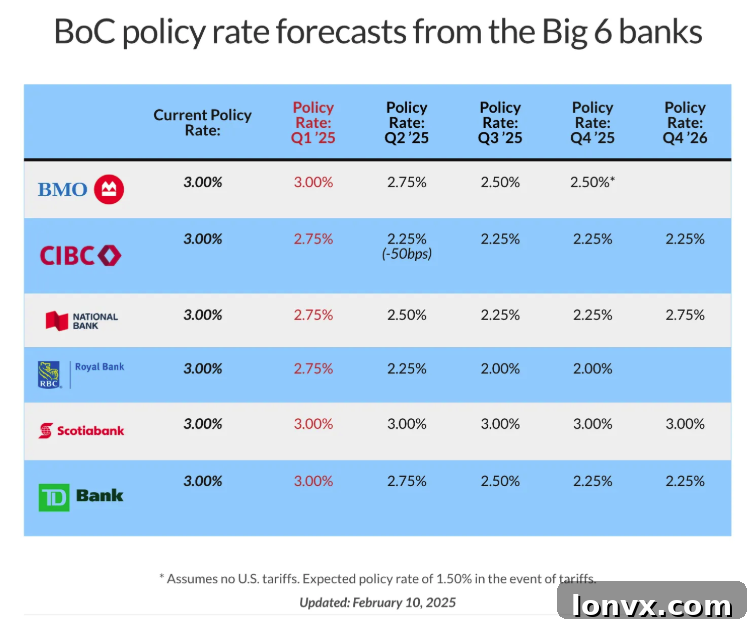
The Shadow of Economic Uncertainty: Tariffs and Interest Rate Dynamics
The economic outlook for Canada has become notably more uncertain following the recent imposition of U.S. tariffs on various Canadian imports. This international trade tension has reverberated through domestic markets, significantly impacting confidence within the Toronto real estate market. Both buyers and sellers are adopting a cautious “wait-and-see” approach, delaying major financial commitments until there is greater clarity on the economic horizon.
One direct consequence of these tariffs, and the broader economic slowdown they may trigger, is the potential for downward pressure on interest rates. Analysts at Canadian banks are increasingly speculating that the Bank of Canada may be compelled to cut its benchmark interest rate more aggressively and sooner than initially forecasted. The primary objective would be to stimulate economic activity and counteract the negative repercussions of the tariffs. Theoretically, lower interest rates would reduce borrowing costs, making mortgages more affordable for potential homebuyers and thereby boosting housing demand. However, the current challenge lies in a paradox: even with the prospect of cheaper borrowing, individuals are hesitant to commit to major purchases like homes when their economic future and job security appear uncertain. This very hesitation is often the catalyst that forces central banks to implement rate cuts in the first place, creating a complex feedback loop within the economy.
Predicting the precise long-term impact of these tariffs on interest rates and the broader Toronto real estate market remains a complex task. What is unequivocally clear, however, is that these trade disputes are introducing a substantial layer of uncertainty. This pervasive ambiguity is likely to influence decision-making for both prospective buyers and sellers in the months ahead, necessitating careful monitoring of economic indicators and policy responses.
Decoding the Data: Sales Plummet, Prices Show Resilience (For Now)
Following a period of robust year-over-year sales growth in late 2024, the GTA housing market experienced a dramatic downturn in early 2025. February, in particular, marked the most significant decline, solidifying one of the slowest starts to the year for sales in recent memory. This stark contrast to previous years, where the initial months typically saw a surge in real estate activity, underscores the unprecedented sluggishness currently characterizing the market, as illustrated in the accompanying chart.
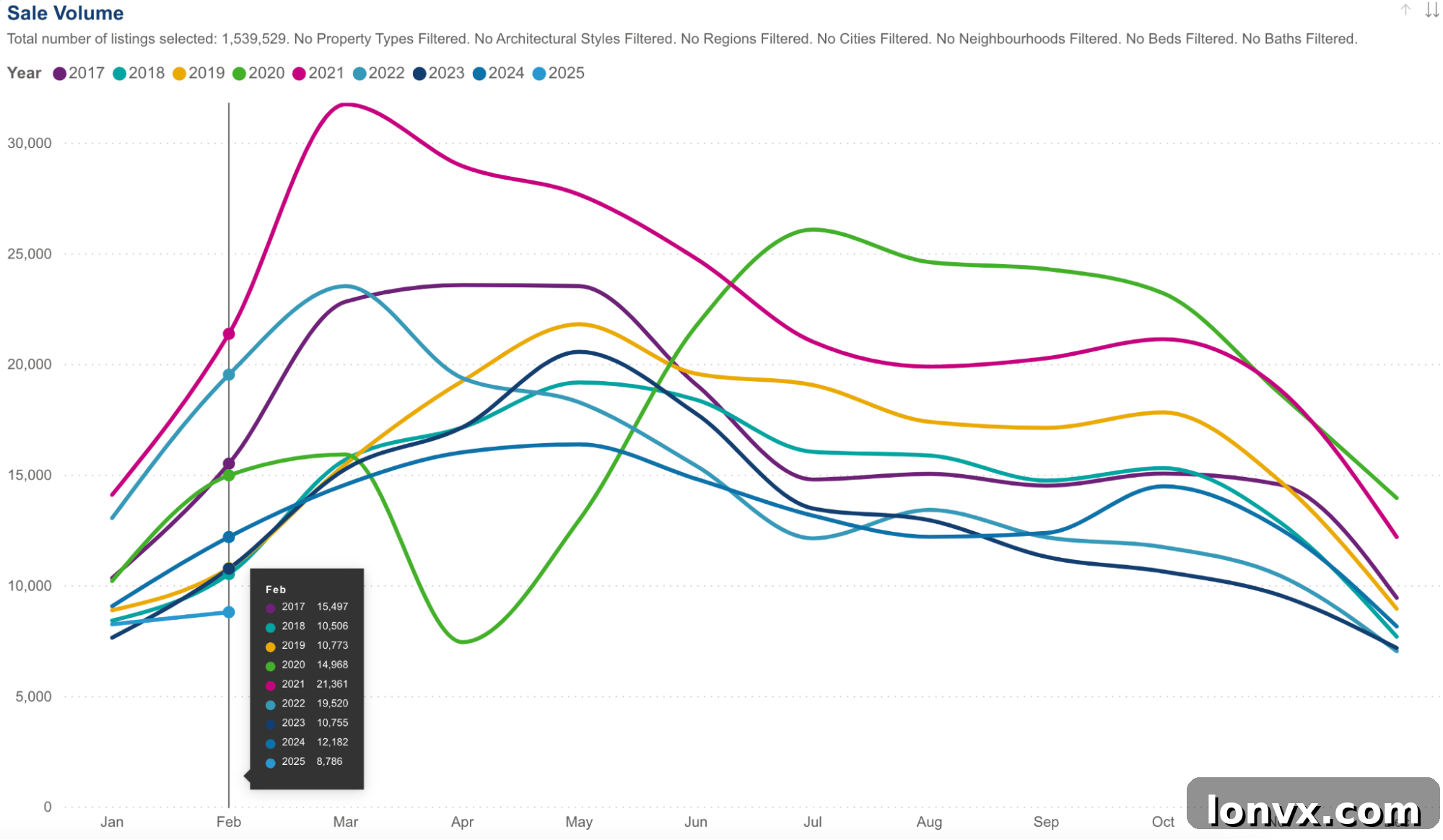
Source: thehabistat.com
Data released by the Toronto Regional Real Estate Board (TRREB) for February further confirmed a widespread and substantial drop in sales across all major housing categories. Every segment of the market, from detached homes to condo apartments, recorded double-digit declines in transactions compared to the previous year. While average prices have softened across most property types, the declines have largely remained moderate, suggesting a degree of resilience in asset values despite the pronounced slowdown in transaction volumes:
- Detached Homes: Sales plummeted by 31.1 percent, totaling 1,706 transactions. Remarkably, average prices largely held firm, recording a slight increase of 0.2 percent to $1,445,879. This resilience often reflects the scarcity and desirability of this housing type.
- Semi-Detached Homes: This segment saw a 22.3 percent reduction in sales, with 356 properties changing hands. Average prices experienced a more noticeable decrease of 4.0 percent, settling at $1,079,996.
- Townhouses: Sales in the townhouse category dropped by 30.6 percent to 700 transactions. Average prices softened by 2.3 percent, reaching $911,483.
- Condo Apartments: Experienced a 22.0 percent decline in sales, accounting for 1,225 transactions. The average price dipped modestly by 1.3 percent to $688,055, indicating that even entry-level segments are feeling the pressure.
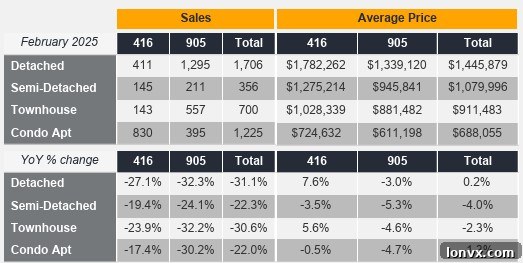
Source: TRREB
A key factor contributing to the relatively modest decline in prices, despite the significant drop in sales, appears to be seller resistance. Many homeowners, accustomed to years of consistent and substantial price growth, remain reluctant to significantly lower their asking prices. This psychological barrier creates a standoff, where sellers are holding out for pre-downturn valuations, even as market conditions weaken. At the same time, the dynamics are increasingly shifting in favor of buyers, evidenced by homes taking considerably longer to sell.
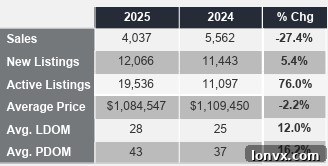
This market rebalancing is clearly reflected in key metrics such as average listing days on market (LDOM), which surged to 28 days (a 12 percent increase year-over-year), and average property days on market (PDOM), which rose to 43 days (a 16.2 percent increase year-over-year). The substantial increase in the time properties spend on the market signals a reduction in buyer urgency and a greater need for sellers to adjust their expectations. Moreover, the trend of rising available inventory, first observed in January, continued robustly into February. Active listings have soared by an impressive 76 percent year-over-year, while new listings also increased by 5.4 percent, dramatically expanding the options available to prospective homebuyers and further empowering them in negotiations.
Source: TRREB
A Shifting Power Dynamic: The Emergence of a Buyer’s Market
For individuals contemplating a home purchase in Toronto, current market conditions are arguably the most favorable they have been in years. The combination of rising inventory and moderating demand has fundamentally reshaped the landscape. Buyers now benefit from an expanded selection of properties, significantly enhanced negotiating power, and the luxury of time, removing the intense pressure to act swiftly that characterized previous years. The once fiercely competitive market has undeniably shifted, granting buyers a level of control that was previously unimaginable:
- Fewer Bidding Wars: The intense competition that often led to aggressive bidding wars has largely subsided, allowing buyers to make more deliberate and calculated decisions without the fear of being outbid in a matter of hours.
- Enhanced Negotiating Power: With properties lingering on the market for longer periods, sellers are increasingly more receptive to price adjustments, accommodating conditional offers (such as home inspections or financing clauses), and being flexible on closing dates.
- Extended Decision-Making Time: The prolonged market duration for listings provides buyers with ample opportunity to conduct thorough due diligence, compare multiple options, and ensure their chosen property perfectly aligns with their needs and financial capabilities.
Despite these significant advantages, a considerable number of potential homebuyers remain hesitant. This reluctance is primarily driven by two persistent hurdles: stubbornly high mortgage rates that continue to strain affordability, and a pervasive sense of broader economic uncertainty that makes large financial commitments feel risky.
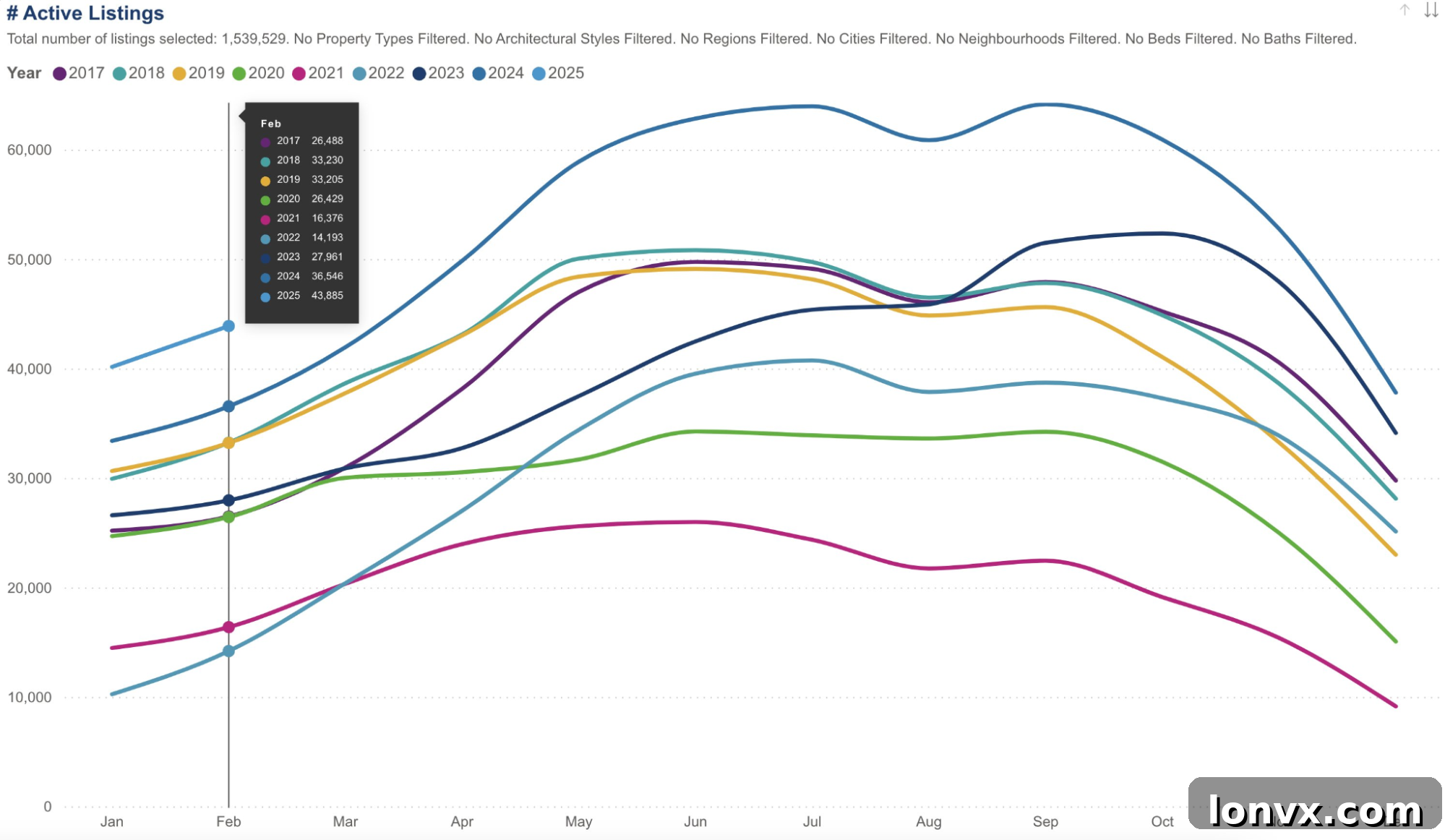
Adding to the buyer-friendly environment, 2025 has witnessed an extraordinary surge in active listings across the Toronto real estate market. The sheer volume of properties available has reached levels not seen in recent memory, prompting industry observers to question whether this is merely a temporary fluctuation or if it signifies a more permanent “new normal” for the market, characterized by greater supply and more balanced conditions.
Key Barriers to Recovery: Mortgage Rates and Economic Confidence
While buyers may now find themselves in a more advantageous negotiating position, the cost of borrowing remains prohibitively high for many, severely limiting overall housing affordability. As TRREB President Elechia Barry-Sproule aptly observed, despite a strong underlying desire among many households to purchase a home, “current mortgage rates make it difficult for the average household to comfortably afford monthly payments.” This sentiment highlights a critical bottleneck: until borrowing costs become more manageable, a significant segment of potential buyers will remain on the sidelines, regardless of other market conditions. A material reduction in interest rates, should it materialize, would likely serve as the primary catalyst for reigniting demand within the Toronto housing market.
Economic Uncertainty Is Holding Back Confidence
Beyond the immediate concern of mortgage rates, a deeper psychological factor is at play: many prospective buyers are delaying their home purchase decisions until they perceive greater economic stability. This wait-and-see attitude is being shaped by several critical macroeconomic indicators:
- High Unemployment in Toronto: The city’s elevated unemployment rate of 8.4 percent is a significant concern for many. It directly impacts job security, which in turn erodes confidence in long-term financial commitments such as homeownership and mortgage payments.
- Impact of U.S. Tariffs on Canada: The recent implementation of U.S. tariffs on Canadian imports is widely expected to intensify economic instability. These protectionist measures can disrupt supply chains, increase operational costs for businesses, and potentially lead to job losses in affected sectors, further dampening consumer and investor confidence.
TRREB Chief Market Analyst Jason Mercer elaborates on this point, stating, “On top of lingering affordability concerns, homebuyers have arguably become less confident in the economy. Uncertainty about our trade relationship with the United States has likely prompted some households to take a wait-and-see attitude towards buying a home.” Mercer suggests that a resolution or clarification of these economic uncertainties in the coming months could lead to a resurgence in buyer confidence, potentially translating into stronger market activity in the latter half of the year. Until such clarity emerges, the Toronto real estate market will likely remain in a delicate equilibrium, presenting both unique opportunities for agile participants and significant challenges for those navigating the prevailing conditions.
Looking Ahead: Trajectories for the Toronto Real Estate Market
The central question dominating discussions about the Toronto real estate market remains: will sales rebound robustly later in 2025, or is the current slowdown merely the prelude to a more prolonged period of cooling? The trajectory of the market in the coming months will hinge on the interplay of several critical factors that buyers, sellers, and investors must closely monitor.
What Could Keep the Market Sluggish?
- Sustained High Interest Rates: If central banks maintain elevated interest rates for an extended period, the fundamental issue of affordability will persist. High borrowing costs will continue to deter potential buyers, particularly first-time homeowners, severely restricting transaction volumes and preventing a significant market recovery.
- Seller Price Rigidity: A continued refusal by homeowners to adjust their asking prices to align with current market realities will exacerbate the slowdown. If sellers hold out for peak-market valuations, a significant disconnect between buyer expectations and seller demands will lead to fewer successful transactions and longer listing periods.
- Ongoing Economic Uncertainty & Trade Tensions: The recent imposition of U.S. tariffs on Canadian imports is a key driver of heightened economic instability. These trade tensions can create ripple effects across various industries, potentially leading to job market disruptions, increased costs for businesses, and reduced consumer spending. As long as these uncertainties weigh heavily on market sentiment, potential buyers are likely to delay significant purchasing decisions, including homeownership. This prolonged hesitation could further suppress real estate activity, extending the slowdown in both sales and price growth.
As the crucial spring market approaches, all eyes will be on these interconnected factors. Their evolution will dictate whether the Toronto real estate market stabilizes and begins a cautious rebound, or if it continues to experience a prolonged period of softness and adjustment.
Strategic Insights for Market Participants
Understanding the nuances of this transitional phase is paramount for anyone involved in the Toronto housing market.
For Buyers
For buyers who possess the financial stability and flexibility to enter the market now, this period could represent one of the most opportune moments in recent memory. The reduced competition and increased inventory mean that securing a desired home without engaging in intense bidding wars is a distinct possibility. Crucially, the power of negotiation has returned to the buyer’s side, allowing for more favorable terms and conditions. However, it is vital for buyers to consider the broader economic context, including the potential impacts of U.S. tariffs on Canadian industries. Such geopolitical factors could influence job stability and income prospects, necessitating a thorough assessment of personal financial resilience alongside mortgage rates and property values. Due diligence, including robust home inspections and carefully structured offers, is more important than ever.
For Sellers
The days of listing an overpriced property and expecting it to sell within days are over. For homeowners genuinely committed to selling, adapting to the new market reality is essential. This means pricing competitively from the outset, based on current comparables rather than peak-market aspirations, and being mentally prepared for longer listing periods. While homes are still selling, successful transactions are contingent upon realistic expectations and strategic positioning. The ongoing trade tensions and economic uncertainty could further temper buyer demand, necessitating a proactive approach to pricing and marketing. Sellers who are flexible, well-informed, and willing to negotiate will find greater success in this evolving environment.
For Investors
Despite some softening in the GTA rental market, real estate in Toronto continues to hold significant potential as a long-term investment. However, the current landscape demands heightened scrutiny and strategic foresight. The impact of U.S. tariffs and broader trade uncertainty on economic growth, employment levels, and consumer spending could indirectly affect rental demand and the pace of property value appreciation. With borrowing costs still elevated, a rigorous cash flow analysis is more critical than ever before. Investors who can minimize their reliance on external financing, or who possess substantial capital (“dry powder”), may discover strategic opportunities. This downturn could potentially lead to the availability of undervalued assets for well-capitalized investors heading into 2025 and 2026, making careful market research and patience key.
A Market in Transition: Navigating the New Landscape
The Toronto real estate market is undoubtedly in a state of profound transition. Sales volumes have decelerated significantly, active inventory is steadily accumulating, and properties are remaining on the market for extended durations. The critical question facing all market participants is whether this current slowdown is a temporary adjustment or the precursor to a more prolonged period of market cooling and price correction.
The ultimate direction of the market will largely depend on how key macroeconomic factors — including evolving economic conditions, future adjustments to interest rates by the Bank of Canada, and the resolution or intensification of international trade tensions — collectively shape buyer confidence and seller expectations in the months and quarters ahead.
For the immediate future, prospective buyers currently possess a rare window of opportunity, characterized by reduced competition and enhanced negotiating leverage. Yet, whether they choose to act decisively remains uncertain, as the broader economic landscape continues its intricate and unpredictable shift.