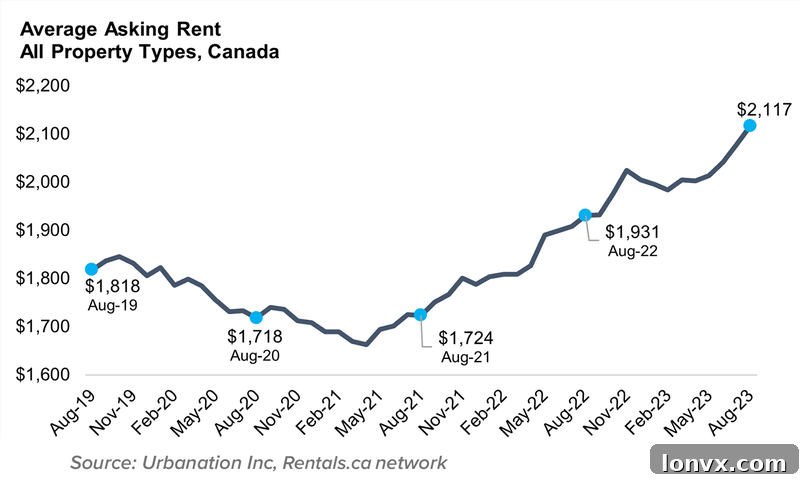
Canada’s rental market continues its relentless ascent, reaching unprecedented levels as average asking rents climbed to a staggering $2,117 in August. This significant milestone, detailed in the latest National Rent Report by Rentals.ca and Urbanation, marks a sharp 1.8 percent month-over-month increase and an eye-opening 9.6 percent year-over-year growth. The figures underscore a deeply challenging landscape for renters nationwide, as the cost of living continues to be dominated by housing expenses.
Over the span of just three months, the average asking rents across the Canadian rental market have surged by a remarkable 5.1 percent. This translates directly to an additional burden of over $100 per month for the average renter, highlighting the rapid pace at which rental affordability is deteriorating across the country. The upward trajectory shows no signs of abatement, signaling a deepening crisis for both prospective and current tenants.
Shaun Hildebrand, president of Urbanation, offered a stark comparison, noting that unlike the United States, where rent inflation appears to be cooling, Canada’s rental market shows persistent upward pressure. This trend persists even as rental completions have “reached their highest level in decades.” Hildebrand emphasized that this dichotomy is “illustrative of the severe rental housing shortage across the country and the magnitude of the impact on rental demand as the population expands at a record pace.” The confluence of robust population growth, particularly through immigration, and a lagging housing supply creates a perfect storm for escalating rental costs.
Understanding the Canadian Rental Crisis: A Deeper Dive
The current state of Canada’s rental market is not merely a cyclical fluctuation but rather a manifestation of systemic issues. Rapid population expansion, driven by ambitious immigration targets, has outpaced the construction of new housing units, especially purpose-built rentals. This imbalance between supply and demand is the primary driver behind the consistent and steep rent increases. Furthermore, rising interest rates have made homeownership less accessible, pushing more Canadians into the rental market and intensifying competition for available units. Investors, facing higher borrowing costs, often pass these expenses onto tenants through increased rents, creating a vicious cycle.
The economic implications of these soaring rents are far-reaching. For many Canadians, a significant portion of their income is now dedicated to housing, leaving less for other essential expenditures like food, transportation, and healthcare. This financial strain disproportionately affects lower and middle-income households, young professionals, and students, many of whom are forced to make difficult choices, such as living in overcrowded conditions or relocating to more affordable, often less convenient, areas. The dream of homeownership becomes increasingly distant, and even securing stable rental accommodation is becoming a significant challenge.
Regional Insights: A Patchwork of Pressure
While the national picture is one of widespread increases, a closer look at regional data reveals specific hotspots and varying degrees of intensity across Canada’s diverse urban landscape. Understanding these localized trends is crucial for grasping the full scope of the rental crisis.
Major City Dynamics
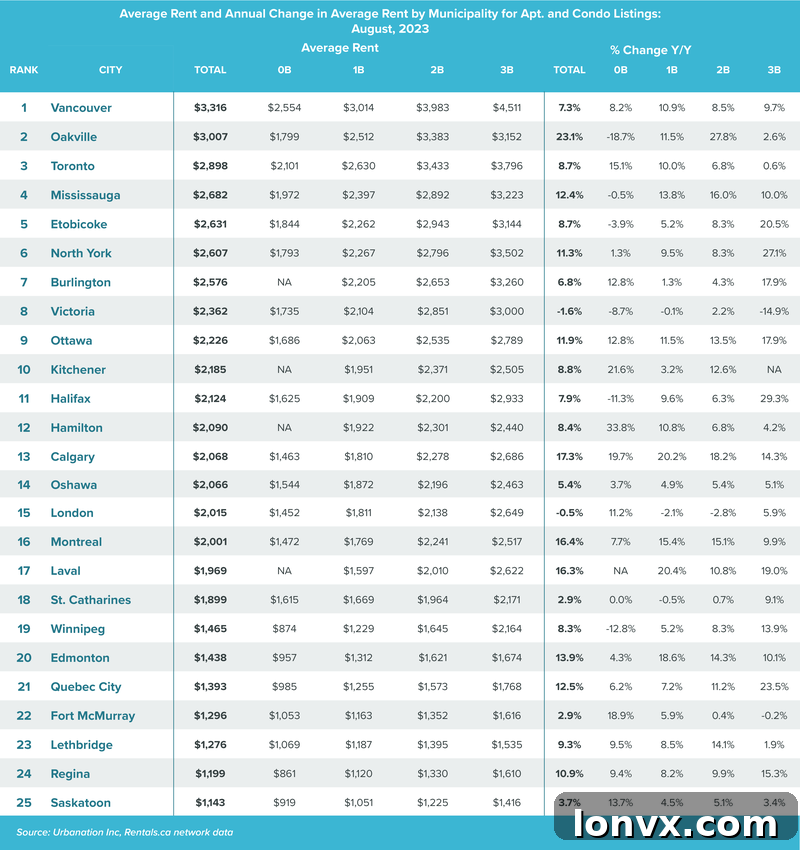
Among Canada’s largest metropolitan areas, **Calgary** continues to lead the pack in rent growth, posting an impressive year-over-year increase of 17.3 percent. This robust growth has pushed the average rent for purpose-built and condominium apartments in Calgary to $2,068. Calgary’s appeal lies in its strong economy, particularly its energy sector, coupled with a relatively lower cost of living compared to Vancouver or Toronto. This attracts significant inter-provincial migration, contributing to an intense demand for rental housing that the current supply struggles to meet.
**Montreal** is not far behind, experiencing an annual growth rate of 16.4 percent. For the first time, asking rents in Montreal have breached the formidable $2,000 threshold, now averaging $2,001. The vibrant cultural scene, numerous universities, and a growing tech sector contribute to Montreal’s strong appeal, drawing a steady stream of students and young professionals. This increased demand, combined with a historically tighter rental market, has pushed prices upwards at an alarming rate for the city’s residents.
Even Canada’s most expensive cities, **Toronto** and **Vancouver**, despite posting below-average annual rent increases of 8.7 percent and 7.3 percent respectively, saw their average monthly costs reach staggering figures: $2,898 in Toronto and an astounding $3,316 in Vancouver. These cities have long been synonymous with high housing costs, and while their growth rates might seem modest in comparison to Calgary or Montreal, their baseline rents are already exorbitant. The slight decrease observed in Vancouver, a marginal 0.7 percent month-over-month, might offer a glimmer of hope, but it does little to alleviate the deep-seated affordability challenges residents face in one of the world’s least affordable housing markets. The sheer scale of rents in these metropolitan centers continues to exert immense pressure on household budgets and quality of life.
Mid-Sized Markets: The Spillover Effect
The rental crisis is not confined to the largest urban centers; mid-sized markets across Canada are also experiencing significant double-digit annual increases, often a direct result of the affordability squeeze in major cities. As renters are priced out of Toronto, Vancouver, and Montreal, they increasingly look to surrounding communities, driving up demand and subsequently, rents.
- In Ontario, **Brampton** recorded a substantial 21.6 percent annual increase, with average rents climbing to $2,713. Its proximity to Toronto and more ‘affordable’ (though rapidly rising) prices make it an attractive option for those working in the Greater Toronto Area.
- **New Westminster, B.C.**, a key city in the Metro Vancouver region, followed suit with a notable 17.8 percent annual growth, resulting in an average rent of $2,511. This reflects the intense pressure from Vancouver’s hyper-expensive market pushing residents into adjacent communities.
- In Quebec, **Cote Saint-Luc** posted a 16.4 percent increase, setting the average rent at $2,271, indicating a similar spillover effect from Montreal’s surging prices.
Further west, Alberta’s mid-sized markets also saw significant, though slightly more moderate, growth. **Grande Prairie** and **Lethbridge** both experienced a 9.3 percent increase, leading to average rents of $1,169 and $1,276, respectively. These cities benefit from regional economic activity and offer a more affordable alternative to Calgary and Edmonton, albeit with their own rising costs.
In the Prairies, **Regina, Saskatchewan**, took the lead with an annual growth rate of 10.9 percent, while **Winnipeg, Manitoba**, posted an annual increase of 8.3 percent. These cities, traditionally known for their relatively lower cost of living, are now experiencing the ripple effects of national trends, signaling that few corners of the country are immune to the upward pressure on rents.
Unit Breakdown: The Scramble for Smaller Spaces
The analysis of rental unit types reveals a clear pattern: smaller, more accessible units are experiencing the most intense demand and, consequently, the highest rent increases. This trend underscores the desperate search for affordability in an increasingly expensive market.
- **Studio apartments** recorded the highest month-over-month rent increase, jumping by 2.4 percent to an average of $1,480. These units are often the most affordable entry point into a city’s rental market, making them highly sought after by single individuals, students, and those on tighter budgets.
- **One-bedroom units** led the year-over-year growth, boasting a significant 14.8 percent increase and averaging $1,880 per month. This category also caters primarily to single occupants or couples, who represent a large segment of the renter population and are feeling the pinch most acutely.
- **Two-bedroom apartments** commanded average asking rents of $2,233, marking an annual increase of 12.3 percent.
- **Three-bedroom units** followed with an average of $2,448, showing a 10.6 percent annual increase.
While larger units also saw substantial increases, the disproportionate rise in smaller unit rents highlights the pressure on individuals and couples looking for independent living spaces. This trend forces many to consider less ideal alternatives, such as shared accommodations.
Rising Demand for Shared Accommodations: A Necessity, Not a Choice
The relentless increase in individual unit rents has driven a significant surge in demand for shared accommodations, such as roommate arrangements. For many, sharing a unit is no longer a lifestyle choice but a financial necessity, allowing them to split exorbitant rental costs.
- In **Quebec**, average asking rents for shared units grew by a staggering 24 percent annually to $888 per month. This high growth rate reflects the rapidly changing affordability landscape in the province, pushing more individuals into shared living.
- **Alberta** closely followed with a 20.5 percent annual growth, reaching an average of $851 for shared accommodations. The province’s growing population and rising general rents contribute to this trend.
- **British Columbia** saw a 17.7 percent annual increase in average asking rents for shared accommodations, amounting to $1,150 per month. Given the incredibly high cost of individual units in BC, particularly in Vancouver, shared living is a prevalent solution for many.
- In **Ontario**, roommate rents grew at a more moderate annual pace of 7.5 percent, settling at an average of $1,040. While the growth rate is lower than other provinces, the absolute cost remains high, indicating a sustained and high demand for shared living arrangements in Canada’s most populous province.
The increasing reliance on shared accommodations points to a broader societal shift, where traditional pathways to independent living are becoming increasingly inaccessible. This impacts social dynamics, personal privacy, and the overall quality of life for a growing segment of the Canadian population.
Conclusion: A Critical Juncture for Canada’s Housing Market
The latest National Rent Report paints a clear and concerning picture: Canada’s rental market is in a state of unprecedented strain. Record-high asking rents across the nation, driven by a severe housing shortage and robust population growth, are creating significant affordability challenges for millions. While regional nuances exist, the overarching trend is one of escalating costs, pushing major cities, mid-sized markets, and even shared accommodations to new price points. The implications extend beyond mere economics, affecting the social fabric and future prosperity of the country. Addressing this complex issue will require concerted efforts from all levels of government, focusing on sustainable supply creation, innovative housing solutions, and policies that balance growth with affordability to ensure a stable and equitable housing future for all Canadians.
For more detailed information, you can read August’s full National Rent Report here.