
Navigating Toronto’s Shifting Real Estate Landscape: An August 2024 Market Deep Dive
Analyzing real estate market trends requires a discerning eye, especially when relying on data from traditionally slower seasons. The months of July, August, December, and January often see a natural suppression in sales volume, which can sometimes skew perceptions and lead to misinformed decisions if not viewed in proper context. However, even with this caveat, the most recent Market Watch release from the Toronto Regional Real Estate Board (TRREB) for August 2024 presents several compelling indicators that warrant close attention and careful analysis.
The latest data reveals a nuanced market experiencing various pressures and unique localized trends. While overall sales volume continues a downward trajectory, specific segments demonstrate surprising resilience, hinting at underlying shifts in buyer and investor behavior. Understanding these dynamics is crucial for anyone navigating the complex Toronto and Greater Toronto Area (GTA) real estate environment, from prospective homeowners and seasoned investors to industry professionals.
Key Market Indicators for August 2024
A closer look at the TRREB data for August 2024 reveals a continuation of several trends observed throughout the year, alongside some emerging patterns:
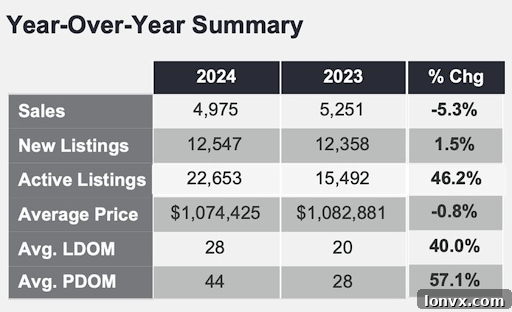
- Sales Volume Decline: Home sales across the TRREB region decreased by 5.3 percent compared to August of last year. This consistent month-over-month decline throughout 2024 indicates a sustained cooling in buyer activity.
- Extended Days-On-Market: Properties are spending significantly longer on the market before selling, with an increase ranging from 40 to 57 percent in the average days-on-market. This signals a shift from a seller’s to a more balanced or even buyer-favored market in many segments.
- Accumulating Inventory: In the absence of robust absorption, active listings have surged by an impressive 46.2 percent. This accumulation of inventory provides buyers with more choice and reduces the urgency that characterized previous boom periods.
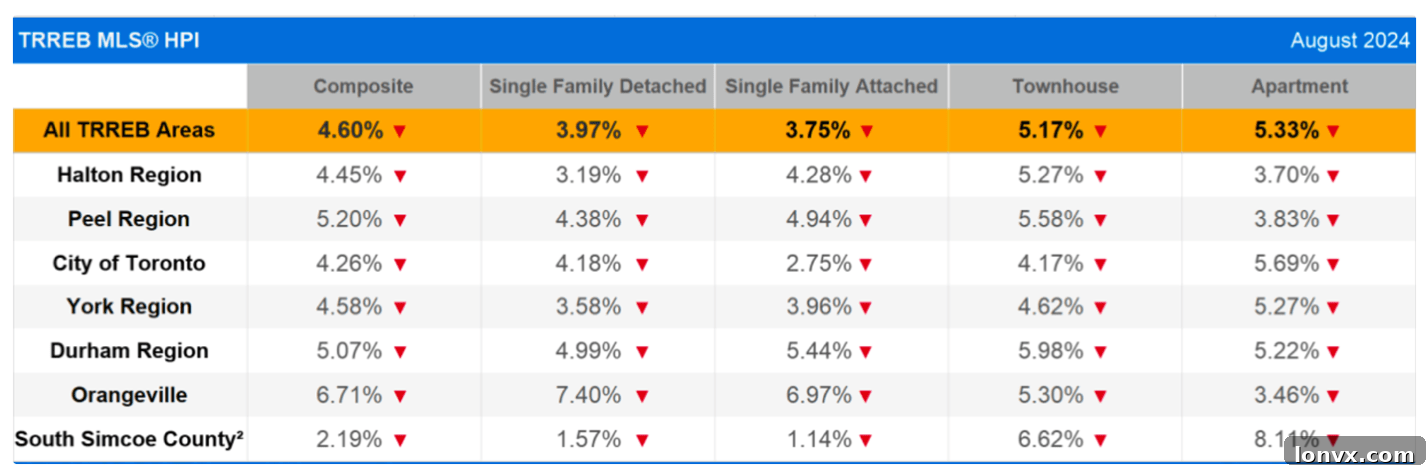
- Moderate Price Adjustments: Nominal prices experienced a slight dip of 0.8 percent year-over-year. When adjusted for the current inflation rate, the real decline in house prices since last year exceeds 3.0 percent, reflecting a genuine decrease in purchasing power and property values.
These overarching trends paint a picture of a market grappling with higher interest rates, affordability challenges, and a cautious sentiment among both buyers and sellers. However, drilling down into specific property types and geographical areas unveils distinct narratives within this broader context.
The Fourplex Effect: Resilience in 416 Detached Homes
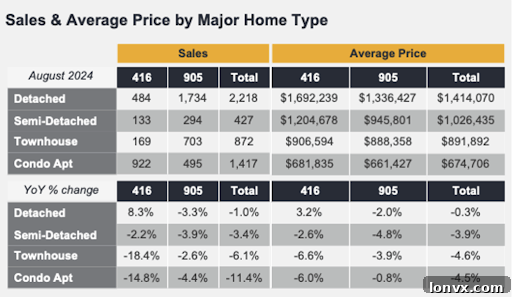
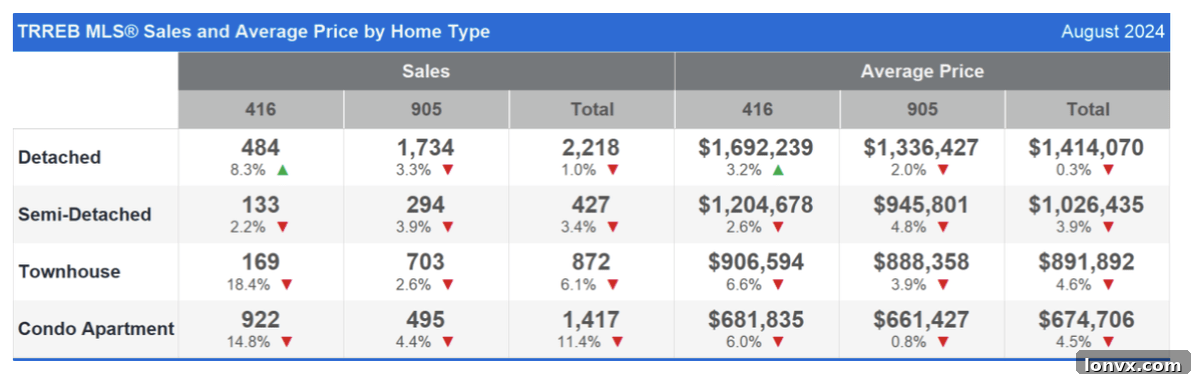
One of the most striking anomalies in the August data pertains to detached homes within the 416 area code (City of Toronto). This segment stands out as the only category to post a year-over-year increase in both units sold and average price, bucking the broader market trend.
416 Detached Homes: A Unique Surge
- Sales Volume Increase: Detached home sales in area code 416 jumped by 8.3 percent compared to August last year.
- Price Appreciation: Concurrently, prices for 416 detached homes saw a notable 3.2 percent year-over-year increase.
This unusual strength in the 416 detached market can be largely attributed to the City of Toronto’s recent upzoning initiatives. The municipality’s decision to permit the construction of four units on residential detached lots has fundamentally altered the investment calculus for these properties. Previously, an investor purchasing a detached home for redevelopment might have been limited to converting it into a duplex or triplex. Now, the ability to build a fourplex significantly increases the potential output value of the land.
This policy change has effectively established a new “floor” for detached home prices in the 416 area. The last buyer in the market, often an investor, is now willing to pay a premium for properties with redevelopment potential, viewing them not just as single-family residences but as lucrative sites for multi-unit housing. This heightened demand from developers and investors, driven by the prospect of higher returns, is injecting a unique form of stability and even growth into a segment that would otherwise face the same headwinds as the rest of the market. It underscores how regulatory changes can have profound, immediate impacts on specific property segments.
905 Detached Homes: A Different Story
In contrast, the detached housing market in the 905 area code (surrounding GTA municipalities) exhibits a different picture. While showing some resilience compared to other property types, it is less optimistic than its 416 counterpart. Detached sales in the 905 region recorded a 3.3 percent decrease year-over-year. This suggests that while demand for detached properties outside the core remains, it hasn’t received the same investor-driven boost seen in the 416 area due to differing local zoning regulations and development pressures.
The 905 market continues to be influenced more directly by factors such as affordability, commute times, and the broader interest rate environment, without the distinct uplift from intense redevelopment opportunities that currently characterize central Toronto’s detached segment.
The Cooling Condominium Market: A Tale of Accumulating Inventory
The condominium market, particularly within the GTA, presents a starkly different narrative from the resilient 416 detached sector. Alarming reports of accumulating inventory and significantly reduced sales volume have become increasingly common, painting a challenging picture for this once-booming segment.
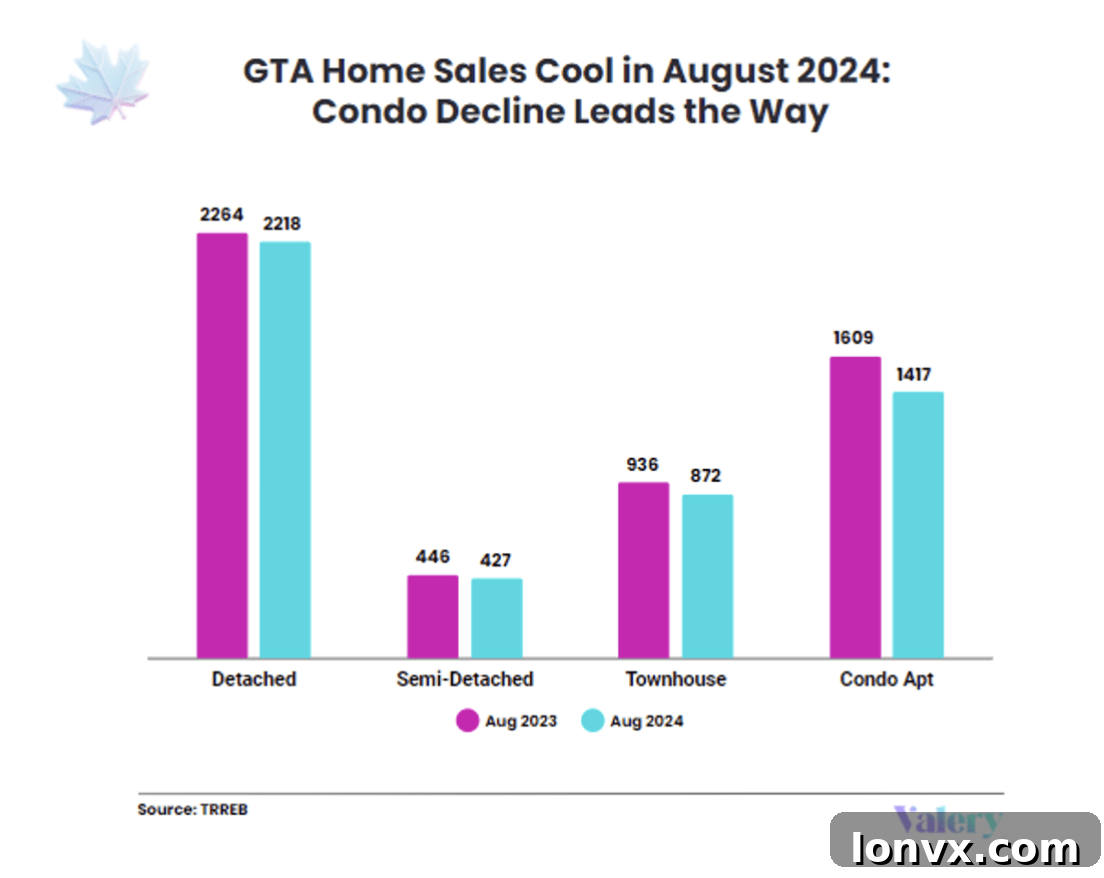
Condominium apartment sales continue their downward trend, with a significant 11.4 percent decline across the entire GTA compared to August of last year. This double-digit drop is not confined to existing units; the pre-construction condominium market is experiencing even more severe contractions, with sales plunging by 50 to 75 percent below the long-term average. This is a critical indicator, as pre-construction sales are a bellwether for future supply and developer confidence.
The primary drivers behind this pronounced cooling in the condominium sector are a combination of rising interest rates and, paradoxically for investors, declining rental yields. The rapid increase in borrowing costs has made it significantly more expensive to carry investment properties. Simultaneously, while rents in some segments remain high, the rate of increase has slowed, and in certain areas, particularly for newer, higher-priced units, rental demand has softened. This creates a difficult cash flow scenario for many condominium investors, pushing many into a negative cash flow position where their mortgage payments and carrying costs exceed their rental income.
As a result, a growing number of condominium investors are looking to offload their assets, contributing to the surge in active listings. Conversely, very few new investors are entering the market to purchase these assets, given the challenging economic landscape and uncertain returns. This imbalance between sellers and buyers is leading to an accumulation of inventory, with some reports indicating that certain condominium products are sitting on the market for over 12 months. This extended inventory period puts downward pressure on prices and forces sellers to adjust their expectations significantly.
Broader Pricing Trends Across TRREB
Beyond the specific dynamics of detached and condominium markets, the overall pricing landscape across the TRREB region shows widespread adjustments. While the 416 detached market defied this trend, most other property types are experiencing a retraction from their peak values.
A notable pattern emerges when examining areas that benefited most from the pandemic-induced urban exodus. These regions, often suburban or exurban areas that saw dramatic price surges between 2020 and 2022, are now experiencing a steeper recoil. The magnitude of their current price decline often correlates directly with the extent of their price increases during the exodus. This suggests a market correction where areas that became significantly overvalued are now adjusting back to more sustainable levels, influenced by factors such as the return to office, higher commuting costs, and increased interest rates impacting mortgage affordability.
This widespread downward pressure on prices, when viewed in real terms, highlights a significant recalibration underway in the GTA housing market. Buyers are gaining more leverage, and sellers, particularly those who purchased at the market’s peak, are facing difficult decisions regarding price adjustments.
Looking Ahead: Interest Rates and Market Recovery
The recent 25 basis point rate cut from the Bank of Canada offers a glimmer of hope, potentially easing some of the financial stress on certain sellers and borrowers. This, coupled with a general decline in fixed mortgage rates, provides a little more “light at the end of the tunnel” for homeowners facing significant mortgage payment increases upon renewal in 2025 and 2026. For these individuals, slightly lower fixed rates can translate into more manageable monthly payments, potentially preventing forced sales.
However, the broader question remains: when will these interest rate adjustments have a material and sustained impact on bringing purchasers back to the market in significant numbers? So far, the cumulative effect of 75 basis points in rate cuts has been relatively muted. The persistent weight of financial stress, including high household debt levels, ongoing inflation concerns, and a general sense of economic uncertainty, appears to be outweighing the marginal benefit of slightly lower borrowing costs.
Market recovery will likely be a gradual process, influenced by several factors:
- Further Rate Cuts: More substantial and consistent rate cuts from the Bank of Canada would be necessary to significantly improve affordability and reignite buyer confidence.
- Economic Stability: A return to greater economic stability, including sustained wage growth and contained inflation, would foster a more conducive environment for home purchases.
- Population Growth vs. Supply: While immigration continues to fuel population growth, the ongoing challenges in housing supply, especially for affordable options, will remain a critical long-term factor.
The Toronto and GTA real estate market is currently in a state of recalibration, moving towards a more balanced, albeit challenging, environment. While specific policies like upzoning are creating unique pockets of resilience, the broader market remains sensitive to macroeconomic pressures and consumer sentiment. Participants in this market are advised to stay informed, exercise caution, and consider long-term trends over short-term fluctuations.