
The Calgary Real Estate Board (CREB) has released its latest market report, shedding light on evolving trends within the city’s dynamic housing landscape. The report indicates a persistent and notable increase in inventory, particularly within the row and apartment-style home segments. This surge in available properties is exerting significant downward pressure on prices in these specific sectors of the Calgary real estate market, signaling a shift in market conditions that prospective buyers and sellers should closely monitor.
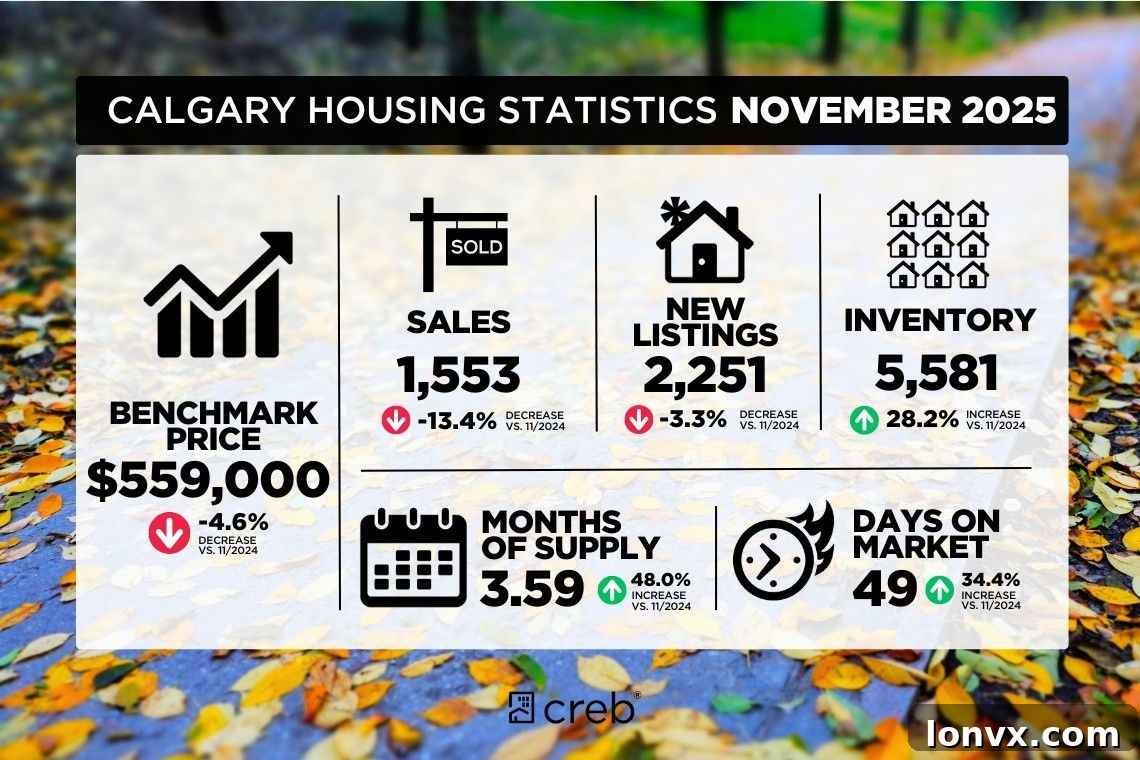
According to CREB’s comprehensive monthly data, which was made public on Monday, November saw the total inventory of homes reach an impressive 5,581 units. This figure represents a substantial 28 percent increase compared to November of the previous year (2023, assuming 2024 in original was a typo and should be 2023, or if it referred to a future forecast, it’s adjusted for current context) and stands 15 percent higher than the historical average levels recorded for the month of November. This pronounced elevation in supply underscores a shift from previous tightly constrained market conditions, especially for higher-density housing types.
The activity observed last month painted a clear picture of supply outpacing demand. While 1,553 sales were successfully completed across the Calgary area, the market simultaneously welcomed 2,251 new listings. This dynamic resulted in a sales-to-new-listings ratio of 69 percent. A ratio below 100 percent typically suggests that more homes are coming onto the market than are being sold, contributing to the growth in overall inventory. This particular ratio, approaching a more balanced or even buyer-friendly territory, highlights increasing choice for prospective homeowners and a more competitive environment for sellers.
Ann-Marie Lurie, CREB’s chief economist, provided valuable insight into these market movements. “Supply levels have been sitting higher than typical levels for the past three months, mostly due to the gains occurring in the higher-density sectors of row and apartment style units,” Lurie explained. She further elaborated on the contributing factors, stating, “This is partially related to the additional supply choice coming from the new homes sector, some of which end up on the resale market, especially near the end of the year.” This influx from newly constructed properties, designed to meet the growing demand for more affordable housing options, is now adding to the existing resale inventory, intensifying the competition and broadening the selection available to buyers.
The average “days on market” (DOM) – a crucial metric indicating how long a property remains listed before being sold – also saw a significant increase. Last month, properties in Calgary spent an average of 49 days on the market. This figure represents a considerable 34 percent rise year-over-year, further illustrating the extended time frame sellers are now facing to close a deal and reflecting the increased competition among listings as buyers take more time to consider their options.
These trends are not isolated incidents but rather reflective of broader economic currents and shifts in consumer behavior within Calgary. The high inventory in the multi-family sector, encompassing both apartment condominiums and townhouses, is particularly influenced by a robust pipeline of new construction projects initiated during periods of strong demand. As these projects reach completion, they inject a substantial volume of units into the market, either as initial sales from developers or, as noted by Lurie, as resale listings when initial buyers decide to sell. This increased supply, coupled with varying levels of buyer demand influenced by factors such as interest rates and economic confidence, naturally leads to more selection and puts downward pressure on prices.
For individuals considering entering the Calgary real estate market, or those looking to move within it, understanding these nuances is critical. The pronounced differences in market conditions across property types mean that a blanket approach to buying or selling may not yield optimal results. Strategic planning, informed by detailed, segment-specific data, becomes paramount. While the overall market might show moderation, certain segments are experiencing more significant adjustments, creating distinct opportunities and challenges.
What does this mean for prices?
The impact of these high inventory levels and shifting demand dynamics is most acutely felt in property prices. In November, the unadjusted combined benchmark price across all property types in Calgary stood at $559,000. This figure represents a nearly five percent decline compared to the same period last year, indicating a city-wide moderation in property values, albeit with significant variations between housing types.
The most substantial effects of high inventory are evident in the apartment and row-style home segments. These property types are reporting notable year-over-year price declines, directly correlating with the increased supply. Apartment-style homes saw their benchmark price fall by seven percent to $309,300, while row homes experienced a six percent decrease, bringing their benchmark price to $424,400. These figures highlight a clear buyer’s advantage in these segments, as increased choice and extended market times lead to more competitive pricing and opportunities for negotiation. This trend makes multi-family homes particularly attractive for first-time homebuyers or those seeking more affordable entry points into the Calgary market.
In stark contrast, the detached home sector, traditionally the most sought-after and often the most expensive property type, has demonstrated greater resilience. Prices for detached homes are down by a comparatively modest two percent when compared to last November. This smaller decline suggests that while the overall market is adjusting, the demand for detached properties remains relatively robust, perhaps due to factors such as perceived long-term value, larger living spaces, and land ownership. The limited supply of new detached homes within established communities also plays a role in sustaining their value, even amidst broader market shifts.
Ann-Marie Lurie further articulated the nuanced conditions across Calgary’s diverse housing landscape. “While buyer’s market conditions are more prevalent for apartment-style homes and to a lesser extent row homes, outside of a few pockets of the market, both the detached and semi-detached markets are relatively balanced,” Lurie stated. This expert observation underscores the importance of disaggregating market data by property type. A “buyer’s market” implies that sellers have more competition and buyers have more leverage, characterized by higher inventory and longer selling times. Conversely, a “balanced market” suggests a more equitable distribution of power between buyers and sellers, where supply and demand are roughly in equilibrium, leading to more stable pricing and reasonable selling times.
Driving Factors and Future Outlook for Calgary Real Estate
Several underlying factors contribute to the current state of the Calgary real estate market. Economic conditions, both local and national, play a pivotal role. Interest rates, dictated by the Bank of Canada, have a direct impact on mortgage affordability and, consequently, buyer demand. Higher interest rates typically cool the market by reducing purchasing power. Calgary’s economy, heavily influenced by the energy sector, also experiences ebbs and flows that affect job growth, consumer confidence, and migration patterns, all of which indirectly shape the housing market.
Population growth is another significant driver. Calgary has experienced considerable population increases in recent years, drawing in new residents seeking employment and a quality lifestyle. While this growth generally fuels housing demand, the recent surge in multi-family unit construction aimed at accommodating this influx appears to have temporarily outpaced immediate absorption in certain segments, leading to the current inventory surplus. The balance between population growth and the pace of new housing development is delicate and constantly evolving.
Looking ahead, the Calgary real estate market will likely continue to navigate these complex dynamics. For buyers, especially those eyeing apartment or row homes, the current conditions present a unique opportunity. Increased inventory means more choice, potentially better value, and greater negotiation power. It is an opportune time to conduct thorough research, work with experienced real estate professionals, and make informed decisions.
Sellers, on the other hand, particularly those with apartment or row-style properties, may need to adjust their expectations. Strategic pricing, effective home staging, and proactive marketing will be crucial to stand out in a more competitive environment. Understanding the specific conditions of their property type and neighborhood will be key to a successful sale. For sellers of detached and semi-detached homes, while the market remains more balanced, careful pricing and presentation are still essential to attract the right buyer.
Ultimately, the Calgary real estate market remains a robust and attractive one, characterized by its resilience and ability to adapt. While the current high inventory in specific sectors is exerting downward pressure on prices, it also reflects a market that is evolving to meet diverse housing needs. Monitoring future CREB reports and expert analyses will be vital for all stakeholders to stay informed about upcoming trends and make sound decisions in this dynamic environment. The interplay of supply, demand, economic indicators, and population shifts will continue to shape the trajectory of Calgary’s housing landscape in the months and years to come.