
The views expressed in this column are solely those of the author.
Navigating the Future: Why Competence, Not Just AI Adoption, Defines Success for Real Estate Agents
The real estate industry stands at a pivotal crossroads, grappling with the transformative potential of artificial intelligence. A recent article in REM explored AI as a polarizing subject: on one side, doomsayers predict AI will decimate global property values within two years; on the other, industry optimists proclaim that embracing AI is the sole path for tomorrow’s winners to outpace today’s laggards. Both perspectives, however, fundamentally misunderstand the true impact of AI on real estate. They operate under a shared, erroneous premise: that the adoption of AI is the determining factor for an agent’s survival in the coming decade. This premise is false. What truly matters is competence. AI, rather than being a magic bullet or an existential threat, serves as an accelerator, exposing existing levels of expertise—or the lack thereof—with unprecedented speed. The following discussion delves into the evidence supporting this critical claim.
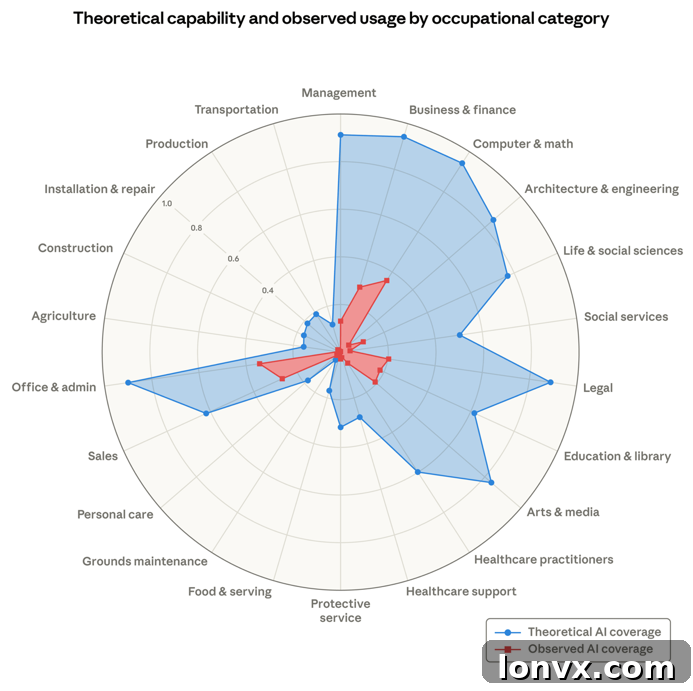
To put AI’s current capabilities into perspective, consider the most AI-exposed profession in the economy: computer programming. As of early 2026, even highly advanced large language models like Claude are capable of performing only about 33% of the tasks they could theoretically handle within this field. The theoretical ceiling for automation in programming sits at a remarkable 94%, yet actual usage remains significantly lower—roughly one-third of that theoretical capacity. This glaring disparity exists in a sector where, by all accounts, AI should be making its most immediate and dramatic inroads. The fact that it isn’t, and that human oversight remains crucial even here, speaks volumes about the current state of AI’s practical application.
This substantial gap between theoretical capability and observed use is perhaps the most crucial data point for a real estate industry that is currently misinterpreting AI’s role. AI functions as a powerful multiplier of existing competence; it amplifies what an agent already brings to the table. Crucially, it is not, and cannot be, a substitute for a foundational lack of competence. Understanding this distinction is paramount for agents and brokerages aiming to navigate the evolving landscape successfully.
The False Binary: Deconstructing AI’s Misunderstood Role in Real Estate
The prevailing narratives surrounding AI in real estate often fall into one of two extreme, and equally flawed, categories. The “doomer” scenario, which paints AI as an impending catastrophe for property values and agent livelihoods, rests on a significant category error. Real estate is fundamentally different from occupations like programming, customer service, or data entry—professions identified as the most AI-exposed in the Anthropic Economic Index. Even within these highly susceptible fields, the actual implementation of AI consistently lags far behind its theoretical potential. Real estate agents, notably, do not even appear on the list of most exposed occupations, and for good reason.
The essence of a real estate agent’s job transcends mere data processing or routine tasks. It is deeply rooted in human judgment, empathy, and complex interpersonal dynamics. Agents counsel families through what is often the largest financial decision of their lives, requiring a profound understanding of individual needs and emotional intelligence. They navigate the intricate psychology of multiple-offer negotiations, skillfully reading the room and anticipating reactions. They possess the nuanced insight to discern a seller’s true motivation—for instance, recognizing when a seller facing a looming divorce might not be genuinely motivated by price alone. While a language model can efficiently draft a listing description, it cannot offer the comforting presence and practical guidance to a first-time buyer whose pre-approval has unexpectedly vanished. These irreplaceable human elements are the bedrock of effective real estate practice, tasks AI simply cannot replicate.
On the other hand, the “booster” narrative, while seemingly more optimistic, is in many ways more insidious. It posits that AI adoption is the singular defining skill for the next generation of agents, suggesting that those who embrace AI will inevitably dominate, while those who don’t will be rendered obsolete. This viewpoint, while possessing a superficial appeal, is dangerously incomplete. It overlooks the crucial truth that AI functions solely as a multiplier. As with any multiplication, if the initial value is zero, the product remains zero. An agent who, in 2024, relies on superficial lifestyle content instead of deep market knowledge will not be saved by generating ten times more AI-produced lifestyle content in 2026. The output merely becomes louder, not more valuable. Without a foundation of genuine competence, AI simply amplifies a void, making an unproductive agent more visibly unproductive.
The Competence Ceiling: Why AI Amplifies, Not Replaces, Fundamental Skills
This discussion about AI’s role directly intersects with a significant, pre-existing problem within the real estate industry. Data from the Toronto Regional Real Estate Board (TRREB), compiled by Redatum, paints a stark picture: as of December 31, 2025, a staggering 52.7% of the 69,728 agents registered with TRREB closed zero transactions in the preceding year. An additional 36.6% managed to close between one and four deals. Combined, an alarming 89.3% of the registrant pool completed four or fewer transactions in an entire calendar year. This concerning statistic did not arise from a lack of AI adoption. Instead, it is a direct consequence of a 25-year bull market that prioritized mere presence over genuine precision and skill. The competencies that sufficed during two decades of effortless growth became rapidly obsolete when the market dynamics dramatically shifted in 2022.
Layering AI onto such a foundation of widespread underperformance promises to exacerbate existing disparities, rather than alleviate them. An agent who lacked the fundamental skill to accurately price a home in 2021 will not magically transform into a pricing expert simply because an AI model like Claude can generate a comparative market analysis (CMA) in mere seconds. This agent, lacking the requisite market knowledge and critical thinking, will be incapable of properly auditing, verifying, or interpreting the AI’s output. The Anthropic’s March 2026 report on the labor market impacts of AI strongly reinforces this point: even in the most AI-exposed occupations, observed AI use covers only a fraction of its theoretical capability—33% in computer and math roles, and even lower elsewhere.
This persistent gap is not because the technology is incapable of performing the tasks. Rather, it exists because performing these tasks *well* still demands human judgment: knowing what questions to ask, how to critically verify the AI’s answers, and, crucially, when to override the machine entirely. This final skill—the discerning judgment to trust or distrust AI-generated output—is a quality that cannot be acquired through a software subscription or an online course. It is cultivated through experience, deep market understanding, and critical thinking. An agent who utilizes AI poorly is, in essence, not truly leveraging AI at all. They are merely using it to create a superficial semblance of productivity—generating an abundance of posts, emails, and automated follow-ups—none of which are anchored in the deep market knowledge and personalized insights that clients genuinely value and pay for. Producing sixty AI-generated market update reels each week is not a viable business model; it is a content mill, with a real estate agent merely attached to its output.
Where AI Actually Earns Its Keep: Strategic Application for Enhanced Competence
None of the preceding arguments are intended to diminish the immense value and potential of AI within the real estate business. Instead, this is a forceful argument against misapplying AI, particularly against using it to scale the wrong parts of an agent’s business. The cohort of agents poised to thrive over the next five years will be those who employ AI intelligently and strategically, much like a skilled carpenter uses a nail gun. Their approach will be to delegate tasks that are pure repetition and administrative burden to AI, thereby freeing up invaluable hours. These reclaimed hours can then be dedicated to the core of their profession: the part of the job that demands pure judgment, strategic thinking, and human connection.
This means effectively utilizing AI to handle routine yet time-consuming tasks such as drafting initial listing descriptions, summarizing showing feedback, conducting preliminary comparable-sale research, assisting with disclosure reviews, streamlining FINTRAC documentation workflows, and managing the myriad of 40-odd micro-tasks that typically consume the latter half of every working day. Every hour that AI successfully claws back from these administrative duties is an hour returned to the sole purpose for which clients truly engage an agent: the invaluable presence of a human being. This human agent can then be fully present, meticulously prepared, and capable of rendering the high-stakes, nuanced judgment required in critical moments—whether that’s during a negotiation, a client consultation, or advising on complex market conditions. When applied strategically, AI doesn’t replace the agent; it empowers them to be more human, more effective, and ultimately, more valuable.
The Compliance Tail Nobody Is Talking About: Unseen Risks of Unchecked AI Adoption
There’s a critical second problem that the “adoption-first” narrative conveniently sidesteps, and it’s a monumental challenge that managing brokers will likely spend the next two years diligently cleaning up. Every single AI-generated output an agent produces—whether it’s a document, a report, or a piece of marketing material—is legally considered the agent’s work product. By direct extension, this liability extends to the brokerage. This is not a trivial matter; the legal and regulatory implications are substantial.
Consider the potential pitfalls: an AI-generated comparative market analysis that “hallucinates” or fabricates a sale price constitutes a direct pricing misrepresentation. Similarly, an AI-enhanced listing photo, perhaps one that digitally adds a window where none exists, is a clear misrepresentation under the Trust in Real Estate Services Act (TRESA). This also triggers a disclosure obligation that the Real Estate Council of Ontario (RECO) is now actively and rigorously examining. Furthermore, an AI-drafted Financial Transactions and Reports Analysis Centre of Canada (FINTRAC) client identification record that inadvertently misses a “politically exposed person” (PEP) flag is not merely an agent-level oversight; it escalates to a serious, brokerage-level compliance failure. The financial penalties and reputational damage associated with such failures can be severe.
The common thread weaving through all these scenarios is critically important: you cannot effectively audit or verify an AI-generated output if you lack the fundamental, underlying knowledge that the AI was ostensibly designed to assist with. An agent unfamiliar with the intricacies of a neighborhood will be utterly incapable of identifying a bad comparable sale or a fabricated data point in an AI-generated report. Far from lowering the competence floor required for compliance work, AI actually raises it significantly. The rapid speed of AI output drastically compresses the time window available for human agents to meticulously catch and correct errors before they are disseminated. Brokerages that are already burdened with managing thousands of under-producing agents face an existing monitoring nightmare. Introducing AI-generated work product into this already strained environment, without a corresponding and substantial investment in enhancing agent competence and oversight, is a direct pathway for a compliance department to go from merely stretched to catastrophically overwhelmed.
Actionable Takeaways: Strategizing for Real Estate’s AI-Powered Future
To navigate the evolving real estate landscape effectively, agents, brokerages, and industry educators must recalibrate their approach to AI. Focusing solely on adoption misses the point; the emphasis must shift to strategic application and foundational competence.
For Agents: Redefine Your Focus and Leverage AI Intelligently
Stop framing the question as whether or not to adopt AI. Instead, shift your inquiry to: “Which 30% of my week truly involves client-facing judgment and strategic advice?” Direct AI toward managing the other 70%—the repetitive, administrative, and data-intensive tasks. Adopting AI merely to churn out more content without substance is not a sustainable strategy; it’s a recipe for burnout and diminished client value. The true strategic advantage lies in adopting AI to reclaim precious hours, allowing you to dedicate more time to personalized client interactions, in-depth market analysis, and the cultivation of unique human judgment. This approach transforms AI from a mere content generator into a powerful tool for enhanced client service and professional development.
For Brokerages: Proactive Policy and Robust Oversight
The time to write a comprehensive AI policy is now, not after the first RECO complaint or compliance audit. Establish clear guidelines defining precisely what tasks agents can and cannot delegate to AI. Crucially, mandate a human sign-off on all client-facing outputs generated with AI assistance. Treat AI-generated work product with the same rigorous scrutiny and accountability that the brokerage applies to any other document bearing a registrant’s name. Understand that the liability for AI-produced errors already resides within your file cabinets. Proactive policy development and stringent oversight are essential to mitigate risks and protect both agents and the brokerage.
For Associations and Educators: Elevating Competence as the Prerequisite
The current continuing education curriculum is lagging by at least three technological cycles. It is imperative to update and modernize training to reflect the realities of an AI-integrated industry. An agent who lacks the fundamental skills to accurately price a home without AI assistance should absolutely not be registered or empowered to price a home with AI. Competence must be firmly established as the non-negotiable prerequisite for leveraging technology. Tools, including AI, are powerful multipliers, but they amplify existing skills, not create them. The order of operations—competence first, then tools—is absolutely critical for fostering a proficient and responsible real estate workforce.
The Reframe: AI as a Stress Test, Not a Short
So, is artificial intelligence truly the next “big short” for real estate, poised to trigger a market collapse? The answer is a definitive no. The industry is not facing an AI bubble; it is confronting a deeply ingrained competence bubble. For 25 years, an era of effortlessly rising market conditions fostered an agent population, many of whom never developed the foundational skills required to operate effectively under modern, more challenging market dynamics. During this time, the trade press has largely focused on selling these agents on the promise of AI as a convenient solution to their underlying issues. This narrative is misleading.
AI will not “fix” a lack of competence. Instead, AI serves as a powerful stress test for the real estate profession. The agents who consistently demonstrate superior performance, those who were always destined for the top 10%, will ingeniously integrate AI to further refine their skills, enhance their efficiency, and deepen their client relationships. They will leverage AI to become even better versions of themselves. Conversely, agents who were already on a trajectory toward attrition will likely use AI to generate a superficial appearance of busyness, masking their underlying lack of genuine value on their way out of the industry. There is nothing about this scenario that suggests a market crash. What it represents, rather, is the accelerated arrival of the reckoning that began in 2022. AI is merely speeding up the inevitable differentiation between truly competent professionals and those who can no longer adapt to the demands of a dynamic and discerning market.
David’s data notes: TRREB agent and transaction data sourced from TRREB via Redatum, covering Jan. 1, 2025 to Dec. 31, 2025. Membership denominator (69,728) is the 2025 annual average derived from monthly TRREB statistics. Zero-deal agent count includes appraisers, managers and non-trading members. Team transactions reported under team leader names are excluded from individual agent counts. Data covers MLS resales only; excludes pre-construction, exclusive listings, leases and commercial transactions. AI usage and task coverage data sourced from Anthropic, “Labour market impacts of AI: A new measure and early evidence” (March 5, 2026). Regulatory references: TRESA; RECO; FINTRAC. This article is industry commentary and does not constitute legal advice.