
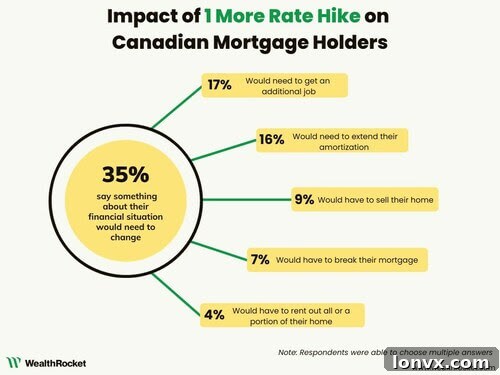
A recent comprehensive survey conducted by WealthRocket has brought to light a significant concern for Canadian mortgage holders: a potential seventh interest rate increase by the Bank of Canada could push over one-third (35 per cent) of homeowners into making critical financial adjustments. These changes are not minor tweaks but could encompass substantial shifts in housing arrangements and even employment status, signaling a deepening crisis in household financial stability across the nation.
Canadian Homeowners on Edge: Navigating the Realities of Rising Interest Rates
The economic landscape in Canada is undergoing significant shifts, primarily driven by the Bank of Canada’s efforts to curb inflation through successive interest rate hikes. While these measures aim to stabilize the broader economy, they cast a long shadow over Canadian homeowners, particularly those with variable-rate mortgages or those facing renewal. The latest findings from WealthRocket underscore the growing pressure on these households, revealing a critical juncture where many may be forced to re-evaluate their financial strategies.
Significant Financial Shifts Loom for Many Canadians
While approximately 65 per cent of survey respondents expressed confidence that their current financial situation would remain stable even after another rate hike, the remaining segment paints a picture of imminent distress. The survey’s granular data illustrates the stark realities and potential sacrifices awaiting a substantial portion of Canadian mortgage holders. Even a single additional increase in interest rates is projected to trigger a series of significant, and often undesirable, coping mechanisms.
The Ripple Effect: How One More Rate Hike Could Reshape Lives
The anticipated adjustments vary but all point towards a tightening of household budgets and a re-prioritization of financial commitments. Seventeen per cent of homeowners facing this scenario reported they would likely seek an additional job to supplement their income. This necessity speaks volumes about the current strain on disposable income, where primary employment is no longer sufficient to cover escalating housing costs. The pursuit of side hustles or second jobs often comes at the cost of personal time, family commitments, and overall well-being, highlighting the profound impact on quality of life.
Another 16 per cent of respondents indicated they would consider extending their mortgage amortization period. While extending amortization can provide immediate relief by reducing monthly payments, it typically results in significantly higher interest paid over the life of the loan. This strategy, though a viable short-term solution for cash flow, essentially defers the financial burden into the future, potentially trapping homeowners in a longer cycle of debt and diminished equity accumulation.
Perhaps the most drastic measure, yet a reality for 9 per cent of those surveyed, is the prospect of selling their home. This decision, often emotionally charged and financially complex, implies downsizing, relocating to a more affordable area, or even transitioning from homeownership to renting. Such a move not only represents a loss of investment but also a disruption of family life and community ties, underscoring the severe financial pressure many Canadians are experiencing.
An additional 11 per cent of respondents reported anticipating other, unspecified changes, suggesting a wide array of personal and household adjustments that could range from cutting discretionary spending drastically to seeking financial counselling or government assistance programs. The cumulative impact of these potential actions reflects a broad-based challenge that extends beyond mere budget tightening.
David O’Leary, WealthRocket’s respected personal finance expert, aptly captures the human element of this crisis. “Most of us will know somebody who had to sell their home and downsize, or start renting because they couldn’t afford it any longer. But many people facing this situation will be reluctant to admit it until they have no choice,” O’Leary explains. His observation highlights the social stigma and personal pride often associated with financial struggles, which can delay seeking help until options become severely limited. This reluctance can exacerbate the problem, making timely intervention and proactive planning even more crucial.
A Key Underlying Factor: Overspending on Housing
Source: WealthRocket
A significant contributor to the current vulnerability of Canadian homeowners is the widespread practice of exceeding recommended housing affordability guidelines. The Canadian Mortgage and Housing Corporation (CMHC) strongly advises that homeowners allocate no more than 39 per cent of their gross monthly income towards housing costs, including mortgage payments, property taxes, and utilities. This guideline is designed to ensure financial flexibility and prevent households from becoming “house-poor,” where a significant portion of income is tied up in housing, leaving little for other necessities, savings, or emergencies.
The Peril of Exceeding the 39% Guideline
Despite CMHC’s clear recommendation, the WealthRocket survey reveals a concerning trend: over 30 per cent of Canadian homeowners with a mortgage consciously disregard this advice. This statistic is alarming because it indicates that nearly one-third of mortgaged households are already operating with limited financial breathing room. For these households, any increase in fixed costs, such as mortgage interest rates, can rapidly push them beyond their financial breaking point. Exceeding the 39% threshold significantly amplifies vulnerability to economic shocks, making it harder to absorb unexpected expenses, save for retirement, or manage other forms of debt.
The reasons for exceeding this guideline are complex and varied, often stemming from the prohibitive cost of housing in desirable urban centers, a strong desire for homeownership, or insufficient awareness of long-term financial risks. However, regardless of the cause, the consequence is a fragile financial position that leaves many homeowners susceptible to the very economic fluctuations the Bank of Canada is currently orchestrating.
Innovative Strategies: How Canadians Manage Housing Costs Today
In the face of persistently rising housing costs and stagnant wage growth in many sectors, Canadian households have adopted a variety of financial arrangements to maintain their homeownership dreams. These strategies highlight the creativity and resilience of families navigating a challenging economic environment, but also underscore the systemic pressures forcing them to make difficult choices.
Collaborative Income Management in Partnerships
A prevalent strategy, employed by 36 per cent of respondents, involves a collaborative approach where one partner’s income is primarily dedicated to covering mortgage costs, while the remaining household expenses are managed by the other partner’s income. This arrangement often relies on a high degree of financial coordination and trust within the partnership. It can optimize cash flow by clearly delineating responsibilities, but it also carries inherent risks. Should one partner’s income stream be disrupted, the entire household’s financial stability could be jeopardized, making robust emergency savings and insurance paramount.
Another significant segment, 27 per cent, reported an even more concentrated financial effort: all housing costs, including the mortgage, are covered by a single partner’s income. This setup typically reflects a household where one partner earns significantly more, or where one partner is out of the workforce, perhaps caring for children or pursuing education. While this can simplify financial management for some, it places immense pressure on the primary income earner and leaves the household extremely exposed to any loss or reduction in that income. The lack of diversification in income sources for essential expenses means such households must maintain an even larger emergency fund and robust contingency plans.
These varied arrangements illustrate the diverse socio-economic realities of Canadian families and the compromises they are making to achieve or maintain homeownership. They also serve as a stark reminder of the financial juggling act many are performing, often with little room for error or unforeseen expenses.
Proactive Steps for Mortgage Holders Amidst Economic Uncertainty
Given the current economic climate and the projections for future interest rate movements, it is imperative for Canadian mortgage holders to take proactive steps to safeguard their financial well-being. Waiting until the last moment, as David O’Leary noted, can severely limit options. Strategic planning and informed decision-making are key to navigating these turbulent waters.
Re-evaluating Your Financial Health
The first step is a thorough review of your current budget and financial situation. Understand precisely where your money is going, identify areas where spending can be reduced, and project how an increase in mortgage payments would impact your monthly cash flow. Tools like budgeting apps or financial spreadsheets can be invaluable. Consider consulting with a certified financial planner who can provide personalized advice based on your unique circumstances and help you develop a robust financial plan that accounts for potential rate hikes and other economic uncertainties.
Exploring Mortgage Options and Refinancing
For those with variable-rate mortgages, now might be the time to assess the benefits of converting to a fixed-rate mortgage, especially if further rate increases are anticipated and fixed rates are still competitive. Homeowners nearing their mortgage renewal date should actively shop around for the best rates and terms well in advance. Don’t simply accept the offer from your current lender; competition among lenders can yield better deals. Exploring options like increasing payment frequency or making lump-sum payments, if feasible, can also reduce the overall interest paid and accelerate debt repayment.
Building an Emergency Fund
An adequate emergency fund is more critical than ever. Financial experts typically recommend having three to six months’ worth of essential living expenses saved in an easily accessible account. This fund acts as a crucial buffer against unexpected job loss, illness, or significant increases in housing costs, providing a safety net that can prevent drastic measures like selling your home or taking on high-interest debt.
Considering Additional Income Streams
For some, taking an additional job, as identified in the WealthRocket survey, may become a necessity. However, even for those not immediately facing distress, exploring side hustles or opportunities to increase income can provide greater financial resilience. This could involve freelancing, consulting, or leveraging skills in the gig economy, allowing for increased savings or faster debt reduction without necessarily compromising primary employment.
Seeking Professional Guidance
If you are already struggling or anticipate difficulty managing your mortgage payments, don’t hesitate to reach out to your lender or a non-profit credit counselling agency. Lenders may offer solutions like temporary payment deferrals, interest-only payments, or extending your amortization period, though these come with their own long-term costs. Credit counsellors can provide impartial advice on debt management and budgeting, helping you explore all available options before the situation becomes unmanageable.
The insights from the WealthRocket survey are a critical wake-up call for many Canadian homeowners. While the dream of homeownership remains strong, the financial realities are becoming increasingly challenging. Proactive planning, informed decision-making, and a willingness to adapt are essential for navigating the current economic climate and securing a stable financial future.
You can read the full WealthRocket survey here to gain deeper insights into their methodology and additional findings.
*Please note that some respondents chose multiple answers in the survey, contributing to the aggregated percentages.
Enjoying this article?
Get the latest REM articles directly in your inbox three times a week so you stay up to date on the latest in the Canadian real estate industry.
Sign Up for Our Newsletter