The Enduring Legacy of the Taino: Uncovering Cuba’s Indigenous Roots
Contrary to the pervasive historical narrative that often implies a complete disappearance, the Indigenous people of Cuba, particularly the Taino, did not vanish entirely following the arrival of Spanish colonizers. While their populations dramatically dwindled, the descendants of the Taino, the last Amerindian group to profoundly shape the island’s culture and landscape, continue to preserve their heritage. Predominantly found in Cuba’s eastern provinces, their story is a testament to resilience and cultural persistence, challenging the common misconception of their total extinction.
For centuries, the intricate details of Taino life remained largely obscured, relegated to historical footnotes or romanticized tales. However, thanks to a confluence of diligent archaeological investigations over the past few decades and careful examination of historical documents, we now possess a much clearer understanding of their sophisticated civilization. These insights allow us to reconstruct a vivid picture of how they lived, worked, and thrived many hundreds of years ago, offering a profound connection to Cuba’s pre-Columbian past. This vital work helps illuminate a crucial, often overlooked, chapter in the island’s rich history.
Step Back in Time: Discover Aldea Taina Near Guardalavaca
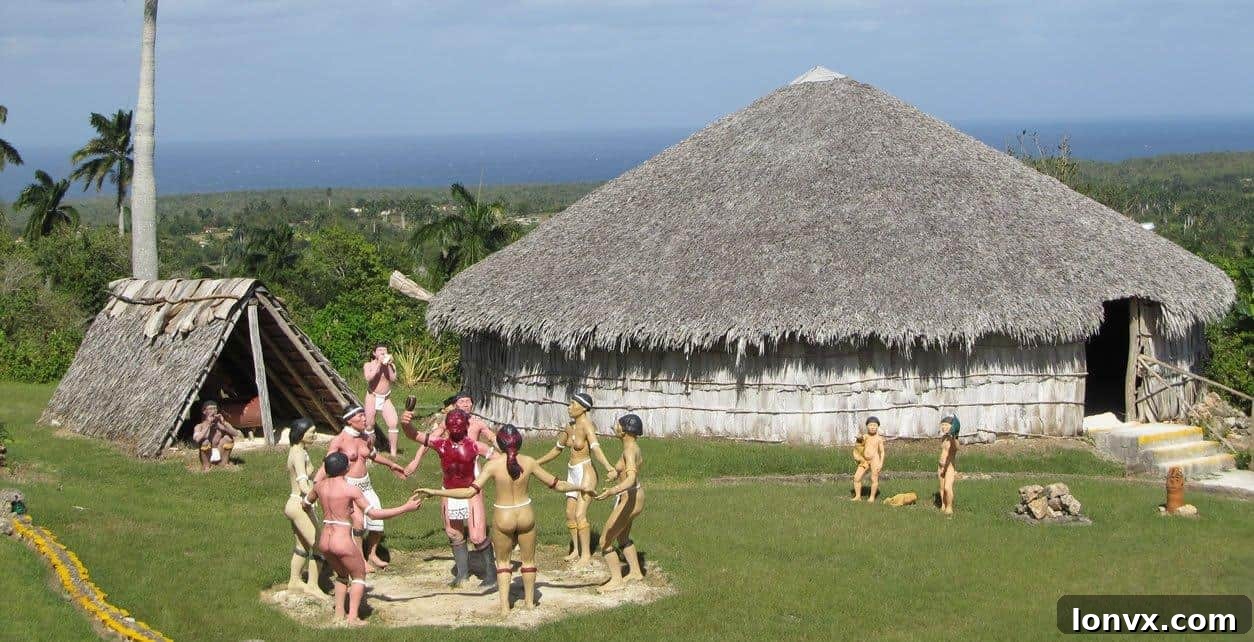
Nestled approximately six kilometers from the popular resort area of Guardalavaca, in the province of Holguín, lies Aldea Taina – a remarkable and authentic reconstruction of a traditional Taino village. This living museum offers visitors an immersive journey into the daily life and spiritual world of Cuba’s indigenous inhabitants. More than just a collection of structures, Aldea Taina is a meticulously crafted homage, bringing the ancient world to life with incredible detail and a commitment to historical accuracy.
Spread across a spacious, open grassy area, the village showcases beautifully recreated versions of their characteristic large, circular thatched dwellings, known as bohios. These structures, built with natural materials sourced directly from the surrounding environment, stand as powerful symbols of Taino architectural ingenuity. Beyond the dwellings, the site features a small, yet instructive, plot of cultivated land, demonstrating the Taino’s advanced agricultural practices. Tropical fruit trees, vital to their diet and culture, dot the landscape, providing an authentic backdrop to the scene.
Adding to the authenticity, life-sized models of Taino people are strategically placed throughout the village, depicting them engaged in various activities – from daily chores and craftsmanship to ceremonial practices and leisure. These realistic representations offer a captivating glimpse into the social fabric and individual roles within a Taino community, allowing visitors to visualize the vibrant human element that once thrived here.
The Ingenuity of Taino Craftsmanship: Bohios and Daily Life
The Taino, who began migrating to Cuba around AD 1250 from neighboring Hispaniola and Puerto Rico, were renowned for their peaceful nature and exceptional skills. Their expertise extended across various domains, including sophisticated pottery and masterful boat building. Their canoes, or kanowas, were essential for navigating the Caribbean waters, facilitating trade, fishing, and travel between islands. The robust and elegant design of these vessels allowed them to traverse vast distances, forging connections across the archipelago.
Their agricultural prowess was equally impressive. The Taino cultivated a variety of staple foods, notably manioc and yucca (cassava), crops that remain fundamental to the Cuban diet today. The ingenuity of their farming techniques ensured a stable food supply, supporting thriving communities. Beyond sustenance, their cultural impact resonated in their language, contributing words such as hurikan (hurricane), hamaka (hammock), and kanowa (canoe) that have seamlessly integrated into English, Spanish, and other European languages, a testament to their enduring linguistic legacy.
Even Cuba’s global reputation for producing exceptional quality cigars can be traced directly back to the Taino. They were among the first known cultivators and smokers of tobacco, using it as an integral part of their spiritual rituals and communal gatherings. This ancient practice, refined over centuries, laid the foundation for an industry that defines a significant part of Cuba’s modern identity.
The construction of their distinctive bohios exemplifies the Taino’s deep understanding and harmonious relationship with nature. As a knowledgeable guide might explain, pointing to a towering Royal Palm tree, a quintessential symbol of Cuba: “Do you see those dried fronds and bits that naturally fall from the trunk near where the berries grow? Those were meticulously collected and ingeniously used to construct the sturdy walls of their homes. And the roofs? Those were expertly woven from the broad, strong leaves of the same palm, creating a resilient and weatherproof shelter.” This sustainable approach to architecture not only provided comfort but also reflected a profound respect for their environment.
The interior of one of the recreated Taino huts at Aldea Taina, offering a glimpse into communal living spaces.
Spiritual Journeys: Taino Rituals and Beliefs
Not all Taino bohios were designated for habitation. One specific dwelling, often the first entered by visitors to Aldea Taina, would have been reserved exclusively for particular tribal members, most notably the chief, or cacique. This sacred space served as the epicenter for significant spiritual ceremonies and community leadership. Inside, often on a smoothed dirt floor, visitors can observe a decorated idol, a profound symbol representing the cyclical forces of life and death, an essential tenet of Taino cosmology.
Nearby, models depict a group of Taino men seated in a circle, illustrating one of their most powerful rituals. Here, they would engage in ceremonies that involved inhaling cigar smoke through their nostrils, a practice believed to induce profound trance-like states and generate hallucinations. These altered states of consciousness were not mere recreation but a revered method for facilitating communication with the spirit world, seeking guidance, wisdom, and understanding from their ancestors and deities.
Upon the conclusion of such an intensely spiritual ceremony, one of the men would traditionally blow into a conch shell. The resonant, far-reaching sound served as a powerful signal, announcing that they had successfully communed with the divine and were prepared to share the visions and messages received from the gods with the wider community. This communication was then often followed by a communal dance, a vibrant expression of their spiritual connection and gratitude, much like the replicated performances that frequently take place in the central courtyard of Aldea Taina today, bringing the ancient rhythms to life.
Another hut, similar in its robust size and traditional construction, represents the communal living quarters of the Taino. This large, open space would have housed multiple families, fostering a strong sense of community and shared life. Hammocks, woven from natural fibers and another lasting Taino innovation, would have been strung throughout the interior, serving as comfortable and practical sleeping arrangements for the inhabitants. This communal living arrangement underscored the Taino’s interdependent social structure, where cooperation and shared resources were paramount.
Beyond the Bohios: Culture, Medicine, and Sustenance
Elsewhere on the expansive site of Aldea Taina, visitors can explore various facets of Taino culture and daily life. A particularly insightful display demonstrates the meticulous process of preparing cassava, or manioc, from its raw root form into a versatile flour, which was then baked into flatbreads. This staple food was fundamental to the Taino diet, and understanding its preparation highlights their agricultural ingenuity. Today, visitors often have the unique opportunity to sample a piece of this traditional cassava bread at the village’s restaurant, directly connecting with ancient culinary traditions.
The village also features replicas of carved “zemis,” intricate sculptural objects revered by the Taino. These zemis were far more than mere carvings; they were believed to house spirits, acting as conduits between the physical and spiritual realms. Each zemi held unique significance, often representing specific deities, ancestors, or natural forces, and played a crucial role in Taino religious practices and communal worship.
Further demonstrating the holistic nature of Taino society, another hut at Aldea Taina functions as a clinic, offering a glimpse into their traditional healing practices. Here, a shaman, or medicine person, would engage in rituals involving the waving of various plants and the rhythmic shaking of rattles over a patient. These actions were not arbitrary; they were believed to facilitate contact with the god of health, allowing the shaman to diagnose the nature of a person’s ailment and prescribe appropriate remedies. This blend of spiritual and herbal medicine underscores the Taino’s deep understanding of their environment and their holistic approach to well-being.
Unearthing the Past: Significant Taino Archaeological Discoveries
While the Taino people are often mistakenly thought to have disappeared entirely, it is estimated that of the roughly 500,000 Tainos who inhabited the island before the Spanish conquest, only about 5,000 pure descendants remain today. However, hundreds of thousands of Cubans likely possess indigenous roots, a testament to intermarriage and the quiet persistence of Taino heritage within the broader Cuban population. Aldea Taina’s location is particularly poignant and fitting, as the eastern region of Cuba has yielded more significant indigenous remains and archaeological evidence than any other part of the island, solidifying its status as a vital hub for Taino studies.
The Graves of Chorro de Maita: A Window into Ancient Lives
Just across the street from Aldea Taina lies another crucial site for understanding Taino history: the Museo Chorro de Maita. This museum houses an extraordinary collection of archaeological finds that provide an unparalleled look into the lives and funerary practices of the Taino. Among its most compelling exhibits are the remains of 108 Taino skeletons, dating back to the 15th century. These skeletons were meticulously uncovered in 1986, revealing a communal burial ground that has offered invaluable insights into Taino demography, health, and social structure.
Within illuminated glass cabinets lining the museum walls, visitors can observe dozens of artifacts that were painstakingly recovered from these ancient graves. These items are not merely decorative; they are deeply personal objects that speak volumes about Taino culture and beliefs. The collection includes exquisite ceramic jewelry, crafted with artistic precision; carefully preserved shells, possibly used for adornment or ritual; unique spatulas designed to induce vomiting during purification ceremonies, highlighting their spiritual cleansing rituals; and fragments of earthenware pots, indispensable for cooking, storage, and daily life. Each artifact tells a story, collectively painting a vivid portrait of a sophisticated and spiritually rich society.
Los Buchillones: An Underwater Revelation
The journey of discovery into Cuba’s Taino past continues with astonishing new finds. Approximately two decades ago, a groundbreaking discovery was made at an underwater site known as Los Buchillones, located in the central province of Ciego de Ávila. A team led by Canadian archaeologist David Pendergast and his Cuban counterparts stumbled upon a series of submerged posts. What initially appeared to be mere timber fragments soon revealed itself to be something far more extraordinary: the first almost perfectly preserved Taino house ever discovered.
This remarkable underwater dwelling, estimated to be between 400 and 700 years old, provided an unprecedented look into Taino architecture and daily life, undisturbed by colonial-era destruction or subsequent human activity on land. The unique preservation conditions beneath the water allowed for the survival of organic materials that would have long since decomposed on dry land, offering invaluable data to archaeologists. Finds like Los Buchillones underscore the vast potential for future discoveries and emphasize that much of Cuba’s indigenous history still awaits revelation, promising even deeper insights into the lives of these fascinating people in the years to come.
Preserving a Precious Heritage
The Taino legacy in Cuba is a vibrant tapestry woven from resilience, cultural innovation, and spiritual depth. From the living history presented at Aldea Taina to the profound archaeological revelations at Chorro de Maita and Los Buchillones, the story of Cuba’s indigenous people is far from over. It is a dynamic narrative of survival, adaptation, and enduring cultural impact that continues to shape the identity of the island. These sites serve as crucial educational resources, inviting visitors from around the world to connect with a past that is both ancient and profoundly relevant to understanding modern Cuba.
As research continues and new technologies aid in uncovering more secrets, the Taino people’s contributions to language, agriculture, art, and spirituality are increasingly recognized and celebrated. Visiting places like Aldea Taina and Museo Chorro de Maita offers an extraordinary opportunity to honor this precious heritage, challenging preconceived notions and fostering a deeper appreciation for the rich, complex layers of Cuban history. The enduring spirit of the Taino stands as a powerful reminder of the resilience of indigenous cultures worldwide and the continuous importance of preserving their unique stories for future generations.