Discover the Enchanting World of Amsterdam Houseboats: A Journey into Floating Heritage
Amsterdam, a city inextricably linked to its iconic canals, offers a unique way of life that continues to captivate residents and visitors alike: houseboat living. Far from the rustic image many might conjure, these floating homes are vibrant, comfortable, and deeply integrated into the city’s urban fabric. For centuries, the waterways have been central to Amsterdam’s identity, initially serving as arteries for trade and transport, and later evolving into picturesque residential havens. Among the hundreds of houseboats gracefully moored along the city’s historic canals, one particular vessel stands out as a beacon of this distinct lifestyle: the Hendrika Maria, home to the world’s only Houseboat Museum.
The allure of Amsterdam’s canals and the intriguing concept of living on water often spark endless curiosity. Passersby frequently gaze at these unique dwellings, wondering about the practicalities of such a life. Questions like, “How do they get water and electricity?” or “Is it truly cold and damp onboard?” are common refrains. It was precisely this widespread curiosity that inspired Vincent van Loon, a former houseboat resident himself, to create a space where these mysteries could be unraveled. Two decades ago, his vision transformed a historic vessel into the Hendrika Maria Houseboat Museum, a testament to Amsterdam’s enduring floating heritage that continues to draw a steady stream of curious visitors.
Van Loon, intimately familiar with the questions and misconceptions surrounding houseboat life, recognized the need for an authentic, educational experience. His personal journey, living on the tranquil waters of Amsterdam, provided him with unparalleled insight into the unique challenges and profound joys of this alternative dwelling. He understood that while the exterior might suggest a quaint, perhaps even primitive existence, the reality was one of ingenuity, comfort, and a strong connection to the city’s watery pulse. The museum, therefore, was conceived not just as a static exhibit, but as an immersive portal into the heart of Amsterdam’s houseboat culture, designed to satisfy public curiosity and celebrate this remarkable way of living.
The Hendrika Maria: A Historic Vessel on Prinsengracht
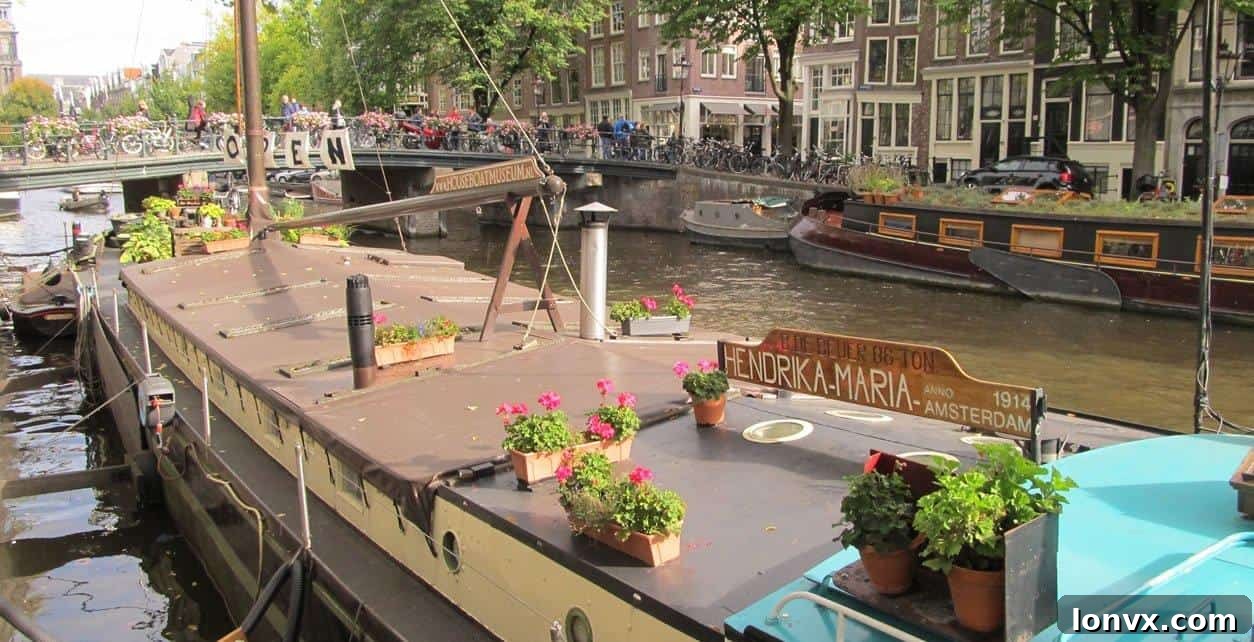
Nestled on the picturesque Prinsengracht canal, right in the heart of Amsterdam’s charming Jordaan district, the Hendrika Maria Houseboat Museum presents an inviting sight. Its deck, adorned with vibrant geraniums and other potted plants, exudes a warm, welcoming charm that blends seamlessly with the surrounding historic architecture. A simple yet compelling sign outside beckons passersby with the promise to “See a houseboat inside,” an invitation that few can resist, offering a rare glimpse into a truly unique domestic environment.
The choice of location on the Prinsengracht is no coincidence. This canal is one of the three main concentric canals of Amsterdam’s Grachtengordel (canal belt), a UNESCO World Heritage site celebrated for its stunning beauty and historical significance. Moored amidst grand canal houses, the Hendrika Maria benefits from a prime position that makes it easily accessible for tourists while also showcasing the authentic charm of urban canal living. The serene waters reflect the Dutch gabled houses, creating a quintessentially Amsterdam experience even before stepping aboard the floating museum.
The interior of the houseboat, with a reproduction of a Van Gogh painting above the sleeping quarters.
From Freighter to Floating Home: The Hendrika Maria’s Rich History
The Hendrika Maria boasts a fascinating and storied past that is typical of many Amsterdam houseboats. Built in 1914, she began her life not as a tranquil residence, but as a sturdy working freighter. For decades, this robust vessel plied the Dutch waterways, diligently transporting essential goods such as timber, sand, and gravel, playing a vital role in the country’s developing infrastructure and economy. Her strong iron hull and spacious holds were perfectly suited for the demanding task of freight transport across canals and rivers.
However, as transportation methods evolved, the era of the traditional working freighter began to wane. In a brilliant act of repurposing that speaks to Dutch ingenuity, the Hendrika Maria underwent a significant transformation in 1967. She was lovingly converted into a houseboat, adapting her robust structure to serve as a comfortable, permanent residence. This transformation extended her life and gave her a new purpose, reflecting a broader trend in Amsterdam where disused barges and cargo ships found new identities as charming homes on the water. The vessel served as a private dwelling until 1997, providing shelter and a unique lifestyle to its inhabitants for three decades.
Preserving the Past: The Restoration Journey
The dedication to preserving the authentic spirit of houseboat living culminated in a significant restoration project in 2008. This meticulous effort aimed to return several key areas of the Hendrika Maria to their original, charming state as a working houseboat, reflecting the aesthetics and functionality of the mid-20th century. Areas such as the deckhouse, kitchen, living room, sleeping nook, and the bathroom were carefully restored, ensuring that visitors could experience the vessel as it once was when it served as a family home.
Today, the Hendrika Maria no longer serves as a private residence. Instead, it functions strictly as a museum, offering an unparalleled educational experience. Every detail, from the furnishings to the historical appliances, has been curated to transport visitors back in time, allowing them to truly grasp the daily life, challenges, and joys of living on an Amsterdam houseboat. This commitment to authenticity ensures that the museum is not just a collection of artifacts, but a living, breathing testament to a unique cultural phenomenon.
Dispelling Myths: The Realities of Houseboat Living in Amsterdam
Many visitors approach the Hendrika Maria with preconceived notions of what houseboat living entails. There’s a common perception that life on the water must be primitive, lacking the comforts of a land-based home. The reality, as demonstrated within the Hendrika Maria, is a delightful debunking of these myths. Houseboat residents in Amsterdam enjoy virtually all the modern conveniences that their land-dwelling counterparts do, often with the added bonus of unparalleled canal views and a serene, waterborne ambiance.
Modern Comforts on the Water: Fully Equipped Floating Homes
Modern Amsterdam houseboats are far from rudimentary. They are fully integrated into the city’s utility infrastructure, providing residents with essential services including reliable electricity, gas for heating and cooking, fresh running water, robust phone lines, and high-speed internet. Waste management systems, including sewage connections, ensure that these floating homes are environmentally responsible and meet urban living standards. This seamless integration means that occupants do not sacrifice comfort or convenience for the unique experience of living on the water.
Spacious Interiors: Beyond Expectations
One of the most surprising revelations for many museum visitors is the sheer spaciousness of the interior. Contrary to expectations of cramped, confined quarters, the Hendrika Maria, measuring an impressive 23 meters long by 4.5 meters wide (approximately 75 by 15 feet), offers a substantial living area. This internal volume is roughly equivalent to the size of an average apartment in central Amsterdam, providing ample room for comfortable living, dining, and sleeping spaces. The clever use of vertical space and built-in storage solutions often maximizes perceived roominess, creating a sense of openness despite the unique dimensions.
A Glimpse into the Past: The Interior Design and Functionality
Your journey into the Hendrika Maria begins with an inviting descent of five steps from the stern into the deckhouse. This area was historically the nerve center of the vessel, where the skipper and his family lived, navigated, and managed the daily operations. Here, visitors can see a traditional hand pump situated above the sink, a historical artifact that was once crucial for drawing drinking water from the onboard tank. It serves as a tangible reminder of the ingenuity and self-sufficiency required in earlier houseboat life, contrasting with today’s direct water connections.
Continuing the tour, you’ll discover a small, functionally designed kitchen, which would have been bustling with daily activities. Adjacent to this is a remarkably cosy and authentically furnished living room, meticulously decorated with period pieces from the 1950s. This inviting space features a classic wood burner, providing both warmth and a charming focal point, though the entire boat also benefits from the modern comfort of radiators connected to a gas-fired central heating boiler. The sleeping quarters, subtly tucked away, offer a private sanctuary, famously featuring a reproduction of a Van Gogh painting above the bed, adding a touch of Dutch artistic heritage to the intimate space.
The living room of the Hendrika Maria.
The Unseen Engineering: Stability and Structure
Beneath the floor of the Hendrika Maria lies a clever engineering solution crucial for its stability and functionality: a space filled with insulation and heavy tiles. The insulation plays a vital role in maintaining comfortable indoor temperatures, protecting against the cold dampness often associated with water environments. The tiles, however, serve a dual purpose as ballast. This added weight helps the ship lie lower in the water, significantly enhancing its stability and ensuring a smooth, level living experience. Furthermore, by sitting lower, the houseboat can more easily pass under the numerous low bridges that crisscross Amsterdam’s intricate canal network, an essential feature for any vessel navigating the city.
The Diverse World of Amsterdam’s Floating Homes: Types and Maintenance
While the Hendrika Maria offers a glimpse into one type of houseboat, Amsterdam’s waterways are home to a remarkable diversity of floating residences, each with its own characteristics, advantages, and maintenance requirements. Understanding these variations adds another layer to appreciating the ingenuity behind houseboat living.
The Iron-Hulled Classics: Maintenance and Charm
Traditional houseboats, often converted from old barges like the Hendrika Maria, typically feature iron hulls. While undeniably charming and historically significant, these vessels require regular and diligent maintenance. The iron hull is susceptible to rust due to constant exposure to water, necessitating a comprehensive inspection and treatment every three to six years. This process is quite an undertaking: most houseboats lack engines, so they must be carefully tugged to a specialized shipyard. Once there, the hull is thoroughly pressure hosed to remove marine growth and old paint, meticulously inspected for corrosion, and then professionally primed and painted to protect against the elements for the next few years. This maintenance ensures the longevity and safety of these cherished floating homes, albeit at a considerable effort and expense for their owners.
The Resilient Concrete “Arks”
A contrasting type of floating dwelling found in Amsterdam is the concrete houseboat, often affectionately referred to as an “ark.” These structures are built on a solid concrete base, which gives them inherent buoyancy and exceptional stability. A significant advantage of concrete houseboats is their reduced maintenance. Unlike iron hulls, concrete does not rust, meaning they do not require the frequent dry-docking and painting associated with traditional vessels. This makes them a more practical and often more cost-effective option for those seeking a less maintenance-intensive floating home. They can be found in various architectural styles, often resembling modern, minimalist structures.
The Hybrid “Scharks”
Amsterdam’s innovative spirit extends to a third category of houseboat: the “schark.” As the name ingeniously suggests, a schark is a fascinating combination of a traditional “ship” (schippie) and a modern “ark” (ark). These hybrid vessels blend the characteristics of both types, perhaps featuring a concrete base with a more traditionally shaped superstructure, or integrating elements of both in unique architectural designs. This adaptability highlights the continuous evolution of houseboat design, driven by a desire for both aesthetic appeal and practical functionality, catering to diverse tastes and needs.
Modern Houseboat Innovations: Sustainability and Design
Beyond these established types, modern houseboat design in Amsterdam is constantly evolving, with a growing emphasis on sustainability and innovative architecture. New constructions often incorporate eco-friendly materials, solar panels, and advanced waste management systems, reflecting a global shift towards greener living. These contemporary floating homes push the boundaries of design, transforming simple vessels into architectural marvels that offer luxurious, energy-efficient, and highly customized living spaces, further diversifying the already rich tapestry of Amsterdam’s waterborne community.
Amsterdam’s Unique Waterborne Community: Culture, Regulations, and Tourism
In a city characterized by its extensive network of canals and facing ongoing challenges with housing shortages, it is perhaps unsurprising that a significant number of its residents have chosen to make their homes on the water. This practical solution has blossomed into a unique and vibrant culture, deeply embedded in Amsterdam’s identity.
A City Shaped by Water: Contextualizing Houseboat Living
Amsterdam’s history is intrinsically linked to its waterways. From its origins as a fishing village to its rise as a global trading power, the canals have been its lifeblood. Today, they are not just historic relics but living arteries that support a thriving residential community. The sheer number of houseboats—with approximately 900 moored in the city center alone—speaks volumes about their integral role in urban life, offering a distinct alternative to traditional land-based housing in a densely populated metropolis.
The Houseboat Community: A Sense of Belonging
Living on a houseboat is more than just an address; it often fosters a strong sense of community among residents. Neighbors share a common lifestyle, often facing similar practicalities and enjoying the unique camaraderie that comes with life on the water. This community spirit, combined with the unparalleled views of historic canal houses and passing boats, creates a deeply cherished living experience. The gentle rocking motion, the changing light on the water, and the unique soundscape contribute to a peaceful and often idyllic existence that sets it apart from conventional urban living.
Navigating Regulations: Permits and Mooring
While idyllic, houseboat living in Amsterdam is governed by strict rules and regulations. Owners must secure specific mooring permits, which are often highly sought after and limited in number, making new houseboat ownership a competitive endeavor. These regulations cover everything from the size and appearance of the vessel to waste disposal and environmental compliance, ensuring that houseboats coexist harmoniously with the city’s infrastructure and ecosystem. The careful management of these permits and the adherence to environmental standards are crucial for preserving the delicate balance of Amsterdam’s urban waterways.
Experiencing Floating Life: Rentals and Tourism
For those who dream of experiencing life on an Amsterdam houseboat, even if only for a short stay, the city offers numerous opportunities. Several houseboats are available for rent, providing tourists with a truly unique and memorable accommodation option that goes beyond a typical hotel stay. These rentals offer a taste of the authentic houseboat lifestyle, allowing visitors to wake up to the gentle lapping of water, enjoy breakfast with canal views, and immerse themselves in the rhythm of Amsterdam’s waterways. They represent a significant part of the city’s appeal, drawing visitors looking for distinctive travel experiences.
The Hendrika Maria: A Global Landmark of Floating Heritage
As a global city renowned for its innovations and cultural richness, Amsterdam offers a singular institution that celebrates its unique waterborne heritage: the Hendrika Maria. More than just a static exhibition, the museum provides an enriching, multi-faceted insight into a way of life that continues to define a part of the city’s character.
A Visual Journey Through Diversity: The Bow Room Experience
In a dedicated room located near the bow of the Hendrika Maria, visitors are treated to an engaging four-minute slide presentation. This visual journey extends beyond the museum’s own historical vessel, showcasing the incredible variety of other houseboats that grace Amsterdam’s canals. The images reveal the vast spectrum of design and creativity within the houseboat community. Some houseboats are strikingly shaped like actual traditional houses, complete with gabled roofs and windows, while others embrace minimalist aesthetics, resembling modern architectural marvels. Particularly noteworthy are designs that evoke famous artworks, such as a houseboat inspired by the geometric abstraction of a Mondrian painting, highlighting the artistic and innovative spirit thriving on the water.
The World’s Only Houseboat Museum: A Unique Cultural Institution
What truly sets the Hendrika Maria apart is its unique distinction as the only houseboat museum in the world. This singular status underscores its importance as a cultural and historical institution dedicated to preserving and sharing the story of houseboat living. It serves as an invaluable resource for understanding the evolution of waterborne residences, the practicalities of canal life, and the enduring human desire to connect with nature within an urban environment. By stepping aboard the Hendrika Maria, visitors gain not only knowledge but also a profound appreciation for this extraordinary facet of Dutch heritage.
Plan Your Visit to Amsterdam’s Houseboat Museum
For anyone eager to delve into the fascinating world of Amsterdam houseboats, the Hendrika Maria offers an unparalleled opportunity. Located on the picturesque Prinsengracht in the vibrant Jordaan district, it provides a welcoming and informative experience that demystifies life on the water. Whether you’re a history enthusiast, an architecture admirer, or simply curious about Amsterdam’s unique charm, a visit to the Hendrika Maria Houseboat Museum is an essential stop. It’s an invitation to explore a piece of living history, understand the ingenuity behind floating homes, and truly connect with the heart and soul of this remarkable canal city.