
Canada’s Rental Market Soars: Average Rents Exceed $2,000 Amidst Unprecedented Demand
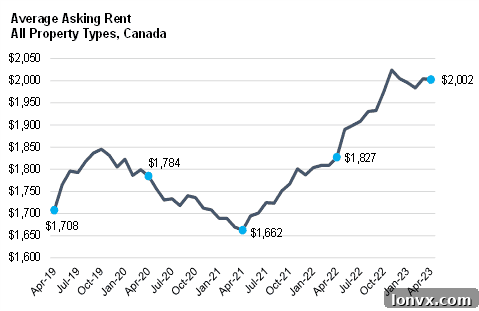
The Canadian rental market is currently experiencing a period of significant escalation, with average asking rents reaching an impressive $2,002 across all property types in April. This figure represents a substantial 20 percent surge compared to the pandemic low recorded in April 2021, when the average stood at $1,662. According to the latest National Rent Report compiled by Rentals.ca and Urbanation, this rise translates to an average monthly increase of $340 for tenants over a two-year span. While average rents climbed by a notable 9.6 percent year-over-year from April 2022 ($1,827), they remained largely consistent with March 2023 figures ($2,004), potentially signaling a temporary plateau within a long-term upward trend.
Key Drivers Behind Canada’s Accelerating Rental Costs
The continuous climb in average asking rents is expected to persist in the coming months, primarily fueled by a powerful combination of factors contributing to robust demand. Canada’s ambitious population growth targets mean a steady influx of newcomers, a significant portion of whom immediately enter the rental market. This demographic shift places immense pressure on an already constrained housing supply, creating fierce competition for available units.
Adding to this pressure, the prevailing economic conditions are compelling more Canadians to remain in the rental sector. The persistent challenge of high home prices, coupled with elevated interest rates, has made homeownership increasingly unattainable for many, especially first-time buyers. This situation effectively sidelines potential homeowners, funnelling them back into the rental market and further intensifying demand.
Shaun Hildebrand, president of Urbanation, highlights a critical observation: “The strongest rent growth is occurring in markets that experience high levels of immigration.” He further explains a compounding issue: “Tenants that signed leases during the pandemic may be facing rent increases of 20 per cent or more if they decide to move, causing reduced turnover that is exacerbating the low supply situation.” This dynamic creates a bottleneck, as existing tenants, wary of steep increases, choose to stay put, thereby limiting the availability of units and driving up prices for the few that enter the market.
Matt Danison, CEO of Rentals.ca, notes that Canadians have, by now, become accustomed to the trend of rising rents in the post-pandemic era. Danison identifies the multifaceted drivers at play: “Record immigration with most newcomers renting, high interest rates keeping first-time home buyers on the sidelines, and inflation are all drivers of rising rents, increasing demand and low vacancy rates.” These interconnected factors collectively paint a picture of a rental market under severe stress, where demand consistently outstrips supply, leading to significant affordability challenges nationwide.
Canada’s Most Expensive Rental Markets: Vancouver and Toronto Lead the Way
As anticipated, Vancouver and Toronto continue to hold their positions as Canada’s most expensive rental markets. These metropolitan areas consistently command the highest rental prices, reflecting their status as major economic hubs, desirable global cities, and destinations for both domestic and international residents. The sustained demand in these cities, coupled with their geographical constraints and robust job markets, keeps rental costs at a premium.
Vancouver: Navigating Canada’s Priciest Rental Landscape
Vancouver topped the list of 35 cities surveyed, demonstrating its sustained status as Canada’s costliest city for renters. In April, the average monthly rent reached $2,787 for a one-bedroom home and a staggering $3,741 for a two-bedroom unit. The year-over-year increases highlight the intensity of the market: a one-bedroom apartment in Vancouver saw a 14.7 percent rise, while two-bedroom units experienced an even sharper increase of 17.6 percent. These figures underscore the significant financial burden faced by individuals and families seeking housing in this highly sought-after West Coast city.
Toronto: A Close Second in Rental Affordability Challenges
Toronto, Canada’s largest city and economic engine, secured the second position. Renters in Toronto faced average monthly costs of $2,526 for a one-bedroom apartment and $3,290 for a two-bedroom unit in April. The annual percentage increases were particularly steep, indicating rapid market appreciation. A one-bedroom unit in Toronto saw a 20.5 percent increase year-over-year, while two-bedroom units rose by 18 percent. This robust growth reflects the city’s continued appeal to a diverse population, coupled with a constrained housing supply unable to keep pace with escalating demand.
The recovery from pandemic-era lows has been particularly pronounced in these two major markets. Compared to April 2021, the average rents for condo rentals and apartments in Vancouver and Toronto surged by 47 percent and 41 percent, respectively. This rapid rebound and subsequent acceleration in rental prices signify the intense pressure these global cities are experiencing.
Montreal: Quebec’s Rental Market Overview
Further east, Montreal offered a comparatively more accessible rental market, ranking 25th nationally. In April, average prices in Quebec’s largest city were $1,655 for a one-bedroom home and $2,169 for a two-bedroom. However, even Montreal experienced notable year-over-year increases, with a 10.7 percent rise for one-bedroom units and an 11.2 percent increase for two-bedroom units, indicating that the upward pressure on rents is a widespread phenomenon, albeit with varying degrees of severity.
Calgary Leads Major Cities in Apartment and Condo Rent Growth
Calgary has consistently demonstrated robust growth in its rental market, topping the list of Canada’s major cities for increasing average rents in purpose-built and condominium apartments for the third consecutive month. This consistent performance underscores the city’s burgeoning economy, fueled by its energy sector and increasing appeal to residents seeking relatively more affordable living options compared to the prohibitive costs of Vancouver and Toronto.
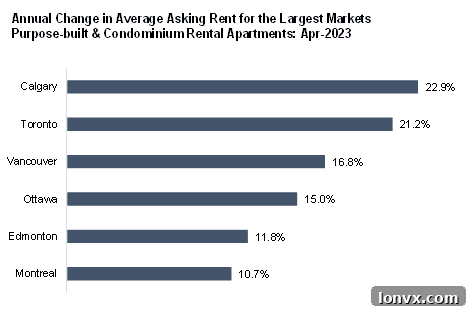
In April, average rents in Calgary experienced a remarkable 22.9 percent surge compared to the previous year, reaching an average of $1,924. This substantial percentage increase highlights a rapidly shifting rental landscape in Alberta. Toronto followed closely in terms of year-over-year growth, with average monthly rents for condo rentals and apartments increasing by 21.2 percent to $2,822. Vancouver, despite holding the title of the highest-priced major market for renters, still witnessed a significant 16.8 percent increase in April, pushing its average monthly rent to $3,236.
The upward trend was not limited to these top-tier cities. Other major Canadian urban centers also reported substantial rent increases. Ottawa saw average rents for condo rentals and apartments rise by 15 percent, reflecting its stable job market and appeal as the nation’s capital. Edmonton, another key city in Alberta, recorded an 11.8 percent increase, benefiting from internal migration within the province and from other parts of Canada. Montreal’s average rents increased by 10.7 percent, further solidifying the nationwide pattern of escalating rental costs. These figures collectively illustrate a rental market that is tight and highly competitive across a wide spectrum of Canada’s urban landscape.
Medium-Sized Ontario Cities Witness Explosive Year-Over-Year Rent Increases
Beyond the major metropolises, the latest report shines a spotlight on Canada’s medium-sized cities, particularly those in Ontario, which are experiencing some of the most rapid year-over-year rent increases for condos and apartments. This trend suggests a significant ripple effect, where high demand pushes renters out of core urban centers into surrounding communities, leading to substantial price appreciation in these formerly more affordable areas.
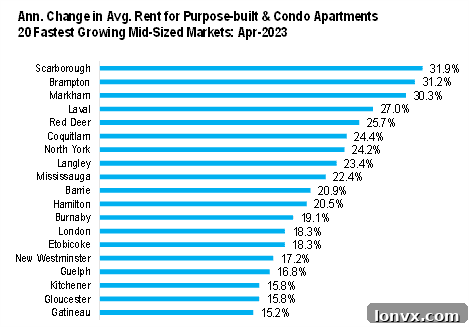
Topping this list were Scarborough, Brampton, and Markham, all integral parts of Ontario’s Greater Toronto Area (GTA). These cities recorded average rent increases exceeding a staggering 30 percent year-over-year. The report directly attributes this accelerated growth to high levels of immigration, as newcomers and existing residents alike seek more accessible housing options that still offer proximity to economic opportunities and urban amenities. The sheer volume of demand, coupled with lagging housing construction, has created extremely competitive conditions in these suburban markets.
The pattern of significant increases is not confined solely to the GTA. Other medium-sized cities across Canada also demonstrated explosive growth. Following closely behind were Laval, Quebec, with a 27 percent increase; Red Deer, Alberta, experiencing a 25.7 percent jump; Coquitlam, British Columbia, with a 24.4 percent rise; North York, Ontario, at 24.2 percent; and Langley, British Columbia, showing a 23.4 percent increase. This geographical diversity underscores that while Ontario is a hotspot, provinces nationwide are grappling with intense pressure on their regional rental markets.
Further examples of medium-sized cities with notable annual average rent increases for condos and apartments in April include Mississauga, Ontario (22.4 percent); Barrie, Ontario (20.9 percent); and Hamilton, Ontario (20.5 percent). The list of communities experiencing double-digit rent growth continues with Burnaby, B.C. (19.1 percent); London, Ont. (18.3 percent); Etobicoke, Ont. (18.3 percent); New Westminster, B.C. (17.2 percent); Guelph, Ont. (16.8 percent); Kitchener, Ont. (15.8 percent); Gloucester, Ont. (15.8 percent); and Gatineau, Que. (15.2 percent). This extensive data illustrates the pervasive nature of the rental crisis affecting a wide spectrum of communities across Canada, not just its largest cities.
Oakville: Canada’s Most Expensive Medium-Sized Rental Market
Among medium-sized markets, Oakville, Ontario, distinguished itself as the most expensive in Canada for condo rentals and apartments, with average monthly rents reaching an astounding $3,413. This figure, often surpassing averages in some larger metropolitan areas, reflects Oakville’s high quality of life, robust local economy, and significant desirability. Following Oakville in terms of high costs were Burnaby, B.C. ($2,894), Coquitlam, B.C. ($2,788), and Richmond, B.C. ($2,723), further highlighting the trend of premium prices in desirable suburban areas, particularly within the Greater Vancouver Area.
Notably, Halifax, Nova Scotia, was the only city outside of Ontario and British Columbia to enter the top 25 most expensive medium-sized markets, with average monthly rents at $1,999. This indicates a growing demand and tightening market in the Atlantic provinces, often driven by inter-provincial migration seeking relative affordability and lifestyle changes compared to Canada’s more expensive regions.
Provincial Rental Landscape: A Deeper Dive into Regional Trends
Analyzing the Canadian rental market at a provincial level reveals distinct patterns and varying degrees of affordability challenges. As expected, Ontario and British Columbia have witnessed the most substantial average monthly rent increases for condos and apartments when compared to their pandemic-era lows in April 2021, underscoring their roles as major economic powerhouses and population magnets.
Ontario and British Columbia: Leading the Post-Pandemic Rental Recovery
Ontario experienced a remarkable 29 percent increase in average rents since April 2021, showcasing a powerful recovery and subsequent acceleration in its housing market. British Columbia closely followed with a 28 percent increase over the same period, firmly establishing its position as one of Canada’s most expensive provinces for renters. This rapid escalation in both provinces is a clear indicator of the intense competition and demand pressures that have reshaped their rental landscapes over the past two years.
Current Provincial Averages and Year-Over-Year Growth
Focusing on the more recent year-over-year changes and current averages, Ontario’s average rent for purpose-built and condominium apartments rose by 16.7 percent in April, reaching $2,421. This significant increase reflects the province’s robust job market, strong economic activity, and continuous population growth, particularly concentrated in the Greater Toronto Area and surrounding communities.
Alberta secured the second position in terms of year-over-year percentage increase, with a robust 14.8 percent rise, bringing its average monthly rent to $1,500. This growth is largely driven by Calgary’s booming market, coupled with an influx of inter-provincial migrants seeking more affordable living costs relative to Canada’s most expensive provinces.
Conversely, British Columbia recorded the lowest average rent increase at 5.6 percent for condo rentals and apartments in April. However, this seemingly modest percentage increase can be misleading, as B.C. still maintains the highest absolute average rent across all provinces, standing at an impressive $2,468. This indicates that while the rate of growth might be decelerating compared to previous surges, the foundational cost of renting in B.C. remains exceptionally high, posing significant barriers to entry for many residents.
Quebec, a significant player in the Canadian rental market, saw an 11 percent increase in its average rent, reaching $1,850 in April. This steady growth points to a tightening market in its major urban centers, notably Montreal, as demand continues to outstrip the available supply of rental housing, leading to a consistent upward pressure on prices.
The Future Outlook for Canada’s Dynamic Rental Market
The current trajectory of the Canadian rental market suggests a complex and persistently challenging future for renters across the nation. While the year-over-year percentage increases are anticipated to stabilize as the market adjusts from the immediate post-pandemic boom, the fundamental drivers of high demand are unlikely to dissipate in the near future. Canada’s ongoing commitment to high immigration targets, combined with chronic housing supply shortages and a high-interest-rate environment that keeps potential buyers out of the ownership market, will likely ensure that upward pressure on rents remains a significant and pervasive factor.
For tenants, this translates into continued competition for available units and the probability of further rent increases, albeit potentially at a more moderate pace than the explosive growth witnessed in recent months. The housing affordability crisis is undeniably deepening, affecting not only major urban centers but increasingly spreading to medium-sized communities. Policymakers and developers face an urgent imperative to address the structural deficiencies contributing to the housing shortage, including streamlining zoning regulations, incentivizing new construction, and exploring innovative housing solutions.
The rental market is an indispensable component of Canada’s overall housing ecosystem, and its current trajectory highlights a growing disparity in access to affordable shelter. As the nation continues to expand, ensuring a diverse, equitable, and accessible range of housing options will be paramount for maintaining economic stability and social cohesion. Without substantial and coordinated interventions to boost supply and temper demand, the aspiration of affordable housing may unfortunately remain an elusive dream for a considerable portion of the Canadian population.
In conclusion, the April National Rent Report paints a clear and compelling picture: Canada’s rental market is robust, increasingly expensive, and profoundly influenced by a powerful interplay of demographic and economic factors. While the pace of increases may eventually moderate, the high baseline costs and persistent demand mean that renters will continue to navigate a challenging and competitive landscape for the foreseeable future. Addressing these challenges will necessitate concerted and innovative efforts from all levels of government and stakeholders to foster a more balanced, affordable, and accessible housing market across Canada.