
British Columbia’s Housing Market: A Comprehensive Forecast for 2024-2025 Points Towards Revival
The British Columbia Real Estate Association (BCREA) has released its highly anticipated 2024 First Quarter Housing Forecast Update, offering a detailed and largely optimistic outlook for the province’s real estate sector. This pivotal report arrives after a period of significant market adjustment, signaling a potential shift from the subdued activity of 2023 towards a more vibrant and balanced environment in the coming years.
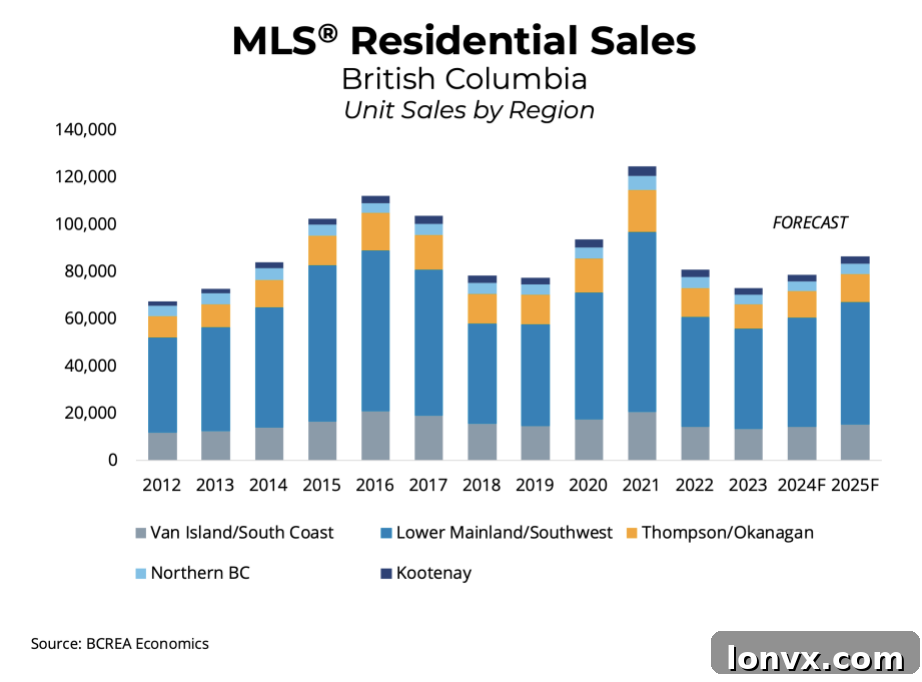
The year 2023 represented a challenging chapter for British Columbia’s housing market, recording its slowest activity since 2013 with only 73,000 home sales. This substantial downturn was primarily driven by persistently elevated mortgage rates, which acted as a considerable deterrent for both prospective buyers and sellers. High borrowing costs constrained purchasing power, leading to widespread hesitation and a notable reduction in transaction volumes across the province. However, the economic landscape is now evolving, and a series of promising developments are expected to breathe new life into the market. A recent and encouraging decline in fixed mortgage rates, combined with the strong anticipation of policy rate cuts by the Bank of Canada, is poised to revitalize housing activity throughout 2024, setting a robust foundation for even stronger performance as we move into 2025.
Specifically, the BCREA’s update projects a significant rebound in market activity. MLS residential sales in British Columbia are forecasted to increase by 7.8 per cent in 2024, reaching an estimated total of 78,775 units. This upward trajectory is expected to gain further momentum in 2025, with projections indicating a rise to 86,475 units. These figures highlight a growing confidence among market participants and suggest a gradual return to healthier, more sustainable transaction levels after a period of contraction. The anticipated growth signals not just a recovery but a potential recalibration of the market, moving towards equilibrium.
A Delicate Equilibrium: Sales, Inventory, and Price Stability in BC Real Estate
Brendon Ogmundson, the Chief Economist for the British Columbia Real Estate Association, offers a nuanced perspective on the forthcoming market conditions. “In 2023, the housing market unquestionably grappled with strong headwinds, predominantly due to the sustained elevation of mortgage rates. This understandably led to a cautious approach from both buyers and sellers, resulting in diminished activity,” Ogmundson explains. “However, the recent moderation in fixed mortgage rates, coupled with the increasing probability of Bank of Canada rate reductions, presents a distinctly optimistic outlook for 2024.”
Ogmundson further elaborates on the critical dynamics expected to define the market in the near future: “As we progress through 2024, our analysis points to a delicate but crucial balance emerging between rising sales volumes and a normalizing trend in housing inventories. This anticipated equilibrium is paramount, as it should foster a relatively quiet year for prices, preventing the rapid and unsustainable escalations witnessed during past periods of intense demand, while simultaneously supporting a healthy level of market transactions.” This insight suggests a market that is finding its footing, moving towards sustainable growth rather than speculative cycles, which benefits the overall economic stability of the province.
The Direct Impact of Declining Mortgage Rates on Affordability
The observed decrease in fixed mortgage rates, with some now falling below 5.5 per cent, is a pivotal development that directly enhances affordability for a broader spectrum of potential homebuyers. When the cost of borrowing diminishes, it has a twofold effect: it allows buyers to qualify for larger loan amounts, expanding their options in a competitive market, and it simultaneously reduces their monthly mortgage payments, making homeownership more financially manageable. This improvement in purchasing power is instrumental in stimulating renewed demand, encouraging individuals and families who may have paused their home-buying plans in 2023 due to prohibitive financing costs to re-enter the market. Beyond the tangible financial benefits, the psychological impact of seeing rates decline also plays a significant role, fostering a sense of opportunity and prompting hesitant buyers to act before rates potentially adjust upwards again.
The Bank of Canada’s Pivotal Role in the BC Housing Market Revival
Central to the BCREA’s optimistic forecast is the anticipated shift in the Bank of Canada’s (BoC) monetary policy. The update clearly indicates a strong expectation that the central bank will embark on a series of policy rate reductions, projecting a decrease to 4 per cent by the close of the year. This forward-looking stance is grounded in the considerable progress made in bringing inflation back within the BoC’s target range of 2 per cent, alongside growing evidence of softer economic growth and a cooling labor market. Collectively, these macroeconomic indicators suggest that the period of stringent monetary policy, implemented to curb inflationary pressures, is drawing to a close, paving the way for more accommodative measures.
How Bank of Canada Rate Cuts Directly Influence Home Sales
The Bank of Canada’s policy rate serves as the benchmark for commercial banks’ lending rates, including those for mortgages. Consequently, a reduction in this key rate typically translates into a corresponding decrease in both fixed and variable mortgage rates offered to consumers. This adjustment significantly lowers the cost of borrowing for homebuyers, thereby making homeownership more accessible and attractive across the province. This direct link is crucial for stimulating increased home sales in British Columbia. The BCREA’s confidence in these impending policy adjustments has already precipitated a noticeable drop in some fixed mortgage rates, with rates falling below the 5.5 per cent threshold. This early movement has already begun to improve affordability and reignite buyer interest, setting the stage for a more robust transaction environment in BC’s real estate sector. The BoC’s strategic pivot is thus an essential catalyst for unlocking previously dormant demand and facilitating a smoother, more active market.
Navigating Demand and Supply: The Path to Sustainable Price Stability
While the prospect of increasing home sales is a positive indicator for market vitality, it also introduces a critical consideration regarding inventory levels. The BCREA forecast prudently addresses the potential for rapid price appreciation—a scenario that could materialize if a sudden surge in buyer demand significantly outpaces the available supply of homes. Such an imbalance could quickly undermine the hard-won improvements in affordability achieved through lower mortgage rates, potentially leading to another period of intense market competition and pricing pressures.
However, the forecast also identifies a crucial mitigating factor: the anticipated influx of new listings into the market. This expected increase in supply could be driven by a confluence of factors:
- Renewed Seller Confidence: As the market exhibits signs of strengthening and price stability, many homeowners who previously hesitated to list their properties during a slower or uncertain market may now feel more confident in selling.
- Evolving Financial Circumstances: Despite overall rate declines, some homeowners may still face higher variable mortgage payments or the prospect of renewing their mortgages at rates that, while lower than peak, are still elevated compared to historical lows. This could prompt some to sell their current homes.
- New Construction Activity: Ongoing and newly completed residential developments across British Columbia will consistently contribute to the overall housing stock, particularly in rapidly growing urban and suburban areas.
This projected increase in available listings is absolutely vital for fostering a more balanced market. A healthy and responsive supply of homes ensures that rising demand can be met without triggering excessive competition among buyers, which in turn helps to maintain stable pricing conditions. Achieving this equilibrium is key to preventing the market from overheating and supports sustainable growth that benefits both buyers and sellers, leading to a more predictable and fair real estate landscape.
Beyond the Average: Exploring Regional Nuances Across British Columbia’s Housing Market
It is imperative to acknowledge that the British Columbia housing market is far from uniform; it is a complex tapestry woven from diverse regional economies, unique demographic trends, and varied housing inventories. While the provincial forecast offers invaluable overarching guidance, local markets—such as the bustling Greater Vancouver area, the sprawling Fraser Valley, the scenic Vancouver Island, the vibrant Okanagan region, and the distinct northern communities—often exhibit their own specific trends and responses to broader economic shifts.
For instance, major urban hubs like Vancouver and Victoria, characterized by high population density, robust employment opportunities, and limited developable land, typically experience higher demand and elevated property values. These areas are likely to show a more immediate and pronounced reaction to changes in interest rates, with affordability often remaining a significant challenge despite any rate cuts. In contrast, smaller communities might observe more gradual market shifts, which could be influenced by factors such as the rise of remote work, specific local industry growth, or the impact of major infrastructure projects. Understanding and accounting for these regional variations is critical for all market participants. Localized market conditions can significantly influence property values, the intensity of buyer competition, and the overall potential for real estate investment or homeownership across British Columbia’s diverse geographical landscape.
Looking Ahead: Sustaining Growth and Addressing Future Challenges in BC Housing
The 2024-2025 forecast from the BCREA paints a compelling picture of cautious optimism, suggesting a significant move towards a more sustainable and balanced housing market in British Columbia. The anticipated decline in mortgage rates and the strategic shift in the Bank of Canada’s monetary policy are expected to serve as the primary catalysts for this revitalization. However, the long-term health and stability of the market will depend on a confluence of other critical factors:
- Population Growth Dynamics: British Columbia continues to be an highly attractive destination for both inter-provincial and international migrants. Sustained and robust population growth will inevitably exert persistent upward pressure on housing demand, requiring a thoughtful response from the supply side.
- Governmental Policy & Regulation: Provincial and federal government policies regarding housing supply, taxation, and affordability initiatives will play an increasingly crucial role in shaping market dynamics. Measures aimed at accelerating new construction, streamlining permitting processes, or introducing targeted incentives could significantly impact future inventory levels and overall accessibility.
- Global Economic Resilience: While Canada’s economy is demonstrating notable resilience, global economic uncertainties—including geopolitical events, trade fluctuations, and international financial market shifts—can still ripple through the local market, potentially affecting investor confidence, job growth, and consumer spending.
- Persistent Supply-Side Solutions: Addressing the fundamental and long-standing shortage of housing units, particularly in high-demand urban and suburban areas, remains the most significant long-term challenge. This requires ongoing, concerted commitment and collaboration from all levels of government, the development industry, and community stakeholders to implement innovative housing solutions.
By carefully monitoring and proactively responding to these interconnected factors, all stakeholders—from policymakers and developers to buyers and sellers—can better anticipate market shifts and actively contribute to the development of a resilient, accessible, and equitable housing market for all British Columbians in the years to come.
Conclusion: A Path Towards Market Stability and Renewed Opportunity
The latest BCREA forecast presents a compelling narrative of recovery and rebalancing for the British Columbia housing market. After the significant challenges experienced in 2023, the convergence of declining mortgage rates and an anticipated, more accommodative stance from the Bank of Canada is poised to reinvigorate sales activity across the province. While a period of price stability is largely expected, driven by a projected normalization of housing inventory levels, the market’s trajectory will nonetheless require careful and ongoing observation. This current period represents a crucial transition towards a more predictable and sustainable real estate environment, offering renewed opportunities and clearer pathways for both buyers and sellers across the diverse regions of British Columbia.
For a detailed analysis and the complete set of data informing these projections, please read the full BCREA 2024 First Quarter Housing Forecast Update by clicking here.
Enjoying this article?
Get the latest real estate articles and insights in your inbox 3x a week so you stay up to date on the latest in the Canadian real estate industry.