
For real estate professionals across British Columbia, staying abreast of property assessments is not merely a suggestion—it’s an essential aspect of their practice. Clients, whether first-time homebuyers or seasoned investors, frequently inquire about assessed values, using them as a benchmark for understanding market worth, regardless of how precisely these figures reflect the dynamic shifts in real estate prices.
BC Assessment, a crucial crown corporation, meticulously updates and releases property assessments annually. These valuations are anchored in real estate market trends observed as of July 1st of the preceding year. This year, homeowners throughout the province have witnessed a notable upward trend in the assessed values of their properties, a development that carries significant implications for the broader real estate landscape.
The latest data from BC Assessment reveals a substantial increase in overall assessed values for the pivotal Lower Mainland region. The collective valuation surged from approximately $1.75 trillion in 2022 to an impressive $1.94 trillion in the current year. This nearly 11% growth underscores a robust and appreciating market, signaling a period of significant value creation for property owners in one of Canada’s most coveted real estate markets.
Understanding these assessed values is paramount for realtors for a multitude of compelling reasons that directly influence their operational effectiveness and client satisfaction.
Firstly, assessed values directly impact the amount of property taxes a homeowner is liable to pay. This is a critical piece of information for real estate professionals, enabling them to accurately factor in ongoing ownership costs when advising clients on property purchases or when formulating competitive pricing and marketing strategies for a listing. A clear grasp of these tax implications allows realtors to provide comprehensive financial insights, building trust and demonstrating expertise.
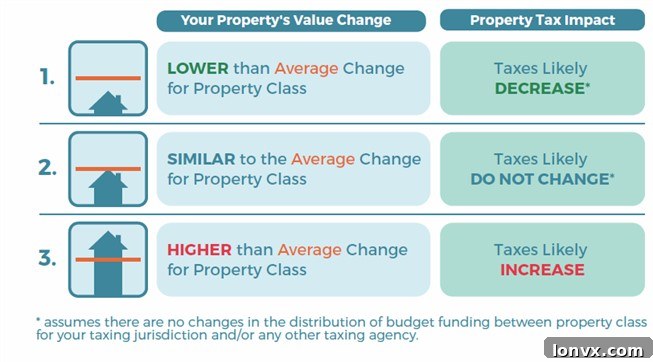
Source: BC Assessment
Secondly, assessed values frequently serve as a foundational starting point for negotiations on a property’s sale price. While not a direct market valuation, they offer a government-backed estimate that buyers and sellers often reference. For realtors, comprehending the perceived value derived from these assessments is invaluable. It equips them with the data necessary to strategically price a property and market it effectively, setting realistic expectations and facilitating smoother transactions.
Moreover, a property’s assessed value can profoundly affect its attractiveness to prospective buyers. A higher-than-expected assessment, or an assessment that aligns well with the asking price, can bolster buyer confidence. Conversely, a significant discrepancy might raise questions. Therefore, real estate agents must be acutely aware of assessed values to accurately gauge and understand the prevailing demand for a particular property, allowing them to tailor their marketing efforts and manage client expectations proactively.
Beyond individual property transactions, diligently tracking assessment numbers across different areas provides Vancouver realtors—and indeed, all BC realtors—with an invaluable sense of the overall health and future trajectory of the local real estate market. These trends can illuminate hot markets, identify areas of stagnation, and offer predictive insights into how market dynamics may evolve over time, empowering realtors to offer strategic advice and identify emerging opportunities.
Understanding BC Property Assessment Trends and Their Impact
The annual property assessment notices, typically mailed out on January 3rd, are eagerly anticipated by homeowners and real estate professionals alike. This year’s notices brought news of generally robust growth, with many property owners observing an increase of between five and 15 percent in their home values. However, it is crucial to recognize that this growth was not uniform; certain regions experienced significantly greater gains than others, highlighting the diverse nature of British Columbia’s property market.
Notably, the communities of White Rock and Abbotsford emerged as frontrunners in condo property price appreciation, reporting a remarkable and staggering 21 percent increase. This substantial jump reflects strong demand and perhaps a greater degree of affordability or development potential in these areas compared to the more established, densely populated urban centres.
In contrast, the City of Vancouver, while still experiencing growth, saw a more modest increase of six percent. While this figure might appear less dramatic when compared to the 21 percent surges in other regions, it is still a positive return, especially when viewed against the backdrop of volatility in other investment avenues such as stocks and cryptocurrency in recent times. A six percent increase in a high-value market like Vancouver still represents significant capital appreciation.
Regions Leading the Way in Condo Price Appreciation
As previously highlighted, the top-performing areas for condo appreciation were unequivocally White Rock and Abbotsford, both registering an impressive 21 percent increase in assessed values. To fully appreciate the significance of such a gain, consider a hypothetical scenario: if an individual purchased a condo in White Rock in 2021 for $800,000, a 21 percent increase translates to a substantial on-paper capital gain of $168,000. This brings the assessed value of that property to $968,000, a testament to the rapid appreciation experienced in these markets.
Other areas that demonstrated strong performance included Surrey and Maple Ridge. These regions, like White Rock and Abbotsford, often present more affordable entry points into the market compared to central Vancouver. This relative affordability likely contributes to their higher rates of appreciation as buyers seek value and greater space outside the immediate urban core.
A key factor contributing to the differential growth rates is the availability of land for development. Places like Maple Ridge and Abbotsford generally possess more undeveloped land, allowing for new construction and community expansion, which can fuel growth and attract new residents. This contrasts sharply with the City of Vancouver, where developable land is scarce, leading to slower, albeit still positive, appreciation rates.
However, it is also important for realtors and homeowners to consider the long-term implications of such rapid price increases. When prices surge at rates exceeding 20 percent annually, as seen in parts of the Fraser Valley, affordability can quickly become a pressing concern. This rapid escalation, while beneficial in the short term for existing owners, can inevitably lead to a cooling or slowdown in the rate of property price increases as market saturation is reached and fewer buyers can afford the inflated prices.
Empowering Realtors: Leveraging Assessed Values for Strategic Advantage
For real estate professionals, a comprehensive understanding of assessed property values in their target areas is more than just data; it’s a powerful tool that offers deep insights into the overall health and future direction of the local real estate market. These values represent the government’s best estimate of a property’s market value as of a specific date (July 1st), making them an invaluable barometer for market conditions.
By diligently tracking changes in assessed values over time, realtors can identify critical market trends and shifts. For instance, a consistent upward trajectory in assessed values within a particular area is a strong indicator of a robust and expanding market, signaling high demand and potential for further growth. This insight can help realtors advise clients on investment opportunities or when to enter or exit a market. Conversely, stagnant or declining assessed values could signal weakening demand, an oversupply of properties, or broader economic challenges, prompting a more cautious approach to pricing and marketing.
Beyond identifying trends, assessed values serve as an essential benchmark for evaluating a property’s asking price. If a listing’s asking price is significantly higher than its assessed value, it might raise questions for potential buyers and lenders, potentially making the property less appealing or justifying more aggressive negotiation tactics. On the other hand, an asking price that is in line with or slightly below the assessed value can enhance a property’s attractiveness, signaling a fair valuation and potentially encouraging quicker offers. Realtors can use this comparison to guide sellers in setting competitive prices and to help buyers understand the underlying value proposition.
Moreover, understanding the nuances of assessed values enables realtors to proactively address client inquiries. Homeowners often become concerned when they receive their assessment notice, especially if it indicates a large increase or decrease. Realtors can provide clarity by explaining how assessments are determined, how they differ from actual market value (which is influenced by many factors including current demand, interest rates, and specific property features), and how they relate to property taxes. This level of informed guidance positions realtors as trusted advisors, enhancing their professional credibility and fostering stronger client relationships.
In conclusion, by integrating a deep understanding of assessed values and their relationship to the broader local real estate market into their practice, real estate professionals can make more informed, data-driven decisions. This empowers them to optimize pricing strategies, develop more targeted marketing campaigns, provide superior client education, and ultimately, navigate the complexities of British Columbia’s dynamic real estate landscape with greater confidence and success.