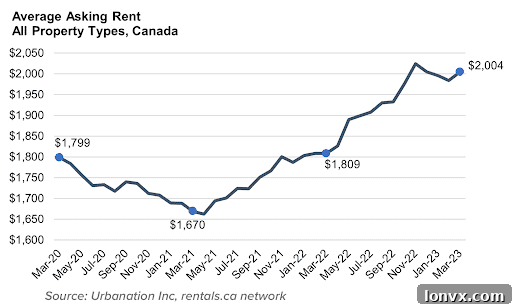
The Canadian rental market is currently experiencing unprecedented growth, with average asking rents surging across the nation. According to the latest National Rent Report, a collaborative effort by Rentals.ca and Urbanation, March 2023 saw the average asking rent for all property types in Canada climb to an impressive $2,004. This figure represents a substantial 10.8 percent increase year-over-year, underscoring a dynamic and increasingly competitive housing landscape.
This upward trend is not just an annual phenomenon; the average monthly rent also rose by 1.0 percent from February, marking the first month-over-month increase since November 2021. This persistent rise in rental costs highlights a fundamental imbalance in the Canadian housing market: demand for rental accommodation continues to significantly outstrip the available supply. Over the past year alone, average asking rents have escalated by $196, further emphasizing the widening gap between the number of prospective tenants and the number of available rental units.
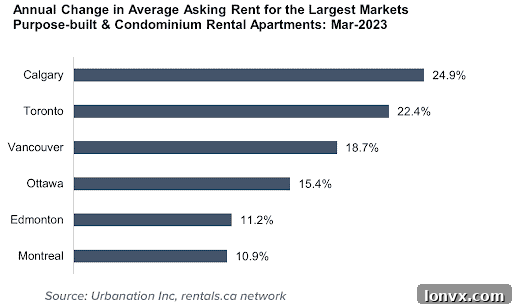
Leading this surge are some of Canada’s most vibrant urban centers. Vancouver, consistently at the forefront of the nation’s most expensive rental markets, once again claimed the top spot among 35 major cities for both one-bedroom and two-bedroom homes in March. Following closely were Toronto, Calgary, and Ottawa, each reporting significant annual rent hikes for condominium rentals and apartments. Toronto experienced a 22.2 percent increase, Calgary saw a remarkable 24.9 percent rise, and Ottawa’s rental market grew by 15.4 percent annually. Beyond the major metropolitan hubs, provinces like Nova Scotia also felt the heat, with average rents for condo rentals and apartments soaring by 20.8 percent annually to $2,167, marking the fastest provincial growth recorded in March.
These figures paint a clear picture of a rental market under immense pressure, driven by a confluence of factors including robust population growth, constrained housing supply, and escalating homeownership costs. For millions of Canadians, finding affordable and suitable housing is becoming an increasingly formidable challenge, reshaping urban demographics and economic planning across the country. Understanding these trends is crucial for tenants, landlords, and policymakers alike as they navigate the complexities of this evolving market.
Vancouver Continues to Lead as Canada’s Most Expensive Rental Market
Vancouver’s status as Canada’s most expensive city for renters remains unchallenged, with its rental prices setting national benchmarks. In March, the average monthly rent for a one-bedroom home in the city stood at a staggering $2,743, while a two-bedroom residence commanded an average of $3,653. These figures represent significant year-over-year increases, with one-bedroom rents climbing by 17.3 percent and two-bedroom rents rising by 21.5 percent. The month-over-month data also underscored Vancouver’s consistent upward trajectory, showing a 3.9 percent increase for one-bedroom homes and a 0.6 percent rise for two-bedroom units. This continuous escalation solidifies Vancouver’s position as a market where rental affordability is a critical concern for residents, influencing everything from daily commutes to lifestyle choices. The city’s unique geographical constraints, combined with persistent demand from both local and international residents, contribute to an exceptionally tight rental supply and consequently, some of the highest housing costs globally. Prospective renters often face intense competition, requiring swift decision-making and preparedness for premium pricing.
Toronto’s Rental Market Sees Substantial Increases Amid High Demand
Not far behind Vancouver, Toronto asserted its position as the second most expensive rental market in Canada. In March, the average monthly rent for a one-bedroom home in Toronto reached $2,506, while a two-bedroom home averaged $3,286. These figures reflect considerable annual growth, with one-bedroom rents seeing a 22.2 percent increase year-over-year and two-bedroom rents rising by 19.7 percent. As Canada’s largest city and a major economic hub, Toronto attracts a vast influx of students, professionals, and new immigrants, all vying for limited rental housing. This relentless demand, coupled with a construction pace that struggles to keep up, creates an environment where rental prices are consistently pushed upwards. The sheer scale of the city’s population growth, particularly in recent years, has amplified the strain on its housing infrastructure. Tenants in Toronto often find themselves navigating a highly competitive landscape, where bidding wars and rapid decision-making are not uncommon, making the search for suitable and affordable housing a significant challenge for many.
Calgary and Ottawa Experience Rapid Rental Cost Growth
Calgary and Ottawa are emerging as hotspots for rental price appreciation, reflecting broader shifts in Canada’s urban migration patterns and economic landscapes. For the second consecutive month, Calgary led Canada’s largest cities in terms of rent increases for condominium rentals and apartments. Rents in Calgary soared by an impressive 24.9 percent year-over-year to an average of $1,890. This significant jump can be attributed to several factors, including a robust job market, an influx of inter-provincial migrants seeking more affordable living compared to Vancouver or Toronto, and a perception of greater value for money. The city’s energy sector and diversifying economy continue to attract talent, further fueling demand for rental housing.
Similarly, Ottawa’s rental market experienced substantial growth, with average rents for condo rentals and apartments increasing by 15.4 percent annually in March. As the nation’s capital, Ottawa benefits from stable government employment and a burgeoning tech sector. Its appeal as a family-friendly city with a relatively high quality of life continues to draw residents, placing upward pressure on housing costs. While still more affordable than Vancouver or Toronto, the rapid growth in both Calgary and Ottawa indicates a tightening rental market where tenants are beginning to feel the squeeze. These cities represent key indicators of the nationwide rental trend, demonstrating that rising rents are not confined solely to the traditionally expensive coastal cities but are spreading to other major urban centers as well.
Ontario’s Medium-Sized Cities Witness Unprecedented Rent Hikes
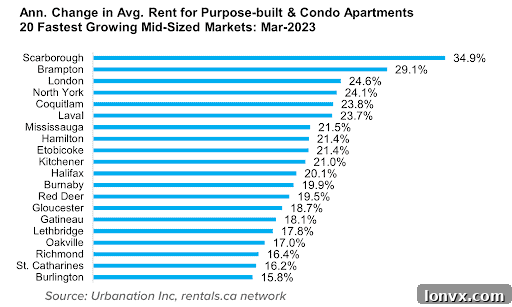
Beyond its major metropolises, Ontario’s medium-sized cities are experiencing some of the most dramatic year-over-year rent increases for condominium rentals and apartments. This trend underscores the ripple effect of high housing costs in Toronto, pushing residents outwards in search of relative affordability. In March, Scarborough and Brampton led this surge, both cities significantly impacted by high levels of immigration and spillover demand from the Greater Toronto Area (GTA). Average rents in Scarborough skyrocketed by 34.9 percent, while Brampton saw a substantial 29.1 percent increase.
London, a university city and growing economic hub, finished third with rents up 24.6 percent, followed closely by North York at 24.1 percent. This pattern suggests that as affordability becomes a major concern in core urban areas, surrounding and mid-sized cities become increasingly attractive, leading to intensified competition and rapidly escalating prices. Other cities and areas reporting some of the fastest-growing annual rent increases in March for condo rentals and apartments included Mississauga, Hamilton, Etobicoke, Kitchener, Gloucester, Oakville, St. Catharines, and Burlington. These communities, many within commuting distance of Toronto, offer varying degrees of affordability and lifestyle, yet all are feeling the effects of the province’s overall housing supply crunch and robust population growth. The continued growth in these markets reflects a critical challenge for urban planners and residents as they contend with the swift transformation of once-more-affordable alternatives into increasingly expensive locales.
Diverse Rental Dynamics in Ontario and B.C.’s Medium-Sized Markets
The rental market complexities extend further into specific medium-sized urban centres across Ontario and British Columbia, where varying factors contribute to elevated housing costs. Within the Greater Toronto Area (GTA), affluent suburbs and established communities command the highest average rents among medium-sized markets. Oakville leads this list, renowned for its quality of life and desirable neighbourhoods. It is followed by Etobicoke, Mississauga, Scarborough, Brampton, Burlington, Markham, Richmond Hill, North York, Vaughan, and Pickering. These areas, while offering alternatives to downtown Toronto, still fall under the immense demand pressures of the wider metropolitan region, maintaining high rental costs.
Venturing outside the immediate GTA but remaining within Ontario, other prominent cities also report significant average rents. Kanata, a tech hub near Ottawa, demonstrates the impact of a strong local economy on housing. Barrie, Cambridge, Guelph, and Kitchener — all vibrant cities with growing populations, educational institutions, and emerging industries — also feature high on the list of average rental costs, reflecting their attractiveness to both students and professionals alike. These markets highlight the widespread nature of Ontario’s rental challenges, demonstrating that the trend of rising prices is not confined to the largest urban cores.
On the West Coast, British Columbia’s medium-sized rental markets similarly show elevated average rents. Burnaby and Coquitlam, both situated close to Vancouver, experience strong demand due to their proximity to employment centers and transit lines, often serving as more “affordable” alternatives to Vancouver proper, despite still being very expensive. Richmond, New Westminster, Kelowna, Surrey, Langley, and Victoria complete this list. Kelowna, for instance, is a highly desirable destination with a strong tourism industry and natural beauty, driving up its housing costs. Surrey and Langley benefit from being part of the broader Metro Vancouver region, accommodating population growth and offering diverse housing options, albeit at rising prices. Victoria, the provincial capital on Vancouver Island, combines governmental and tourism sectors with a high quality of life, leading to a consistently competitive rental market. These specific regional breakdowns emphasize that while the national average provides a broad stroke, local economic and demographic factors play a crucial role in shaping individual market dynamics.
Anticipating Continued Upward Pressure on Rents in the Coming Months
The current state of Canada’s rental market, characterized by rapid price increases and intense competition, is a direct consequence of powerful economic and demographic forces at play. Shaun Hildebrand, president of Urbanation, succinctly captured this reality, noting, “Spring arrived with a highly competitive rental market in Canada, driven by a record population increase of over one million people in the past year and low homeownership affordability after last year’s spike in interest rates.” This statement underscores two primary drivers: unprecedented population growth, largely fueled by immigration, and the financial barriers preventing many from entering the homeownership market due to rising interest rates and high property values.
The implications of this scenario are clear and concerning. As Hildebrand further articulated, “with supply unable to keep up with current levels of demand, expect further upward pressure on rents in the coming months.” This forecast suggests that the current challenges faced by renters are likely to persist, if not intensify. The fundamental issue remains a severe imbalance between the number of people seeking rental homes and the insufficient pace of new rental unit construction. Regulatory hurdles, labor shortages, and rising material costs continue to impede developers, making it difficult to bridge this supply gap effectively.
For individuals and families across Canada, this means that finding an affordable place to live will continue to be a significant struggle. Policymakers face increasing pressure to address this crisis through various strategies, including incentivizing new construction, streamlining permitting processes, exploring purpose-built rental developments, and potentially introducing measures to support renters. Without concerted efforts to boost housing supply and address affordability challenges, the upward trajectory of rents is set to continue, profoundly impacting the economic well-being and quality of life for millions of Canadians.
For a comprehensive analysis and detailed breakdowns, including provincial overviews and municipal rental rates, the latest Rent Report can be found here.