
Don’t miss a critical market update! Join us online for REM’s essential monthly market breakdown on January 27th at 2 PM ET. Esteemed columnist Daniel Foch will provide an in-depth analysis of the Canadian Real Estate Association’s (CREA) most recent statistics, dissecting crucial regional variations and interpreting what the evolving market sentiment truly signifies for Realtors and industry professionals. This session offers invaluable insights to navigate the complexities of the current housing landscape. Secure your spot now and gain a competitive edge for the year ahead – register here.
Navigating Canada’s Housing Market: A Deep Dive into 2025 Trends and 2026 Outlook
The Canadian housing market often presents a deceptive calm as the calendar year draws to a close. December, with its holiday season and parliamentary adjournment, typically ushers in a noticeable slowdown in market activity. This lull frequently shifts the focus of analysis towards year-end wrap-ups and future projections rather than immediate, urgent shifts. However, for those intimately familiar with real estate dynamics, this apparent deceleration is more often seasonal than indicative of any profound, lasting change. Many critical decisions, whether from buyers or sellers, are simply postponed and pushed into the new year, creating an illusion of stability.
As the pace of transactions eases, daily headlines become less alarming, and the raw data might begin to suggest a balanced market. This can lead to a common pitfall: mistaking a temporary pause in activity for genuine market improvement or a significant turnaround. The quiet can be misinterpreted as recovery, when in reality, it often masks underlying tensions.
Experienced observers, particularly those who have weathered multiple market cycles, understand this pattern intimately. In the later stages of a market cycle, the shifts tend to be subtle, gradual, and often less dramatic than initial surges or crashes. Prices may cease their sharp movements but show little sign of robust recovery. Sales activity slows down without a catastrophic collapse, reflecting a cautious adjustment rather than a renewed surge of confidence. What might seem like a period of calm often truly reflects a collective sense of fatigue among participants and a heightened degree of caution, rather than an emerging wave of renewed market strength or conviction. This nuance is crucial for accurate interpretation.
Such was the backdrop as Canada’s housing market concluded 2025. Sales volume softened gently but did not experience a dramatic breakdown. Property prices drifted downwards in certain segments rather than undergoing a sharp, decisive reset across the board. Inventory levels, while fluctuating, settled near figures that, in prior, more stable periods, might have suggested equilibrium. The overall picture presented was not one of immediate alarm, yet it was far from comforting, hinting at unresolved pressures beneath the surface.
Canada has found itself in this particular market phase before. This period typically emerges when the housing market has adjusted just enough to maintain its momentum, avoiding an outright crash, but crucially, not enough to fully resolve the deep-seated, underlying pressures that continue to influence supply, demand, and affordability. The primary risk in such a phase is not that the data appears overtly negative; rather, it’s the danger that familiar market signals, which would typically denote stability, are accepted at face value without the rigorous, closer scrutiny they unequivocally deserve.
December’s Market Activity: Softness Without Clear Direction
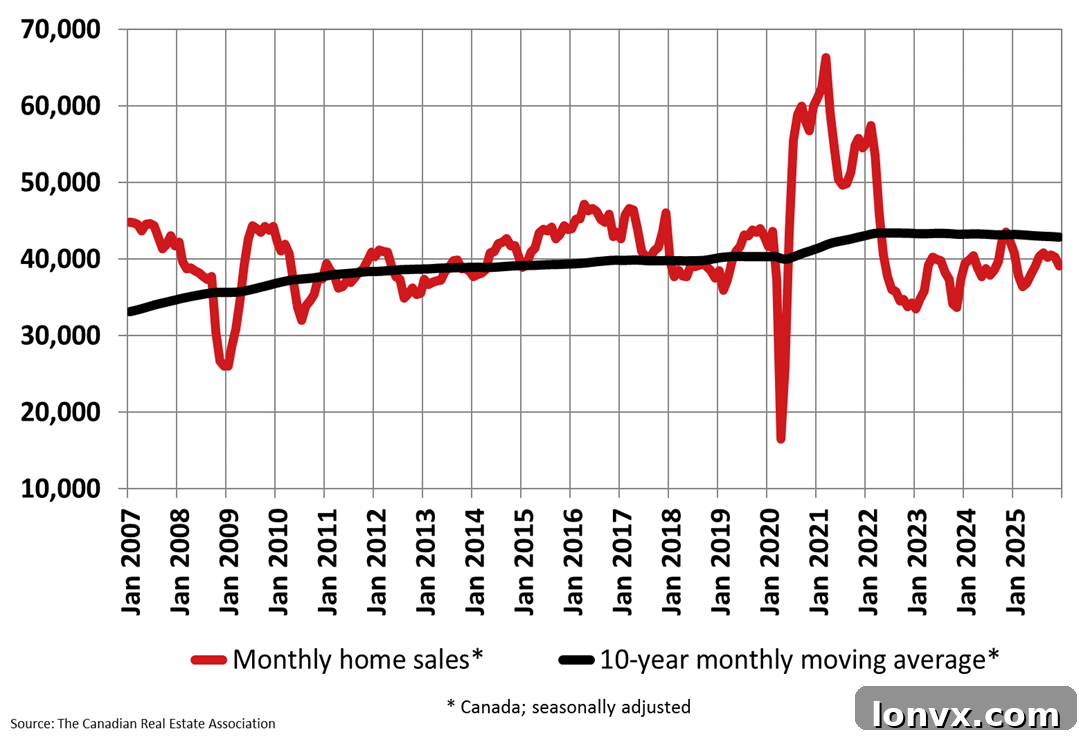
According to the Canadian Real Estate Association (CREA), national home sales experienced a modest decline of 2.7 percent month-over-month in December 2025. When viewed on an annual basis, actual sales activity for December came in 4.5 percent below the levels recorded in December 2024. For the entirety of 2025, the total number of transactions reached 470,314 units, marking a 1.9 percent decrease compared to the previous year. These figures paint a picture of a market that cooled but did not plunge dramatically.
While these statistics, when isolated, might tempt observers towards over-interpretation, it’s essential to place them within their broader context. CREA’s accompanying analysis highlighted that December’s pullback was not attributable to a single, overarching national catalyst. Instead, it reflected coincident slowdowns observed across several major Canadian markets, notably including Vancouver, Calgary, Edmonton, and Montreal. This distinction is vital for accurate forecasting: when market weakness is diffuse and uncoordinated across various regions, it tends to be less predictive of an imminent, sharp national downturn compared to a decline driven by a singular, powerful economic shock.
Examining the full year of 2025 reveals a recognizable and somewhat cyclical pattern for the housing market. The year began with activity stalling, largely influenced by tariff-related uncertainty and broader economic anxieties. The mid-year period brought a modest but welcome revival as some of these initial constraints eased and conditions appeared to stabilize. However, this momentum gradually faded once again as the market approached year-end, mirroring the seasonal slowdowns observed annually. What became evident throughout 2025 was a market continuously negotiating with various economic and financial constraints, adapting incrementally rather than undergoing radical shifts.
Market Balance Returns, But Conditions Remain Precariously Fragile
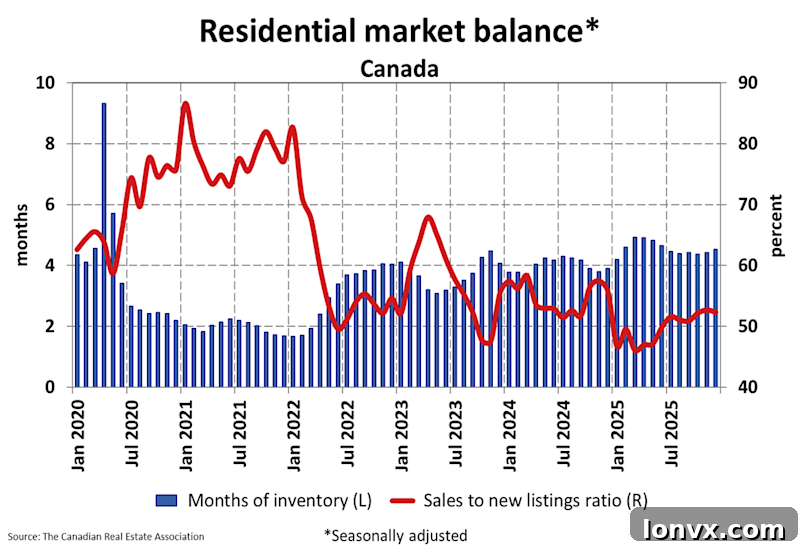
By December 2025, national balance metrics within the housing market had largely reverted to what might conventionally be considered normal. The critical sales-to-new listings ratio eased to 52.3 percent, a figure remarkably close to its long-term historical average. Similarly, the months of inventory, a measure indicating how long it would take to sell all available homes at the current sales pace, edged up to 4.5 months. While this is still slightly below the historical norm of 5.0 months, it signifies a move towards equilibrium.
Based on these conventional definitions, the Canadian housing market appeared to be in a balanced state. However, for real estate practitioners and homeowners, it is crucial to remember the inherent limitations of what “balance” truly captures and what it deliberately omits. These measures primarily describe the present-day flow dynamics between active buyers and available sellers. They do not, by themselves, convey information about the market’s underlying resilience, the conviction of its participants, or the financial capacity of households under sustained economic stress. A numerically balanced market can still be fundamentally fragile.
Active listings, though 7.4 percent higher than a year earlier, remained nearly 10 percent below long-term seasonal averages. This indicates that while more homes were available compared to the previous year, the overall supply environment remained tighter than historical norms suggest. Inventory levels, after a brief mid-year increase, trended lower post-May 2025, primarily driven by a rebound in buyer demand during that period. Should spring activity in 2026 materialize with the expected seasonal surge, supply conditions could rapidly tighten once more, even as the fundamental challenge of affordability for many prospective homeowners remains severely stretched.
In essence, a superficial “balance” has indeed returned to the market, largely achieved through arithmetic adjustments in supply and demand ratios. Yet, this numerical equilibrium does not automatically equate to a return of genuine stability, particularly given the persistent underlying economic and financial vulnerabilities within the Canadian household sector.
Price Softening: Concentrated in High-Risk Segments
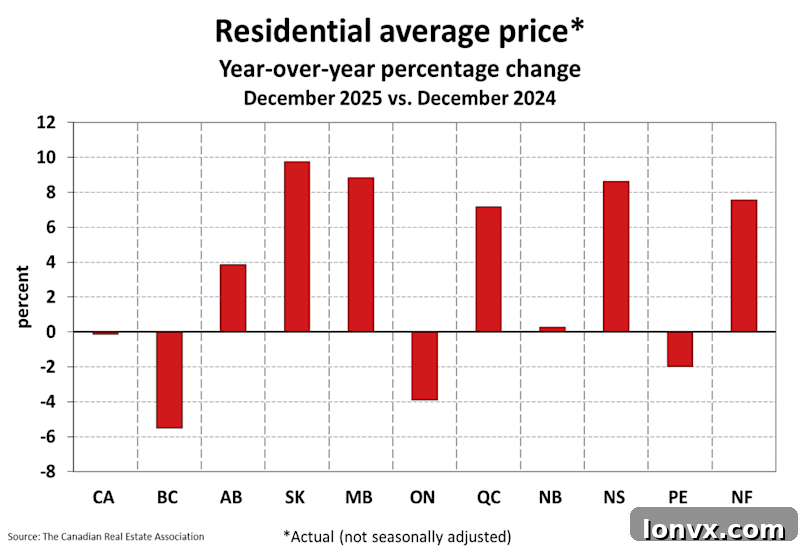
On a national average basis, property prices remained effectively unchanged in December 2025, registering a marginal decline of just 0.1 percent from the previous year. However, a more granular and revealing perspective is offered by the MLS Home Price Index (HPI), which accounts for differences in housing type and features over time. The benchmark prices, as captured by the HPI, declined by 0.3 percent month-over-month and were down 4 percent year-over-year, illustrating a more pronounced cooling than the simple average price might suggest.
This softness in pricing is far from uniformly distributed across the country. A disproportionate share of the national price declines was concentrated in specific, high-risk regions: British Columbia and Ontario’s Greater Golden Horseshoe. Furthermore, within these markets, distinct property types bore the brunt of the adjustments. Condo apartments and townhomes recorded significantly larger year-over-year drops in value compared to detached homes, highlighting a segmentation in market performance.
This particular pattern of price softening is not accidental; it is directly correlated with specific market vulnerabilities. These segments – particularly condo apartments and townhomes in highly unaffordable regions – sit at the critical intersection of several intensifying pressures: severely stretched affordability for first-time buyers, significant exposure to investor activity, and a heightened sensitivity to mortgage refinancing costs and interest rate changes. The available data compellingly suggests that the current cycle’s price discovery process is unfolding gradually, manifesting through selective and temporal adjustments within these vulnerable segments, rather than through widespread, sudden, or forced selling events across the entire market. This measured adjustment provides a degree of stability, but the underlying pressures remain.
Mortgage Behavior Underpins Market Fragility
To truly grasp why the housing market maintains a pervasive sense of fragility, even amidst numerically balanced conditions, it becomes essential to look beyond the immediate metrics of sales and prices. The Bank of Canada’s financial stability indicators offer critical insights into how Canadian households navigated the complex economic realities and rising interest rates of the past year. These indicators reveal a market adapting through financial maneuvering, which carries its own set of risks.
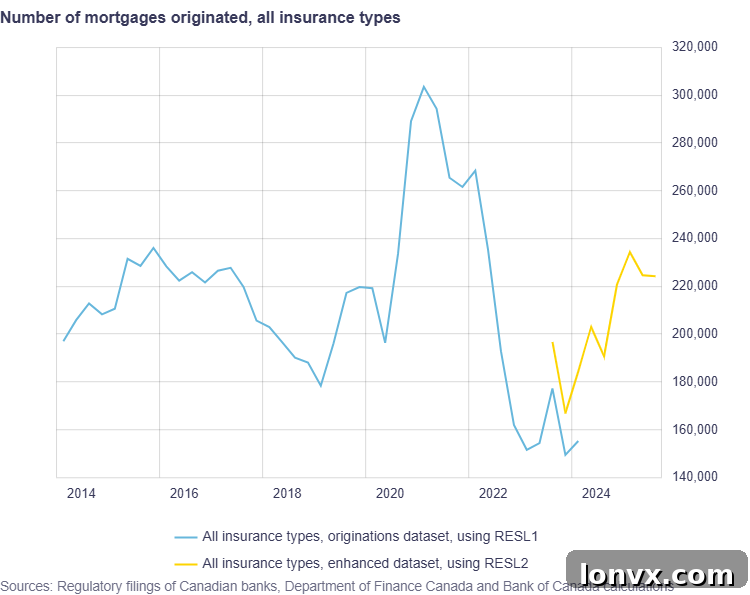
Mortgage originations experienced another rise in 2025, a trend primarily propelled by the necessity of renewals rather than a surge in new demand from first-time buyers or those looking to upgrade. To manage the escalating monthly payments associated with higher interest rates, a growing number of borrowers resorted to stretching their amortization periods, effectively extending the repayment timeline and reducing immediate financial strain. Furthermore, there was an increasing preference for shorter fixed-rate mortgage terms. This strategic choice often reflects an expectation among borrowers that refinancing conditions, particularly interest rates, are likely to improve in the coming years, offering a pathway to lower payments in the medium term.
Concurrently, as policy rates by the Bank of Canada eased slightly or stabilized, the average loan-to-income ratios for new mortgages climbed higher. This indicates that any modest gains in affordability, often temporary or localized, were frequently converted into larger debt loads rather than being utilized to reduce overall borrowing or build greater equity. While regulatory limits appeared to successfully contain the most extreme forms of borrowing, a significant consequence was that financial leverage became more broadly distributed across the housing market, potentially increasing systemic risk.
At the same time, fewer buyers were entering the market equipped with substantial equity buffers. Minimum down payment mortgages became an increasingly common reality, especially among first-time homebuyers. This trend, while enabling entry into the market for some, exposes these homeowners to greater vulnerability in the event of any future market corrections or personal financial shocks, as their protective equity cushion is considerably thinner.
What These Trends Signify for the 2026 Housing Market Outlook
As 2025 drew to a close, Canada’s housing market did not find itself teetering on the brink of an imminent downturn. Yet, it also did not emerge from the year on genuinely solid or unshakeable footing. The market is undoubtedly functioning, facilitating transactions and maintaining a semblance of order. However, this functionality is being sustained by a collective leaning on various coping mechanisms: significantly longer mortgage amortizations, increased household leverage, and notably thinner equity buffers among homeowners. These strategies, while providing immediate relief, introduce structural vulnerabilities that could manifest in the longer term.
For all individuals who work within the housing market, depend on its stability, or are considering entering it, a crucial takeaway from 2025 is that numerically balanced supply and demand figures can be profoundly misleading. A market can indeed present an appearance of superficial stability while significant financial stress continues to quietly build underneath the surface, particularly within household balance sheets. Furthermore, sales activity can pick up momentum without any corresponding or actual improvement in fundamental affordability for buyers, or a strengthening of the financial health of Canadian households.
The trajectory of the Canadian housing market throughout 2026 will, more than any other single factor, be determined by its capacity for endurance. This endurance will be tested across multiple fronts: the ability of homeowners to manage sustained high mortgage payments, the resilience of household finances against potential economic headwinds, and the broader economy’s capacity to absorb continued leverage. Successfully navigating 2026 will require vigilance, strategic planning, and a deep understanding of these underlying financial currents, rather than a sole reliance on conventional market indicators.