
The Canadian real estate landscape is undergoing a significant transformation, characterized by a persistent tightening of market conditions. Recent data from February indicates a notable surge in home sales across the nation, occurring simultaneously with a decline in new listings. This critical divergence signals a dynamic shift in the supply-demand balance, where buyer activity has evidently outpaced the willingness of sellers to list their properties. Such a trend often foreshadows a pivotal shift in market sentiment, potentially setting the stage for a spring market that could see greater leverage for sellers, especially in popular urban and suburban centres.
While the month-over-month increase in sales volume—a modest yet meaningful 2.3 percent from January to February—offers a glimmer of renewed activity, it is imperative to contextualize this growth. The overall transaction volume remains substantially lower, a stark 40 percent below the figures recorded in February 2022. It is crucial to acknowledge that February 2022 represented an exceptional peak in the housing market, a period of unprecedented demand and rapidly escalating prices, making it an outlier in historical data. However, even when compared against the more stable and predictable 10-year average, current transaction volumes are still considerably subdued. This comparison underscores a market that, despite recent upticks, is far from its historical levels of activity, prompting a need for careful analysis among industry professionals and potential homeowners alike.
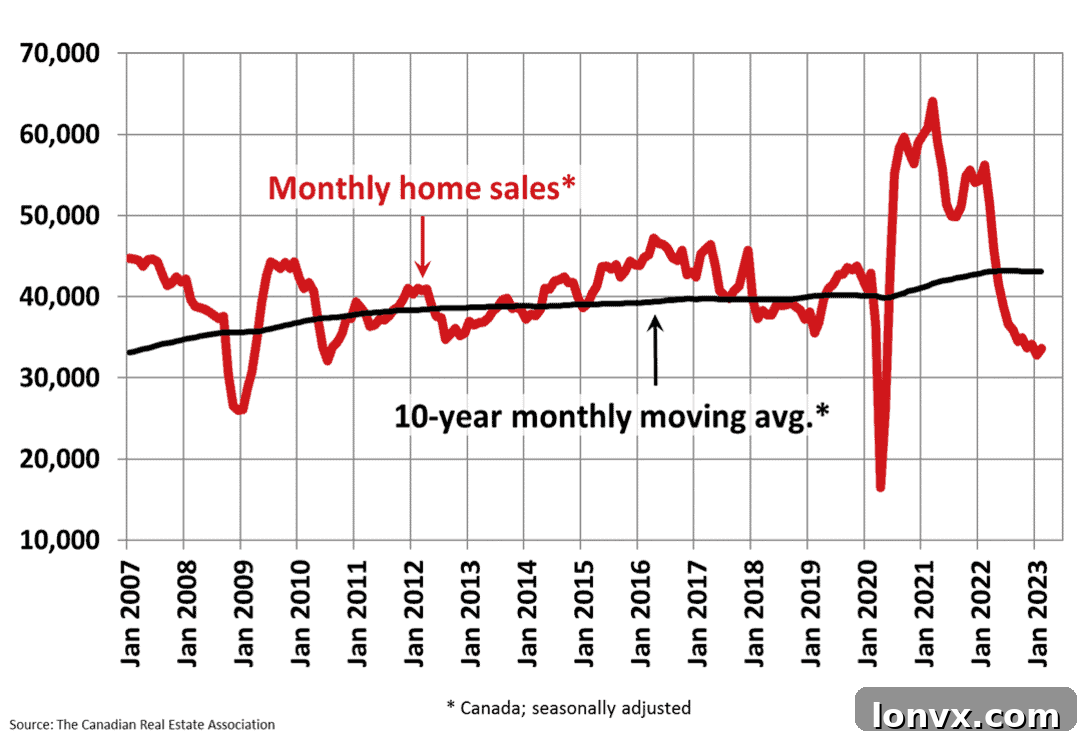
For real estate professionals, accurately interpreting these evolving market signals is paramount. The fundamental question revolves around whether the observed uptrend in sales signifies a genuine and sustainable market recovery, or if it merely reflects a return to the predictable patterns of spring-market seasonality. Understanding this distinction is not just an academic exercise; it forms the cornerstone of effective strategy for both buyers and sellers navigating the complexities of the current environment. A true recovery would imply a fundamental strengthening of economic conditions and buyer confidence, whereas seasonality suggests a temporary surge driven by cyclical factors that may not endure beyond the warmer months.
In a typical year, the spring market inherently brings an increase in activity, often driven by factors such as improved weather, the academic calendar influencing family moves, and psychological readiness to transact after the slower winter months. This seasonal uptick, combined with shifts in the “composition mix” – referring to the types of homes being sold (e.g., more detached homes, fewer condos, or vice versa) – can significantly influence average prices and overall transaction volumes in February and March. However, the impact of these national cycles, especially in a volatile market, is rarely uniform. A deeper, more nuanced understanding necessitates a granular, market-by-market analysis. What might appear as a robust recovery in a high-demand urban center like Toronto could merely be a seasonal blip in a smaller, more stable regional market, highlighting the importance of local expertise and data.
Canadian House Prices Experience Record-Breaking Declines
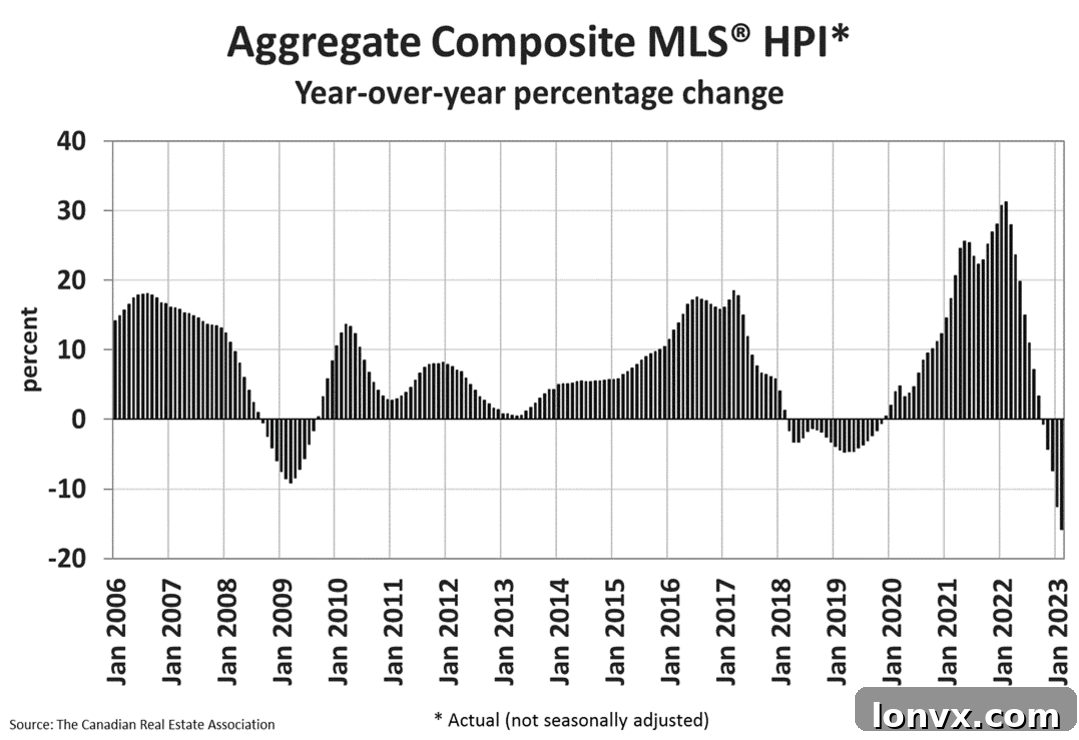
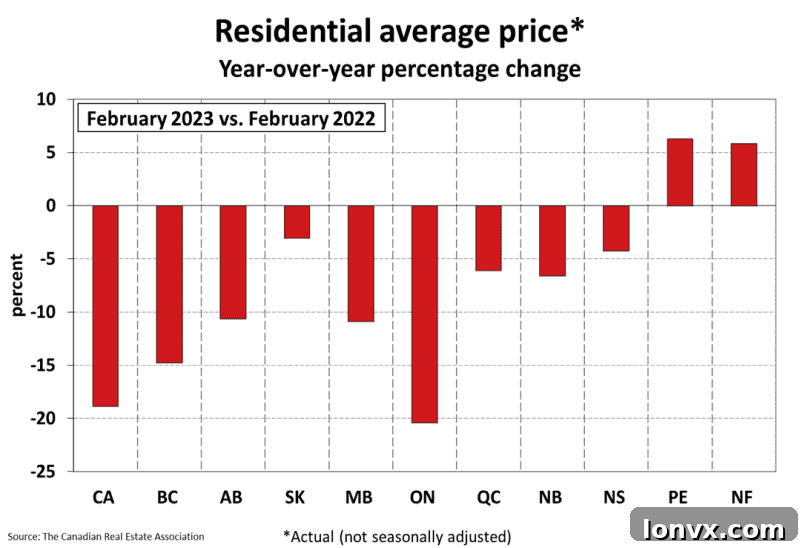
The Canadian housing market has recently recorded an astonishing and historically significant downturn in property values. February’s data revealed an 18.9 percent year-over-year decline in the actual (not seasonally adjusted) national average sale price. This statistic is more than just a number; it represents the largest recorded drop in house prices in Canadian history, surpassing even the severe market corrections experienced during the challenging periods of 1981 and 1989. These previous downturns were characterized by high-interest rates and economic recessions, and the current decline, while perhaps driven by different immediate factors, echoes their severity in terms of price erosion.
Despite the gravity of this record-setting decline, there is a silver lining that offers a degree of optimism. Analysis suggests that the most acute phase of price depreciation is likely behind us. The majority of Canadian housing markets reached their peak valuation in February 2022, marking the beginning of the downward trend. While prominent markets like Toronto and Vancouver significantly skewed the national average due to their sheer volume and higher price points, leading to a more pronounced average decline, it’s worth noting that some smaller, regional markets experienced their peak slightly later, around March 2022. This staggered peaking suggests that the initial shockwave of price adjustments has largely dissipated across the country.
Looking forward, while it is probable that we may see one more month of impactful, perhaps “shocking,” price-drop data as year-over-year comparisons continue to reflect the steep decline from early 2022, it is increasingly unlikely that the subsequent months will register even worse numbers. This anticipated stabilization, or at least a deceleration of the decline, plays a critical role in shaping consumer sentiment. Historically, buyer activity tends to gather momentum and confidence once the perception of overwhelming economic uncertainty begins to subside. As the market shows signs of bottoming out or entering a more stable phase, prospective buyers who have been on the sidelines, waiting for clearer signals, may start to re-enter the market, gradually contributing to a more balanced environment.
Navigating Persistent Economic Uncertainty and Its Impact on Real Estate
While the housing market shows signs of potentially moving past its worst price declines, the broader economic landscape presents a new set of challenges and uncertainties. Recent global banking crises, exemplified by high-profile collapses and rescue mergers, have injected a fresh wave of turmoil into the international financial system. These events, combined with lingering inflation concerns and the ongoing geopolitical instability, are fostering an environment of heightened economic uncertainty that profoundly impacts consumer and investor confidence worldwide, including in Canada. As consistently illustrated in historical data, such as CREA’s Chart A, Canadians typically respond to periods of pronounced economic uncertainty with a marked slowdown in real estate transaction activity. This is a natural reaction, as individuals and families become more risk-averse, postponing major financial commitments like home purchases until there is greater clarity regarding economic stability and job security.
However, amidst this cloud of uncertainty, there is a potential silver lining for prospective homebuyers. The recent apprehension in global financial markets, often triggered by banking sector jitters, has led to a noticeable reduction in bond yields. These bond yields are not merely abstract financial indicators; they serve as the primary pricing mechanism for fixed-rate mortgages in Canada. When bond yields fall, the cost for lenders to borrow money typically decreases, which can, in turn, translate into lower fixed-rate mortgage offerings for consumers. This potential easing of borrowing costs could offer significant relief for a segment of buyers who have been priced out or restricted by the elevated interest rates seen in previous months. For these individuals, a decline in fixed-rate mortgage rates could improve affordability, making homeownership a more tangible goal once again. Yet, it is crucial to balance this potential relief with the persistent economic uncertainty, as reduced rates might be a symptom of broader concerns rather than a definitive sign of a robust economic recovery. The interplay of these complex factors will undoubtedly continue to shape the Canadian real estate market in the months to come, demanding vigilant observation and strategic adaptation from all participants.