
Canada’s real estate landscape has been in a constant state of flux over recent years, undergoing significant transformations primarily driven by an unprecedented surge in its population. The nation proudly reached a milestone of 40 million residents this year, a figure poised for further expansion as the federal government plans to welcome an additional 1.5 million immigrants by 2025. This ambitious immigration target sets the stage for a profound demographic shift, inherently reshaping the dynamics of Canada’s housing market.
Historically, population growth has consistently proven to be a pivotal factor in influencing home prices, as an expanding populace naturally demands more housing units. To understand this intricate relationship better, Zoocasa conducted an extensive analysis, delving into data from Statistics Canada census records, population estimates, and CREA’s benchmark prices over the past 18 years. Their findings shed light on the complex interplay between demographic expansion and housing market trends, revealing both direct correlations and the influence of other economic forces.
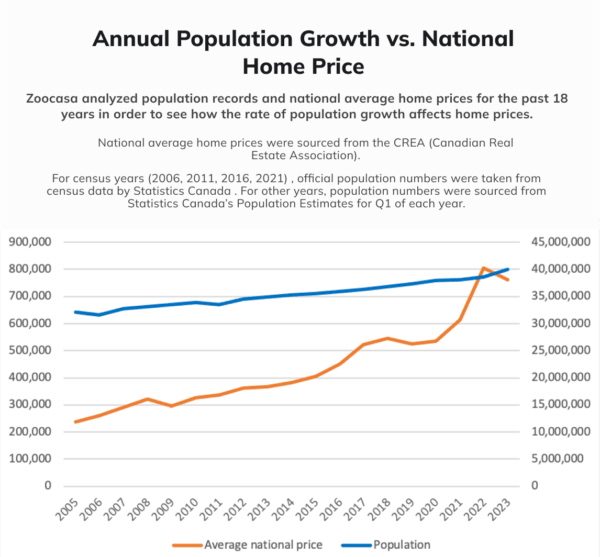
The analysis from Zoocasa reveals a discernible correlation between population growth and home prices across Canada. While this connection is clear, it’s crucial to understand that the impact is rarely immediate or perfectly proportional. Home prices are, in reality, influenced by a complex web of factors extending far beyond mere population figures. These include broader economic cycles, shifts in government policies, interest rate fluctuations, and even global events. However, the undeniable reality is that a continuously rising demand for homes, fueled by population growth, significantly exacerbates an already constrained housing supply, inevitably exerting upward pressure on prices.
National Home Price Growth Consistently Outpaces Population Expansion
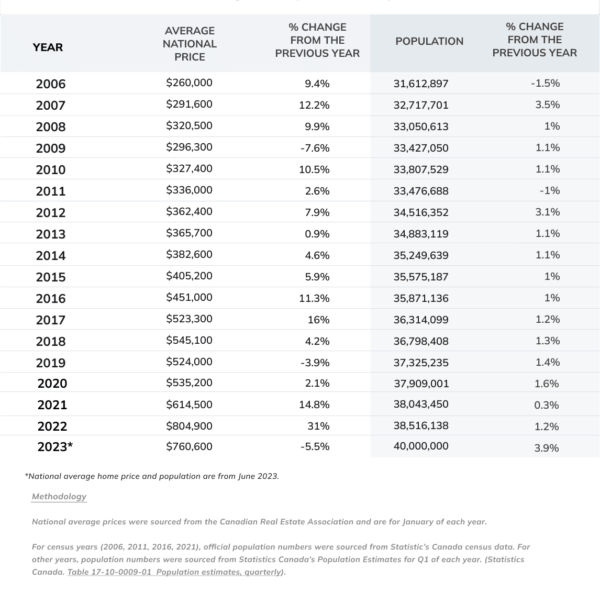
A striking observation from the 18-year dataset is that in 14 of those years, national home price growth has markedly outpaced population growth. This phenomenon isn’t just marginal; often, home prices have escalated at double, or even triple, the rate of population expansion. While Canada’s population growth has maintained a relatively steady trajectory, typically hovering just above one percent annually, the trajectory of national home prices has been characterized by much greater volatility. This divergence underscores a market where demand pressures, intensified by immigration, regularly push values beyond what simple demographic increases might suggest.
This consistent outperformance by home prices signals a deeper structural challenge within the Canadian housing market. It indicates that the supply side has largely struggled to keep pace with fundamental demand, even during periods of moderate population increase. This imbalance is not solely a function of more people needing homes, but also reflects the interplay of factors like land availability, zoning restrictions, construction timelines and costs, and investor sentiment which collectively amplify price movements in response to population influx.
Understanding Canada’s Housing Market Dynamics
Stay informed on the latest trends, expert analyses, and developments shaping the Canadian real estate industry.
Explore More Insights
The year 2022 serves as a pivotal example of the market’s sensitivity to demographic shifts and broader economic conditions. Canada experienced a record-breaking influx of immigrants, contributing to a staggering 31 percent increase in the national average home price compared to the previous year. This period reflected robust buyer confidence, fueled by historically low interest rates and a strong desire for homeownership, further intensified by the increased competition from new residents entering the market.
However, 2023 presented a contrasting narrative. Despite immigration reaching a new annual record with 3.9 percent year-over-year growth, the national home price experienced a 5.5 percent decline. This divergence can be largely attributed to the aggressive interest rate hikes implemented by the Bank of Canada. Rising interest rates significantly increase borrowing costs, thereby reducing purchasing power and cooling buyer enthusiasm, effectively mitigating the upward pressure that continuous population growth would typically exert on prices. This scenario vividly illustrates how monetary policy can temporarily override the fundamental demand generated by demographic expansion, creating a more challenging environment for homebuyers and investors alike.
Long-Term Outlook: Persistent Upward Trajectory for Home Prices and Population Growth
Despite occasional dips and market corrections, the overarching long-term trend strongly indicates that both home prices and population growth in Canada are poised to continue their upward trajectory. This trend is particularly pronounced in major metropolitan areas such such as Toronto, Vancouver, and Calgary, which consistently attract the lion’s share of newcomers seeking employment opportunities, established communities, and vibrant urban amenities. These cities act as powerful magnets, concentrating demand and further intensifying the supply-demand imbalance within their respective regions.
For prospective homebuyers and investors, this long-term outlook carries a crucial implication: waiting indefinitely for a significant, sustained downward trend in prices might not be a realistic strategy. The consistent influx of new residents, coupled with structural challenges in increasing housing supply at a commensurate pace, forms a powerful bedrock for continued price appreciation over the long run. Market corrections, while offering temporary relief, have historically proven to be transient phenomena in the broader context of Canada’s demographic expansion.
Zoocasa’s historical analysis further underscores this point by highlighting the largest drop in the national average home price over the past 18 years. This occurred in 2009, during the tumultuous period of the global Financial Crisis, when prices fell by 7.6 percent. Yet, the market demonstrated remarkable resilience, with prices rebounding swiftly. Over the subsequent years, the persistent population growth, coupled with insufficient new housing supply, led to a significant worsening of housing affordability, setting the stage for the challenges seen today.
The concentrated demand in urban centers creates a unique set of challenges. Toronto, for instance, faces intense pressure due to its status as an economic powerhouse and a global city, attracting both immigrants and interprovincial migrants. Similarly, Vancouver’s desirable lifestyle and strong job market in sectors like technology ensure consistent demand despite some of the highest housing prices in North America. Calgary, experiencing a resurgence in its economy and relatively more affordable housing compared to its coastal counterparts, has also become a popular destination for newcomers, leading to rapid price appreciation in recent years.
Addressing these affordability challenges requires a multi-faceted approach. While increasing housing supply is paramount, it also involves streamlining complex municipal approval processes, investing in infrastructure, and encouraging the development of diverse housing types, including purpose-built rentals and more affordable options. Government policies aimed at both stimulating supply and managing demand without stifling economic growth will be crucial in shaping a more balanced and accessible housing market for all Canadians.
In conclusion, Canada’s housing market is inextricably linked to its population growth strategy. While economic factors and interest rates can introduce short-term volatility, the fundamental demand created by continuous immigration provides a strong underlying current for long-term appreciation in home prices. Understanding this dynamic is crucial for anyone navigating the Canadian real estate market, whether as a buyer, seller, or policymaker. The challenges of affordability and supply will persist, demanding innovative solutions and strategic planning to ensure a sustainable housing future for Canada’s growing population.