
The dream of homeownership in Canada is becoming increasingly elusive for many, a pressing concern amplified by a confluence of sky-high interest rates and a critically limited housing inventory. This potent combination has pushed homeownership beyond the reach of a significant portion of the population, transforming housing affordability into a dominant national issue.
Recent data from the Canadian Real Estate Association (CREA) paints a stark picture of this escalating crisis. In August 2023, the benchmark price for a home across Canada surged to an astounding $757,600. This represents a substantial 40% increase over a mere five-year period, considering the benchmark price stood at $543,000 in August 2018. Parallel to this dramatic rise in prices, the months of inventory—a crucial indicator of housing supply—plummeted from 5.4 months to a mere 3.4 months over the same timeframe. This dwindling supply further intensifies the affordability crunch, creating a market where demand far outstrips the available homes.
While the Bank of Canada’s aggressive rate-hiking cycle, initiated 17 months ago, has seemingly caused home prices to level off in some areas, the underlying and persistent severe housing shortage casts a long shadow over any hopes for a swift restoration of widespread affordability. The fundamental imbalance between supply and demand continues to exert upward pressure, making the path to homeownership incredibly challenging for first-time buyers and those looking to upgrade.
To gain a deeper understanding of these market dynamics, a recent comprehensive analysis by Zoocasa meticulously examined how shifts in housing supply have influenced affordability across the country. The study specifically compared home prices from August 2018 to August 2023, dissecting the data by various property types: single-family homes, townhouses, and condo apartments. This detailed approach allows for a clearer view of the specific segments of the market most affected by these unprecedented changes.
The Unrelenting Surge: Soaring Prices Across Canada’s Housing Market
The Zoocasa analysis reveals a widespread and significant increase in home prices across nearly every city surveyed, irrespective of the property type. This uniform upward trajectory underscores the broad nature of Canada’s housing affordability challenge, demonstrating that few regions have been immune to the market’s relentless ascent. The magnitude of these increases, particularly in major urban centers, highlights the pressure facing prospective homeowners nationwide.
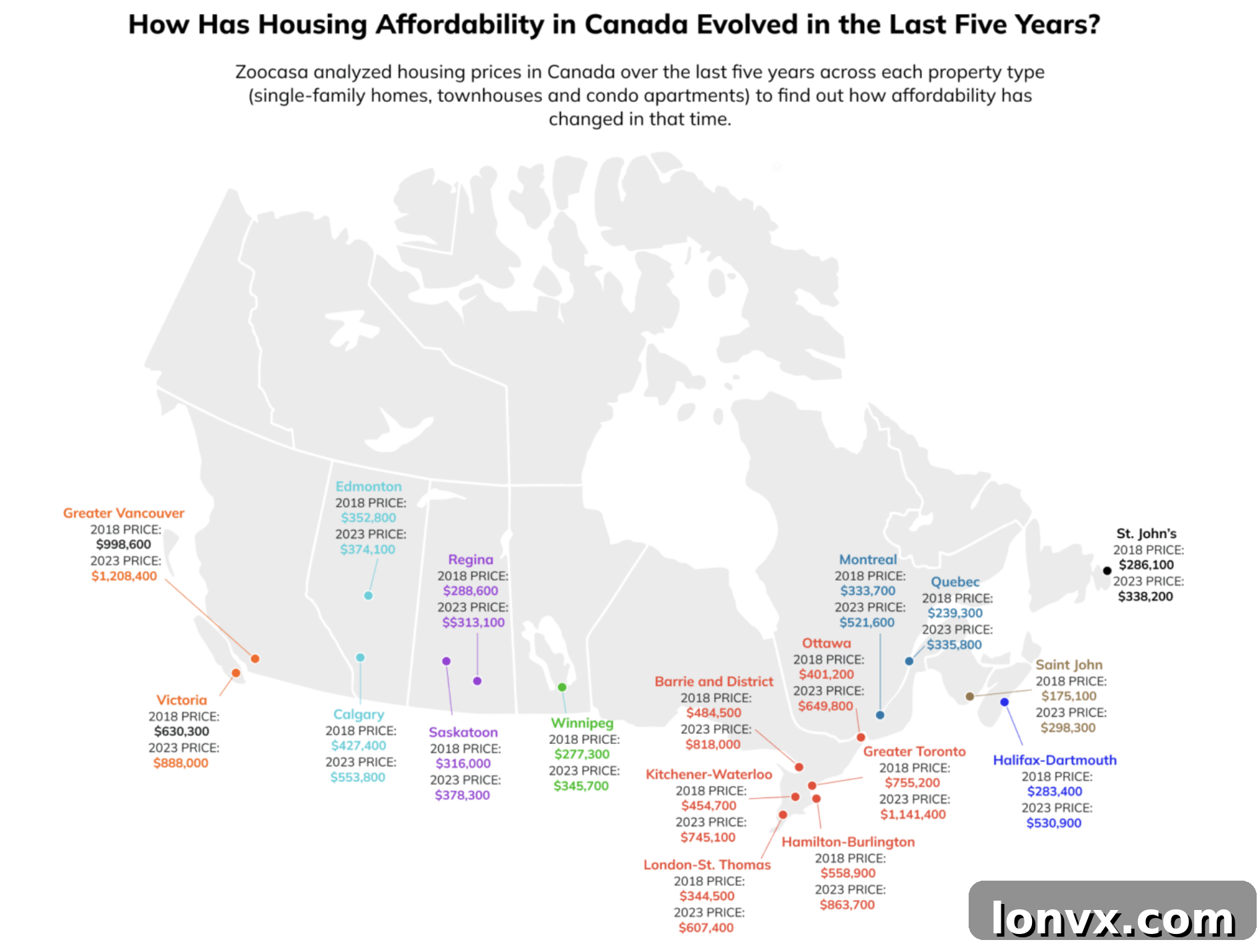
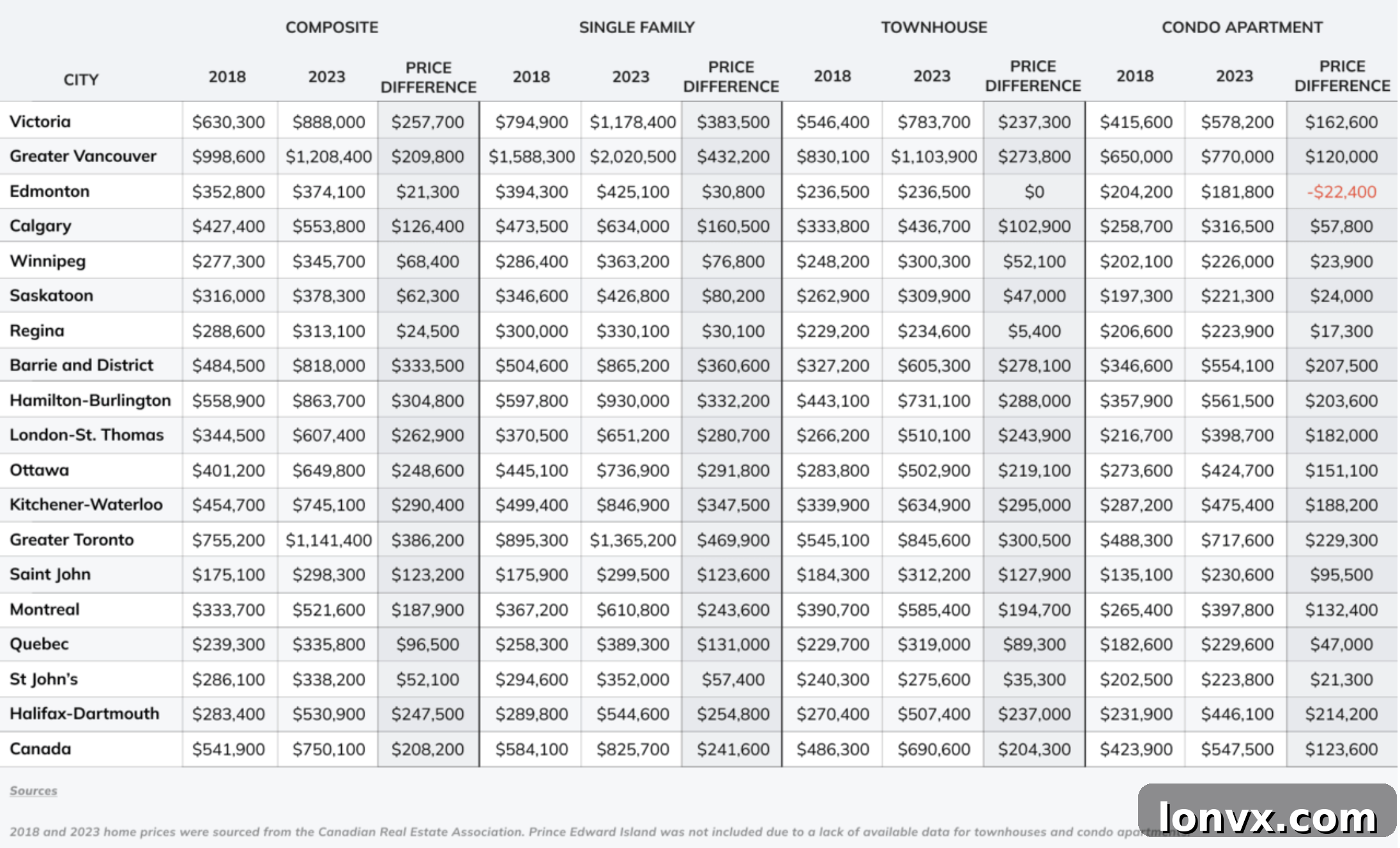
Leading the charge in price appreciation is Toronto, Canada’s largest city and economic powerhouse, where the composite home price across all property types experienced the most substantial jump. Prices in Toronto skyrocketed by an astonishing $386,200, climbing from $755,200 in August 2018 to an eye-watering $1.14 million in August 2023. This explosive growth underscores the intense demand and limited supply characterizing the Greater Toronto Area’s real estate landscape.
Delving deeper into Toronto’s market, the city also recorded the most significant individual property price increases across all categories. Single-family homes saw their prices surge by an astounding $469,900, reflecting the premium placed on detached properties. Townhouses, often seen as a more accessible option, were not far behind, with prices jumping by $300,500. Even the condo apartment segment, typically considered the entry point into the market for many, witnessed a considerable increase of $229,300. These figures illustrate the immense financial hurdles faced by individuals and families attempting to enter or advance within the Toronto housing market.
The ripple effect of Toronto’s booming market extends to other regions within Ontario. Cities like Barrie and Hamilton–Burlington, which are popular commuter towns, also experienced substantial price hikes. Barrie’s composite home prices increased by $333,500, while Hamilton–Burlington saw a rise of $304,800. This trend indicates a spillover effect, where demand and affordability pressures in major metropolitan areas push buyers to surrounding communities, subsequently driving up prices in those regions as well.
Beyond Ontario, Victoria, British Columbia, also registered a significant increase in the single-family home segment. This picturesque capital city saw prices climb by an impressive $383,500, rising from $794,900 to $1.18 million. The strong demand in desirable coastal markets, coupled with limited land availability, continues to fuel robust price appreciation in cities like Victoria, contributing to the broader narrative of escalating housing costs across Canada.
Source: Zoocasa
Edmonton: An Outlier in Canada’s Escalating Housing Market
Amidst a national landscape characterized by sharp increases in home prices, Edmonton stands out as a notable outlier. The capital of Alberta recorded a relatively modest increase in its average home price, rising by just $21,300. This figure represents the smallest increment among all the cities analyzed by Zoocasa, making Edmonton a fascinating case study in Canada’s diverse housing market. Its distinct trajectory offers a stark contrast to the rapid price acceleration observed in major urban centers across Ontario and British Columbia.
The moderation in Edmonton’s market is particularly evident when dissecting price changes by property type. While other cities saw significant gains across the board, townhouses and condo apartments in Edmonton either maintained their price points or, in a rare turn, experienced a decline. Townhouses in Edmonton, for instance, held firm at the same price point in August 2023 as they did in August 2018, averaging $236,500. This stability suggests a balanced market for this property type, possibly due to a steady supply or different demand dynamics compared to other regions.
Even more remarkably, condo apartments in Edmonton recorded a rare decline in prices. From August 2018 to August 2023, the average price for a condo apartment dropped by $22,400, falling from $204,200 to $181,800. This downward trend for condos is highly unusual in the current Canadian housing climate and could be attributed to a number of factors, including a healthy inventory of new developments, more subdued population growth compared to cities like Toronto or Vancouver, or local economic conditions that influence buyer demand. Edmonton’s unique market behavior provides a glimmer of relative affordability, making it an attractive option for those seeking homeownership without the intense bidding wars and soaring costs prevalent elsewhere.
Pockets of Affordability: Select Cities Offering More Modest Gains
While much of the Canadian housing narrative revolves around steep price increases, a closer look reveals that some cities have experienced more modest gains, offering relative affordability within the broader market context. These urban centers present a contrasting picture to the overheated markets of Toronto and Vancouver, providing alternative pathways to homeownership for many Canadians. The Zoocasa analysis highlighted several such cities where the pace of price appreciation has been considerably slower.
In Winnipeg, the composite home price saw a rise of $68,400, a significant increase but notably less aggressive than those observed in major hubs. Similarly, Saskatoon recorded an increase of $62,300, while St. John’s experienced a gain of $52,100. Regina, in Saskatchewan, showed the most conservative composite home price increase among these cities, with a rise of $24,500. These moderate increases suggest that while prices are still trending upwards, the pressure on buyers is less intense, potentially allowing for more manageable entry points into the market.
Within Regina, the condo market proved to be particularly stable, with prices rising by a mere $5,400 between August 2018 and August 2023. This minimal appreciation makes Regina’s condo market one of the most accessible in the country, appealing to first-time buyers or those looking for more budget-friendly housing options. Such stability in the condo segment is a rare commodity in today’s Canadian real estate environment.
Quebec also stands out as a province where home prices, while increasing, have done so at a more measured pace compared to its Ontario and British Columbia counterparts. The composite home price in Quebec saw a five-figure increase of $96,500 over the five-year period. However, delving into property types, single-family homes in this province experienced a more substantial jump of $131,000 between August 2018 and August 2023. This indicates a strong demand for detached homes even in more moderately priced markets, reflecting a national preference for larger living spaces.
These regions, often characterized by different economic drivers, slower population growth, or a more balanced approach to development, represent crucial pockets where the dream of homeownership remains more attainable. They offer a counterbalance to the intense competition and escalating costs seen in the nation’s largest metropolitan areas, providing viable options for Canadians seeking to establish roots without facing the same overwhelming financial burden.
Source: Zoocasa
The Deeper Roots of the Crisis: Supply and Demand Imbalance
The dramatic price surges and plummeting inventory levels observed across much of Canada are not merely market fluctuations; they are symptoms of a deep-seated structural issue: a persistent and worsening imbalance between housing supply and demand. The “months of inventory” metric, which dropped from 5.4 months to 3.4 months nationally in just five years, is a critical indicator of this predicament. A healthy, balanced market typically has between four and six months of inventory. Canada’s current figure signals a severe seller’s market, where there are simply not enough homes available to meet the robust demand.
On the supply side, several interconnected factors contribute to the chronic housing shortage. Slow construction rates, often hampered by bureaucratic delays, restrictive zoning regulations that favor single-family homes over higher-density developments, and a scarcity of skilled labor and materials, all play significant roles. Additionally, land availability in urban centers is increasingly limited, driving up land costs and, consequently, the final price of new homes. The “Not In My Backyard” (NIMBY) phenomenon, where existing residents oppose new developments in their neighborhoods, further exacerbates the problem by stalling or preventing much-needed housing projects.
Conversely, demand for housing in Canada has soared due to a confluence of powerful forces. Rapid population growth, largely driven by ambitious immigration targets, continuously adds new households to the housing market. Investor activity, especially during periods of low interest rates, has also contributed by absorbing a portion of the housing stock, sometimes converting it to rentals or holding it for appreciation, further reducing the pool of homes available for primary residents. Moreover, the long period of historically low interest rates preceding the Bank of Canada’s recent hikes incentivized borrowing and fueled buyer confidence, creating a surge in purchasing power that outpaced supply growth. Interprovincial migration, with people moving from more expensive provinces to relatively more affordable ones (and then driving up prices in those areas), also plays a role in shifting demand dynamics across the country.
Addressing this complex crisis requires a multifaceted approach that tackles both supply and demand. Strategies must include streamlining the permitting process for new constructions, incentivizing higher-density developments, investing in infrastructure to support new communities, and potentially exploring measures to curb speculative investment. Without significant structural changes to boost supply and manage demand effectively, housing affordability will likely remain a critical national challenge for the foreseeable future.
The Road Ahead: Navigating Canada’s Housing Future
The data unequivocally demonstrates that Canada’s housing market is at a critical juncture. The significant price increases, coupled with dwindling inventory, have transformed the dream of homeownership into a formidable challenge for countless Canadians. While the Bank of Canada’s interest rate hikes have somewhat cooled the frenetic pace of price growth, they have not resolved the fundamental issue of inadequate housing supply, leaving millions grappling with affordability concerns.
The insights from Zoocasa’s analysis highlight the uneven impact of these market forces across the country. While major metropolitan areas like Toronto and Victoria continue to experience soaring prices across all property types, cities such as Edmonton, Winnipeg, Saskatoon, St. John’s, and Regina offer a contrasting narrative of more stable or even declining prices in certain segments. These regional disparities underscore the need for tailored solutions that recognize the unique dynamics of local markets, rather than a one-size-fits-all national policy.
Looking ahead, the path to restoring housing affordability will undoubtedly be complex and protracted. It will necessitate concerted efforts from all levels of government, collaboration with the private sector, and innovative policy solutions. This includes a robust focus on increasing housing supply through expedited construction, modernizing zoning bylaws to encourage diverse housing types, and investing in infrastructure to support sustainable urban growth. Furthermore, discussions around managing demand, supporting first-time homebuyers, and potentially addressing speculative investment will remain central to the national dialogue.
As Canadians navigate this challenging real estate landscape, the insights provided by comprehensive analyses like Zoocasa’s become invaluable. They not only illuminate the current state of affairs but also equip stakeholders with the data necessary to inform policy, guide investment decisions, and empower individuals in their pursuit of a place to call home. Ultimately, the future of Canada’s housing market hinges on a collective commitment to tackle the supply-demand imbalance head-on, ensuring that homeownership, or at least affordable housing, remains an achievable goal for generations to come.