The global pandemic undeniably reshaped countless aspects of daily life, with perhaps one of the most significant being the widespread adoption of remote work. This shift didn’t just transform office culture; it fundamentally altered how and where Canadians envisioned their futures, especially concerning international real estate. With the shackles of daily commutes and geographic limitations loosened, a burgeoning desire for overseas properties emerged. Yet, a recent comprehensive analysis by Point2Homes, meticulously examining over 2,000 real estate-related keywords spanning numerous islands, countries, and cities across the Americas, reveals a nuanced and evolving landscape. While the classic allure of sun-drenched beach destinations persists, the data surprisingly indicates a notable decline in searches for oceanside homes, signaling a profound recalibration of priorities among Canadian homebuyers seeking properties beyond their borders.
This in-depth report, a critical barometer of Canadian aspirations in the international property market, illuminates the dynamic interplay of economic factors, lifestyle aspirations, and post-pandemic sensibilities. It suggests that while the dream of a foreign retreat remains vibrant, the specific characteristics and locations of those dream homes are undergoing a significant transformation. From bustling metropolitan areas to tranquil rural landscapes, Canadians are casting a wider net, driven by a complex mix of investment potential, lifestyle enhancements, and the newfound freedom that remote work affords.
Mexico: The Unwavering Magnet for Canadian Homebuyers
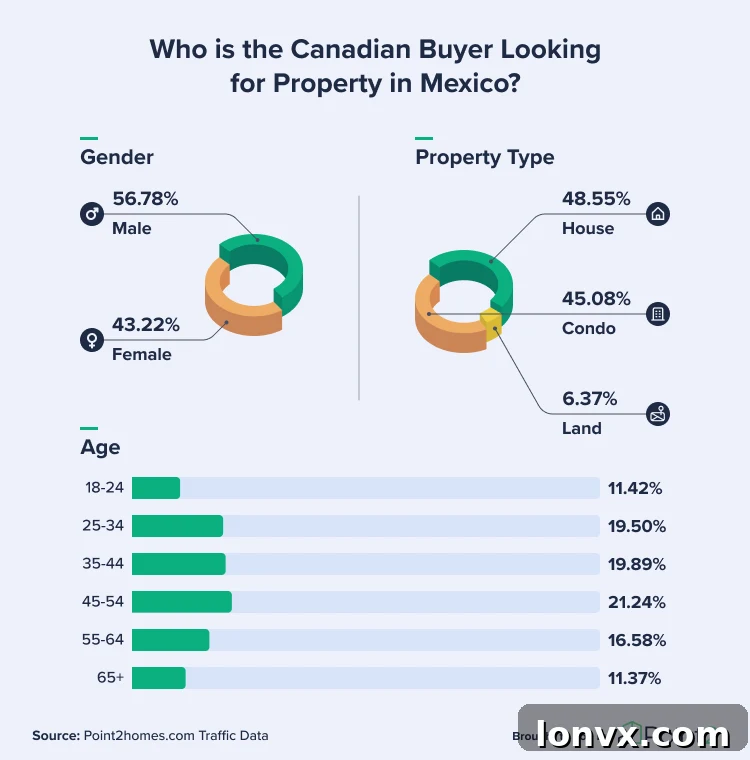
Despite the fluctuating tides of global real estate trends and the broader decline in international property searches, Mexico steadfastly retains its premier position as the most coveted destination for Canadian homebuyers. Its enduring appeal is a testament to a unique blend of cultural richness, vibrant communities, favorable climate, and accessible proximity. Canadians demonstrate an almost perfectly balanced interest in both houses and condos, with approximately 48 percent of total searches directed towards houses and a very close 45 percent for condominiums. This near-equal distribution underscores the diverse needs and preferences of Canadian buyers, ranging from families seeking spacious homes to individuals or couples desiring low-maintenance urban or resort living.
Intriguingly, the data also highlights a surprising curiosity in vacant land for sale in Mexico, capturing the interest of around 6.0 percent of home seekers. This segment suggests a subset of buyers with a long-term vision, perhaps looking to build custom homes, develop investment properties, or secure land as a future asset. Mexico’s robust infrastructure in popular expat areas, coupled with a relatively lower cost of living compared to Canada, continues to solidify its status as an irresistible prospect for those looking to invest, retire, or simply enjoy a different pace of life. The country offers a spectrum of experiences, from the vibrant coastal cities of the Riviera Maya to the cultural heartlands of colonial cities and the burgeoning digital nomad hubs, catering to a wide array of Canadian dreams.
Costa Rica Claims the Runner-Up Position: A Pura Vida Ascendancy
In a notable reshuffling of Canadian homebuyers’ international preferences, Costa Rica has emerged as the clear runner-up, securing its position as the second most favored destination. This rise is intrinsically linked to a significant shift away from properties in the United States, which has experienced a substantial 40 percent decrease in searches from Canadian buyers. This dramatic decline in interest for American real estate has effectively propelled Canada’s southern neighbor, Mexico, into the top spot and paved the way for Costa Rica’s increased prominence.
Costa Rica’s ascent is hardly coincidental; it reflects a growing appreciation for its unique blend of “Pura Vida” (pure life) lifestyle, unparalleled natural beauty, and a strong commitment to environmental conservation. The country offers a captivating mosaic of lush rainforests, pristine beaches on both the Pacific and Caribbean coasts, active volcanoes, and an abundance of biodiversity. For Canadians seeking an escape that prioritizes eco-tourism, outdoor adventure, and a tranquil, healthy lifestyle, Costa Rica presents an ideal scenario. Its stable democratic government, relatively high standard of living for the region, and established expat communities further enhance its appeal. Buyers are drawn to opportunities for sustainable living, retirement in nature, or investment in a thriving tourism market, making Costa Rica a compelling alternative to more traditional, and now less desirable, destinations.
Widespread Decline in International Property Searches
Beyond the top two preferred destinations, the overall sentiment among Canadian homebuyers appears to be one of heightened caution, manifesting as a broad decline in interest across numerous international markets. The data reveals a concerning trend: eight out of the top 10 most coveted locations for vacation homes and investment properties experienced reduced search volumes. This diminished enthusiasm isn’t confined to just the elite tier; a more comprehensive examination of the extended list of 30 popular locations demonstrates a significant decline in searches in 23 of them. This widespread shift in sentiment indicates a collective hesitation among Canadian buyers when considering properties abroad, suggesting a more complex interplay of factors at play than initially meets the eye.
Several underlying reasons could contribute to this overarching decline. Global economic uncertainties, including inflationary pressures and potential recessionary concerns, might be prompting a more conservative approach to high-value, discretionary purchases like international real estate. Rising interest rates, both domestically and internationally, make borrowing more expensive, thereby impacting affordability and returns on investment. Furthermore, fluctuating exchange rates can introduce an element of unpredictability, making property acquisitions more costly or less attractive depending on the strength of the Canadian dollar. Logistical challenges associated with buying and managing property abroad, coupled with potential shifts in personal or corporate remote work policies that might require more frequent returns to Canada, could also be tempering enthusiasm. This broad trend suggests that while the allure of international property remains, Canadians are exercising greater prudence and selectivity in their pursuit of overseas assets.
The Diminished Allure of the U.S. Market for Canadians
While Canadian preferences for international properties are undeniably shifting, perhaps no market has witnessed a more profound contraction of interest than the United States. The significant decline in searches for homes in iconic American cities and states, including but not limited to New York, Hawaii, Las Vegas, Miami, and Florida, serves as a stark illustration of this trend. These destinations, historically popular among Canadians for vacation homes, investment opportunities, or snowbird retreats, are now experiencing a notable downturn in their appeal.
This decrease in search volumes is not merely anecdotal; it is mirrored by a substantial decline in actual transactions. A comprehensive report by the National Association of Realtors (NAR) provides compelling evidence, indicating that international buyers in the U.S. real estate market purchased only 84,600 homes, marking a decade-low and the lowest figure recorded since 2009. Several factors likely contribute to this significant shift. The U.S. market, particularly in popular areas, has seen considerable appreciation in property values, making it increasingly expensive for Canadian buyers whose purchasing power is directly affected by the exchange rate. A stronger U.S. dollar means a higher cost in Canadian dollar terms for American properties. Furthermore, competition from domestic buyers in the U.S., particularly during recent years of low inventory, has intensified, making it harder for international buyers to secure properties. Changes in travel restrictions, perceived political climates, or even simply a diversification of interests towards other global markets like Mexico and Costa Rica could also be contributing to the U.S. market’s reduced magnetism for Canadian investors and homebuyers.
A Closer Look at the Evolving Canadian Buyer Demographics
Amidst this evolving landscape of international real estate preferences, distinct buyer profiles are emerging, offering valuable insights into the motivations and characteristics of Canadians venturing abroad. For instance, the typical Canadian buyer browsing Mexico’s real estate market is often identified as a Gen X individual, generally displaying a preference for traditional houses over other property types. A significant majority, nearly 60 percent, of these home seekers are men, with a substantial portion (21.24 percent) falling within the 45 to 54 age group. This demographic suggests buyers who are likely established in their careers, potentially nearing retirement, or looking for long-term investment opportunities that can also serve as seasonal residences.
However, a particularly surprising revelation lies in the heightened interest shown by younger and older Millennials (ages 25 to 34 and 35 to 44) in Mexico’s diverse real estate offerings. This younger demographic, often associated with seeking flexibility, career growth, and digital nomad lifestyles, now significantly outnumbers retirees aged 65 and above – a group traditionally associated with seeking warmer climates for their retirement homes. This demographic shift is profoundly significant. It implies that Canadian interest in Mexico is no longer solely driven by the pursuit of a leisurely retirement in the sun. Instead, it suggests a growing trend among younger professionals and families who may be exploring possibilities for remote work, long-term investments, or a lifestyle change that offers greater affordability and cultural immersion, all while potentially being able to maintain their careers from a different country. This broader demographic appeal bodes well for the sustained popularity of destinations like Mexico, indicating a more diversified and robust buyer base.
Future Outlook: Navigating the Global Real Estate Recovery
As the international real estate market continues to recalibrate and adjust to the unique post-pandemic landscape, experts from the National Association of Realtors (NAR) maintain a cautiously optimistic outlook regarding the eventual revival of international transactions. Chief Economist Lawrence Yun offers critical insights, noting that the persistent scarcity of housing inventory within the United States, coupled with significant global shifts in borrowing costs, has undeniably tempered international buyer activity over the past two years. These factors have created a challenging environment, leading to a period of reduced cross-border investments and purchases.
However, Yun articulates a clear vision for recovery, stating, “Recovering international travel following the end of the pandemic will bring more foreign transactions in coming months and years.” This statement encapsulates the core expectation that as global travel fully normalizes and pandemic-era restrictions recede further into memory, the inherent desire for international property ownership, both for lifestyle and investment purposes, will rebound. The pent-up demand, coupled with increasing confidence in global economic stability and the continued flexibility offered by remote work arrangements, is anticipated to gradually re-energize the market. While the immediate future may still present challenges such as fluctuating exchange rates and localized market conditions, the long-term prognosis, particularly for resilient and attractive markets, appears to be one of renewed growth and sustained interest from Canadian buyers looking to expand their real estate portfolios beyond national borders.
The journey of Canadian homebuyers in the international real estate market is one of continuous evolution. From the enduring appeal of Mexico to the rising star of Costa Rica, and the complex factors influencing the broader market, the landscape is dynamic. While a general decline in searches indicates caution, it also underscores a more discerning and strategic approach to overseas property acquisition. As global conditions stabilize and travel becomes seamless once more, the Canadian pursuit of international homes is poised for a vibrant and exciting new chapter, driven by a mix of timeless aspirations and newly discovered flexibilities.
Newsletter
Subscribe to our e-newsletters to receive regular updates on what’s happening in the real estate industry in Canada. Delivered every Tuesday, Friday and Sunday.
View our most recent newsletters.