Canadian Capital Continues to Dominate U.S. Commercial Real Estate Investment
The allure of the United States commercial real estate market has long captivated international investors, offering robust opportunities for growth, stability, and diversification. Among the global contenders, Canadian investors have consistently stood out, not just as significant players, but as the dominant force in foreign direct investment into U.S. commercial properties. This robust trend underscores a strategic alignment between Canadian capital and the dynamic American real estate landscape, marking it as one of the most substantial cross-border capital flows in the world.
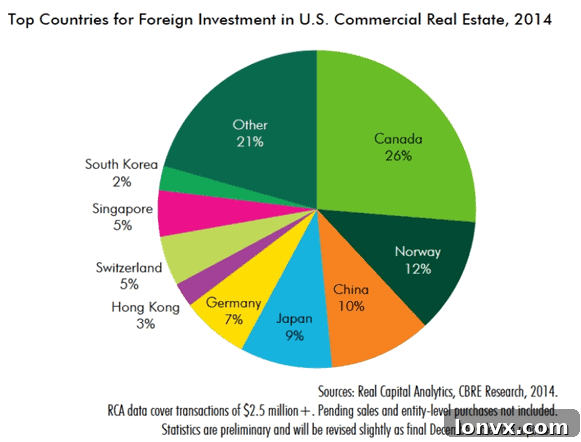
In 2014, Canadian entities injected nearly US$10 billion directly into U.S. commercial real estate. This staggering figure, as highlighted by a comprehensive analysis from CBRE, positioned Canada far ahead of other prominent global investors, including Norway, China, Japan, and Germany. This remarkable investment volume represented a significant 26 percent of the total foreign direct investment into U.S. real estate that year, which collectively amounted to an impressive US$41 billion. The momentum showed no signs of abating, with Canadian investors having already transacted approximately $2.75 billion in U.S. real estate by mid-January 2015, signaling a continued strong appetite for American assets.
Canada-U.S. Real Estate Flow: A Global Powerhouse
The scale of Canadian real estate investment into the U.S. is not merely impressive in isolation; it ranks among the largest cross-border capital flows globally. According to CBRE, the Canada-to-U.S. real estate capital flow secured the third position worldwide in 2014, trailing only the U.S.-to-United Kingdom and Hong Kong-to-China capital movements. This ranking solidifies Canada’s pivotal role in shaping the international investment landscape and underscores the unique economic and geographical ties that bind the two North American neighbors.
This enduring relationship between Canadian capital and U.S. real estate markets is driven by a confluence of compelling factors. Ross Moore, CBRE’s Director of Research for Canada, eloquently summarizes the primary motivations: “Canadian investors find U.S. real estate attractive for many of the same reasons that other countries do. The U.S. offers opportunities for value creation, healthy cash flows and favourable risk-adjusted returns.” However, Moore also emphasizes a distinct strategic imperative for Canadian institutions: “The level of Canadian investment is highly correlated with the health of the American economy and exchange rates, but the overriding motivation is that Canadian institutional investors need to look beyond their borders to find product and achieve greater diversification.”
Why Canadian Investors Choose U.S. Real Estate
The sustained and substantial flow of Canadian capital into U.S. commercial real estate is underpinned by several strategic advantages and market characteristics:
- Robust Economic Fundamentals: The U.S. economy, with its vast consumer market, innovative industries, and stable legal framework, presents a compelling environment for real estate investment. Strong economic performance translates into demand for various property types, from office spaces and industrial warehouses to retail outlets and multifamily residences, promising healthy rental growth and capital appreciation.
- Attractive Risk-Adjusted Returns: Canadian investors, particularly large institutional funds, are constantly seeking investment opportunities that offer superior risk-adjusted returns. The U.S. market, with its diverse geographic regions and property types, allows for granular investment strategies that can yield strong returns relative to perceived risks. This includes opportunities for value creation through strategic acquisitions, development, and repositioning of assets.
- Portfolio Diversification: For Canadian institutional investors, looking beyond domestic borders is a critical component of a comprehensive diversification strategy. The Canadian market, while stable, is relatively smaller than the U.S. market. Investing in the U.S. allows these entities to spread risk across a broader range of geographies, economic cycles, and property types, enhancing overall portfolio resilience and performance.
- Geographic Proximity and Familiarity: The shared border and intertwined economies provide Canadian investors with an inherent advantage. The ease of travel, cultural similarities, and a deep understanding of U.S. market dynamics—extending beyond just gateway cities—reduce the transaction costs and complexities typically associated with cross-border investments. This familiarity fosters confidence and enables more informed decision-making.
- Favorable Exchange Rates: Fluctuations in the Canadian-U.S. dollar exchange rate can significantly influence investment decisions. Periods where the Canadian dollar is strong relative to the U.S. dollar make U.S. assets more affordable, encouraging increased capital outflow from Canada. Conversely, a weaker Canadian dollar might necessitate a more cautious approach, yet the long-term strategic drivers often outweigh short-term currency movements.
Global Comparison: Canada’s Unrivaled Position
While Canadian investors led the charge, other nations also demonstrated significant interest in the U.S. real estate market in 2014. Norway emerged as the second-largest global investor, contributing $4.4 billion, which represented 11 percent of the total foreign direct investment – less than half of Canada’s share. China and Japan followed closely, with total investment levels reaching $3.8 billion and $3.5 billion respectively, each accounting for nine percent of the global total. German buyers transacted $2.9 billion in U.S. real estate, making up seven percent of the total. These figures unequivocally underscore Canada’s dominant and unparalleled position in the U.S. foreign direct real estate investment landscape.
The United States is not just a preferred destination; it is by far the largest recipient of Canadian global capital. Of the $22 billion that Canada invested outside its borders in 2014, a substantial 44 percent flowed directly into the U.S. market. The next highest shares went to Australia and the U.K., receiving 17 percent and 14 percent respectively. It’s noteworthy, however, that the U.S. market share of Canadian global investment in 2014 slightly dipped below its 2007-2014 average of 48 percent, indicating a slight diversification into other international markets but without diminishing the U.S.’s primary importance.
Investment Patterns and Geographic Spread
One distinguishing characteristic of Canadian investment in the U.S. is its broad geographical distribution. Unlike some international investors who might concentrate solely on a few major gateway cities, Canadian capital tends to spread across a wider array of U.S. markets. CBRE attributes this to the sheer magnitude of Canadian investment, their extensive familiarity with various U.S. markets beyond just the traditional hubs, and the relatively low cost and time commitment for Canadian investment professionals to travel to different U.S. locations.
For all property types combined, mirroring total global capital flows into the U.S., New York consistently remains the leading destination for Canadian real estate capital. Its status as a global financial and cultural hub, coupled with its deep and liquid real estate market, makes it an evergreen target for significant investment. Following New York, Boston emerges as another prime location, celebrated for its strong academic institutions, growing tech sector, and historic property values. Notably, Broward County in Florida also made the list of top destinations, primarily due to a significant hotel acquisition, highlighting the appeal of the hospitality sector and Sun Belt growth. Finally, Seattle stands out as a unique destination for global capital but is particularly attractive to Canadian investors given its close proximity to Vancouver, fostering strong cross-border economic ties and synergistic growth opportunities in the technology and logistics sectors.
The Future Outlook: Continued Briskness
The sentiment from industry leaders suggests a continued strong outlook for Canadian investment in U.S. real estate. Chris Ludeman, Global President of CBRE Capital Markets, observed, “While we have seen rapidly rising Chinese global investment and oil-rich countries in the Middle East or Norway increasing their allocations to global real estate, Canadian buyers continue to dominate foreign investment in the U.S. and should remain on the radar screens of American investors and owners of U.S. real estate.”
Ludeman also highlighted a shared challenge among all investors, both domestic and international: “Canadians, other global investors and Americans share the same challenge – finding attractive opportunities with reasonable pricing that can produce a favourable risk-adjusted return.” Despite these common hurdles, the overarching expectation is positive: “That said, we expect the investment climate to remain brisk and U.S. volumes will continue rising in 2015 and beyond.” This forward-looking perspective suggests that the strategic rationale for Canadian investment in U.S. real estate—centered on stability, diversification, and robust returns—will continue to drive capital flows for the foreseeable future.
Conclusion
Canadian investors undeniably hold a preeminent position in the U.S. commercial real estate market, a dominance rooted in a combination of strategic necessity, economic alignment, and geographical advantage. Their substantial financial commitments, broad geographical reach, and consistent presence underscore the mutual benefits derived from this cross-border capital flow. As the U.S. market continues to present diverse opportunities for value creation and healthy returns, Canadian capital is poised to remain a critical and influential force, solidifying its role as a key driver in the evolving landscape of global real estate investment.