
Canada’s Housing Market Resurgence: The Driving Force of Move-Up Buyers in Q2 2023
The Canadian housing market experienced a significant surge in the second quarter of 2023, largely propelled by existing homeowners looking to upgrade. These “move-up buyers” capitalized on a temporary hiatus in interest rate hikes by the Bank of Canada (BoC), injecting considerable momentum into residential property sales across the nation. This period was characterized by robust demand meeting constrained inventory levels, creating a dynamic environment for both buyers and sellers.
According to comprehensive analysis from Re/Max Canada’s Move-Up Market Report, the initial pause in the BoC’s aggressive rate hike cycle served as a powerful catalyst. Homeowners, who had built substantial equity over recent years, saw an opportune window to transition into larger homes, more desirable neighborhoods, or properties better suited to evolving lifestyle needs. This segment of the market proved to be the primary engine driving market activity and price appreciation during this crucial quarter.
Regional Price Dynamics: Double-Digit Gains in Key Markets
The Re/Max report meticulously examined nine of Canada’s most prominent housing markets, revealing a distinct pattern of activity following the BoC’s decision to temporarily halt rate increases. This policy shift ignited a flurry of transactions, particularly within the mid to upper-price ranges, signaling a renewed confidence among a specific demographic of buyers.
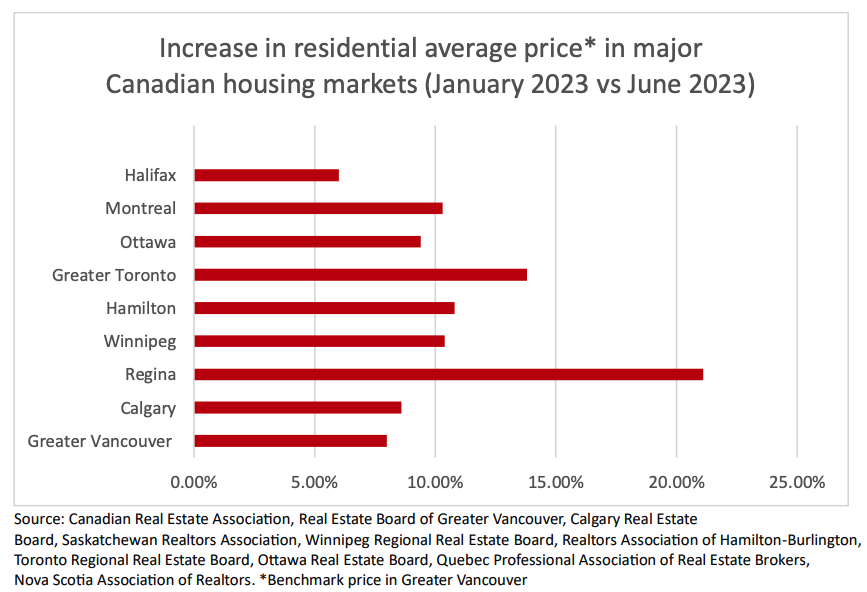
Five major Canadian markets recorded impressive double-digit price increases: Regina, the Greater Toronto Area (GTA), Hamilton, Winnipeg, and Montreal. These regions showcased the most pronounced impacts of the invigorated demand from move-up buyers. Several factors contributed to this concentrated growth, including sustained local economic stability, comparatively more affordable entry points in some markets, and perhaps a quicker absorption of available inventory. The GTA and Hamilton, perennial hotbeds of real estate activity, demonstrated resilience and renewed vigor, while markets like Regina and Winnipeg underscored a broader, geographically diverse recovery.
Conversely, the remaining four markets analyzed — Metro Vancouver, Calgary, Ottawa, and Halifax — experienced more moderate, single-digit price growth. In these areas, sellers often maintained a cautious stance, holding onto properties in the hope of reaching peak price levels last reported a year prior. This hesitancy in listing properties, combined with potentially higher price points already achieved in previous cycles, meant that while demand was present, it didn’t translate into the same dramatic price escalations seen elsewhere. Metro Vancouver, in particular, often operates within its own unique market dynamics, where high baseline prices can lead to more incremental rather than explosive growth during recovery periods.
The Influence of Interest Rates and Buyer Urgency
The specter of impending interest rate hikes played a pivotal role in shaping buyer behavior throughout the second quarter. Move-up buyers, acutely aware of the potential for increased borrowing costs, felt a palpable sense of urgency to finalize their property purchases. Many were driven by the desire to secure more favorable financing terms before the Bank of Canada resumed its tightening policy.
This sentiment led to a notable trend: a significant number of prospective buyers actively pursued pre-approvals for mortgages. These pre-approvals often came with guaranteed rate holds, providing a crucial window of certainty in an otherwise fluctuating interest rate environment. This strategic move allowed buyers to lock in a specific interest rate for a predetermined period, insulating them from potential increases announced in the BoC’s subsequent June and July announcements. The proactive nature of these buyers underscored their deep understanding of market timing and the financial implications of borrowing costs.
Expert Insights: The “Floodgates” Open and Inventory Challenges Emerge
Christopher Alexander, President of Re/Max Canada, articulated the market’s reaction succinctly: “When the BoC signalled its intent to hold on further interest rate hikes, the floodgates opened, sending buyers into the market from coast to coast.” This statement perfectly captures the sudden release of pent-up demand that had accumulated during earlier periods of market uncertainty and rising rates. The pause offered a much-needed psychological boost, prompting hesitant buyers to act decisively.
However, this surge in demand quickly exposed underlying structural challenges within the Canadian housing market, primarily concerning inventory. Alexander further noted, “Inventory challenges re-emerged in most major centres as demand once again outpaced supply. Quality listings were quickly snapped up, many moving in multiple-offer situations, which served to draw more sellers into the market in April. By May, the market was moving full speed ahead until the BoC announced its decision to raise the overnight rate in June and again in July, taking the wind out of the proverbial sails of most markets, with some exceptions, namely Calgary, Regina and Montreal.”
The reappearance of multiple-offer scenarios highlighted the fierce competition for well-priced, desirable properties. This dynamic, while beneficial for sellers, often put pressure on buyers to make swift decisions and potentially bid above asking prices. The subsequent rate hikes in June and July acted as a dampener, moderating the frenetic pace observed earlier in the quarter. Yet, the resilience of markets like Calgary, Regina, and Montreal suggested that local economic factors, ongoing affordability, or specific population growth trends might have provided a buffer against the immediate impact of these later rate adjustments.
Enjoying this article?
Get the latest REM articles in your inbox 3x week so you stay up to date on the latest in the Canadian real estate industry
Equity Gains and Evolving Lifestyle Needs Drive Purchasing Decisions
A primary enabler for the wave of move-up buyers was the significant equity accumulated by existing homeowners over the preceding five years. Despite intermittent fluctuations in property values, particularly those influenced by the pandemic, many Canadians found themselves in a strong financial position, providing the necessary capital to finance their next home purchase. This equity served as a substantial down payment, reducing the overall mortgage amount needed and making higher-priced properties more attainable.
Historically, trade-up activity typically occurs within four to seven years of an initial home purchase. Re/Max’s report confirmed this trend by comparing pricing data from June 2018 to June 2023. The findings revealed a remarkable upswing in value across almost every market. Value appreciation ranged from a modest just over three percent in Regina to an astounding more than 80 percent in Halifax, showcasing the diverse yet generally upward trajectory of Canadian real estate values over this half-decade period. This capital appreciation provided the financial impetus for many to contemplate their next move.
Beyond financial leverage, necessity emerged as a dominant factor steering demand throughout the first half of 2023. As Canadian households adapted to new realities, their housing requirements evolved. Buyers increasingly sought homes that could comfortably accommodate growing families, which often translated into a need for more bedrooms, larger common areas, and bigger backyards. The rise of permanent or hybrid work-from-home arrangements also reshaped preferences, with dedicated home office spaces or flexible rooms becoming highly coveted features. Furthermore, access to better schools remained a timeless and powerful driver for family-oriented buyers, influencing relocation decisions to specific neighborhoods or communities.

Elton Ash, Executive Vice President of Re/Max Canada, highlighted the underlying human element driving real estate: “Inevitably, periods of contraction and short-term restraint ultimately give rise to increased pent-up demand. You can only hold back the impetus for so long. Real estate, after all, is driven largely by lifecycle events and broader factors such as population growth. While some will adjust their timing, most purchasers will eventually move forward, and we’ve seen that pattern emerge time and time again as move-up buyers nationwide re-ignite demand and competition for a limited number of listings.” This perspective underscores that while economic conditions can influence the timing of purchases, fundamental life events – such as marriage, starting a family, career changes, or retirement – ensure a continuous, if sometimes fluctuating, demand for housing.
Future Outlook: Temporary Slowdown Expected, But Demand Poised for Rebound
Looking ahead, the Bank of Canada’s 0.25 basis point rate hike in July is widely anticipated to exert a cooling effect on homebuyer activity during the traditionally quieter summer months across most major housing markets. This latest increase will likely cause some buyers to reassess their budgets, delay their purchasing decisions, or temporarily step back from the market to observe further developments.
However, this expected slowdown is likely to be temporary. Re/Max forecasts that once the central bank signals a definitive end to its period of quantitative tightening and interest rates begin to stabilize or even show signs of unwinding, housing demand is highly probable to ramp up once again. The underlying drivers of demand – population growth, immigration, and the ongoing need for housing upgrades – are robust and persistent in Canada.
A significant challenge looming on the horizon is the issue of supply constraints. Even as demand rebounds, the availability of new and existing homes is not expected to keep pace. This persistent imbalance between supply and demand is poised to become a critical factor, leading to renewed upward pressure on pricing. This trend will likely be pronounced not only in the move-up market, where competition for premium properties remains high, but also across the broader housing spectrum. Therefore, while a brief pause might be in store, the long-term trajectory for Canadian home prices, particularly in the most sought-after segments, appears to be one of continued appreciation driven by fundamental market forces.