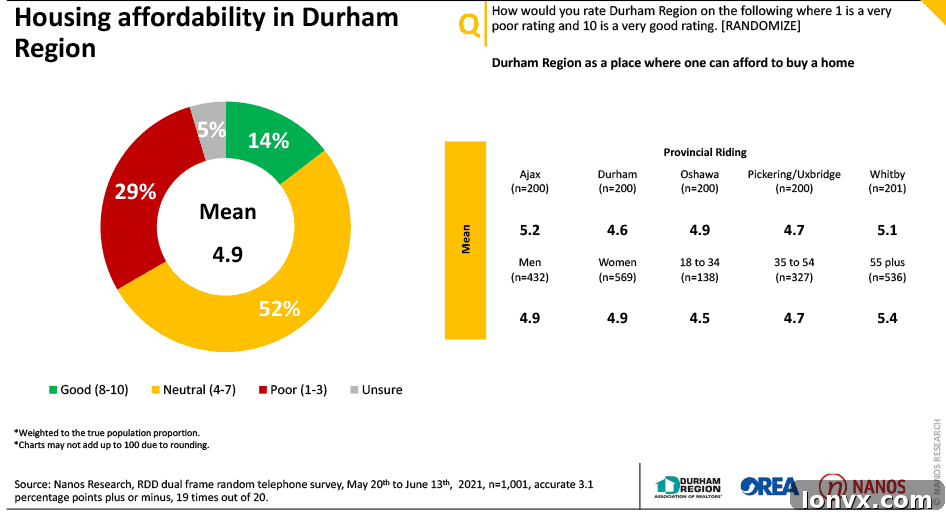
A recent comprehensive survey conducted by Nanos Research on behalf of the Durham Region Association of Realtors (DRAR) has brought into sharp focus the prevailing sentiments of residents regarding life in Durham. The findings underscore a dual reality: while a significant two out of three Durham residents proudly identify the region as an excellent place to raise a family, there is a palpable dissatisfaction with municipal leaders, particularly concerning their perceived inaction on the critical issues of housing affordability and the overall quality of living.
Michael Watson, President of DRAR, emphasizes the imperative for transparency and proactive engagement with the community. “We need to be up front and present the facts to our residents. It’s important to be honest and showcase this information so our residents know what is happening in the region, for us to take necessary steps and raise the concerns to our policymakers,” states Watson, highlighting the association’s commitment to advocating for its members and the broader community.
The Nanos Research survey meticulously delved into several key aspects influencing the lives of Durham residents, including housing dynamics, the healthcare system, the robustness of the job market, the efficiency of the transit network, and, critically, the performance assessment of local leaders. The detailed results paint a nuanced picture:
- Approximately half of Durham residents express satisfaction with municipal leaders’ efforts in addressing the persistent challenge of housing affordability. This statistic, while suggesting some acknowledgment of ongoing work, also implicitly points to a significant portion of the population that remains unconvinced or believes more aggressive action is needed.
- A stark reality for nearly 52 percent of Durham residents is the profound difficulty they encounter when aspiring to own a home within the region. This figure directly reflects the escalating pressures of the housing market, making homeownership an increasingly elusive dream for many.
- Overwhelming support, reaching 66 percent of Durham Region residents, exists for the provincial government’s introduction of a home renovation tax credit. This indicates a strong desire for policies that can help maintain and improve existing housing stock, providing tangible relief to homeowners.
- Even greater consensus is observed for a senior home renovations tax credit, with a remarkable 80 percent of residents in favor. This highlights a community-wide recognition of the need to support seniors in maintaining their homes and promoting aging-in-place initiatives.
- The quality of healthcare services receives a positive rating from 54 percent of Durham residents, suggesting a reasonable level of satisfaction, though still leaving room for improvement given the demands of a growing population.
- Notably, municipal leaders earned an “excellent” rating from Durham Region residents for their decisive and effective handling of the unprecedented COVID-19 pandemic, showcasing their capability to respond robustly to public health crises.
“Durham is a fast-growing region and with more and more people moving to the GTA we need to ensure that individuals are able to afford a place,” Watson reiterates, underscoring the direct correlation between regional growth and the pressing need for housing solutions. He further adds, “The federal government realizes that affordability in Durham Region is an issue and now we need support from our municipal and provincial policymakers to come together and advance this initiative further.” This call to action emphasizes the necessity of a multi-tiered governmental approach to tackle the complex challenges facing Durham’s residential landscape.
Durham Region: A Balancing Act Between Desirability and Development Challenges
Durham Region, a vibrant and rapidly expanding area within the Greater Toronto Area (GTA), is celebrated by its residents for its unique blend of suburban tranquility, access to nature, and proximity to urban centers. The Nanos Research survey for the Durham Region Association of Realtors (DRAR) confirms this sentiment, revealing that a substantial majority of its inhabitants view it as an ideal locale for raising a family. This appeal stems from various factors, including excellent schools, community-focused environments, green spaces, and a relatively less congested lifestyle compared to downtown Toronto. However, this very desirability is fueling rapid growth, bringing with it a unique set of challenges, most notably the escalating crisis of housing affordability and its impact on the region’s overall quality of life.
The Growing Pains of a Desirable Region: Housing Affordability at the Forefront
The survey’s findings on housing affordability are particularly poignant. While many residents appreciate Durham as a place to live, the dream of homeownership is becoming increasingly distant for a significant portion. Over half of Durham residents report considerable difficulty in owning a house, a statistic that resonates deeply within a housing market characterized by soaring prices, limited inventory, and intense competition. This challenge is not merely an economic statistic; it directly impacts the ability of young families to settle, seniors to age in place, and essential workers to live where they serve. Factors contributing to this affordability crunch include a sustained influx of new residents from Toronto and other parts of the GTA seeking more space and perceived value, coupled with supply constraints that struggle to keep pace with demand. Additionally, rising interest rates and speculative investment further exacerbate the situation, pushing homeownership beyond the reach of many.
The perceived inaction of municipal leaders on this critical issue has led to a notable dip in public approval. While roughly half of the residents acknowledge some efforts by local governance to address housing affordability, this figure also implies that the other half remains unconvinced or feels that current measures are insufficient. This discrepancy highlights a gap between policy implementation and public expectation. Residents are not merely seeking incremental changes; they are looking for transformative strategies that can genuinely stabilize the housing market and ensure that Durham remains accessible to all income brackets.
Beyond the Headlines: Understanding the Multifaceted Crisis
The housing crisis in Durham is not monolithic. It encompasses various dimensions, from the scarcity of affordable rental units to the lack of diverse housing types, such as townhouses and stacked homes, which could offer more entry points into the market. Moreover, the planning and approval processes for new developments can be lengthy, further delaying the introduction of much-needed housing stock. This complex interplay of market forces, regulatory frameworks, and demographic shifts creates a challenging environment that demands innovative and collaborative solutions.
Policy Solutions and Public Sentiment: A Call for Action
The Nanos survey not only identified problems but also gauged public support for potential solutions. The overwhelming endorsement for home renovation tax credits, both general (66%) and specifically for seniors (80%), underscores a practical desire among residents to leverage existing housing stock more effectively. Such tax credits could incentivize homeowners to invest in their properties, enhance livability, and potentially increase the longevity and efficiency of homes, deferring the need for new construction or making existing homes more suitable for multi-generational living or rental units. For seniors, these credits are vital, enabling them to make necessary modifications to remain in their homes comfortably and safely, thereby reducing demand on assisted living facilities and fostering stronger community ties.
DRAR President Michael Watson’s call for concerted action from federal, provincial, and municipal policymakers resonates with the multifaceted nature of the housing crisis. Each level of government has a distinct yet interconnected role to play. The federal government can provide critical funding for affordable housing initiatives, implement national housing strategies, and influence lending policies. The provincial government holds significant sway over regional planning, zoning legislation, and the funding of large-scale infrastructure projects that support new developments. Municipalities, at the frontline, are responsible for local zoning bylaws, development approvals, and the provision of essential services that accommodate growth. A lack of coordinated effort across these levels can often lead to bottlenecks and missed opportunities, perpetuating the very issues residents are concerned about.
Quality of Life: A Broader Perspective
While housing dominates the discourse, the Nanos survey also touched upon other crucial elements of quality of life in Durham. The finding that 54 percent of residents rate healthcare positively is encouraging but also suggests that nearly half believe there is room for improvement. In a growing region, maintaining and enhancing healthcare services, including access to family doctors, specialists, and emergency care, is paramount. The continuous influx of residents puts pressure on existing facilities and resources, necessitating strategic investments and planning to ensure healthcare access keeps pace with population growth.
The survey’s mention of the job market and transit system further underscores the holistic view residents have of their quality of life. A robust job market with diverse employment opportunities is essential for economic stability and attracting new talent. Similarly, an efficient and expansive transit system is vital for connecting communities, reducing traffic congestion, improving environmental sustainability, and enhancing accessibility for all residents, particularly those who commute to other parts of the GTA. Investing in public transit can also indirectly contribute to housing affordability by making more distant areas viable for living, thus spreading demand.
Leadership in Crisis: A Glimmer of Hope
One area where Durham’s municipal leaders received unequivocal praise was their handling of the COVID-19 pandemic. The “excellent” rating for their response demonstrates a clear capacity for decisive action, effective communication, and community support during times of crisis. This positive precedent offers a crucial insight: when faced with an undeniable and urgent challenge, leaders in Durham have proven their ability to mobilize resources and implement effective strategies. This success in crisis management can serve as a powerful blueprint for tackling the equally pressing, albeit different, challenge of housing affordability and sustainable growth.
The Path Forward: Collaborative Action for a Sustainable Durham
The findings of the Nanos Research survey present a clear mandate for the Durham Region. To sustain its appeal as an excellent place to raise a family, while effectively managing its rapid growth, leaders must adopt a proactive, transparent, and collaborative approach. Addressing housing affordability requires a multi-pronged strategy that includes accelerating housing supply, diversifying housing types, exploring innovative financing models, and implementing supportive policies like renovation tax credits. Furthermore, continuous investment in healthcare, transit, and job creation will be crucial to maintaining and enhancing the overall quality of life for all residents.
Associations like DRAR play a pivotal role in this dialogue by providing essential data, advocating for policy changes, and fostering communication between residents, industry stakeholders, and policymakers. The future of Durham Region hinges on the ability of its leaders, at all levels of government, to come together with community members and implement comprehensive strategies that ensure the region remains not just a desirable place to live, but an affordable and thriving community for generations to come. The challenge is significant, but with collective will and strategic action, Durham can successfully navigate its growth trajectory and emerge as a stronger, more equitable region.