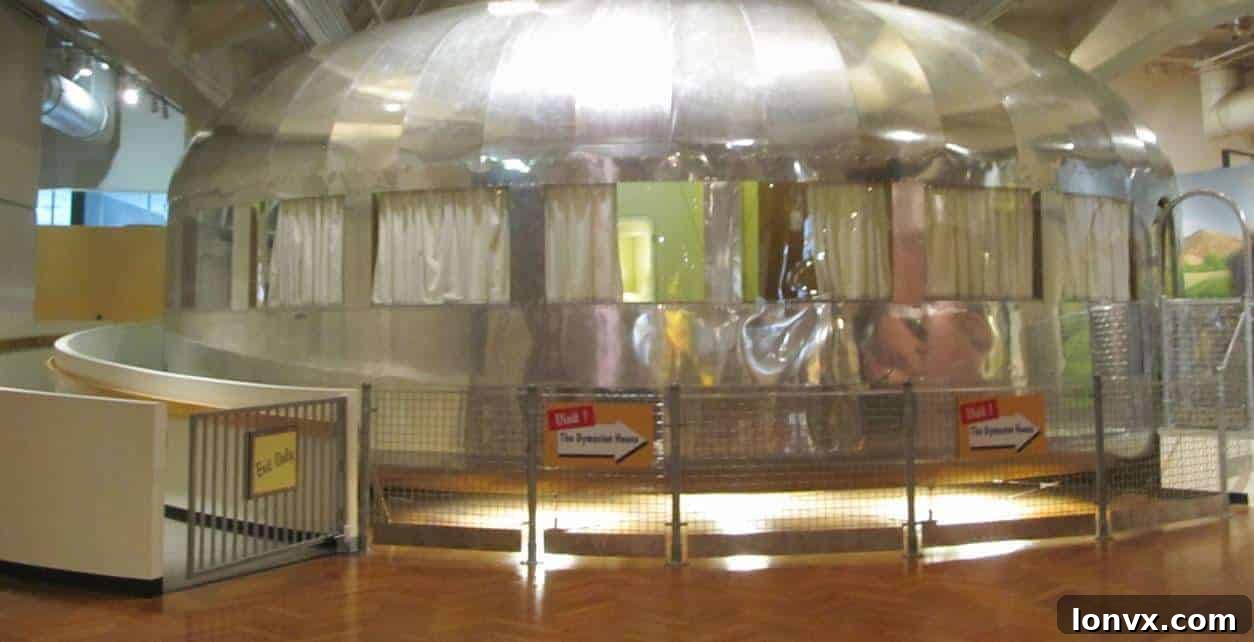
In an era defined by conventional architecture, a revolutionary dwelling emerged, captivating imaginations with its peculiar yet profound design. Resembling a colossal Hershey’s Kiss, boasting the reflective sheen of an Airstream trailer, and bearing a name as memorable as a household product, the Dymaxion House was much more than just a home; it was a bold declaration of the future, envisioned by the avant-garde architect, inventor, and futurist R. Buckminster Fuller. Conceived in 1946, Fuller’s ambition was clear: to create “the strongest, lightest, and most cost-effective housing ever built,” a paradigm shift in residential architecture that sought to redefine our relationship with shelter and resources.
At the heart of the Dymaxion House lay a singular, groundbreaking principle that guided every aspect of its design: “do more with less.” This philosophy, profoundly novel for its time, represented a radical departure from the prevailing consumerist ethos. As Steve Harris, a knowledgeable guide at The Henry Ford Museum of American Innovation in Dearborn, Michigan, points out, where the only full-scale prototype of the Dymaxion House now stands, Fuller’s vision was one of profound efficiency and resourcefulness. In an America burgeoning with post-war prosperity and a drive towards abundance, the idea of conservation and maximal output from minimal input was truly ahead of its time, setting the Dymaxion House apart as a prophetic beacon of sustainable living.
The Dymaxion House’s innovative spirit began with its very structure. Unlike traditional homes built with heavy, labor-intensive materials, this futuristic dwelling embraced lightweight construction without compromising strength. Weighing in at less than three tons, a fraction of a conventional house, it was designed for rapid assembly and efficient transport. Despite its lightness, the Dymaxion House was incredibly robust, engineered to withstand the most extreme weather conditions, including hurricane-force winds up to an astonishing 180 miles per hour. This unparalleled durability, combined with its lightweight nature, underscored Fuller’s genius in material science and structural engineering, demonstrating that efficiency did not necessitate fragility.
One of its most ingenious external features was a sophisticated ventilator system positioned at the apex of the house. This design was meticulously crafted to drastically reduce both heating costs in winter and cooling expenses in summer. By actively drawing in fresh air while skillfully keeping harsh winds at bay, the system ensured optimal indoor climate control. Fuller famously boasted of “a complete air change every six minutes,” a testament to the home’s superior ventilation, guaranteeing a constantly refreshed and healthy living environment. This passive energy management system was a precursor to modern green building techniques, long before such concepts gained mainstream traction.
The living room of the Dymaxion House.
Stepping inside the Dymaxion House, visitors are greeted by a realm of unparalleled interior innovation, all encased within its gleaming aluminum shell. Fuller’s meticulous attention to maximizing space and functionality is evident in every detail. Revolving closets and rotating storage bins, for instance, were designed to display clothes and belongings with a mere push of a button, transforming cluttered spaces into organized, accessible areas. These ingenious mechanisms anticipated contemporary smart home solutions and modular furniture, demonstrating a forward-thinking approach to living efficiency.
The bathroom, though compact, was another marvel of advanced design. It featured a mist-releasing “fog shower,” a revolutionary concept that conserved water by atomizing it into a fine spray, providing a refreshing cleanse with minimal consumption. Even more radical was the toilet, engineered to shrink-wrap waste for composting – an early, albeit bold, foray into sustainable waste management. While a guide at the museum candidly admits the tiny bathroom might appear somewhat “dingy” by today’s standards, they quickly contextualize its significance: “Don’t forget most people had outhouses back then. This would’ve been an improvement.” Indeed, for its time, the Dymaxion House offered a level of domestic convenience and hygiene far superior to what was common, merging innovation with an unprecedented commitment to ecological responsibility.
Beyond its physical attributes, the Dymaxion House was also conceived with economic accessibility in mind. Fuller aimed to produce these homes at a cost lower than that of a luxury automobile, making advanced, sustainable living attainable for a broader demographic. This vision of affordable, high-quality, and environmentally conscious housing underscored Fuller’s belief that innovation should serve humanity broadly, not just an elite few. Its round, aerodynamic shape was not merely aesthetic; it was a fundamental energy-saving strategy. This dome structure required 30 percent less material than a square dwelling of equivalent enclosed volume, leading to a potential 30 percent energy saving due to reduced surface area exposure to external elements. The abundance of windows, far from being an aesthetic extravagance, was another intentional energy conservation strategy, allowing generous natural light to flood the interior, thereby reducing the need for artificial lighting.
A view of the kitchen of the Dymaxion House.
Despite its ingenious innovations and visionary design, the Dymaxion House never achieved commercial success. Its failure to launch into mass production offers a fascinating case study in market readiness and societal values. As Steve Harris explains, “no one cared about conserving resources in 1940s America.” The post-World War II era was characterized by an economic boom, a surge in suburban development, and an emphasis on traditional, expansive homes. The concept of “doing more with less” and environmental conservation simply did not resonate with the prevailing consumer mindset, which prioritized quantity and conventional aesthetics over efficiency and sustainability.
Attracting investors proved to be another formidable hurdle. Harris recounts the challenge: “They weren’t about to fund a company that was proposing this thing that looks sort of like an aluminum teapot with too many windows.” The Dymaxion House’s unconventional appearance, while functionally brilliant, was aesthetically jarring to a public accustomed to rectangular, brick-and-mortar structures. The radical departure from traditional home design made it a hard sell for financial backing. Furthermore, the lack of an existing infrastructure for manufacturing, distributing, and assembling such a novel housing concept presented significant logistical and financial challenges. Fuller’s vision was so far ahead of its time that the supporting industries and supply chains simply did not exist to bring it to fruition on a grand scale.
According to the museum’s extensive literature, Fuller himself eventually abandoned the project, reportedly due to unresolved engineering challenges. While the exact nature of these challenges remains a subject of historical debate, it’s plausible they involved the complexities of scaling up production, integrating plumbing and electrical systems into a prefabricated modular design, or addressing the unforeseen practicalities of mass market adoption. Yet, despite these setbacks, the Dymaxion House generated immense public interest, evidenced by the thousands of unsolicited orders it received. This grassroots enthusiasm hinted at a nascent appreciation for its unique qualities, even if the broader market and investment community weren’t yet ready to embrace it.
The Dymaxion House’s fascinating journey continued even after Fuller’s direct involvement ceased. William Graham, a former employee of Fuller Houses Inc., became the only individual and his family ever to have lived in a Dymaxion home. Graham purchased components of the house and meticulously reassembled them, integrating the innovative structure as an extension to his existing ranch dwelling near Andover, Kansas. This personal adaptation underscored the Dymaxion House’s modularity and adaptability, proving its viability as a functional living space.
After Graham’s passing, his family recognized the historical significance of their unique home and generously donated it to The Henry Ford Museum. The museum embarked on an ambitious and painstaking restoration project, dedicating two years and an estimated $1 million to bring the Dymaxion House back to its original glory. This monumental undertaking involved the careful analysis and reconstruction of more than 3,600 parts, all meticulously referenced against Fuller’s original designs and specifications. Today, the Dymaxion House that visitors experience at The Henry Ford is a true testament to historical preservation, comprising an impressive 70 percent original material, offering an authentic glimpse into Fuller’s revolutionary mind.
The Dymaxion House, with its groundbreaking technological innovations, pioneering use of industrial materials, and profound commitment to efficiency, was unequivocally ahead of its time. Although it never achieved mass production, its profound influence resonated far beyond the confines of architecture. The ideas it championed—prefabrication, resource conservation, lightweight construction, and holistic design—inspired innovators across various fields. Furthermore, the Dymaxion House served as a crucial stepping stone in Buckminster Fuller’s illustrious career, leading directly to other landmark projects that solidified his legacy as one of the 20th century’s most influential thinkers. Chief among these was the creation of the monumental 20-story-high geodesic dome, which famously served as the U.S. pavilion at Expo 67 in Montreal, a structure that encapsulated Fuller’s principles of doing “more with less” on a grand, public scale.
It is a poetic twist of fate that the conservation-minded architect would have undoubtedly appreciated the ultimate destiny of his iconic geodesic dome. Today, that very structure in Montreal houses the Biosphere, an environment museum dedicated to understanding and preserving our planet. This transformation perfectly aligns with Fuller’s lifelong dedication to ecological stewardship and sustainable futures. As for the Dymaxion House itself, its place in history is secure. “This is one of our treasures at The Henry Ford,” affirms Steve Harris, encapsulating its enduring value not just as an architectural marvel, but as a timeless symbol of human ingenuity, forward-thinking design, and an unwavering commitment to a more efficient and sustainable world.