Quebec Real Estate Market Navigates Normalization: A Comprehensive 2023 Review
The Quebec Professional Association of Real Estate Brokers (QPAREB) has released its comprehensive report for 2023, shedding light on a year of significant adjustments and evolving dynamics within the province’s residential property market. The report indicates a total of 75,853 residential sales across Quebec last year, marking a notable 13% decrease compared to the transaction volume recorded in 2022. This figure also places 2023 sales slightly below the historical average, signaling a period of recalibration after the frenetic pace of previous years.
Charles Brant, QPAREB’s market analysis director, eloquently described 2023 as a year characterized by an “orderly normalization.” This crucial insight underscores the market’s response to the pronounced economic shifts, particularly the aggressive interest rate hikes that commenced in 2022. These rate adjustments have had a differential impact across various buyer segments. Younger households, often first-time homebuyers, have borne the brunt of rapidly escalating prices and increased borrowing costs, challenging their entry into the market. In contrast, repeat buyers, typically fortified by accumulated equity and stronger financial capacities, demonstrated greater resilience in navigating these property value increases. Brant emphasizes a critical point: the reduction in the pool of qualified first-time homebuyers can significantly impede the transactional chain, stressing that a fluid and healthy market inherently relies on a sufficient influx of new buyers.
Understanding the Forces Shaping Quebec’s Real Estate
The journey through 2023 for Quebec’s real estate market was undoubtedly complex, influenced by a confluence of economic factors. The “brutal hike in interest rates” mentioned by Brant served as a primary catalyst, directly impacting mortgage affordability and subsequently, buyer demand. Higher interest rates translate to larger monthly payments, effectively shrinking the purchasing power of many prospective buyers, particularly those with less established financial positions. This environment forced many to reassess their timelines, budgets, or even postpone their homeownership aspirations.
For first-time homebuyers, who are often stretching their budgets to enter the market, increased interest rates combined with already elevated property prices created a formidable barrier. Their reduced participation has a ripple effect, slowing down the entire market as fewer initial sales mean fewer subsequent moves for existing homeowners. Conversely, repeat buyers, who typically benefit from equity built up in their current homes, were better positioned to absorb the higher costs. This segment often experiences a less direct impact from rising rates, as their larger down payments can mitigate the overall loan amount, making them more resilient to market fluctuations.
Last Year’s Q4 Insights: Fewer First-Time Buyers, Low Sales, and Inventory Challenges
The fourth quarter of 2023 provided a clear reflection of these evolving market dynamics, showing an even more pronounced scarcity of first-time homebuyers. Charles Brant elaborated on the two principal factors contributing to this trend: a pervasive climate of economic uncertainty and the widespread anticipation of interest rate reductions in 2024. Many potential buyers chose to adopt a wait-and-see approach, hoping for more favorable borrowing conditions in the near future. This cautious sentiment wasn’t confined to buyers alone; sellers too exhibited similar behavior, noting the increased hesitation among prospective purchasers. Consequently, many sellers opted to delay their listing plans, holding off until market conditions seemed more conducive to achieving their desired sale outcomes.
This collective hesitation led to the year concluding with a notably low level of transactions and a relatively limited number of properties available for sale. The net effect was a market experiencing stagnation, steadfastly remaining within what is termed “sellers’ territory.” Despite slower activity, the persistent imbalance between demand and the tight supply of desirable properties meant that sellers largely maintained the upper hand. As a result, property prices across the province generally remained under upward pressure or stayed stable, resisting significant declines. Price reductions were a rare occurrence, observed almost exclusively in very specific, often high-value, markets.
Sales Performance and Active Listings Across Quebec
The slowdown in sales activity permeated all property types across Quebec, albeit with varying degrees of impact. The most significant decline was observed in two-to-five-unit plexes, which experienced a sharp 21% reduction in sales. This segment, often appealing to investors, is particularly sensitive to financing costs and rental market dynamics. Condominiums followed with a 15% decrease in sales, while single-family homes saw a more modest, though still significant, 10% decline. These figures highlight a province-wide trend of cautious purchasing, where rising costs deterred buyers across diverse housing categories.
Geographically, some of Quebec’s largest metropolitan areas recorded the steepest sales declines. Gatineau led with a 15% drop, closely followed by Montreal and Sherbrooke, both experiencing a 14% decrease. This trend suggests that urban centers, often characterized by higher property values and more competitive markets, were more susceptible to the cooling effects of interest rate hikes and economic uncertainty. These areas typically see a higher concentration of first-time buyers and investment activity, both of which were significantly impacted in 2023.
While the broader trend pointed downwards, regional markets showcased interesting divergences. La Tuque and Charlevoix witnessed substantial declines of 36% and 25% respectively, potentially reflecting localized economic factors, demographic shifts, or reduced secondary home demand. Conversely, some markets demonstrated resilience, and even growth, such as Sainte-Adèle, which saw a modest 1% increase in sales, and Montmagny, which surged by 8%. These contrasting performances underscore the nuanced nature of Quebec’s vast real estate landscape, where localized conditions can defy broader provincial trends.
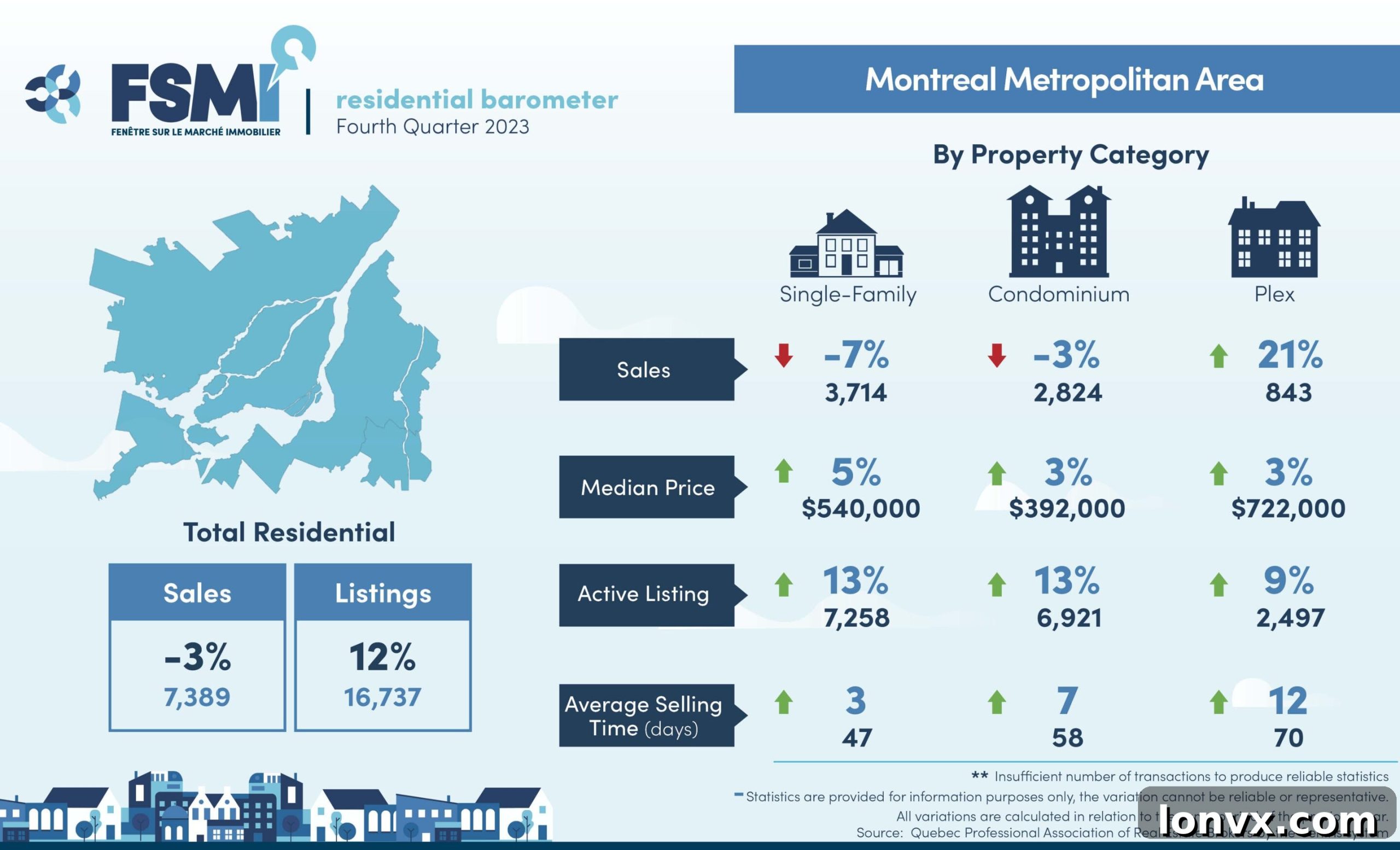
Despite the overall slowdown in sales, 2023 also brought a welcome, albeit modest, increase in inventory across the province. The number of active listings rose by 24%, reaching a total of 32,154 properties. While this represents a significant increase from recent lows, it’s crucial to note that this figure still remains considerably below the historical average. This limited supply continues to underpin the market’s underlying strength for sellers, preventing a dramatic shift towards a buyer’s market despite reduced transaction volumes. The gradual replenishment of inventory is a positive sign for market rebalancing, yet it has not yet reached a level that would substantially ease price pressures.
Property Price Evolution: Stability Amidst Uncertainty
In terms of pricing, 2023 demonstrated remarkable stability, particularly for single-family homes. The median price for a single-family home across Quebec remained unchanged from 2022, holding firm at $416,500. This resilience highlights the enduring demand and limited supply in this segment, even in a challenging economic climate. Condominiums experienced a slight adjustment, with their median price dropping marginally to $360,000, representing approximately a 1% decrease from 2022 levels. This minimal fluctuation in prices, especially in the face of significant interest rate hikes, reinforces the notion of an orderly market normalization rather than a sharp correction.
The stability in median prices indicates that while transaction volumes have decreased, the value of properties has largely been maintained. This is a crucial distinction, suggesting that sellers who entered the market were not forced into drastic price reductions. Instead, the market adjusted through fewer sales, longer selling times, and a more cautious approach from both buyers and sellers, rather than widespread price depreciation. The slight dip in condominium prices could be attributed to a relatively higher supply in certain urban areas or perhaps a greater sensitivity of condo buyers to affordability constraints.
Market Conditions: The Enduring Seller’s Advantage
Despite the slower activity and a noticeable increase in active listings, the Quebec real estate market largely remained in favor of sellers throughout 2023. This seemingly counterintuitive situation arises from the fact that while more properties were available, the underlying demand, coupled with still-below-average inventory levels, prevented a dramatic power shift. The time required to sell inventory, a key metric for market balance, increased to 5.1 months. While an increase from the rapid turnover of previous years, this figure still suggests a market that is not yet fully balanced, where inventory levels are not excessive.
The average selling time for single-family homes in 2023 extended to 54 days, a significant increase of 13 days compared to 2022. This elongation of the sales cycle means sellers needed to be more patient and strategic. Condominiums took an average of 58 days to sell, while small-income properties, such as duplexes and triplexes, required the longest selling period at 75 days. These extended timelines reflect a market where buyers are taking more time for due diligence, are less inclined to engage in bidding wars, and have more options, even if the overall supply remains constrained. For sellers, it means a greater emphasis on competitive pricing and effective marketing strategies to attract qualified buyers in a less frenzied environment.
Outlook for the Quebec Real Estate Market in 2024
Looking ahead to 2024, the Quebec real estate market is poised for continued evolution. The widespread expectation of potential interest rate cuts later in the year could serve as a significant catalyst, potentially reigniting buyer confidence and drawing hesitant first-time homebuyers back into the market. A reduction in borrowing costs would directly improve affordability, making homeownership more accessible and potentially stimulating transactional activity. However, economic uncertainty, including inflation trends and global events, will continue to play a crucial role in shaping market sentiment. The gradual increase in inventory, while still below historical averages, could also contribute to a more balanced market over time, offering buyers more choices and potentially moderating price growth. Navigating these dynamics will require vigilance from both market participants and observers, as Quebec’s housing landscape continues its journey of normalization and adaptation.
For more detailed information and ongoing updates on the Quebec real estate market, please visit the official QPAREB resources here.
Enjoying this article?
Get the latest REM articles in your inbox 3x week so you stay up to date on the latest in the Canadian real estate industry.