
The Canadian housing market presents a formidable challenge for aspiring homeowners, whether they are single individuals or couples embarking on their first property purchase. This difficulty is particularly pronounced in 16 major Canadian cities where benchmark home prices have surged well beyond the $1 million mark, creating an intimidating barrier to entry for many. While the dream of homeownership often feels distant, a comprehensive study conducted by Point2 offers a glimmer of hope, revealing nuanced dynamics within various markets. The research suggests that in certain regions, both single and coupled first-time buyers might have a remarkably similar chance of acquiring a home without enduring decades of saving or facing insurmountable financial strain.
This detailed analysis by Point2 sheds light on the stark disparities and unexpected opportunities within Canada’s diverse real estate landscape. It highlights not only the monumental effort required to save for a down payment but also how geographical location, income levels, and household structure dramatically influence the journey towards owning a piece of the Canadian dream. Understanding these findings is crucial for anyone looking to navigate the complexities of the current market and make informed decisions about their homeownership aspirations.
The Unbalanced Equation: Savings Time for Singles vs. Couples
One of the most striking revelations from the Point2 study is the significant difference in the time it takes for single homebuyers to save for a starter home compared to their coupled counterparts. Across Canada, the average saving time is approximately four years for couples, a figure that pales in comparison to the staggering 29 years required for single individuals. This immense disparity underscores the financial advantage of dual-income households, which can pool resources, share living expenses, and collectively accumulate a down payment at a much faster rate.
The timeframe required for saving is not uniform across the nation; it fluctuates wildly depending on the specific Canadian city. For single buyers aiming to cover an affordable bank loan for a starter home, the saving period can range from a relatively manageable three years to an almost insurmountable 75 years. This vast range highlights extreme market variations and income-to-housing-cost ratios. In stark contrast, couples in 11 of Canada’s largest and most affordable cities might find themselves able to save for a starter home in as little as two years. These cities often feature a more balanced real estate market, where median incomes align more closely with housing costs, allowing for quicker accumulation of savings. This fundamental difference in saving capacity often dictates whether homeownership remains a tangible goal or becomes a perpetually deferred dream.
Geographic Divide: Where Homeownership is More Attainable
The Point2 study reveals a fascinating geographic patchwork across Canada, with some cities offering a more equitable path to homeownership for both singles and couples, while others present formidable barriers. In places like Strathcona County, Alberta; Regina, Saskatchewan; and Lévis, Quebec, the gap in saving time between singles and couples is notably minimal. This makes homeownership a realistic and relatively short-term goal for both demographic groups. These cities often benefit from a combination of factors: more affordable housing prices, stable local economies that support a broader range of incomes, and a potentially less competitive market driven by external speculative investment.
The equilibrium found in these regions allows single individuals to achieve their homeownership dreams without facing the decades-long wait observed elsewhere. This balance reflects a healthier housing ecosystem where supply meets demand more effectively, and local incomes have not been drastically outpaced by property values. For many, these cities represent a viable alternative to the overheated markets, offering a chance to build equity and establish roots without being forced into extreme financial sacrifices.
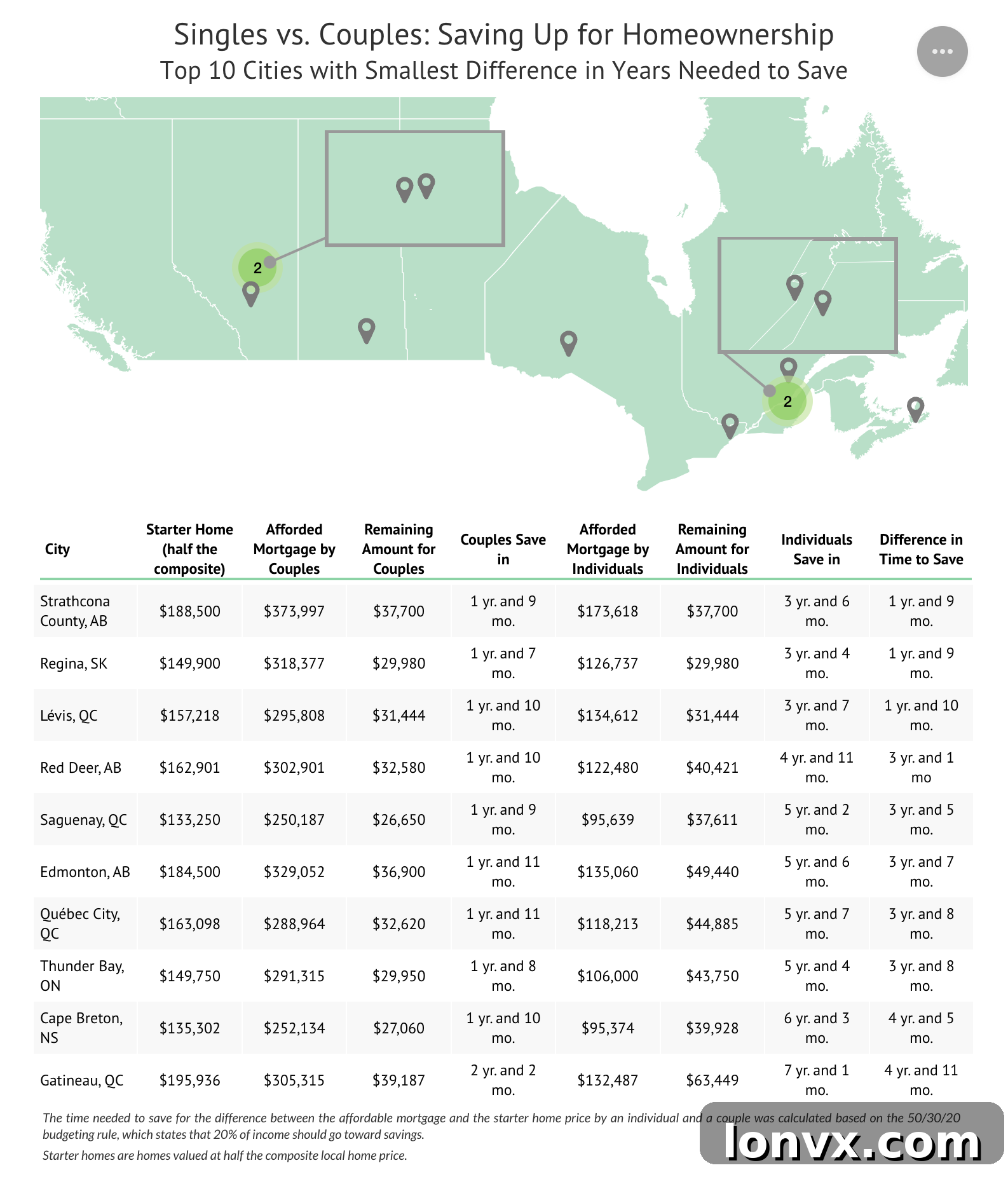
Source: Point2
Conversely, the study identifies several cities in Ontario, such as Richmond Hill, Newmarket, and Vaughan, where the disparities in saving timeframes are alarmingly wide. In these areas, single buyers face a significantly tougher uphill battle, potentially requiring up to 50 years longer than couples to save for a home. These municipalities, often part of the greater Toronto Area (GTA) or its immediate periphery, are characterized by intense demand, limited housing supply, and robust economic activity that, paradoxically, drives up housing costs. The proximity to major economic hubs, coupled with an influx of population, fuels a highly competitive market where property values escalate rapidly.
For a single individual in these markets, the prospect of homeownership can feel almost insurmountable. High average incomes in these cities are often insufficient to keep pace with the exponential growth in housing prices, especially when a single income needs to cover all expenses and savings. This creates a challenging environment where even well-paying jobs may not be enough to bridge the savings gap, pushing many single prospective buyers further out into more distant communities or forcing them to indefinitely delay their homeownership plans.
The Income Paradox: High Salaries Meet High Prices
The Point2 study highlights a peculiar “catch-22” within the Canadian housing market: cities that offer the highest incomes often also boast the most expensive homes. This disparity creates a challenging environment where, despite earning a good salary, buyers find their purchasing power eroded by disproportionately high property values. While high-income cities promise better career opportunities and robust economic growth, the cost of living, particularly housing, frequently negates much of the financial advantage.
Furthermore, while many couples technically possess the ability to save faster than singles due to combined incomes, they often face a different set of financial considerations. Couples frequently seek larger homes to accommodate two people, or eventually a growing family. A larger home naturally comes with a higher price tag, increased property taxes, and greater maintenance costs. Thus, even with a quicker saving trajectory, couples might find themselves needing a significantly larger down payment and a more substantial mortgage. This dynamic introduces a complex interplay: the advantage of dual income for saving might be partially offset by the increased demand for a more spacious and costly property, making the path to homeownership a nuanced journey for every household configuration.
Navigating the $1 Million+ Market
A significant portion of the Canadian housing challenge is concentrated in 16 major cities where benchmark home prices consistently exceed $1 million. These markets represent the pinnacle of housing unaffordability, posing immense challenges for both single and coupled homebuyers alike. In these ultra-expensive urban centers, the dream of finding an accessible “starter home” often transforms into a prolonged, frustrating search, frequently yielding limited and financially daunting options.
The sheer scale of prices in these cities means that even a substantial down payment might only cover a small fraction of the total cost, leading to very large mortgage commitments. For first-time buyers, this necessitates an incredibly disciplined saving strategy, often involving years of aggressive budgeting, delaying other life milestones, or relying on financial assistance from family. The competition for available properties, even modest ones, is fierce, with multiple offers and bidding wars becoming the norm. This environment not only inflates prices but also creates significant emotional and psychological stress for aspiring homeowners. Many are forced to compromise on location, size, or type of home, or delay their entry into the market indefinitely, watching as prices continue to climb, further widening the gap between their savings and market realities. These cities force a re-evaluation of what homeownership means and what sacrifices are acceptable to achieve it.
The Elusive Starter Home
Beyond the high prices, first-time buyers in highly populated urban centers face another significant obstacle: the scarcity of starter homes. A starter home, traditionally a smaller, more affordable property designed for entry-level buyers, is becoming an increasingly rare commodity. This scarcity adds another layer of difficulty to an already challenging housing market, effectively pushing many aspiring homeowners out of urban areas or delaying their entry into property ownership.
Several factors contribute to this dwindling supply. Zoning regulations in many cities prioritize large, single-family dwellings or high-density luxury apartments over smaller, more affordable options. Developers, driven by profit margins, often focus on building larger, more expensive units that yield higher returns, rather than entry-level homes. Furthermore, older, smaller homes that once served as traditional starter properties are frequently targeted for demolition to make way for larger, more modern constructions, or they are snapped up by investors for rental purposes, further reducing the stock available to owner-occupiers. This lack of suitable entry points means that first-time buyers are either forced to compete for a limited pool of properties at inflated prices or look to distant suburban or rural areas, often necessitating longer commutes and a detachment from urban amenities.
Strategies for Aspiring Homeowners in a Competitive Market
Despite the daunting statistics, aspiring homeowners are not without options. Strategic planning and a flexible approach can significantly improve the chances of entering the Canadian housing market. For singles and couples alike, a robust financial plan is paramount. This involves meticulous budgeting, aggressive debt reduction, and exploring various down payment strategies. Government programs, such as the First Home Savings Account (FHSA) and the Home Buyers’ Plan (HBP) through Registered Retirement Savings Plans (RRSPs), offer valuable avenues for tax-advantaged savings and down payment access. Understanding and utilizing these resources can provide a crucial edge in accumulating the necessary funds more quickly.
Market research is equally vital. While major urban centers often capture headlines, exploring alternative locations can yield surprising opportunities. Considering properties in commutable distances from major cities or in smaller towns and secondary markets can reveal more affordable options. These areas may offer a more balanced market where the cost-to-income ratio is more favorable, providing a gentler entry point into homeownership. Staying informed about local market trends, upcoming developments, and community growth plans can help identify emerging opportunities before they become overheated.
Furthermore, embracing creative housing solutions can open doors that traditional ownership might keep shut. Co-ownership, where two or more individuals (friends, siblings, or even unrelated parties) purchase a property together, is gaining traction as a way to pool resources and split costs. Shared equity programs, offered by some provincial governments or non-profit organizations, allow buyers to purchase a home with a smaller down payment in exchange for a share of the home’s future appreciation. Considering different housing types, such as condominiums or townhouses, which are often more affordable than detached homes, can also be a pragmatic first step, allowing buyers to build equity before potentially moving to a larger property in the future. Flexibility, creativity, and persistent research are key attributes for successful first-time homebuyers in today’s dynamic Canadian market.
Policy and Future Outlook: Shaping Canada’s Housing Landscape
The challenges highlighted by the Point2 study underscore the urgent need for comprehensive policy interventions to address Canada’s housing affordability crisis. Governments at all levels are increasingly under pressure to implement measures that increase housing supply, curb speculative buying, and ensure a more equitable path to homeownership. Potential policy solutions include streamlining zoning and permitting processes to accelerate construction, incentivizing the development of affordable housing units, and exploring innovative financial instruments to assist first-time buyers. Additionally, discussions around land value taxes, vacancy taxes, and tighter regulations on non-resident ownership aim to cool overheated markets and ensure housing serves as shelter rather than primarily an investment vehicle.
Looking ahead, several trends are poised to further shape the Canadian housing market. The continued rise of remote work could decentralize population density, potentially making smaller cities and rural areas more attractive and viable for homeownership. Demographic shifts, including an aging population and continued immigration, will influence both demand and the types of housing needed. Interest rate environments will continue to play a critical role, affecting mortgage affordability and borrowing capacity. Understanding these broader economic and social forces is essential for both policymakers crafting solutions and individuals making long-term financial plans.
In conclusion, the Point2 study provides an invaluable snapshot of the Canadian housing market, revealing the significant disparities between singles and couples in their quest for homeownership. While the road ahead remains challenging, particularly in the most expensive cities, hope is not lost. By understanding market dynamics, leveraging strategic financial planning, and exploring alternative solutions, aspiring homeowners can navigate these complexities. The journey to homeownership in Canada requires resilience, adaptability, and a proactive approach, but with informed decisions and appropriate support, the dream remains attainable for many.
Read the full study here.
Enjoying this article?
Get the latest real estate articles in your inbox 3x week so you stay up to date on the latest in the Canadian real estate industry