GTA Real Estate Market Shifts: Navigating the New Normal in June 2025
The Greater Toronto Area (GTA) housing market is currently undergoing significant transformations, and for those closely monitoring the trends, these shifts in June 2025 come as no great surprise. After years of unprecedented volatility, the market is settling into a more deliberate, albeit cautious, rhythm. Key indicators from the latest market reports paint a clear picture of an evolving landscape:
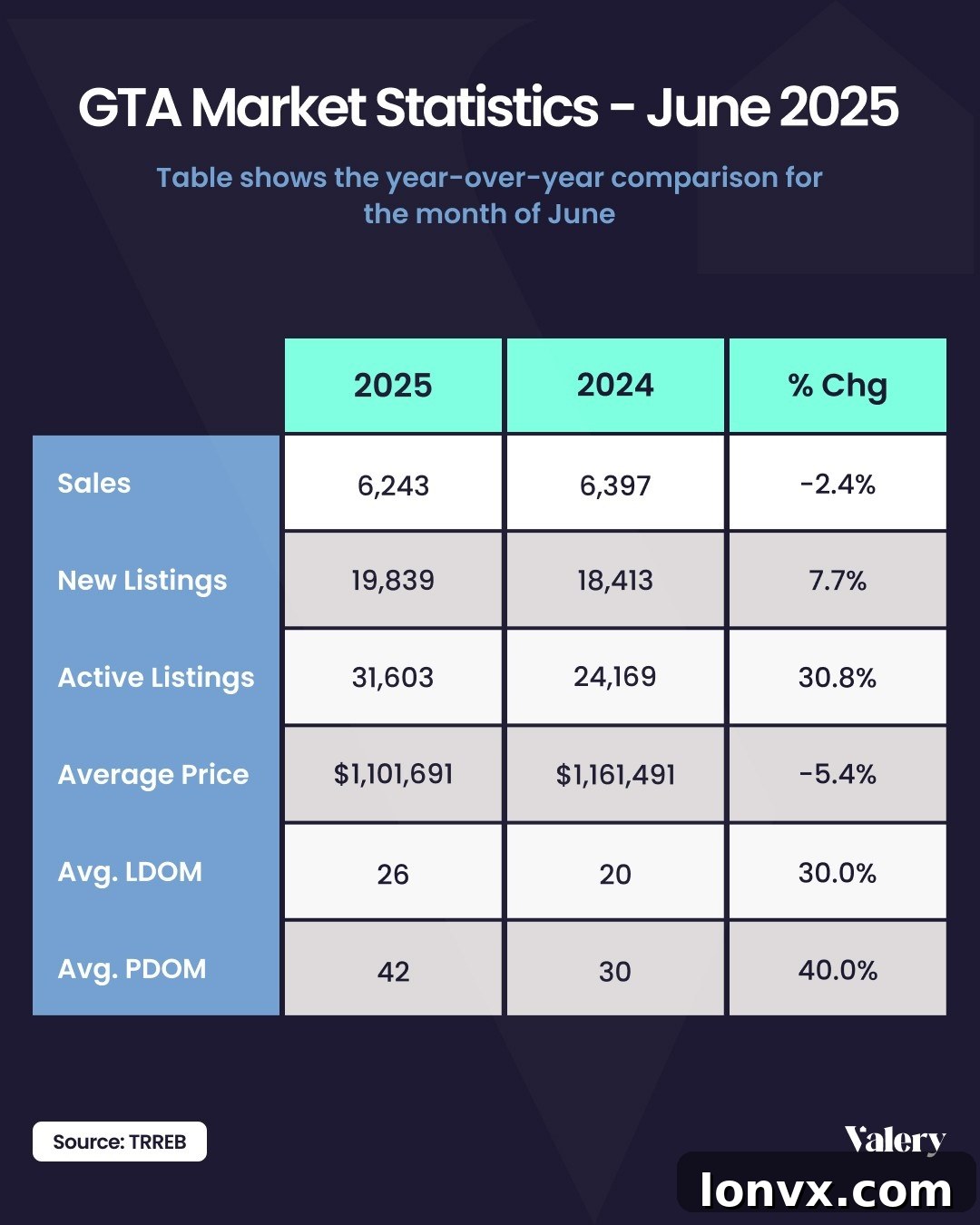
- Average home prices in the GTA have seen a notable decline of 5.4 percent compared to the previous year.
- Overall sales volumes have decreased by a modest 2.4 percent, suggesting a slowdown in transaction pace.
- New listings entering the market have increased by 7.7 percent, providing buyers with more options.
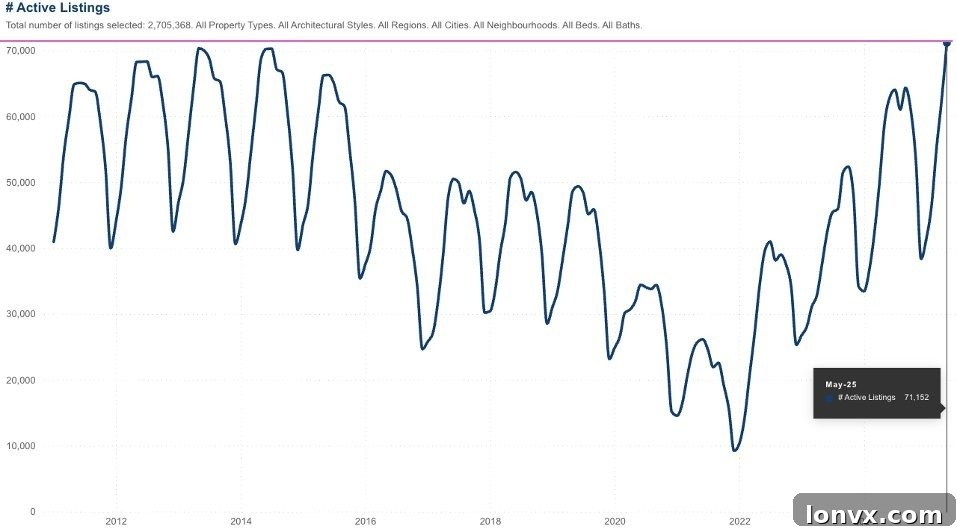
- Perhaps the most striking figure is the substantial 30.8 percent surge in active listings, signaling a significant expansion of available inventory.
- Properties are spending considerably more time on the market, with an increase of 30 to 40 percent in the average days on market.
This dramatic increase in active listings is particularly noteworthy. We are now witnessing the highest number of available properties in the GTA’s history, a stark contrast to the supply-constrained environment of recent years. This abundance of choice fundamentally alters the dynamics between buyers and sellers, shifting leverage toward the purchasing side.
Forecasting the Future: A Look Back at Predictions
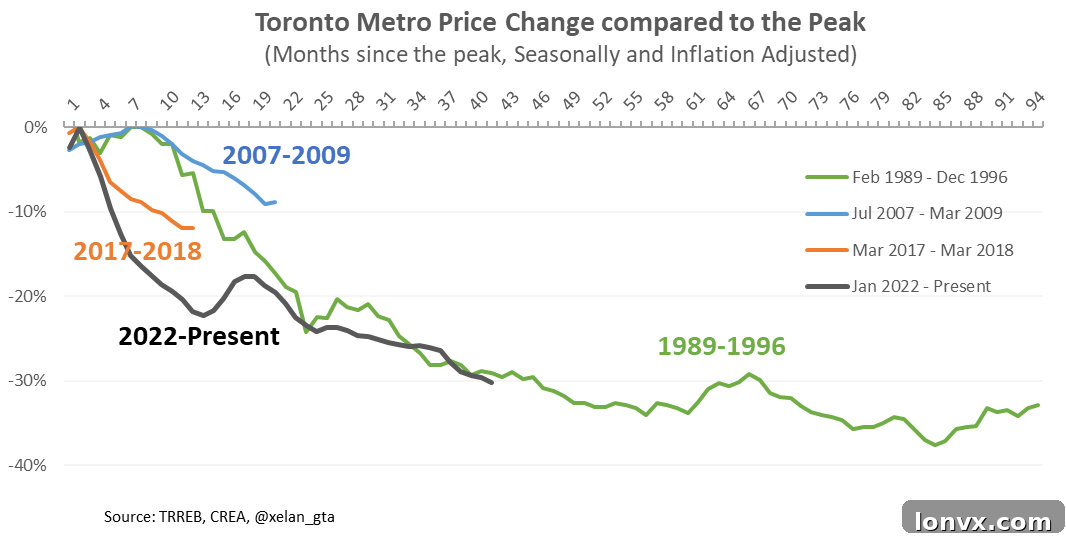
For those who have followed my analyses over the years, my lack of surprise regarding these market shifts might resonate. I have long maintained that Canada’s inevitable real estate downturn would bear a strong resemblance to the one experienced in the 1990s. This isn’t an attempt at self-congratulation, but rather a reflection on a consistent viewpoint expressed since the market’s peak in 2017.
Indeed, for several years, my predictions seemed premature:
Wrong – 2019, 2020, 2021, 2022
Right – 2023, 2024, 2025
One could argue that 2018 might have followed a similar trajectory had it not been for the unprecedented global pandemic and the subsequent policy response of ultra-low overnight rates at 0.25 percent. However, as the current market unfolds, it appears the long-term forecast is finally aligning with reality. This unfolding scenario reinforces the idea that market corrections, though sometimes delayed by external factors, eventually assert themselves. A significant acknowledgement goes to Xelan, whose insightful commentary and charts provide valuable vindication for this long-held perspective.
The GTA Housing Market’s Uneasy Calm: Beyond Volatility
The Greater Toronto Area housing market has decidedly moved beyond the frenzied pace and dramatic price swings that characterized the pandemic era. The days of rapid transactions, bidding wars, and dizzying price discovery are now distant memories. In their place, we observe a more measured and deliberate market. Buyers are taking their time to assess opportunities, sellers are adapting their expectations to new conditions, and policymakers are observing cautiously from the sidelines, ready to intervene if necessary.
June’s TRREB Market Watch report illustrates a market in a state of gradual adjustment, not stagnation. Prices have softened, inventory has expanded significantly, and while mortgage rates remain elevated, there have been hints of optimism among buyers. Yet, this optimism is tempered by a critical underlying tension.
The Mortgage Rate Conundrum: Buyer Expectations vs. Lender Outlook
A curious standoff has developed between prospective homebuyers and the financial institutions that lend to them. On one side, buyers are unequivocally signaling their expectation for further reductions in mortgage rates. This sentiment is evident in their shifting demand towards shorter-term fixed-rate and variable-rate mortgages, a strategic move to position themselves to benefit from anticipated future rate cuts. They are betting on a more favorable interest rate environment just around the corner.
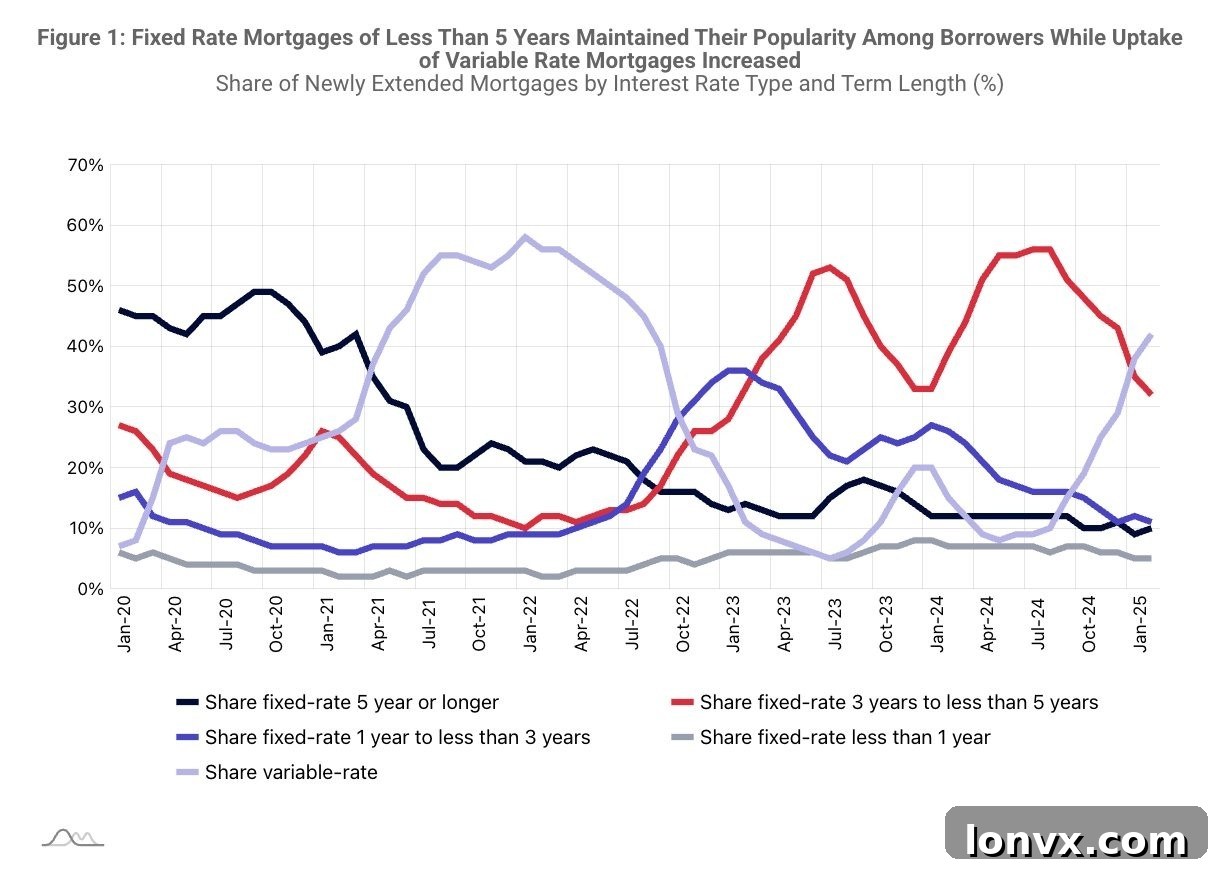
Conversely, leading bank economists are sending a different message, suggesting that the Bank of Canada’s rate-cutting cycle may be nearing its conclusion. Recent articles in prominent financial publications underscore this divergence in outlook:
- “Canadians looking for more interest rate relief might be out of luck / RBC says the Bank of Canada is done with rate cuts for this cycle.”
- “More economists think the Bank of Canada is done cutting interest rates / ‘Shouldn’t even be thinking about thinking about when to cut rates,’ says Scotiabank’s Derek Holt.”
This conflicting information has created an environment of uncertainty. Rather than igniting a surge in demand, the evolving interest rate landscape has ushered in a period of cautious activity. Buyers are meticulously weighing their options, hesitant to commit fully until there is greater clarity on the future trajectory of borrowing costs. The result is an uneasy calm, a market searching for definitive direction amidst mixed signals.
More Choice, Less Conviction: Buyer Behavior in a Shifting Market
At first glance, the current market data appears to strongly favor buyers, offering opportunities not seen in years. Active listings have surged an impressive 30.8 percent year-over-year, translating to over 31,600 homes available on the market. This substantial increase in inventory provides buyers with an unprecedented range of choices. Concurrently, new listings rose by 7.7 percent, indicating a willingness from sellers to test the market, even with softening conditions. Prices have also become more accessible, with the average GTA home now selling for approximately $1.1 million, marking a 5.4 percent decline from June of the previous year.
However, despite these seemingly advantageous conditions, sales figures indicate a more restrained and hesitant response from buyers. June recorded only 6,243 transactions, a slight decline of 2.4 percent compared to a year ago. Furthermore, properties are lingering on the market for longer durations, averaging 26 days to sell, while relisted properties often take an extended 42 days to find a buyer. This extended marketing period underscores a significant shift in buyer psychology: urgency has been replaced by deliberation.
Buyers are demonstrably taking their time, exercising caution in an economy still grappling with uneven job growth and persistent geopolitical uncertainties. Even with borrowing costs marginally lower than their peaks last year, the residual impact of previous rate hikes continues to influence household budgets and decision-making. Many potential homeowners remain reluctant to rush into significant financial commitments, prioritizing stability and affordability over rapid acquisition. This cautious approach prevents the market from gaining significant momentum, even with favorable supply and price conditions.
The Urban-Suburban Divide: Divergent Trends Across the GTA
Within the broader Greater Toronto Area, a distinct and widening divide is emerging between Toronto proper (the “416” area code) and the surrounding suburban regions (the “905”). These two distinct markets are reacting differently to the prevailing economic and housing conditions.
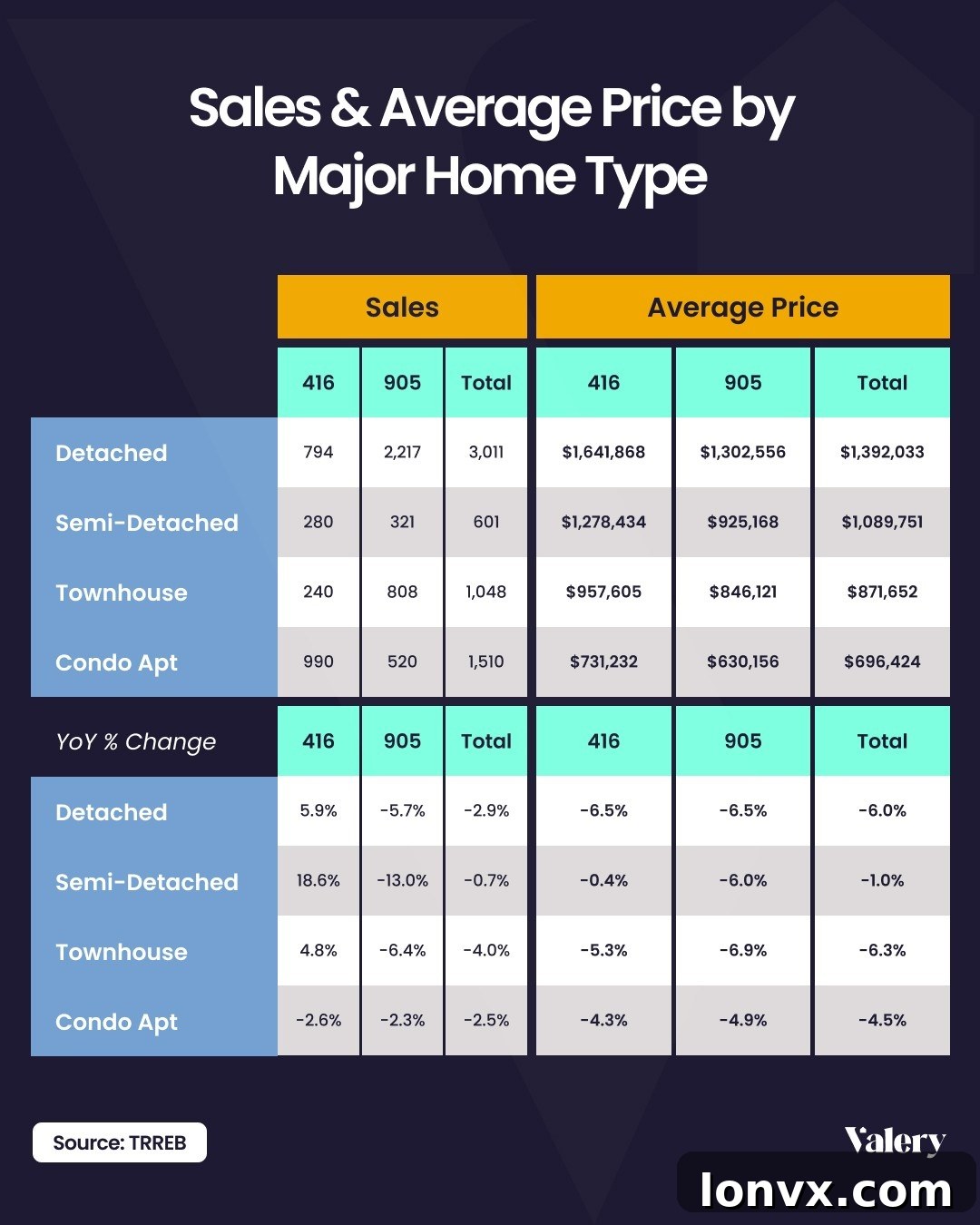
In Toronto proper, faint but discernible signs of renewed confidence are beginning to appear. Detached homes, often seen as a bellwether for the luxury segment, saw their average price slip by 6.5 percent to $1.64 million. This modest price relief seems to have attracted more affluent buyers back into the core urban market, potentially viewing the softened prices as a window of opportunity. Furthermore, semi-detached homes have shown robust performance, posting an impressive 18.6 percent increase in sales year-over-year. This surge suggests that family buyers, who previously migrated to the suburbs in search of affordability and space, are now reconsidering the advantages of urban living. In Toronto’s historically supply-constrained market, it appears that even moderate price adjustments are generating the expected outcome: increased affordability leads to increased demand and sales.
In stark contrast, the 905 regions tell a different story, one that warrants careful attention as it reveals underlying market confidence. Here, lower prices have not translated into a corresponding increase in sales. Detached home prices in the suburbs fell in lockstep with Toronto’s, reaching an average of $1.3 million, yet sales in this category dipped by 5.7 percent. Similarly, semi-detached and townhouse sales also experienced declines. This disconnect – lower prices without a boost in sales – indicates a deeper sense of hesitation and a lack of conviction among suburban buyers, suggesting that price alone is not enough to stimulate activity in these areas. It implies that other factors, perhaps related to economic outlook or local amenities, are weighing more heavily on purchasing decisions in the 905.
Confidence: The Elusive Ingredient for Market Momentum
According to Jason Mercer, TRREB’s chief information officer, the path to rebuilding consumer confidence in the GTA housing market lies in a combination of additional interest rate cuts and greater stability in global trade conditions. While current mortgage rates have eased from their 2024 peaks, they remain elevated enough to significantly strain affordability for many prospective buyers. A survey conducted by BMO earlier this year starkly illustrated this sentiment, revealing that nearly 67 percent of potential homebuyers planned to postpone their purchases until interest rates declined further.
Given that major financial institutions like RBC and Scotiabank are not anticipating further rate cuts in the immediate future, the market faces a potential stalemate. Buyers, holding out for lower rates, are at odds with an economic consensus suggesting the rate-cutting cycle might be over. Even regulatory adjustments, such as OSFI’s review of the B-20 stress test, may not be sufficient to resolve the current slowdown. The recent period of economic volatility has fundamentally shifted expectations, leaving buyers questioning whether the market has truly stabilized. The fear of missing out (FOMO) that fueled the pandemic housing frenzy has been replaced by a pervasive caution. CMHC’s 2025 Mortgage Consumer Survey highlights this shift, reporting that over half of first-time buyers are concerned about overpaying in what still feels like an unpredictable market, underscoring the deep-seated need for greater certainty.
The Unspoken Factor: Public Safety and Social Stability
While often overlooked in traditional housing reports, John DiMichele’s remarks concerning the rise in home invasions and carjackings within the GTA introduce a critical, yet frequently unaddressed, dimension to the market discussion. These concerns serve as a potent reminder that the housing market does not exist in a vacuum; it is deeply intertwined with broader societal conditions. A home is not merely a financial asset or a place of residence; it is fundamentally perceived as a sanctuary, a safe haven for individuals and families. When this intrinsic sense of security is undermined, even marginally, by concerns about public safety, it can have a tangible, albeit difficult to quantify, impact on housing demand and buyer sentiment.
The federal government’s proposed crime bill aims to address these issues and potentially bolster public trust over time. However, in the interim, a lingering unease persists among potential homeowners. This unease contributes to the overall cautious atmosphere, as buyers consider not just affordability and investment potential, but also the fundamental safety and livability of their prospective communities. The perception of public safety plays a silent yet significant role in shaping the desirability of a location, and consequently, its real estate market.
Generational Shifts and the Changing Buyer Profile
Understanding the generational dynamics at play is crucial for comprehending the current market. Millennials continue to form the dominant cohort of first-time homebuyers in the GTA, actively seeking entry into homeownership. Simultaneously, older Gen Zers, many of whom strategically delayed purchasing during the pandemic-era volatility, are now tentatively beginning to explore the housing market. However, their approach to homeownership significantly diverges from that of previous generations.
Grappling with an unprecedented cost-of-living crisis, this emerging cohort is notably more deliberate, cautious, and far less susceptible to market hype. Their decision-making process is rooted in practicality and financial prudence. They prioritize flexibility and affordability, and as a result, are more open to considering alternative ownership models if it means avoiding the pitfalls of overleveraging witnessed during the last boom. This includes exploring co-ownership arrangements, shared equity programs, or even smaller, more attainable property types. This shift in buyer profile necessitates a market that can cater to these evolving needs, moving away from the speculative frenzy of the past and towards more sustainable, accessible pathways to homeownership.
A Market in Search of Momentum: The Path Forward
As I have highlighted in previous analyses of the GTA market, the current environment presents a unique window of opportunity for buyers. The scales have shifted, granting them negotiating power unseen in many years. Prices have softened, inventory is plentiful, and critically, conditional offers are back on the table. This means buyers can now conduct thorough due diligence, secure financing, and include home inspection clauses without fear of being outbid by unconditional offers.
However, the broader trajectory and sustained momentum of the GTA housing market hinge on more fundamental factors than just buyer-friendly conditions. Until a robust sense of confidence returns, anchored by greater economic stability, reduced geopolitical uncertainties, and a clearer path for interest rates, the market is likely to maintain its measured, cautious pace. The true catalysts for renewed vigor will stem from a broader sense of security and predictability, encouraging both buyers and sellers to engage with greater conviction.
The Verdict: A Prolonged Pause at the Crossroads
June’s TRREB report effectively captures a housing market standing at a critical crossroads. Prices have eased, offering a glimmer of relief, and inventory has surged, providing buyers with an abundance of choice. Yet, despite these seemingly favorable conditions for purchasers, a deep-seated conviction remains elusive. Toronto and its surrounding suburbs are no longer dancing to the frantic, speculative tune that defined the previous years. Instead, they move with a hesitant, almost tentative, rhythm.
The market is collectively waiting for a clear cue. This catalyst could manifest in the form of further, sustained reductions in interest rates, providing a much-needed boost to affordability. Alternatively, it might emerge from more robust and positive economic signals, reassuring both consumers and investors about future stability. Or, perhaps, it simply requires the passage of time – time for uncertainties to dissipate, for expectations to realign, and for confidence to naturally rebuild. For the moment, the GTA housing market is caught in a rare moment of quiet introspection, a significant pause that will ultimately either reset its rhythm for a more sustainable future or, inevitably, set the stage for the next great swing in its complex and dynamic cycle.