Unprecedented Decline: GTA Pre-Construction Condo Sales Hit Historic Low
The Greater Toronto Area (GTA) housing market faced a sobering reality in December 2025, marking a critical turning point that demands urgent attention from policymakers, industry stakeholders, and residents alike. In an alarming development, new pre-construction condominium sales plunged to an all-time low, registering the weakest performance not just of the current market cycle, but in the entire 45-year history of available data. This drastic contraction signals more than a temporary market correction; it represents a fundamental, structural shift within the region’s vital housing and economic landscape.
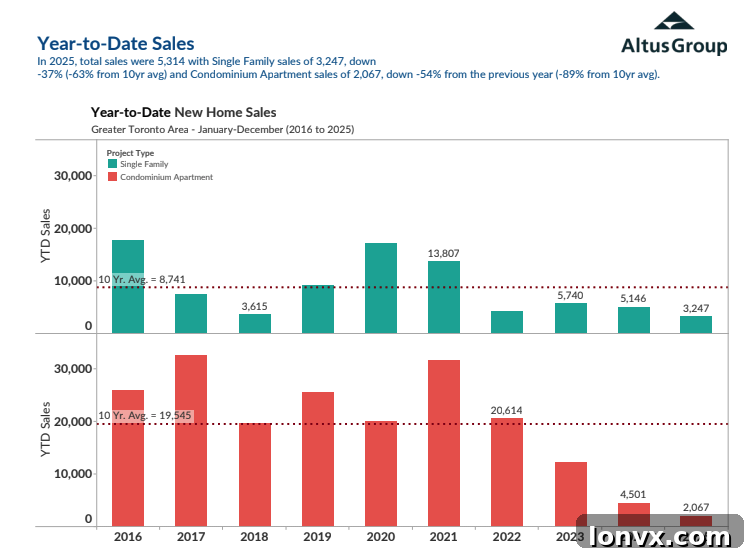
According to comprehensive data compiled by Altus Group and the Building Industry and Land Development Association (BILD), a mere 87 new condominium units were sold across the vast expanse of the GTA during December. Expanding this view to encompass all types of new homes, total sales scarcely reached 240 units. This figure stands at a staggering 80 percent below the 10-year average for the month, and notably, it fell even lower than any recorded period during the severe economic downturn of the early 1990s recession. Such figures underscore a market in unprecedented distress, raising profound concerns about future housing supply, employment stability, and broader economic health across Ontario.
Source: Altus Group/BILD
A Historical Low: Surpassing the Early 1990s Benchmark
For decades, the early 1990s recession stood as the most challenging period for Ontario’s housing market, serving as the definitive benchmark for market stress and sales activity lows. This era, characterized by high interest rates and economic uncertainty, previously represented the lowest watermark for real estate transactions across the province. However, the recent figures from December 2025 have not only approached but definitively surpassed that long-held benchmark, signaling a truly extraordinary downturn in the Greater Toronto Area’s housing sector.
The severity of this comparison is amplified when considering the vast differences between the market landscapes of today and three decades ago. The GTA has undergone immense growth, now boasting millions more residents and a significantly higher number of households compared to the early 1990s. The sheer volume of capital invested in residential real estate has expanded exponentially, and the professional real estate workforce is substantially larger, supporting a far more complex and interconnected industry. Despite this expansion, the market’s inability to generate sales volumes comparable to, let alone exceeding, historical lows points to deep-seated issues.
When analyzing these sales figures on a per capita basis, the unprecedented nature of December’s decline becomes starkly evident. Relative to the current population, transaction volumes are at levels never before witnessed. Furthermore, considering the immense size and intricate dependence of the broader real estate industry — from construction to financing, legal services, and brokerage — on robust transaction volumes, the current contraction can only be described as profoundly severe. This isn’t just a slow down; it’s a systemic shock impacting every facet of the housing ecosystem.
The Pre-Construction Model Under Siege: A Deep Dive into Declining Sales and Supply
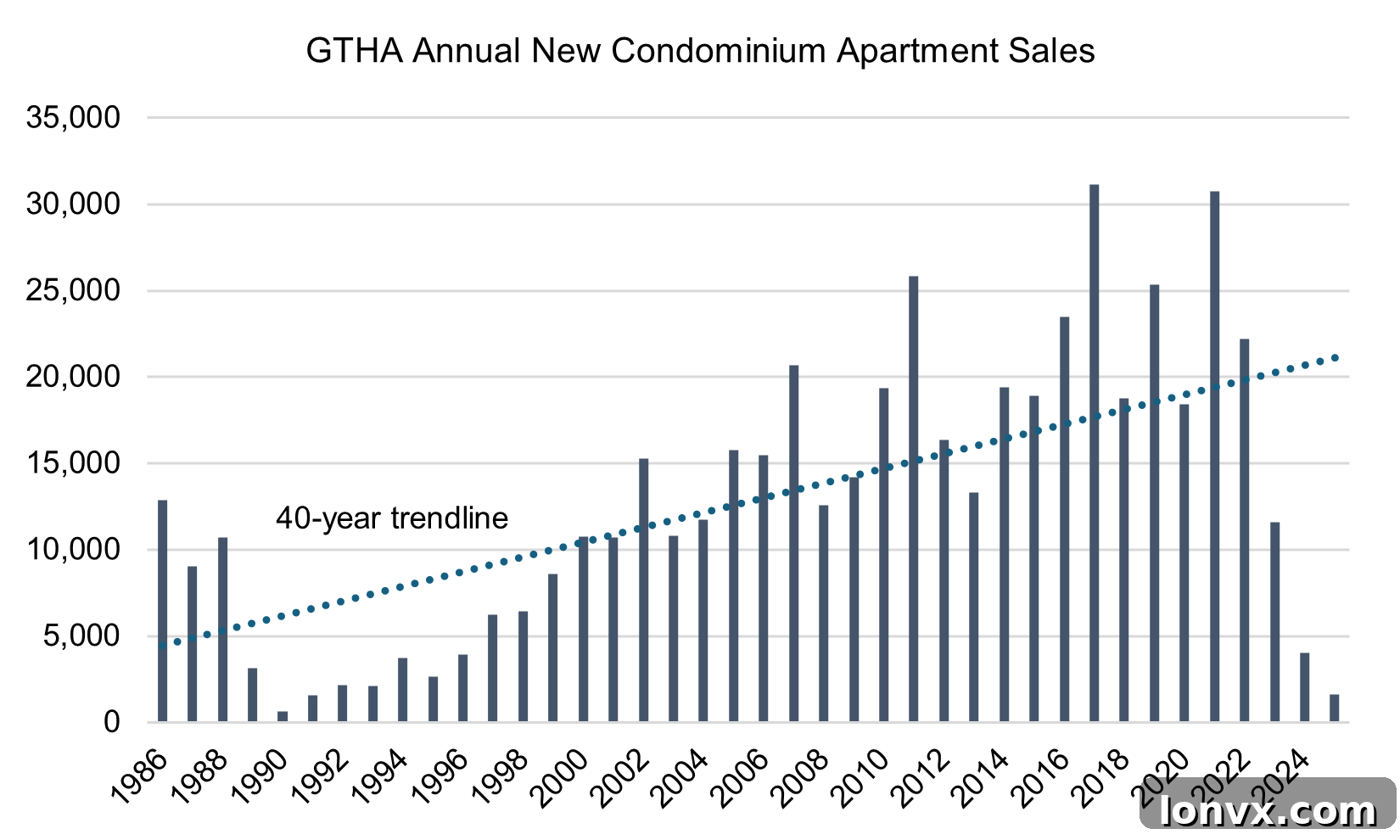
Further solidifying the alarming depth of the market downturn, year-end data from Urbanation paints a grim picture for the pre-construction condominium sector. New condominium apartment sales across the Greater Toronto and Hamilton Area (GTHA) have suffered a significant decline for the fourth consecutive year in 2025, falling 60 percent compared to 2024, and pushing them more than 90 percent below the decade-long average. Astonishingly, current sales volumes now sit at approximately 95 percent lower than the market’s peak in 2021, illustrating a rapid and severe erosion of demand in this once-booming segment.
In the face of rapidly deteriorating demand, developers have been forced to respond with drastic measures, sharply curtailing new activity. The year 2025 witnessed an unprecedented slowdown in new project launches, with only a meager 10 new condominium developments introduced across the entire region. This stark reduction in new supply initiation was compounded by a wave of cancellations: 28 active projects, collectively representing over 7,200 potential housing units, were either put on hold indefinitely or scrapped entirely. While a select few of these cancelled projects were repurposed or converted into purpose-built rental developments, the vast majority were completely withdrawn from the future housing supply pipeline. This collective action by developers directly translates into a significant reduction in forthcoming housing options, which will have profound long-term implications for the region’s ability to meet its housing needs.
Source: Urbanation
The direct and unavoidable consequence of this drastic reduction in new project launches and widespread cancellations is a severe impact on construction activity. Over the past three years, condominium starts have plummeted by nearly 90 percent, bringing the total number of units currently under construction to a 10-year low. Urbanation, a leading authority in the condominium market, grimly projects that unless there is a substantial and material change in market conditions, new condominium completions could be virtually nonexistent by the end of the decade. This impending supply crunch threatens to exacerbate the already critical housing shortage in the GTA, making future affordability an even more challenging prospect for generations to come.
Surge in “Brand New” Resale Units: A Parallel Market Dynamic
Amidst the profound challenges gripping the pre-construction market, another significant, albeit less publicized, trend emerged in 2025, further reinforcing the conclusions about market distress. At our brokerage and across the wider Greater Toronto Area resale market, we witnessed an unprecedented volume of properties being listed as “brand new” for both sale and lease. These units were not new pre-construction offerings, but rather recently completed condominiums from the latest construction cycles, many of which reappeared on the market almost immediately after their initial registration.
The reasons behind this surge of “new” supply in the resale market are multi-faceted. A substantial number of initial purchasers found themselves unable to finalize their transactions, leading to units defaulting and reverting either to the original developers or their lenders, before being subsequently re-marketed. In other instances, buyers managed to close on their purchases but soon discovered that the carrying costs, particularly with prevailing high interest rates, far outstripped the potential rental income they could achieve. This financial strain often compelled them to quickly attempt reselling their units or to pivot them into the rental market, further increasing available stock.
The practical consequence of this phenomenon has been a significant increase in effectively “new” supply that directly competes with, and often undermines, pre-construction offerings. These resale units typically come with the added advantages of lower price points and immediate occupancy, making them highly attractive alternatives for end-users who might otherwise consider buying pre-construction. For developers, this influx of competing, ready-to-move-in units at potentially reduced prices has severely weakened the economic rationale for buyers to commit to purchasing years in advance at a premium, eroding a fundamental pillar of the pre-construction sales model. This observation is directly corroborated by Urbanation’s research, which indicates that approximately 10 percent of pre-sold condominiums registered in 2025 ultimately failed to close and were consequently reclaimed by developers, contributing to record levels of completed and unsold inventory across the region.
Wider Economic Repercussions: Beyond the Housing Sector
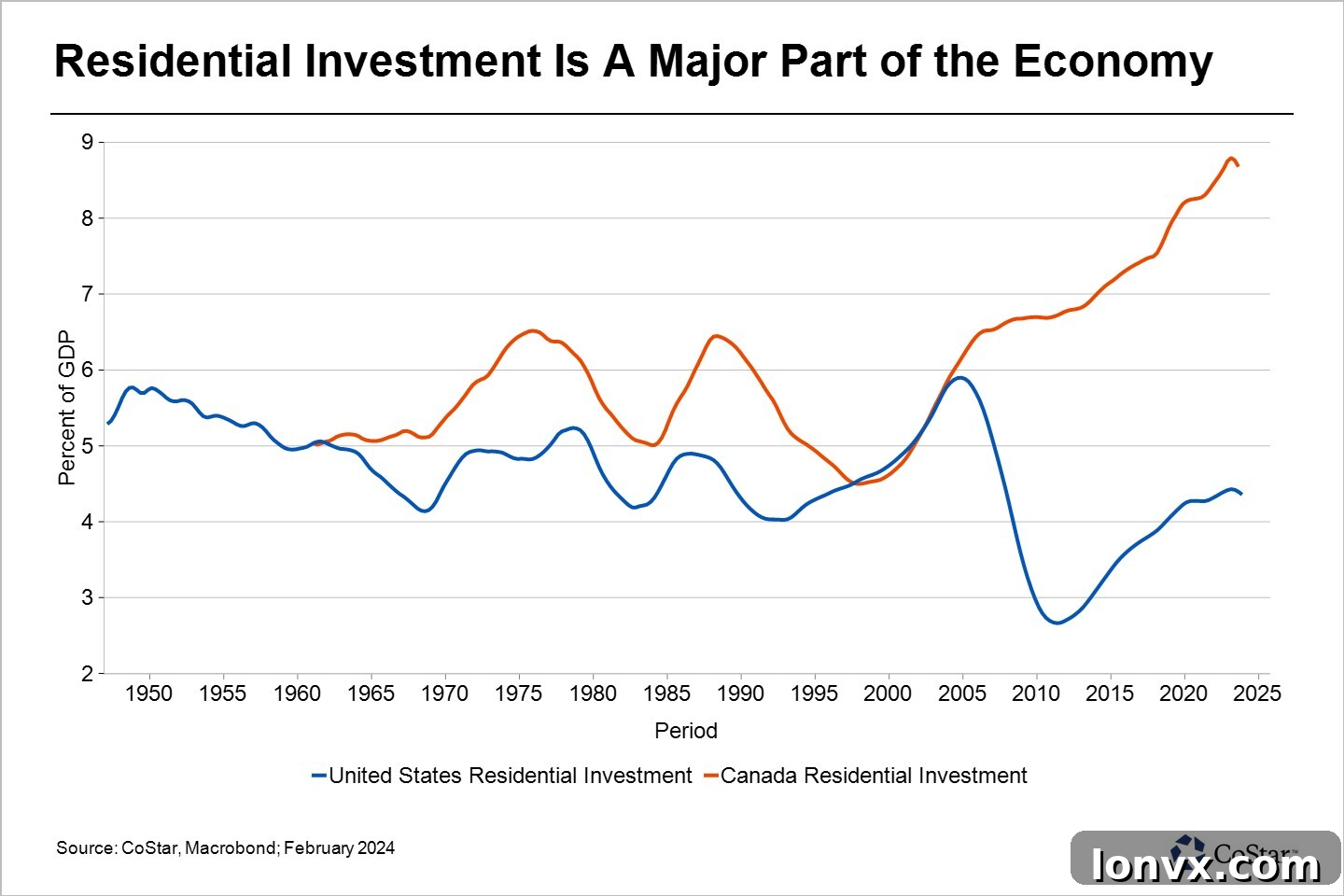
The ramifications of the collapsing pre-construction sales market extend far beyond the immediate concerns of developers and homebuyers, casting a long shadow over the broader Ontario economy. Residential construction is not merely a sector; it is a monumental engine of economic growth, directly and indirectly supporting a vast array of industries and hundreds of thousands of jobs. When the pre-construction sales pipeline grinds to a halt, the ripple effects are profound and pervasive, impacting numerous stakeholders across the economic spectrum.
A functioning development pipeline is the lifeblood for countless businesses and professionals. Tradespeople – including electricians, plumbers, carpenters, and labourers – rely on continuous project flow for their livelihoods. Architects, engineers, and environmental consultants find their project backlogs diminishing. Real estate brokers, lawyers, and suppliers of building materials face reduced demand. Furthermore, the financial sector, particularly lenders who finance both developers and individual unit purchasers, experiences heightened risk and reduced activity. The slowdown in development directly translates to a sharp increase in construction unemployment, which is particularly disruptive due to the concentrated nature of the affected workforce and the rapid pace at which construction activity can cease, leaving many without work almost overnight.
Governments, at both municipal and provincial levels, also find themselves under significant financial pressure. On one side of the balance sheet, crucial revenue streams dry up. Development charges, which fund essential public infrastructure and services, shrink dramatically. Land transfer taxes, property taxes on new construction, and other property-related revenues weaken substantially as transactions decline. Concurrently, the need for public spending often increases, particularly in areas like social support programs for those impacted by job losses, or stimulus measures to kickstart the economy. The typical government response during such downturns is to expand infrastructure investment and engage in counter-cyclical spending to cushion the economic blow. However, this strategy invariably leads to widening deficits as revenues continue to fall, creating a challenging fiscal environment and potentially impacting the province’s long-term financial health.
Source: CoStar
A Painful but Necessary Reset: Navigating Structural Imbalances and Long-Term Fallout
While the current downturn in the GTA housing market is undeniably painful for all involved, it must be viewed within the context of years of accumulating structural imbalances. For too long, housing transitioned from a basic necessity into an outsized driver of economic growth, often fueled by speculative investment rather than genuine end-user demand. This speculative fervor inflated prices and made government revenues increasingly reliant on the booming development and transaction activity, creating a precarious dependency. These dynamics collectively pushed housing prices to unsustainable levels, severely constrained affordability for average Canadians, and embedded prohibitively high costs into every new unit of supply. The current correction, therefore, can be seen as a necessary, albeit brutal, recalibration.
Market corrections of this magnitude are seldom orderly or painless. Yet, they frequently serve a crucial function: to reset distorted incentives and to expose fundamental weaknesses that have been allowed to fester and accumulate during periods of unchecked expansion. This current phase is forcing a re-evaluation of market practices, investment strategies, and policy frameworks. However, the most significant challenge lies in the inherently slow responsiveness of housing supply. The full impact of the widespread project cancellations and stalled construction starts witnessed today will not manifest for several years to come. This delay is particularly concerning given the ongoing robust population growth in the GTA, which will continue to drive demand while new housing completions are simultaneously projected to fall dramatically. This creates a looming crisis where future generations will face an even more acute shortage of housing options.
Charting the Path Forward: A Long Road to Recovery
A question frequently posed by industry participants and concerned citizens alike is, “When can we expect conditions to improve?” While some modest upturn from such an unprecedentedly low baseline is almost inevitable – truly, “you can only go up from here,” as a staunch optimist might assert at rock bottom – this does not necessarily equate to a meaningful or swift recovery. We might indeed see a 10 to 20 percent improvement in sales across the board, potentially returning to the already dismal figures of 2024. While such numbers might be considered impressive compared to the December 2025 low, they are still far from what a healthy, functioning market requires.
The current infrastructure and economic ecosystem built around GTA housing is designed to operate at a long-term average approximately four times higher than our present sales volumes. Achieving a recovery that brings pre-construction sales back to sustainable levels is a complex undertaking with a protracted timeline. Under even the most optimistic scenarios, a truly meaningful recovery in pre-construction sales that approaches historical averages could take approximately three years to materialize. Crucially, such a recovery would not occur spontaneously. It would almost certainly necessitate a coordinated suite of policy interventions and market shifts, including, but not limited to, significant changes to mortgage underwriting rules, substantial reductions in prohibitive development charges, carefully considered adjustments to foreign buyer restrictions, and robust, sustained wage growth across the economy, ideally coupled with measures to stabilize rental costs.
A more pragmatic and realistic expectation places the timeline for a comprehensive recovery even further out, likely spanning five to seven years. This extended period would involve a gradual improvement in market sentiment and a slow easing of financing conditions, rather than any abrupt or dramatic rebound. Furthermore, should key policy constraints that currently impede development and affordability remain unaddressed or be exacerbated, this recovery timeline could easily stretch even further, prolonging the market’s stagnation and the ensuing housing supply crisis. The path forward is not only long but requires deliberate, multi-faceted action.
A Crucial Moment for Caution and Strategic Action
The dramatic collapse of pre-construction sales has, understandably, led some observers to characterize the current market environment as a long-overdue “reckoning” for the housing industry. While a reset was arguably necessary, such a perspective risks overlooking the immense scale of employment and economic activity that is inextricably tied to residential development. This downturn is not merely a correction for overzealous developers or speculators; its profound effects will ripple through the lives of countless workers, impact the stability of households, and ultimately dictate the housing options and affordability for future renters and buyers for years to come, particularly as the supply pipeline continues to constrict.
The decisions, or indeed the lack thereof, made by policymakers and industry leaders during this critical period will fundamentally shape housing affordability outcomes stretching well into the 2030s and beyond. This is not a moment for complacency, nor is it a time for celebrating market “corrections” without fully grasping their widespread human and economic cost. Housing cycles are inherently complex and do not resolve themselves quickly or without significant intervention. The most severe costs of market contraction – in terms of lost jobs, economic stagnation, and future housing shortages – frequently emerge long after sales volumes have bottomed out. Therefore, the present moment unequivocally calls for careful, nuanced analysis, strategic foresight, and collaborative action, rather than premature celebration or passive observation, to mitigate the long-term damage and pave the way for a more sustainable and equitable housing future for the GTA.