
Toronto’s vibrant real estate market, once characterized by intense bidding wars and soaring prices, now presents a perplexing paradox: it’s brimming with listings, yet feels strikingly empty of active buyers. This unusual dynamic has created a standoff, leaving both eager sellers and cautious buyers in a state of prolonged hesitation.
For years, the Greater Toronto Area (GTA) has grappled with a severe housing shortage. Suddenly, the script has flipped. There are more homes for sale across the region than we’ve witnessed in quite some time. Moreover, prospective buyers have seen some positive shifts: mortgage rates have shown signs of easing, property prices have softened, and by many metrics, housing affordability has seen a measurable improvement. In a textbook scenario, these conditions should coalesce into a powerful buyer’s moment—a rare window where lower entry costs and an abundance of choice create an irresistible urge to purchase.
However, this anticipated moment of buyer resurgence remains largely elusive. The market is not materializing as expected, and the widely hoped-for recovery is stalled.
Instead, the month of May 2025 painted a picture of a market swelling with available properties, yet starved of the urgency typically needed to drive transactions. Buyers are conspicuously absent from the open houses and offer tables. Sellers, meanwhile, appear to be clinging to price expectations forged in the frenetic, speculative booms of the past, seemingly detached from current market realities. This creates a palpable sense of uncertainty, where no one—from first-time homebuyers to seasoned investors, and from real estate agents to policy makers—seems entirely sure of what the immediate future holds.
The latest statistical release from the Toronto Regional Real Estate Board (TRREB) unequivocally lays bare the facts: sales volumes are down significantly, new listings are surging, and the chasm between supply and demand has reached an unprecedented width. Yet, these raw numbers only narrate a fraction of the full story. To genuinely comprehend the intricate workings of this market, one must delve deeper, moving beyond mere metrics to explore the intricate psychology and underlying sentiment that are currently driving, or rather, stifling, buyer and seller behaviors.
Ultimately, this is a real estate market fundamentally defined by widespread hesitation. And until the deep-seated root causes of this collective reluctance are adequately addressed and resolved, simply increasing the volume of available listings alone will prove insufficient to inject the necessary momentum and move the market forward from its current frozen state.
The Supply Spike That Was Supposed to Spark Recovery: A Closer Look
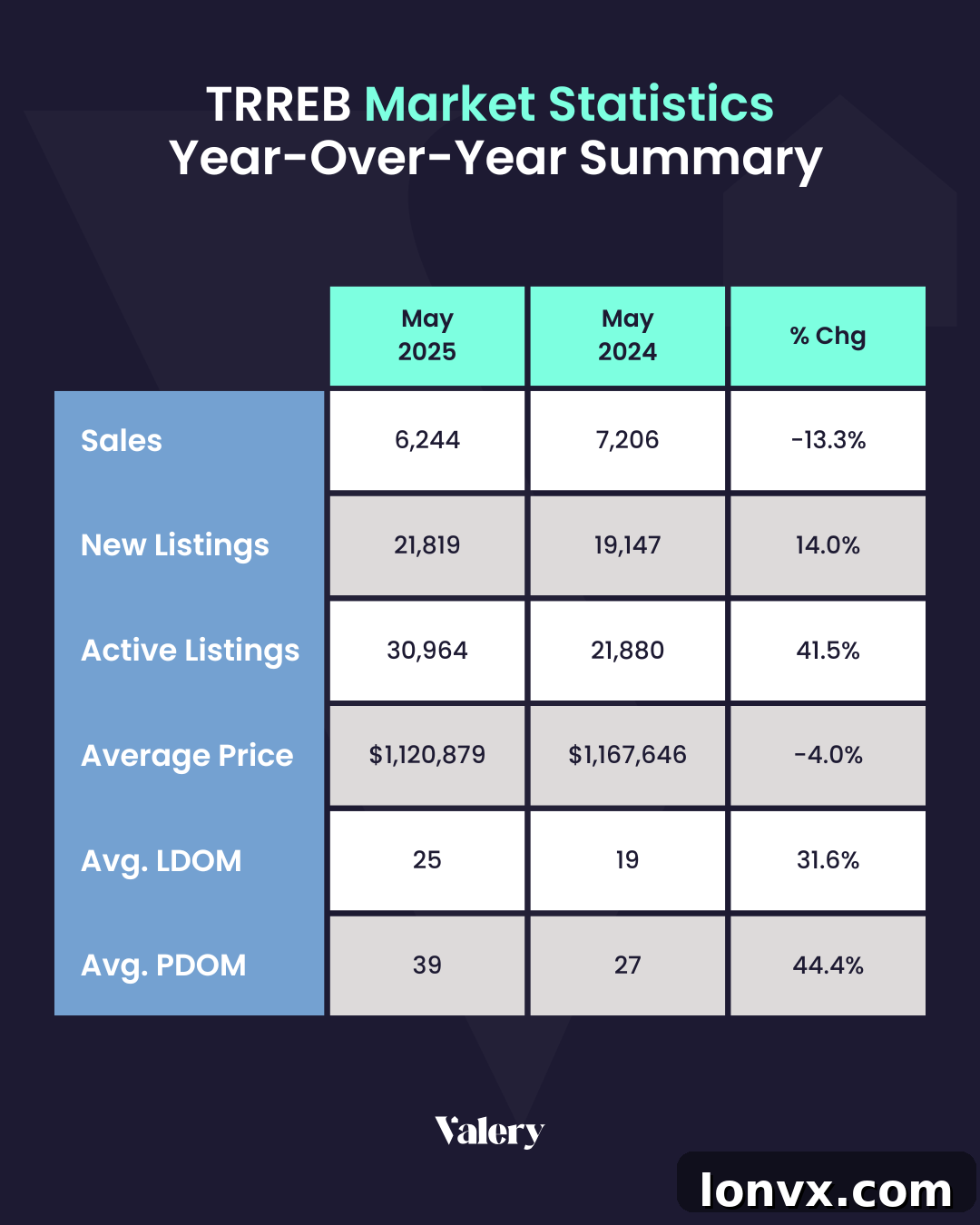
TRREB’s report for May 2025 recorded a staggering 21,819 new listings entering the market. This figure is exceptionally high, rivaled only by the frenzy observed in 2017, a year remembered for its sudden market correction. In 2017, an unexpected policy intervention, coupled with rising interest rates, triggered widespread panic selling across many pockets of the GTA, leading to a swift 20 to 30 percent price adjustment in certain areas. This historical context highlights the sensitivity of the market to external shocks and shifts in sentiment. Furthermore, active listings for May 2025 reached an impressive 30,964 properties, marking the third highest inventory level in TRREB’s recorded history, surpassed only by the market conditions observed in 2013 and 2014.
In a conventionally functioning real estate market, such a substantial injection of supply would typically elicit a predictable response: greater housing affordability, a faster pace of sales as buyers take advantage of choice, and a corresponding increase in buyer participation and confidence. Indeed, one aspect of this textbook response has materialized: affordability has undeniably improved. The latest National Bank of Canada Housing Affordability Monitor indicates the sharpest gains in affordability witnessed in several years. However, the anticipated follow-through—accelerated sales and heightened buyer activity—has failed to materialize. Instead, the broader market numbers paint a starkly different, and concerning, picture.
Despite the improved affordability and burgeoning supply, sales plummeted to a mere 6,244 transactions in May, representing a significant 13.3 percent decline compared to the same period a year ago. This contraction in sales, set against a backdrop of surging listings, has profoundly impacted key market indicators. The sales-to-new-listings ratio (SNLR), a critical measure of market balance, plunged to 34.9 percent. An SNLR below 40 percent is widely recognized as a definitive signal of a buyer’s market, indicating that there are far more properties entering the market than are being sold, granting buyers considerable negotiation leverage. Concurrently, Months of Inventory (MOI) now stands at 4.3. MOI measures how long it would take to sell all current listings at the current pace of sales, and an MOI above 4 is a clear sign that homes are accumulating on the market at a rate significantly faster than they are being absorbed, further underscoring the shift in market power towards buyers.
Collectively, these metrics undeniably reveal a growing and unsustainable imbalance within the Greater Toronto Area’s housing market, characterized by an excess of supply and a notable deficit of demand.
Demand Hasn’t Just Cooled; It’s Frozen Solid
Despite the seemingly favorable conditions for purchasing, buyers are conspicuously failing to respond to the tangible gains in affordability—at least not yet. The year-over-year price declines, which have averaged 4 percent across the region, coupled with a slight downward tick in mortgage rates, should, in theory, act as powerful incentives. Furthermore, the lengthening “days on market” for listings strongly suggests that buyers now have more time to deliberate and significantly greater room to negotiate prices. Yet, against this backdrop of apparent opportunity, the vast majority of prospective buyers continue to observe from the sidelines, adopting a cautious “wait and see” stance.
At the very heart of this unprecedented market inertia lies a complex interplay of psychology and widespread hesitation. The market’s current state is less about raw economic numbers and more about human emotion and perception of risk.
Jason Mercer, TRREB’s own Chief Market Analyst, succinctly articulated this sentiment, alluding directly to the core problem: “The issue is a lack of economic confidence.” This absence of confidence is pervasive, stemming from a myriad of unresolved uncertainties. Buyers are grappling with a lack of clarity surrounding critical economic factors, including the direction of global trade policy, the sustainability of job growth within Canada, and the trajectory of inflation. In essence, potential homebuyers are not merely seeking lower prices or rates; they are waiting for a clear, decisive signal from the broader economy that stability is returning and that the future economic landscape will be predictable enough to make such a significant investment. Until that direction becomes apparent, demand will likely remain profoundly suppressed.
The Confidence Gap: Understanding Market Momentum
Real estate markets inherently thrive on momentum and a sense of urgency. Historically, when buyers perceive conditions such as rising interest rates, climbing property prices, or a tightening inventory of available homes, they are often compelled to act swiftly, fearing they might miss out or face higher costs later. This “fear of missing out” (FOMO) dynamic is a powerful catalyst. However, today’s market presents the exact opposite scenario. There is no prevailing sense of urgency whatsoever; instead, buyers are confronted with an environment where conditions are not deteriorating rapidly, and there are no clear signals suggesting that waiting will result in a worse outcome. This psychological shift fundamentally alters buyer behavior, transforming perceived risk into a rationale for delay rather than action.
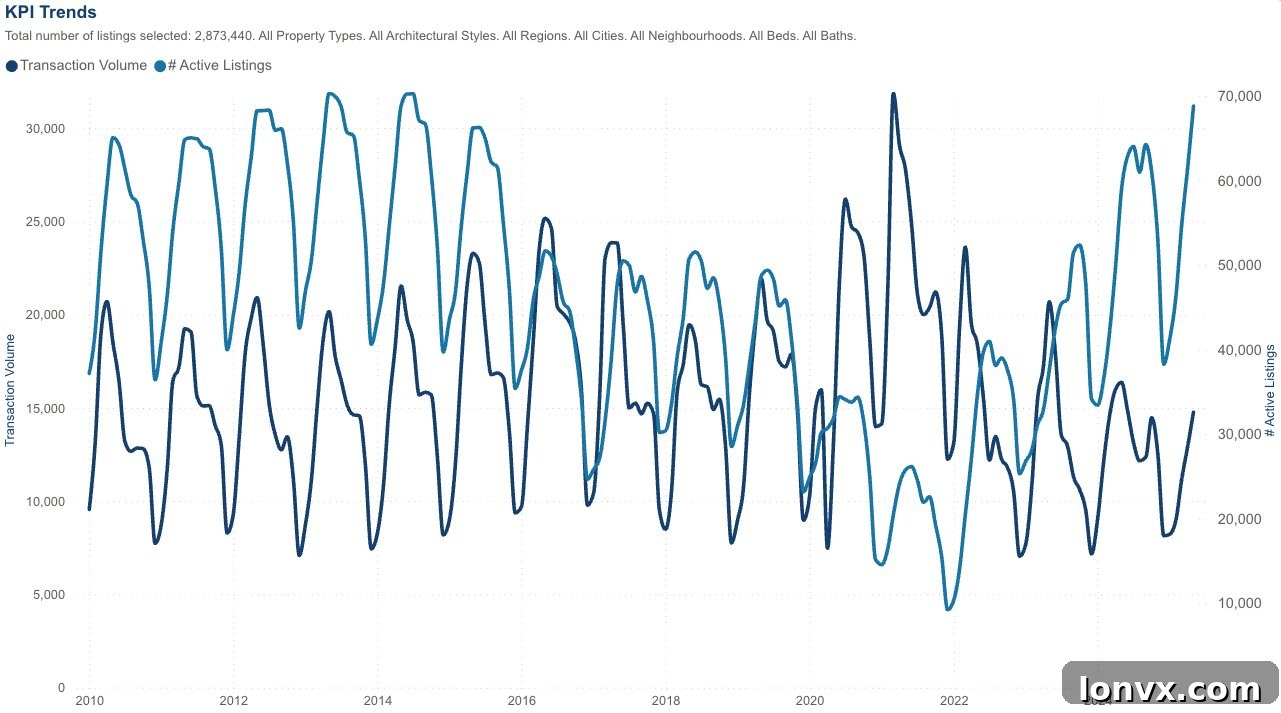
This peculiar dynamic is starkly reflected in what TRREB has described as the most significant gap ever recorded between housing supply and demand. As noted by industry analysts, including Daniel Foch in his recent commentary, May 2025 witnessed an unprecedented divergence between the sheer volume of new listings entering the market and the actual number of properties successfully sold. More homeowners than ever are attempting to capitalize on their assets or adjust their living situations, yet fewer and fewer potential purchasers are sufficiently motivated or confident enough to commit to buying. The inevitable consequence of this widening chasm is a steadily accumulating inventory of unsold properties, leading to listings growing stale and a noticeable reduction in property viewings and genuine buyer inquiries.
The last period in which active inventory so dramatically outpaced sales volumes at this scale was during the protracted 2010–2015 stretch. That era was defined by a slow, largely sideways market, characterized by persistent inertia that gradually wore down the patience and expectations of both buyers and sellers alike. The market of that time became a test of endurance, where slow appreciation, if any, and prolonged listing periods became the norm, offering valuable lessons on the psychological toll of a stagnant market.
Regional Recalibration: What’s Happening in the 416 vs. the 905?
A deeper dive into the market dynamics reveals that the current stagnation is not uniform. The GTA market is diverging not just by property type, but significantly by geographical area, specifically between the core of Toronto (the 416 postal code area) and its surrounding suburban regions (the 905 area code).
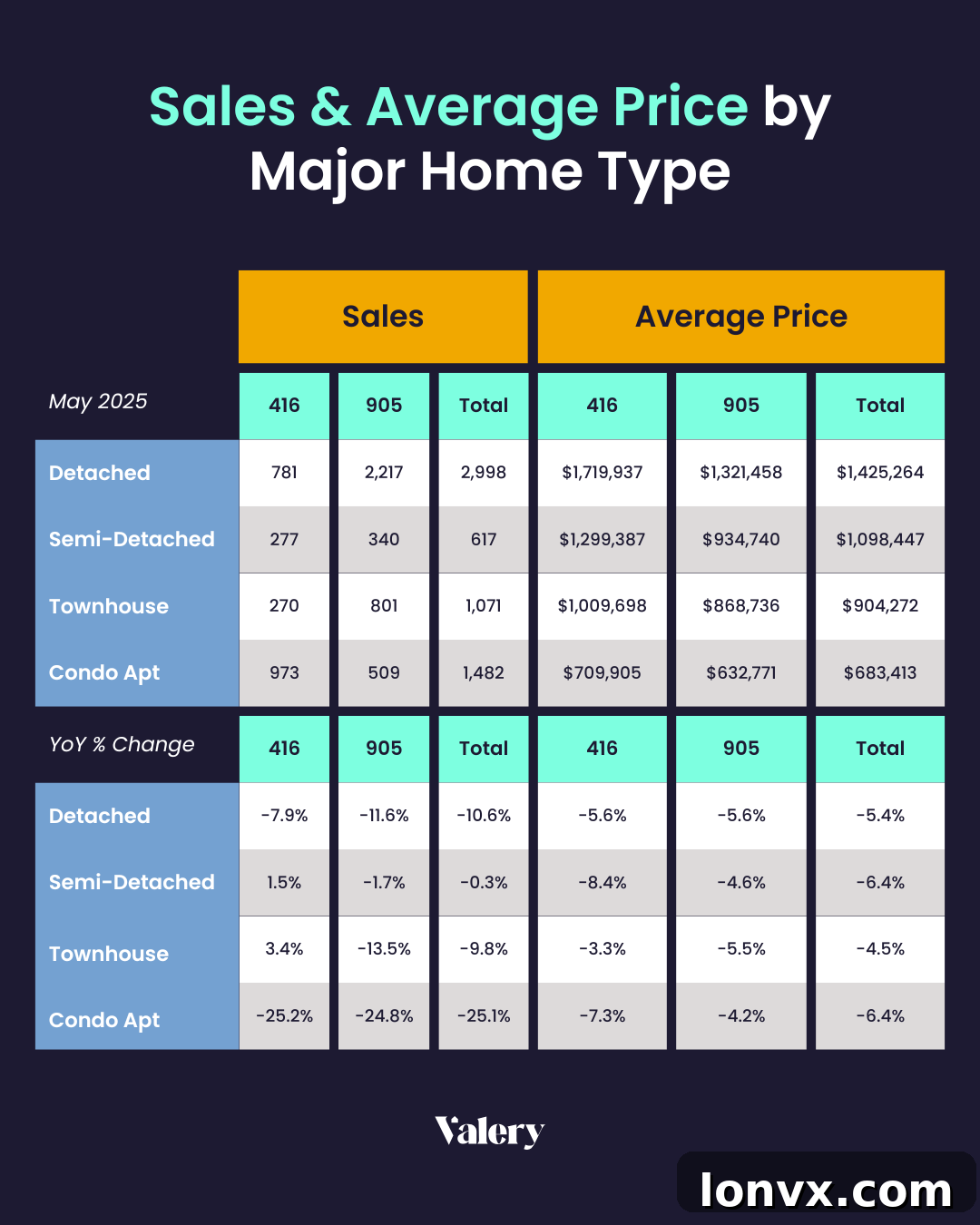
Within the 416, amidst the broader market softening, there are pockets of quiet resilience. Sales of semi-detached homes and townhouses have shown unexpected strength, even registering slight year-over-year gains. This trend suggests that value-conscious buyers, perhaps those who were priced out during previous peaks, are cautiously re-entering the urban market. They are likely drawn to these property types as they offer a more accessible entry point into the city, particularly now that prices have seen some correction and the urban lifestyle remains highly desirable, especially for those returning to office work or seeking vibrant community living.
However, the narrative for detached homes and condominiums within the city core tells a markedly different, and more challenging, story. Detached homes in the 416, with average prices still stubbornly hovering above $1.7 million, continue to face affordability barriers for many. The condo market, in particular, is grappling with a dual challenge: significant oversupply from a wave of newly completed developments and a notable pullback from investors. Many investors, facing higher carrying costs due to elevated interest rates and potentially compressed rental yields, are either reluctant to buy more or are actively offloading existing units. Consequently, condo sales have experienced a dramatic decline, plummeting a whopping 25.2 percent year-over-year—the sharpest drop recorded across all housing types.
Meanwhile, the 905 region, encompassing the vast suburban areas surrounding Toronto, is where the market slack is most acutely felt. Both detached and townhouse sales in these areas have fallen significantly compared to the previous year. The pandemic-driven surge in demand for larger homes and more green space in the suburbs has largely cooled. As life returns to a more pre-pandemic rhythm, and with rising fuel costs making longer commutes less appealing, the premium once associated with suburban sprawl is rapidly eroding. Unless properties are offered at a substantial discount, attracting buyers in the 905 has become increasingly difficult.
What is unfolding across the GTA is a profound regional recalibration. Buyers are meticulously reassessing fundamental factors such as value proposition, commute times, and desired lifestyle attributes. We are observing the nascent signs of urban demand cautiously flickering back to life, driven by a search for relative value within the city. Conversely, suburban inventory is swelling without any corresponding urgency from buyers, creating a sustained imbalance. As interest rates potentially trend further downwards, this divergence between urban and suburban market performance could very well become one of the most defining and enduring shifts of the current real estate cycle.
Sellers Still in Denial: A Disconnect from Current Realities
While prospective buyers exercise extreme caution and demonstrate unprecedented hesitation, a significant portion of sellers appears to be negotiating with the market from a position that, regrettably, no longer accurately reflects current conditions. There is a palpable disconnect between seller expectations, often anchored in the peak prices of yesteryear, and the evolving leverage now wielded by buyers in the current environment.
Despite the overall market slowdown and the growing inventory, average asking prices have, for many, only declined modestly. For instance, detached homes in the highly sought-after 416 area continue to hover around the $1.72 million mark. Similarly, townhomes in the 905 region are often listed at over $860,000. This suggests a persistent belief among sellers that peak pricing, or at least something very close to it, is still achievable, even as their properties languish on the market for weeks or even months without generating serious interest or competitive offers.
However, this strategy of holding onto aspirational pricing is increasingly proving to be ineffective and detrimental in the face of robust buyer leverage. Properties that fail to adjust their price expectations to align with current market demand are consistently being passed over. In today’s buyer-centric market, a successful sale hinges critically on three interdependent factors: realistic pricing that reflects current conditions, meticulous presentation that makes a property stand out, and, perhaps most importantly, a high degree of negotiation flexibility on the part of the seller. Those who fail to adapt risk not only prolonged listing periods but also a potential devaluation of their property as it accumulates “days on market,” sending negative signals to an already wary buyer pool.
What Policy Can’t Fix (Yet): The Limits of Government Intervention
The federal government, through its latest Throne Speech, has once again reiterated its steadfast commitment to addressing housing affordability. This commitment is often articulated through promises of increasing housing supply, streamlining development timelines, and implementing various policy measures designed to make homeownership more accessible. However, it is crucial to recognize that policy tools, while essential for long-term structural changes, often act as blunt instruments in a real estate market primarily governed by nuanced and often unpredictable sentiment.
Measures such as lower development taxes, faster approval processes for new construction, and the promotion of innovative building techniques like modular construction are undoubtedly valuable for increasing the *potential* supply of housing over time. Yet, these initiatives, however well-intentioned, cannot instantaneously alter the fundamental psychological barrier that currently paralyzes the market: the pervasive uncertainty among buyers regarding whether now is truly the opportune moment to make a significant purchase. Unless governments, in conjunction with a stronger, more confident broader economy, can effectively restore widespread trust and conviction in the market’s future trajectory, these policy measures, while adding supply, may inadvertently contribute to an already oversupplied market without stimulating the crucial demand needed for sales. The challenge is not just building more homes, but also ensuring buyers are confident enough to buy them.
So Where Does That Leave Us? Navigating the Limbo
The Greater Toronto Area’s housing market is, by all accounts, drifting. It finds itself in an unprecedented state of limbo, characterized by a persistent stalemate that resists easy categorization or quick resolution. This unique inertia impacts every participant within the ecosystem, creating a landscape fraught with uncertainty and frustration.
In this environment, buyers hold significant leverage, benefiting from an abundance of choice and weakened competition. Yet, paradoxically, they are largely unwilling to utilize this power, opting instead for a cautious wait-and-see approach. Sellers, on the other hand, possess the listings—an ample supply of properties—but find themselves stripped of the pricing power they once enjoyed during the boom years, struggling to reconcile their expectations with current market realities. Policymakers, despite their well-meaning promises and strategic initiatives to boost supply and affordability, currently lack the immediate credibility or the tools to profoundly shift market sentiment, which remains rooted in caution and doubt. It is a market where everyone appears to be waiting for someone else to make the first definitive move, perpetuating the current deadlock.
At its core, the prevailing issue in the Toronto real estate market is fundamentally a question of trust—or rather, the lack thereof. Right now, confidence in the market’s immediate future is in remarkably short supply.
Until buyers develop a genuine belief that a definitive price floor has been established and that further significant drops are unlikely; until sellers are ready to unequivocally accept that the ceiling of achievable prices has indeed lowered from its previous peaks; and crucially, until the broader economy sends clear, consistent signals that widespread stability is returning, this complex and hesitant market will remain precisely where it is: suspended in limbo. It’s a delicate balance of expectations and realities, where trust is the missing ingredient for progress.
It’s not crashing in a dramatic fashion. It’s certainly not climbing with any vigor. Instead, the Toronto housing market is simply, profoundly, stuck—awaiting a catalyst that promises a return to confidence and a renewed sense of direction.