
Canada’s Housing Market: A Cautious Comeback Amidst Shifting Sands
Canada’s housing market is navigating a fascinating and complex period, emerging from a challenging year with a glimmer of hope. As of June, a strategic interest rate cut by the Bank of Canada has acted as a significant catalyst, leading to a 3.7 percent rise in national home sales compared to May. This crucial monetary policy adjustment has injected a much-needed pulse into a market that had experienced months of declining activity, signaling potential life after a prolonged lull. However, the path to a full recovery is far from straightforward, presenting a landscape filled with both opportunities and considerable uncertainties for industry professionals, prospective buyers, and sellers alike.
The central question reverberating across the real estate sector is whether this initial interest rate reduction will be sufficient to sustain a robust recovery. Is this the definitive start of a broader cutting cycle that will systematically draw buyers back into the market? Or could the situation potentially worsen before a sustained improvement takes hold? To understand these dynamics, we must delve beyond the raw numbers, meticulously examining the interplay between evolving economic policies, fluctuating consumer sentiment, and significant regional differences that are collectively shaping the trajectory of Canada’s intricate real estate landscape. This analysis will explore the foundational elements influencing market stability and growth, providing a comprehensive overview of the current environment and its future implications.
The Impact of Interest Rate Adjustments on Buyer Confidence
Since the last market forecast in April, expectations surrounding the speed and magnitude of interest rate cuts this year have undergone a significant recalibration. This adjustment comes despite a noticeable influx of properties hitting the market, particularly during the traditionally active spring season, as many sellers sought to capitalize on potential buyer interest. While the supply side saw an increase, buyer activity and overall consumer sentiment largely remained subdued, indicating a disconnect between available inventory and purchasing intent.
The prevailing anticipation is that a series of gradual and sustained interest rate reductions will eventually prove effective in drawing cautious buyers back into the market. Lower borrowing costs directly translate to more affordable mortgage payments, which can significantly improve housing affordability and stimulate demand. Nonetheless, the sluggish performance observed throughout the spring market, coupled with increasing supply levels that haven’t yet been fully absorbed, has necessitated a downward revision in both projected sales volumes and average home price forecasts for the immediate future. This cautious outlook reflects the understanding that while rate cuts are a powerful tool, their full impact on buyer confidence and market momentum takes time to materialize and is subject to other macroeconomic factors.
Analyzing Market Supply: Listings Up, Yet Below Historical Norms
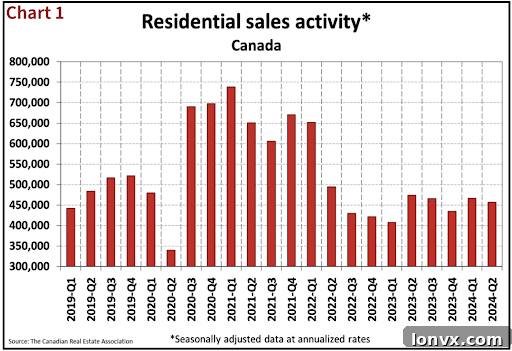
Forecasting a gradual rebound, approximately 472,395 residential properties are expected to be sold across Canada in 2024. This projection marks a notable 6.1 percent increase when compared to the total sales figures from 2023, signaling a positive shift in market activity. Concurrently, the total national average home price is anticipated to experience a modest rise of 2.5 percent, reaching an estimated $694,393. These figures underscore a careful optimism within the industry, predicated on a slow but steady recovery.
Looking further ahead into 2025, the outlook remains even more favorable. Home sales are forecasted to increase by a robust 6.2 percent, pushing the total units sold to an impressive 501,902. This anticipated surge is primarily supported by the expectation of continued declines in interest rates, which are expected to further stimulate demand and enhance affordability for a broader spectrum of buyers. As a result, the national average home price is projected to climb by an additional 5 percent, potentially reaching $729,319 by the end of 2025, reflecting a more confident and stable market environment.
However, a deeper dive into the immediate past reveals nuanced details. By the close of June, Canada saw approximately 180,000 properties listed for sale nationwide. While this represents a significant 26 percent improvement in available inventory compared to the same period in the previous year, it’s crucial to note that this figure still remains below the historical average of roughly 200,000 sales typically recorded by this month. This discrepancy suggests that while supply is increasing, it has not yet reached levels that fully satisfy pent-up demand or return to pre-pandemic market equilibrium, indicating a market still in the process of rebalancing.
Towards a Balanced Market: Inventory Buildup and Sales-to-New Listings Ratio
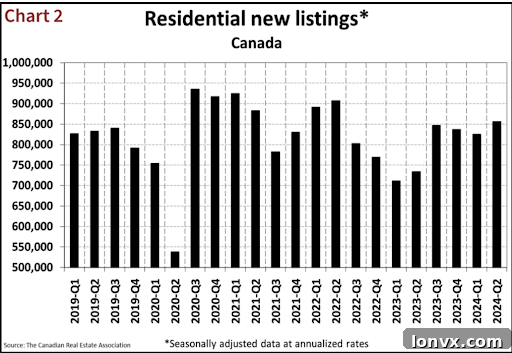
The intricate dance between supply and demand continues to define Canada’s housing market. In June, the number of new listings registered a modest increase of 1.5 percent month-over-month, signaling a gradual, rather than sudden, expansion of available properties. In parallel, the MLS Home Price Index (HPI), a more accurate measure of home value trends due to its composition-adjusted methodology, edged up by a mere 0.1 percent from May 2024. Despite these marginal month-over-month gains, a year-over-year comparison reveals that the HPI was down 3.4 percent from June 2023, and the national average sale price saw a decrease of 1.6 percent compared to the same month last year. These figures highlight the lingering effects of the previous market downturn and the ongoing sensitivity of pricing to broader economic conditions.
At the end of June, the total supply of properties available for sale had increased by an impressive 26 percent compared to the previous year. Yet, as previously noted, this volume still falls short of the long-term historical average, suggesting that while inventory is growing, the market is not yet flooded. This “possible slowdown in inventory buildup” indicates that properties are being absorbed at a rate that prevents a massive accumulation of unsold homes, contributing to a more orderly market transition. A key indicator of market health, the national sales-to-new listings ratio, improved to 53.9 percent in June from 52.8 percent in May. This upward trend is significant as it brings the market closer to the long-term average of 55 percent, which is widely considered indicative of balanced market conditions. A ratio in this range suggests that neither buyers nor sellers hold a distinct advantage, fostering a more equitable and stable environment for transactions.
Regional Disparities: A Patchwork of Price Fluctuations
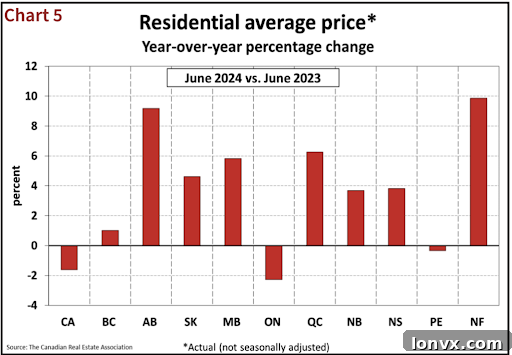
The national narrative of Canada’s housing market often belies significant regional variations. Housing prices, as observed, continue to fluctuate across different provinces and cities, painting a patchwork of performance rather than a uniform trend. Since early last year, major cities like Calgary, Edmonton, Saskatoon, Montreal, and Quebec City have consistently demonstrated an upward trajectory in their housing prices. This sustained growth in these regions can often be attributed to factors such as robust local economies, strong interprovincial migration, relative affordability compared to larger metropolitan centers, and ongoing demand that outpaces available supply.
More recently, Ontario and Nova Scotia have also started to experience discernible price increases, beginning in late last year. For Ontario, this resurgence follows a period of significant adjustments, with renewed buyer interest potentially driven by the prospect of lower interest rates and a slight cooling of the initial rate hike shock. Nova Scotia’s market, particularly its capital Halifax, has seen considerable demand, fueled by population growth and an attractive quality of life, leading to upward price pressures.
Despite these regional upticks, the non-seasonally adjusted National Composite MLS HPI remains 3.4 percent below its June 2023 levels. This broader national perspective reflects the sharp price increases that characterized the spring and early summer of 2023, followed by a subsequent deceleration and correction. The national average home price in June was recorded at $696,179, marking a 1.6 percent decrease from the same month in the previous year. This aggregate figure highlights that while some regional markets are heating up, the overall national average is still consolidating after a period of volatility. Understanding these regional differences is crucial for both buyers and sellers, as localized market conditions dictate specific strategies and expectations.
The Road Ahead: Cautious Optimism and Evolving Dynamics
The story of Canada’s housing market in June 2024 is best characterized by a delicate balance of cautious optimism and rapidly evolving market dynamics. The initial signs of revival, largely triggered by the Bank of Canada’s strategic interest rate adjustment, have undoubtedly laid crucial groundwork. This pivotal move is widely seen as setting the stage for potential continued rate cuts, fostering an environment that could lead to an expected, and much-hoped-for, period of sustained growth in the coming years. This forward momentum is vital for restoring long-term stability and confidence in the market.
With a projected 6.1 percent increase in property sales anticipated for this year, and forecasts pointing towards continued growth extending into 2025, there is an palpable sense of nervous anticipation throughout the real estate sector. This anxiety stems from the understanding that buyer and seller expectations, having been dramatically reshaped by recent market volatility, still have considerable ground to cover to align with the unfolding realities. Rebuilding robust buyer confidence will be paramount, requiring not only favorable interest rates but also sustained economic stability and clarity regarding future market trends.
However, it is crucial to recognize that the narrative of Canada’s housing market is far from complete. The journey ahead is complex, fraught with challenges that must be effectively navigated for a full and lasting recovery. Chief among these challenges is the critical task of maintaining a delicate balance between supply and demand, ensuring that inventory levels are sufficient to meet buyer needs without overwhelming the market. Furthermore, addressing the ongoing affordability crisis, particularly in high-demand urban centers, remains a pressing concern that requires innovative solutions from policymakers and industry stakeholders.
Looking ahead, the ongoing evolution of Canada’s housing market promises a compelling blend of resilience, requiring adaptation from all participants, and a hopeful progression towards a more stable, equitable, and dynamic environment. The ability of the market to overcome existing hurdles and capitalize on emerging opportunities will define its trajectory for the remainder of the decade, making it a critical watch for anyone invested in the country’s economic health and individual prosperity.
Get the latest REM articles in your inbox 3x week so you stay up to date on the latest in the Canadian real estate industry