The Canadian real estate market experienced a significant shift following the Bank of Canada’s decision to pause interest rate hikes. After a series of aggressive increases throughout 2022, which saw the benchmark interest rate climb to 4.5 per cent by January 2023, the central bank opted to hold steady. This pivotal decision has had a multifaceted impact, influencing everything from borrowing costs and buyer confidence to overall market sentiment across the nation. The period of rapid rate adjustments brought an end to an era of exceptionally low interest rates, fundamentally altering the dynamics for prospective homebuyers, existing homeowners, and real estate investors alike.
To understand the repercussions of this policy change, leading real estate platforms like Zoocasa have meticulously analyzed market data, providing valuable insights into how home prices have adapted across various Canadian cities and provinces. Their comprehensive reports offer a clearer picture of the geographical disparities and emerging trends in a housing market that is constantly evolving. The shift from a seller’s market, characterized by intense bidding wars and soaring prices, to a more balanced or even buyer-favored environment in certain regions has been a direct consequence of these monetary policy adjustments. This article delves into these changes, exploring the provincial and municipal variations, and offering a closer look at the Greater Toronto Area (GTA) – a crucial barometer for the national housing landscape.
Source: Zoocasa
Understanding the Impact on Home Prices Across Canada’s Provinces
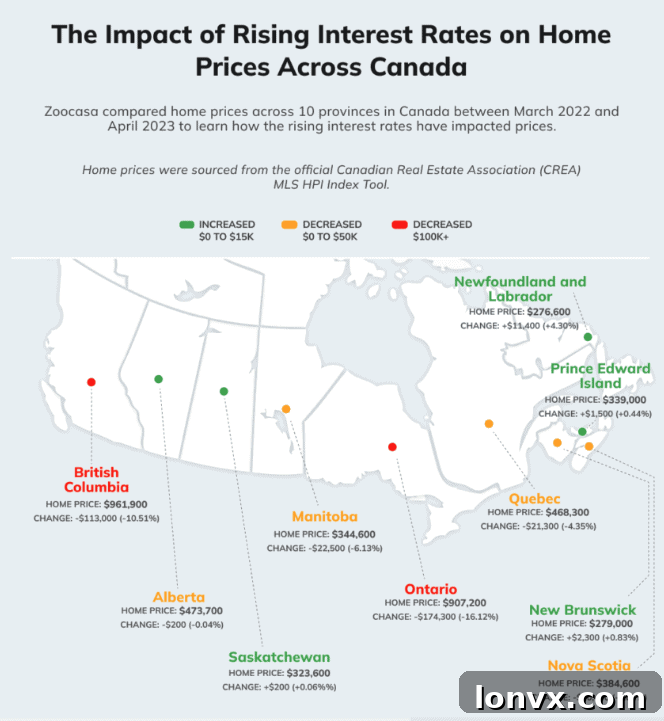
The ripple effects of the interest rate hikes have been felt differently across Canada’s diverse provincial housing markets, creating a distinctly bifurcated landscape. Provinces with historically higher average home prices, such as British Columbia and Ontario, bore the brunt of the initial market correction. These regions, often characterized by strong demand and limited supply, had seen exponential price growth in previous years, making them particularly sensitive to changes in borrowing costs.
British Columbia, renowned for its vibrant West Coast cities and picturesque landscapes, experienced a significant price decline, with the average home price dropping by $113,000, representing a 10.51 per cent reduction from its peak. This decrease reflects a cooling in some of the country’s most expensive markets, where even a modest increase in mortgage rates can significantly impact affordability thresholds for potential buyers. Similarly, Ontario, home to Canada’s largest metropolitan area, Toronto, and numerous other robust urban centers, suffered the largest absolute dip in average home prices. The province saw an average decline of $174,300, marking a substantial 16.12 per cent correction. This downturn can be attributed to a combination of factors, including elevated pre-hike prices, a high proportion of variable-rate mortgages, and a general tightening of buyer budgets in response to increased carrying costs.
Conversely, the more affordable provinces demonstrated a remarkable resilience, with some even experiencing price increases. Newfoundland and Labrador, a province that consistently ranks among the most affordable in the country, saw its average home price rise by 4.3 per cent, translating to an $11,400 increase. This upward trend suggests a growing appeal for regions offering greater value, potentially attracting inter-provincial migration from more expensive urban centers. Alberta, buoyed by a relatively stable economic environment and attractive housing prices compared to its western counterpart, remained largely flat. It registered only a minimal $200 difference in its average price, settling at approximately $473,700. This stability indicates that Alberta’s market, while not immune to national trends, possessed a stronger underlying demand and affordability factor that helped mitigate the broader downturn seen elsewhere. The varying provincial responses highlight how local economic conditions, existing affordability levels, and migration patterns play crucial roles in shaping regional real estate outcomes in a dynamic interest rate environment.
The impact of rising interest rates on cities/regions across Canada, source: Zoocasa
Major Cities Experience Varying Price Trends Amidst Rate Adjustments
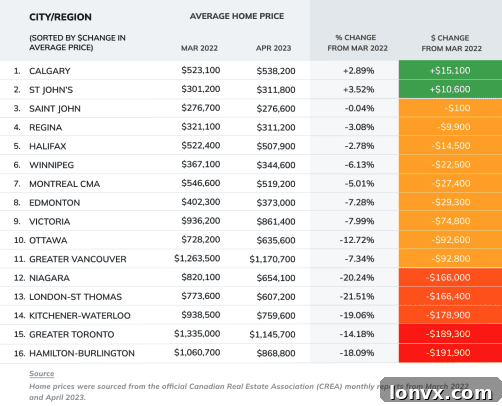
Beyond the provincial overview, a deeper dive into Canada’s major urban centers reveals an intricate tapestry of price adjustments, with some cities experiencing notable declines while others defied the trend with modest increases. According to data compiled by the Canadian Real Estate Association (CREA), the highest percentage declines in home prices were predominantly concentrated in Ontario, reflecting the significant impact of interest rate hikes on its historically overheated markets. The top five cities with the greatest declines were all situated within this province, underscoring its particular sensitivity to the changing economic climate.
Among these, major urban hubs like Toronto and the broader Hamilton-Burlington area witnessed substantial price corrections. Toronto, a perennial hotspot for real estate investment, saw its average home prices fall by $189,300, while its neighbour, Hamilton-Burlington, experienced an even steeper drop of $191,900. These figures represent not just a cooling but a significant rebalancing in markets that had previously seen unsustainable growth. London-St. Thomas, another prominent Ontario market, registered the highest percentage decline across the board, with prices plummeting by 21.51 per cent, or $166,400. This dramatic shift highlights how regions that saw explosive growth during the pandemic, often driven by a quest for more space and relative affordability compared to the GTA, were also prone to sharper corrections once interest rates began to climb.
In stark contrast to the Ontario experience, several cities in other parts of Canada demonstrated remarkable resilience, or even experienced growth, under the same economic pressures. Calgary, Alberta’s bustling economic hub, stands out as a success story in this environment. It has seen increased popularity, partly due to its relative housing affordability and a robust job market, particularly in the energy sector. This influx of inter-provincial migrants, often from more expensive markets like Toronto and Vancouver, has fueled demand, resulting in price increases of $15,100 since February 2022. Similarly, St. John’s, the capital of Newfoundland and Labrador and one of Canada’s most affordable cities, also witnessed a positive trend, with average home prices increasing by $10,600. This growth in more affordable markets suggests a broader demographic shift and a renewed focus on value, as buyers recalibrate their expectations and seek out regions where homeownership remains a more attainable goal despite higher borrowing costs.
A Closer Look at Price Dynamics in the Greater Toronto Area (GTA)
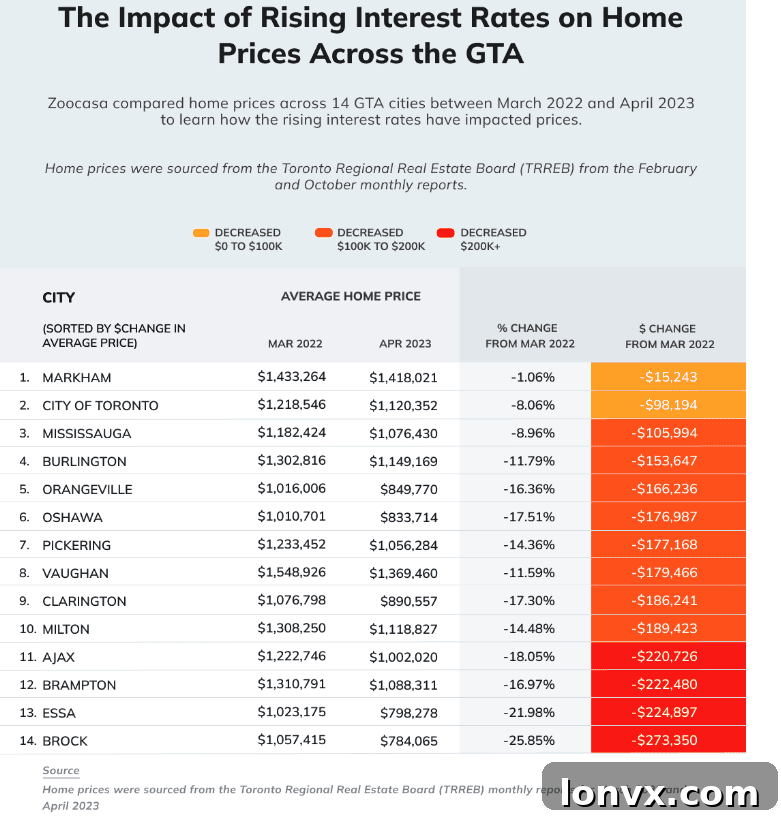
The Greater Toronto Area (GTA), as a critical economic engine and one of Canada’s most competitive housing markets, provides a compelling microcosm of the broader national trends influenced by the Bank of Canada’s interest rate policies. Data from the Toronto Regional Real Estate Board (TRREB) confirms that virtually every city and region within the GTA experienced some form of price decline following the rate hikes, illustrating the widespread impact across this densely populated and economically vibrant area.
While the downturn was pervasive, the severity of the declines varied significantly. Markham and Toronto proper, often considered the core of the GTA’s high-value real estate, proved to be comparatively more resilient. Markham saw a decline of $15,243, representing a modest 1.06 per cent adjustment, while Toronto experienced a more substantial but still less dramatic drop of $98,194 compared to some other regions. This relative stability in the core markets can be attributed to their enduring demand, strong job markets, and limited housing supply, which act as inherent stabilizers even during periods of market volatility. These areas often benefit from strong international migration and a persistent desire for urban living, ensuring a consistent buyer pool.
However, the picture was considerably different in some of the more peripheral and exurban communities within the GTA. Cities such as Ajax, Brampton, Essa, and Brock experienced much more significant declines, with average home prices falling by over $200,000. Brock, in particular, was the most affected, suffering a precipitous decline of $273,350, which translates to a substantial 25.85 per cent reduction. These communities, having witnessed unprecedented growth and price appreciation during the pandemic, often driven by buyers seeking larger homes and more space away from the urban core, were more susceptible to market corrections. Their rapid growth was largely facilitated by ultra-low interest rates, making them more vulnerable when borrowing costs increased sharply.
Despite the considerable declines observed since the onset of the rate hikes, the Toronto real estate market has shown encouraging signs of recovery in 2023. This resurgence indicates a degree of stabilization and a renewed sense of buyer confidence. For instance, home prices increased by 4.0 per cent on a monthly basis from March to April, signalling a positive shift in market momentum. This upturn is driven by a combination of factors. As the market stabilizes, both buyers and sellers have begun to adjust their expectations and strategies to the current interest rate environment. More importantly, the perennial issue of limited housing supply in the GTA continues to exert upward pressure on prices. With fewer homes available to meet the sustained demand from a growing population, competitive conditions are gradually returning, leading to a steady rise in prices. This recovery suggests that while the market has certainly cooled from its frenzied peaks, the underlying fundamentals of strong demand and constrained supply continue to support the long-term value of real estate in the GTA.
The pause in interest rate hikes has provided a much-needed period of adjustment for the Canadian housing market. While the initial shock led to significant price corrections in major urban centers, particularly in Ontario and British Columbia, more affordable markets demonstrated resilience or even growth. The GTA, after experiencing substantial declines in many of its communities, is now showing signs of recovery, driven by persistent demand and ongoing supply challenges. As the market continues to adapt, prospective buyers and sellers are navigating a more complex but potentially more balanced environment, requiring careful consideration of regional nuances and long-term economic indicators.