
Navigating the Toronto Real Estate Market: A Deep Dive into Early 2024 Trends
The Toronto real estate market, a consistent subject of intense scrutiny and speculation, began 2024 with what initially appeared to be a promising rebound. Following a challenging 2023, characterized by historic lows in sales volume and cautious buyer sentiment, early indicators suggested a potential shift. However, a closer examination reveals a more nuanced picture, one that moves beyond simplistic year-over-year comparisons to uncover the underlying dynamics shaping Canada’s most vibrant housing market. While the real estate industry often seizes upon positive year-over-year data for a bullish narrative, understanding the month-over-month context is crucial for discerning genuine trends from mere statistical anomalies.
Last month, the Toronto and Greater Toronto Area (GTA) housing market indeed showcased an uptick in sales compared to the subdued activity witnessed in January 2023. This immediate improvement, after what many considered a “ghost town vibe” the previous year, might lead some to believe a full-fledged recovery is underway. Yet, given that 2023 marked a record-low year for transactions, almost every month in 2024 is inherently poised to demonstrate a significant year-over-year improvement. This article aims to cut through the noise, providing a clear, concise, and SEO-friendly analysis of the latest GTA real estate trends, focusing on the key metrics that truly reflect market health and future direction for buyers and sellers alike.
Unpacking the Monthly Context: Beyond Year-Over-Year Statistics
While annual comparisons offer a broad stroke, the granular, month-over-month data provides invaluable insights into the immediate momentum and underlying health of the Toronto real estate market. One of the most notable occurrences as we transitioned from December 2023 into January 2024 was an uncommon dip in average home prices. This phenomenon is particularly rare, with GTA realtor Vassil Staykov highlighting that such a decline from December to January has only occurred two other times in the past 16 years (in 2009 and 2019). Historically, the market typically commences the new year with an average median price increase of approximately two percent. This recent deviation signals a unique shift in market behavior, warranting a deeper exploration into its causes and potential implications for Toronto home prices.
To fully grasp the significance of these current trends, it’s essential to establish two critical facts that contextualize the data:
- December 2023 presented an uncharacteristically strong performance, witnessing a highly atypical jump in both home prices and sales volume compared to November. This late-year surge defied conventional seasonal patterns, perhaps influenced by a temporary lull in interest rate uncertainty or buyers rushing to finalize transactions before the year-end.
- The entirety of 2023 proved to be an exceptionally weak year for price growth and sales volume across the GTA. The market touched a 23-year record low in the number of sales, underscoring the deep impact of rising interest rates, inflation, and affordability challenges that kept many prospective buyers on the sidelines.
Understanding these two points is paramount. While the annual outlook for 2024 will almost certainly appear robust due to the low baseline of 2023, the monthly shifts tell a more immediate story about supply, demand, and buyer confidence. This detailed perspective is vital for anyone looking to understand true Toronto real estate market trends. Let’s delve into the specific metrics that shaped the market’s trajectory from December to January and what they imply for the critical spring selling season in Toronto.
New Listings: Gauging Seller Confidence and Market Supply
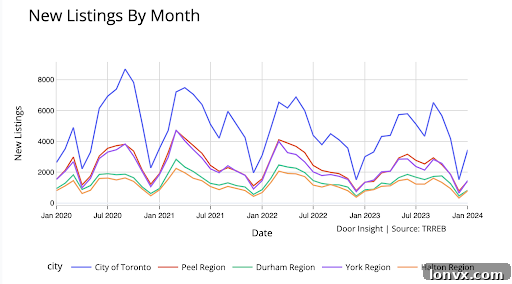
A crucial indicator of market activity and future price trends is the volume of new listings entering the market. As expected, January saw a significant jump in new listings compared to December. This is a common seasonal trend in Toronto, primarily because many property listings expire on December 31st and are subsequently re-listed in the new year. Sellers often wait for the post-holiday period to re-engage with the market, hoping for renewed buyer interest and a fresh start in the GTA housing market.
What’s particularly noteworthy this year, however, is that the January listing increase was slightly larger than that observed in the previous year. This expanded influx of new properties suggests a potential shift in seller sentiment. It could indicate renewed confidence among homeowners looking to capitalize on perceived market stability, or it might reflect an accumulation of inventory from sellers who previously hesitated to list their properties during the more volatile periods of 2023. A higher volume of new listings, especially if not met with commensurate buyer demand, typically places downward pressure on prices and offers more choices for buyers, shifting the market balance. This dynamic is key to understanding the current state of housing inventory in Toronto.
Source: DoorInsight.com/GTA-real-estate
Monitoring the trajectory of new listings over the coming months will be essential. If this trend of elevated inventory persists into the spring, it could solidify a balanced or even buyer-favored market, where sellers may need to adjust their price expectations to attract offers. This metric serves as an early warning system for shifts in supply-demand dynamics within the competitive Toronto housing market, influencing everything from average property values to the likelihood of multiple offers.
Sales Activity: A Closer Look at Buyer Engagement
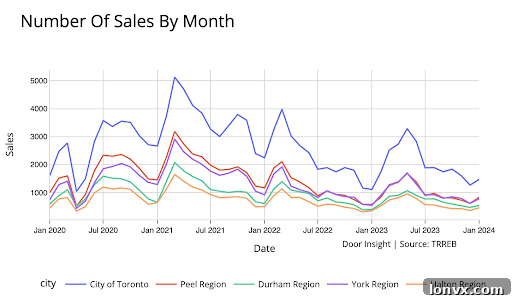
Following the increase in new listings, the number of sales transactions across the Greater Toronto Area also saw an uptick, rising approximately 10-16 percent from December to January. This increase, much like the rise in listings, is largely consistent with typical seasonal patterns. January often marks the beginning of renewed buyer activity after the holiday slowdown, as individuals finalize their plans for the new year and re-enter the housing search, contributing to overall Toronto home sales.
However, the crucial question isn’t just *if* sales increased, but *by how much* in relation to the new inventory and what quality of sales these represent. While a 10-16% increase is positive, it must be viewed in the context of the larger-than-usual jump in new listings. Is this sales volume robust enough to absorb the incoming supply without creating an oversupply? The composition of these sales—whether they were primarily condominiums, detached homes, or specific price points—also offers deeper insights into which segments of the market are demonstrating the most resilience or demand. A cautious buyer base, still grappling with high interest rates and tight affordability, might be selective, leading to slower sales in certain property types or price brackets, impacting the overall GTA property transactions landscape.
Source: DoorInsight.com/GTA-real-estate
The level of sales activity in the early months of 2024 will be a key indicator of consumer confidence. A sustained, healthy increase in sales volume, particularly one that keeps pace with or slightly outstrips new listings, would signal a strengthening market. Conversely, if sales growth lags behind new inventory, it could exacerbate an existing supply-demand imbalance, potentially leading to increased days on market and downward pressure on prices in the long run. Investors and prospective homeowners alike are keenly watching these figures to gauge the overall temperature of the Toronto and GTA real estate landscape, including future real estate activity.
Sales-to-Listings Ratio: The Balance of Power
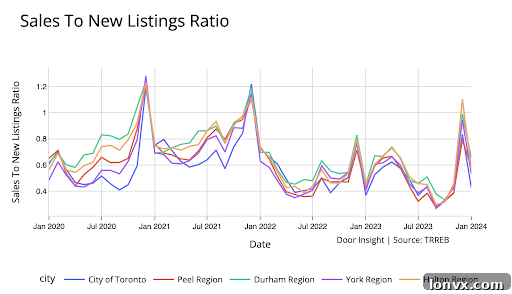
The sales-to-listings ratio is a vital metric that provides a snapshot of the equilibrium between supply and demand in the real estate market. A ratio of 40-60% typically indicates a balanced market, where neither buyers nor sellers have a significant advantage. Ratios above 60% often signify a seller’s market, characterized by fewer listings and higher competition, while ratios below 40% point towards a buyer’s market, with ample inventory and more negotiating leverage for purchasers. This ratio is a primary indicator of market conditions, showing the current dynamic of supply and demand in Toronto.
After experiencing a notable jump in December, the sales-to-new-listings ratio declined from December into January. This shift suggests that the market, which showed signs of leaning back towards a seller’s market at the very end of 2023, has now reverted to a more balanced territory. The primary driver for this rebalancing appears to be that the surge in new supply (listings) slightly outpaced the increase in demand (sales) to kick off 2024. This excess supply, as previously discussed, could largely be attributed to the influx of re-listed properties in January, impacting the overall sales-to-listings ratio in Toronto.
Source: DoorInsight.com/GTA-real-estate
The implications of a balanced market are significant for both buyers and sellers in the GTA. For buyers, it means more options and potentially less intense bidding wars, offering more time for due diligence. For sellers, it implies the need for realistic pricing strategies and possibly more flexibility in negotiations. However, to truly understand the long-term market balance, we will need to observe how this ratio evolves as the robust spring market gets into full swing. The spring season traditionally brings a higher volume of both listings and sales, and its performance will be critical in determining whether the market sustains its balanced state or shifts definitively towards buyers or sellers within the GTA housing market.
Days on Market (DOM): A Barometer of Absorption Rates
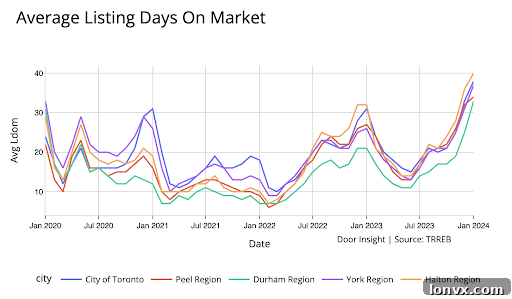
The “Days on Market” (DOM) metric provides critical insight into how quickly properties are being absorbed by the market. A rising DOM generally indicates a slower market where homes are taking longer to sell, often correlating with increasing inventory and potentially easing price pressures. Conversely, a declining DOM suggests a fast-paced market with high demand and quick sales, typical of seller’s market conditions. The DOM trend in Toronto is a key indicator of buyer caution and market speed.
In the Toronto real estate market, DOM has continued its upward trend, with listings spending more time on the market than they have in the last three years. This extended period on the market is a clear signal that buyers are taking a more measured approach, a direct contrast to the frantic pace observed during the peak of the market frenzy. Should this trend persist and new listings continue to accumulate against a slower absorption rate, it could strongly project a spring market that is either firmly balanced or, more significantly, turning in favor of buyers. In such a scenario, sellers might find themselves needing to be more flexible on pricing or offering incentives to attract bids, further influencing GTA housing market trends.
Source: DoorInsight.com/GTA-real-estate
This increasing DOM aligns perfectly with the narrative of a more cautious buyer who appears to be cautiously re-entering the market after several years of extreme volatility in GTA real estate. These buyers, having witnessed rapid price escalations and subsequent corrections, are likely prioritizing thorough due diligence, ensuring their investments are sound in a still-uncertain economic climate. Factors such as high interest rates, persistent inflation, and broader economic uncertainties are undoubtedly contributing to this more deliberate buying behavior. The extended DOM is thus a direct reflection of a market recalibrating to more sustainable and less frenzied conditions, emphasizing the importance of strategic pricing and presentation for sellers, and highlighting overall buyer caution in Toronto real estate.
Price Dynamics: Average vs. Median Trends Across the GTA
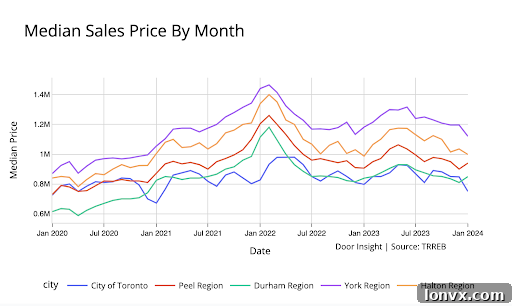
Understanding price movements in the Toronto real estate market requires looking beyond just the aggregate figures; it necessitates a detailed examination of both average and median prices across different GTA regions. Average prices can sometimes be skewed by a few high-value transactions, while median prices offer a more accurate representation of the typical home price, as they are less affected by extreme outliers. The transition from December to January revealed varied price dynamics across the Greater Toronto Area, crucial for grasping Toronto home prices.
Average prices saw a decline in most GTA markets during this period, with the notable exception of Durham Region, which demonstrated resilience or perhaps unique demand factors. This broad-based average price dip suggests a widespread, albeit modest, correction or stabilization following the atypical strength of December. When examining median prices, the picture became even more granular: Toronto, Halton, and York regions experienced a decrease in median prices from the previous month, indicating a softening in the middle tier of the market. Conversely, Durham and Peel regions observed an increase in their median prices, suggesting that these areas might be benefiting from relative affordability, shifting buyer preferences, or perhaps unique local market conditions. This divergence highlights the importance of hyper-local analysis within the broader GTA context for understanding GTA property values.
Source: DoorInsight.com/GTA-real-estate
These price fluctuations underscore the ongoing adjustment of the market to evolving economic conditions, including the persistent influence of interest rates and affordability concerns. The mixed performance across regions suggests a highly segmented market, where localized demand and supply factors play a significant role. Buyers and sellers should pay close attention to the specific trends within their desired or target regions, as a blanket assumption about the entire GTA may not accurately reflect ground realities. The spring market will undoubtedly provide more clarity on whether these price adjustments are temporary seasonal dips or the beginning of a more sustained recalibration in real estate price trends.
Sale-to-List Price Ratio: Decoding Negotiation Dynamics
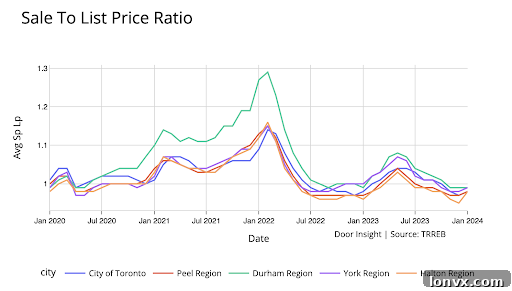
The sale-to-list price ratio is a powerful indicator of buyer and seller negotiation power and market intensity. It measures the final selling price of a property as a percentage of its last advertised list price. A ratio close to 100% or above suggests a strong seller’s market with competitive bidding, while a ratio below 100% implies that properties are selling for less than their asking price, indicating more buyer leverage. This ratio is crucial for understanding the current negotiation power in Toronto real estate.
From December to January, the sale-to-list price ratio in the GTA market tightened considerably, moving from a range of 95-98 percent to 98-99 percent. This upward shift, although seemingly minor, is quite significant. It signals that while properties are not consistently selling for significantly above their asking price, sellers are generally achieving prices much closer to their initial list price. This trend aligns with anecdotal evidence from within the industry, which suggests an increase in the number of multiple offers on properties, but notably, not a meaningful surge in bids that significantly exceed the asking price. This nuance is vital for interpreting the dynamics of multiple offers in the GTA.
Source: DoorInsight.com/GTA-real-estate
What does this imply for buyers and sellers? For buyers, it means that while they might face competition from multiple offers, they are less likely to encounter situations where properties are selling for tens or even hundreds of thousands over asking. This suggests a more rational and disciplined buyer pool, unwilling to overpay in the current environment. For sellers, it reinforces the importance of strategic and realistic pricing. While multiple offers might be common, setting an inflated initial list price might deter serious buyers or lead to a longer DOM. This tightening ratio reflects a market where buyers are engaged and willing to bid, but they are doing so with a keen eye on value and affordability, maintaining a cautious stance against overbidding. This metric will be vital to watch as the spring market unfolds, offering continuous insights into the delicate balance of negotiation power in the Toronto real estate market.
Outlook for the Toronto Real Estate Market: Navigating 2024
As we navigate further into 2024, the Toronto and GTA real estate market presents a complex tapestry of emerging trends and persistent challenges. While early year-over-year comparisons offer an optimistic facade, a deeper dive into monthly data reveals a market in a state of delicate rebalancing. The unusual December-to-January price dip, the nuanced interplay between new listings and sales volume, the shift back to a balanced sales-to-listings ratio, and the extended Days on Market all point towards a housing landscape that demands careful observation and strategic decision-making. Understanding these GTA housing market trends is paramount for success.
The market is clearly transitioning from the extremes of recent years, moving towards a more sustainable and potentially balanced environment. Buyers, having weathered significant volatility, are demonstrating a newfound caution and price sensitivity, reflected in the tighter sale-to-list price ratios and longer absorption periods. Sellers, in turn, are being nudged towards more realistic pricing expectations, understanding that while demand exists, it is not as aggressive as during the frenzied peaks. This recalibration suggests a move towards healthier, long-term stability for property values in Toronto.
Looking ahead, the spring market will be a critical test. Key factors to watch include the trajectory of interest rates, which continue to be a dominant force influencing affordability and buyer confidence. Any sustained decrease in rates could inject renewed vigor into the market, while stability or slight increases might reinforce the current cautious sentiment. Additionally, overall economic performance, employment figures, and immigration levels will play significant roles in shaping demand. The interplay of these macroeconomic factors with local supply-demand dynamics will determine whether the Toronto real estate market settles into a truly balanced state, leans towards buyers, or begins a more definitive upswing.
For both prospective buyers and sellers in the GTA, staying informed with detailed, month-over-month analysis, rather than relying solely on generalized narratives, will be paramount. The market is evolving, offering both opportunities and challenges that require a nuanced understanding to navigate successfully in 2024. Property values in Toronto and the GTA remain a significant investment, making informed decisions more crucial than ever.
Enjoying this article? Stay Ahead with Our Insights!
Get the latest articles and expert analysis on the Canadian real estate industry delivered directly to your inbox 3 times a week. Don’t miss out on crucial market updates, trends, and forecasts on Toronto’s real estate.