
Navigating the Canadian Housing Market: Pauses, Rate Cuts, and a Balanced Future
The Canadian housing market continues to be a dynamic and closely watched sector, heavily influenced by evolving monetary policy and shifting economic indicators. While June saw a brief surge in activity following the Bank of Canada’s initial interest rate cut, July brought a temporary pause, signaling a market in flux. This period of adjustment offers valuable insights into the resilience and future trajectory of home sales, prices, and inventory across the nation, providing a clearer picture for homeowners, prospective buyers, and real estate professionals alike.
The Ripple Effect of Rate Cuts and Anticipated Policy Easing
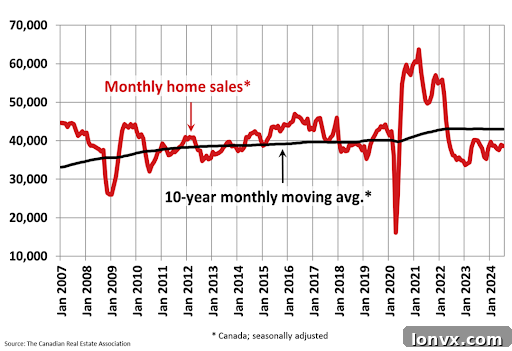
Following a modest gain in June, Canadian home sales experienced a slight dip of 0.7% on a month-over-month basis in July. This marginal contraction reversed only a small fraction of the momentum generated by the Bank of Canada’s initial rate cut. However, this pause should not be misinterpreted as a definitive downturn; instead, it reflects a market carefully absorbing new information and adjusting expectations, especially with the likelihood of further interest rate cuts looming on the horizon.
Market analysts and economists are now increasingly anticipating additional policy easing from the Bank of Canada. After the second rate cut, which brought the key interest rate to 4.5% on July 24th, the prevailing sentiment suggests that more cuts are probable as we move into the fall and winter months. Such decisions are typically driven by a desire to stimulate economic activity, mitigate persistent inflationary pressures, and enhance affordability for consumers, particularly within the housing sector. Lower borrowing costs, as a result of these cuts, are expected to gradually improve buyer confidence, make homeownership more accessible, and potentially reignite demand in the medium term, slowly easing the financial burden on mortgage holders and new entrants to the market.
It’s important to contextualize current market activity against historical highs. The frenzied pace of home sales witnessed during the COVID-era peak in January 2021, which saw approximately 64,000 sales – the highest since January 2009 – is unlikely to return anytime soon. That unprecedented period was characterized by exceptionally low interest rates, government stimulus, pent-up demand, and a profound shift in lifestyle preferences that prioritized larger living spaces. Today’s Canadian housing market operates under fundamentally different conditions, including higher base rates, tighter lending conditions, and an evolving supply landscape. Despite the slight month-over-month dip, July’s activity remained robust, staying close to June’s levels and notably, registering a significant 4.8% higher than in July 2023. This year-over-year growth underscores a steady recovery trajectory, albeit a measured and more sustainable one, moving away from the speculative fervor of previous years.
Shifting Supply Dynamics and the Evolution of Home Prices
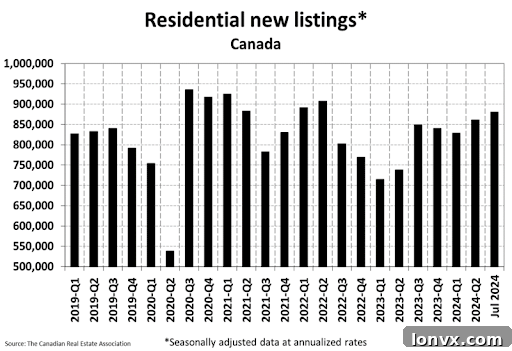
Beyond sales volumes, the supply side of the Canadian housing market is also showing significant movement. The number of newly listed properties saw a modest increase of 0.9% month-over-month in July. This national trend was notably bolstered by a significant boost in supply observed in Calgary, indicating varied regional market conditions. An increase in listings typically provides more options for buyers, reduces intense bidding wars, and can help temper price growth, moving the market towards a more balanced state. This expansion in inventory is a welcome development for many prospective homeowners who have faced limited choices and intense competition in recent years.
When analyzing pricing, the Home Price Index (HPI), which adjusts for compositional shifts in sales and provides a more accurate measure of true price trends by tracking the value of a typical home, rose by 0.2% from June to July. While this signals a slight upward movement in underlying home values on a monthly basis, it’s crucial to note that prices remained 3.9% lower than in July 2023. This year-over-year decline reflects the significant adjustments made during the initial phase of aggressive interest rate hikes, and the current month-over-month stability suggests the market is finding a new equilibrium rather than experiencing a freefall. The HPI offers a clearer picture of market health compared to raw average prices, as it filters out the impact of a changing mix of sold properties.
The national average sale price, often a more volatile metric due to its sensitivity to the mix of homes sold in any given period, remained virtually unchanged, dipping by a mere 0.2% year-over-year to $1,667,317. This remarkable stability in the average price, despite the slight HPI increase, indicates a relatively consistent mix of properties being transacted, without extreme shifts towards either luxury or entry-level homes dominating sales. The nuances between the HPI and the average sale price provide a comprehensive view of how Canada’s real estate values are evolving, suggesting a market that is consolidating rather than experiencing widespread distress. This steadying of prices can contribute to renewed confidence among both buyers and sellers, fostering more predictable market conditions.
A Balanced Market with Potential for Future Oversupply
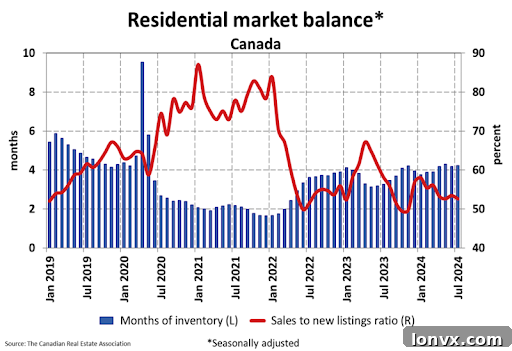
Canada’s housing market is increasingly characterized by a state of balance, a stark contrast to the red-hot conditions of recent years. Key indicators such as months of inventory and the sales-to-new-listing ratio point towards a more equitable environment for both buyers and sellers. The market is steadily hovering at just over four months of inventory, a level that generally signifies a balanced market where neither buyers nor sellers have a significant advantage. In a truly balanced market, it takes approximately four to six months for all current inventory to sell at the prevailing rate of sales. Similarly, sales-to-new-listing ratios are maintaining at just over 50%, further reinforcing this balanced state. This indicates that roughly half of all newly listed homes are finding buyers within a month, a healthy but not aggressive pace. In such a market, property values tend to stabilize, and large, rapid price movements, whether upward or downward, are less likely, fostering a more predictable environment for long-term planning.
However, this balance also introduces the potential for continued downward pressure on prices, especially as new listings continue to climb. July, typically considered one of the slowest periods for new listings due to summer holidays and seasonal patterns, paradoxically saw national new listings inventory continue to grow. This sustained influx of properties onto the market, even during a traditionally quieter month, signals a significant shift in supply dynamics. Looking ahead, this trend suggests that the fall market could experience an oversupply of homes, particularly if buyer demand remains subdued by persistent high interest rates or economic uncertainties. An oversupplied market typically favors buyers, as greater choice and less competition can lead to more favorable negotiation terms and potentially soften prices further. Factors contributing to this potential oversupply include sellers who may have been waiting for better market conditions, investors offloading properties to realize gains or mitigate risks, or homeowners facing financial pressures, all against a backdrop of somewhat subdued buyer demand influenced by prevailing mortgage rates and cautious consumer sentiment.
Regional Stabilisation: Alberta and Ontario Leading the Way
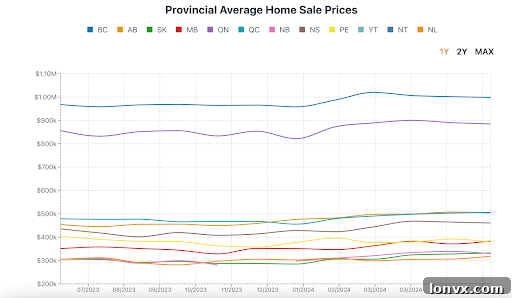
While national trends provide an overarching picture, regional markets often exhibit unique dynamics driven by local economic conditions, population growth, and specific housing policies. In recent months, Alberta and Ontario, two of Canada’s most significant provincial economies, have shown compelling signs of provincial stabilization in terms of average home sales price trends. This stabilization is a result of a complex interplay of internal and external factors.
Within these provinces, specific cities have experienced contrasting movements that contribute to the broader trend. Edmonton and Hamilton-Burlington, for instance, recorded some of the biggest price increases, reflecting strong localized demand, perhaps fueled by relative affordability compared to larger urban centers or specific economic drivers. Conversely, Calgary and Toronto, two of Canada’s largest and most active housing markets, witnessed the largest average price increases, which intriguingly levelled one another out, contributing to the broader provincial stabilization. This suggests a dynamic where strong demand in specific segments or neighborhoods within these major urban centers continues to drive values, even as other areas adjust to changing market conditions and interest rate impacts.
Calgary presents an especially interesting case study in this context. Despite experiencing one of the biggest decreases in average price compared to other major Canadian cities, it concurrently had the highest number of newly listed properties. This surge in listings played a significant role in the 0.9% increase in the national average for new listings. This phenomenon could indicate a market where sellers are responding to softening prices by bringing their properties to market, perhaps to capitalize on previous gains or avoid potential future downturns. Alternatively, it could be a reflection of continued robust population growth and new construction leading to more diverse housing needs and choices for residents. The increase in supply, coupled with somewhat tempered demand, could explain the downward pressure on average prices even as the number of transactions remains robust, maintaining overall market activity.
Alberta, in particular, continues to attract substantial interprovincial migration, driven by its relatively affordable housing compared to the more expensive markets of Ontario and British Columbia, coupled with a strong job market, especially in the energy and tech sectors. This influx of new residents fuels demand, but if supply keeps pace, it can lead to a more balanced market rather than runaway price appreciation. Ontario, on the other hand, with its dense urban centers, diverse economy, and continuous population growth, typically sees consistent demand, but has also been more susceptible to interest rate sensitivity due to higher absolute home prices. The stabilization in these key provinces suggests a recalibration of buyer and seller expectations, leading to more sustainable and predictable growth patterns across the Canadian housing market.
Source: Wowa.ca
Outlook and Strategic Considerations for the Canadian Housing Market
As we move further into the year and anticipate the crucial fall selling season, keeping a vigilant eye on these multifaceted developments will be paramount for anyone involved in the Canadian housing industry. The intricate interplay between the Bank of Canada’s evolving monetary policy, shifting supply-demand dynamics, and nuanced regional economic performance will dictate the market’s trajectory for the remainder of the year and into early next year.
For potential homebuyers, the anticipated rate cuts could offer a crucial window of opportunity, potentially making mortgage financing more affordable and reducing monthly payments. However, they should also consider the potential for continued downward price pressure due to increasing inventory, which might present better negotiation opportunities. Diligence in market research, securing pre-approvals, and understanding local market conditions will be essential for making informed purchasing decisions. For sellers, understanding the implications of a balanced or potentially oversupplied market is crucial. Strategic and realistic pricing, coupled with effective marketing and professional staging, will be key to attracting buyers in an increasingly competitive environment where properties may take longer to sell.
Real estate professionals will need to adapt their strategies to advise clients effectively through this nuanced period. Monitoring a broad range of economic indicators such as inflation rates, employment figures, consumer confidence levels, and demographic shifts will provide deeper insights into future market movements and help anticipate potential shifts. The market is not experiencing a uniform slowdown but rather a strategic rebalancing, which demands a highly nuanced approach from all stakeholders. While the COVID-era exuberance is firmly in the rearview mirror, the current landscape offers opportunities for sustainable growth and the establishment of a more stable, predictable market foundation. The coming months will undoubtedly reveal how these trends solidify, shaping the Canadian real estate narrative for the foreseeable future and providing a clearer path for all participants.
Enjoying this insightful article?
Get the latest, most comprehensive real estate market insights and analyses directly in your inbox three times a week. Stay fully up to date on all the crucial developments in the Canadian real estate industry.