
Navigating Canada’s Soaring Rental Market: A Deep Dive into 2023 Trends and 2024 Outlook
Canada’s rental market witnessed an unprecedented surge in 2023, concluding the year with an average rent reaching a record-high of $2,178 in December. This figure represents a substantial 8.6 percent increase from the previous year, building on a challenging trend where rents climbed over 12 percent in 2022 and 4.6 percent in 2021. The cumulative effect over the past two years has been particularly impactful, with Canadian asking rents escalating by a remarkable 22 percent, translating to an average monthly increase of approximately $390 for tenants across the nation.
According to the National Rent Report by Rentals.ca and Urbanation, the pace of rent growth in 2023 exceeded expectations. Shaun Hildebrand, President of Urbanation, attributed this robust growth primarily to a confluence of factors: a significant influx of non-permanent residents, a surprisingly resilient national economy that maintained strong employment levels, and a sharp downturn in home-buying activity driven by high interest rates and affordability concerns. While forecasts suggest that rents will continue their upward trajectory in 2024, there is an expectation for a moderation in the pace of growth, as demand is projected to increase at a somewhat slower rate and more new supply enters the market.
Unprecedented Growth: A Snapshot of Canada’s Rental Landscape in 2023
The year 2023 marked a pivotal period for the Canadian rental market, characterized by relentless upward pressure on prices. The average asking rent of $2,178 in December painted a clear picture of an affordability crisis deepening across the country. This consistent escalation, from 4.6% in 2021 to over 12% in 2022 and then 9% throughout 2023, highlights a sustained imbalance between supply and demand. Renters, particularly in major urban centers, have faced mounting challenges in securing affordable housing, often dedicating a significant portion of their income to rent.
The cumulative 22 percent increase over just two years underscores a systemic issue that extends beyond simple economic fluctuations. This rapid acceleration has far-reaching implications for household budgets, impacting Canadians’ ability to save, invest, and maintain a reasonable standard of living. For many, the dream of homeownership has become more distant, pushing an increasing number of individuals and families into a competitive and expensive rental market, thereby exacerbating demand pressures.
Decoding the Drivers Behind the Rental Surge
Understanding the forces that propelled Canada’s rental market to new heights in 2023 is crucial for comprehending its future trajectory. The interplay of several key factors created a perfect storm for rent inflation:
Demographic Shifts: The Role of Non-Permanent Residents
Canada’s welcoming immigration policies and robust international student programs have led to a significant increase in its population, particularly through the arrival of non-permanent residents. These individuals primarily seek rental accommodation upon arrival, adding substantial demand to an already undersupplied market. While contributing positively to the economy and cultural diversity, this demographic shift has intensified competition for available rental units, especially in urban areas that serve as primary entry points.
Economic Resilience and High Employment
Despite global economic uncertainties, Canada’s economy demonstrated remarkable resilience throughout 2023. Strong employment rates meant that a large portion of the population had stable incomes, which, paradoxically, sustained their ability to afford higher rents. This economic robustness, while generally positive, indirectly contributed to the rental surge by maintaining a healthy pool of tenants capable of absorbing rent increases, thus providing little incentive for landlords to lower prices.
The Homeownership Hurdle: Impact of High Interest Rates
The Bank of Canada’s aggressive interest rate hikes aimed at curbing inflation had a significant ripple effect on the housing market. Higher borrowing costs severely impacted housing affordability, pushing many prospective homebuyers out of the purchase market. Individuals and families who might otherwise have transitioned to homeownership were compelled to remain in or enter the rental market, further tightening supply and intensifying competition for rental properties. This created a bottleneck, with more people vying for fewer units.
Supply Shortages: A Persistent Challenge
At the core of Canada’s rental crisis lies a chronic housing supply shortage. While efforts are being made to increase construction, the pace of new builds, particularly rental-specific units, has consistently lagged behind population growth. Challenges such as high construction costs, labour shortages, slow permitting processes, and restrictive zoning regulations continue to impede the timely delivery of new housing units. This persistent gap between available homes and growing demand is a fundamental driver of escalating rental prices.
Diverse Rental Segments: Purpose-Built, Condominiums, and Houses Fared
The Canadian rental market is not monolithic; different housing types experienced varying rates of growth and average prices in 2023. Understanding these distinctions provides a more nuanced view of the market’s dynamics:
Purpose-Built Rental Apartments
Traditional purpose-built rental apartments emerged as the segment with the fastest growth last year. Averaging $2,076 per month, these units saw an impressive 12.8 percent climb. This robust growth often indicates strong demand for dedicated rental housing, potentially driven by the desire for professional property management, amenities, and purpose-designed living spaces that cater specifically to renters. The stability and long-term nature of purpose-built rentals make them highly sought after in a tight market.
Condominium and House Rentals
In contrast, condominium rentals and house rentals experienced slower, albeit still significant, growth rates. Condominiums saw a 6.9 percent increase, reaching an average of $2,340, while house rentals grew by 5.9 percent, averaging $2,354. The slower growth in these categories could be attributed to their higher entry price points compared to purpose-built apartments, making them less accessible for some renters. Additionally, the dynamics of individual landlord ownership for condos and houses can introduce more variability compared to the larger, professionally managed purpose-built sector.
Standout Regions: Where Rents are Soaring and Stabilizing
Rental trends varied significantly across Canada’s provinces and major cities, reflecting localized economic conditions, population shifts, and housing supply dynamics.
Alberta’s Ascendance: The New Rental Hotspot
Alberta notably stood out as the province with the fastest-growing purpose-built and condominium apartment rents, experiencing a remarkable 15.6 percent annual increase to an average of $1,691. This surge is largely attributed to significant interprovincial migration from more expensive provinces like Ontario and British Columbia, attracted by Alberta’s relatively lower cost of living and robust job market, particularly in the energy sector and diversifying tech industries. Cities like Calgary and Edmonton have become magnets for those seeking better affordability, intensifying rental demand within the province.
British Columbia & Ontario: Still the Priciest, Facing Adjustments
British Columbia maintained its position as the most expensive province for apartment rents, averaging around $2,500 in December. Interestingly, it saw a slight decrease of 1.4 percent year-over-year, which might indicate that rents in some areas are nearing an affordability ceiling, or that some supply adjustments are beginning to take effect. Ontario, while also among the most expensive, recorded a 3.7 percent annual increase, with average rents at $2,446. Despite slower growth compared to Alberta, both provinces continue to grapple with severe housing affordability challenges, prompting residents to explore alternatives or migrate.
Quebec’s Consistent Climb
Quebec’s average rent rose by a solid 10 percent, reaching $1,953. This increase reflects growing demand in major urban centers like Montreal, fueled by a strong economy, increasing population, and continued investment. While still more affordable than BC and Ontario, the rapid pace of growth signals a tightening market and growing pressure on renters in the province.
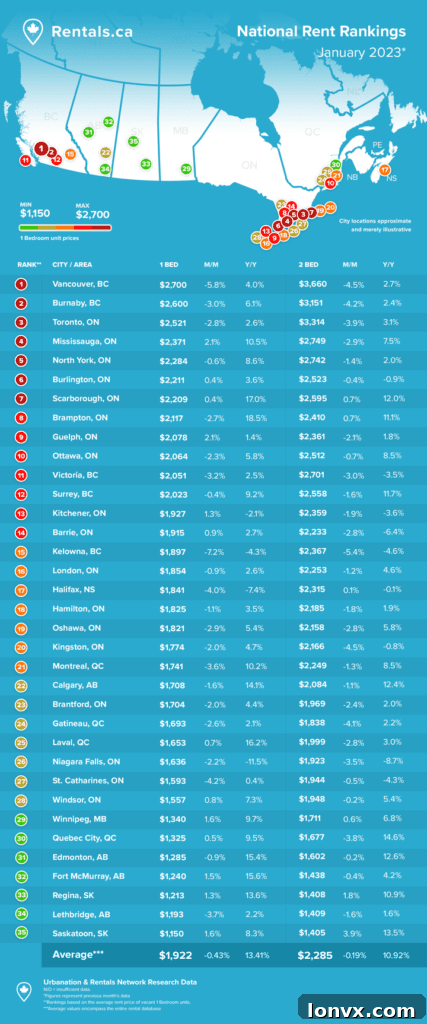
City-Specific Dynamics: A Closer Look at Urban Rental Markets
The granular view of Canada’s major cities reveals distinct patterns of rental market activity, underscoring the localized nature of housing pressures.
Calgary, Edmonton, and Montreal: Leading the Growth Spurt
Among Canadian cities, Calgary led with an impressive 14 percent annual rent increase, bringing its average to $2,071. Edmonton followed closely with a 13.5 percent increase, reaching an average of $1,467, making it a highly attractive option within the booming Alberta market. Montreal also experienced significant growth, with an 11.3 percent increase to an average of $2,019. These cities, particularly in Alberta, are benefiting from strong interprovincial migration and robust local economies, making them current hotspots for rental demand and price appreciation. The relatively lower starting points for rent in these cities compared to Vancouver or Toronto also allowed for more room for dramatic percentage increases.
Vancouver and Toronto: Navigating Stabilization Amidst High Costs
In contrast, Canada’s two most expensive cities, Vancouver and Toronto, saw more modest shifts. Vancouver’s average asking rent decreased by a slight 0.7 percent annually to $3,059, while Toronto’s average asking apartment rent went up by a modest 2.1 percent to $2,832. This stabilization, or even slight decrease in Vancouver’s case, could suggest that rents in these markets might be approaching an affordability ceiling, pushing some renters to seek housing in surrounding suburbs or even other provinces. While the percentage growth was lower, the absolute costs remain extraordinarily high, posing significant challenges for residents and contributing to urban sprawl as people search for more affordable options.
The Road Ahead: 2024 Rental Market Projections
Looking forward to 2024, the Canadian rental market is anticipated to experience a shift towards greater balance, though an undersupplied condition is expected to persist. Several factors are poised to influence the market’s trajectory, potentially moderating the rapid rent increases seen in 2023.
A key influence will be a slowing economy, which may temper demand by impacting employment and migration patterns. Furthermore, policy adjustments regarding non-permanent residents could lead to fewer new arrivals, easing some of the demographic pressure on the rental market. On the supply side, a greater number of new purpose-built rental units and other housing forms are expected to come online, providing much-needed inventory. Additionally, the potential for lower interest rates later in the year could encourage more home buying activity, drawing some demand away from the rental sector. While these factors suggest a less heated market, rent increases are still projected to approach the five-year average of around 5 percent, indicating that affordability will remain a critical issue for many Canadians.
Implications for Renters and Policy Makers
The sustained high rental costs and the projected continued increases in 2024 present significant challenges for renters across Canada. Households will need to continue to budget carefully, with many considering relocation to more affordable regions or adapting to smaller living spaces. This situation also underscores the urgent need for comprehensive policy interventions. Governments at all levels face pressure to accelerate housing supply, particularly affordable rental units, streamline development approvals, and explore innovative solutions to ensure that housing remains accessible for all Canadians. Addressing the root causes of the supply-demand imbalance will be paramount for fostering a sustainable and equitable housing market.
In conclusion, 2023 was a year of record-breaking rent increases in Canada, driven by strong demand and persistent supply shortages. While 2024 is expected to bring a slower pace of growth, the rental market will remain competitive, and affordability challenges will endure. Monitoring these trends and adapting to the evolving landscape will be crucial for both renters and stakeholders in the housing industry.
Get the full report details here.
Enjoying this article?
Get the latest REM articles in your inbox 3x week so you stay up to date on the latest in the Canadian real estate industry