
Canadian Real Estate Market: Analyzing December 2022 Trends and the Path Forward
The Canadian real estate market concluded 2022 with a subtle yet significant shift: a modest uptick in home sales between November and December. This trend deviates from typical year-end patterns, where activity usually slows. While the national statistics released by the Canadian Real Estate Association (CREA) for December 2022 offered few outright surprises given the challenging year, they provide crucial insights into an evolving market dynamic and hint at potential future directions. Understanding these nuanced movements is key for anyone navigating Canada’s housing landscape.
After a year characterized by aggressive interest rate hikes and widespread economic uncertainty, the housing market has shown signs of adapting. This article delves into CREA’s latest data, exploring the historical context of market slowdowns, the pivotal role of affordability, and the regional disparities that are reshaping demand. We will examine how a market stripped of urgency is slowly finding its footing, driven by a renewed focus on value and a cautious return of opportunistic buyers.
Chart A: Monthly Home Sales Volume – A Historical Perspective
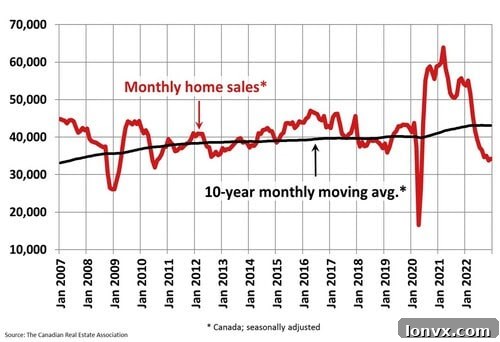
Monthly home sales (Canadian Real Estate Association)
A closer look at Chart A, illustrating the trajectory of monthly home sales, reveals a discernible pattern within the Canadian real estate market: it inherently slows down in response to periods of heightened economic uncertainty. This phenomenon is not unprecedented; significant drops in sales volume were observed in 2009 during the global financial crisis and again in 2020 at the onset of the COVID-19 pandemic. These historical precedents bear a striking resemblance to the deceleration experienced throughout much of 2022. In both previous instances, however, the market demonstrated remarkable resilience, with sales volume rebounding swiftly and trading well above the 10-year average for an extended period following the downturn.
This historical pattern offers a glimmer of optimism for the current market. Such periods of correction and eventual rebound typically reward resilient professionals – those real estate agents, investors, and developers who possess the fortitude to navigate the market’s trough without a clear timeline for recovery. Their ability to adapt, maintain a long-term perspective, and continue serving clients during challenging times positions them to capitalize on the subsequent recovery. Drawing from these historical precedents, CREA anticipates a significant rebound in sales volume to take place in 2024. This forecast is underpinned by expectations of stabilized interest rates, improving consumer confidence, and the inherent long-term demand for housing in Canada.
Sales Volume: Deciphering the December Data
While the headline figure of a nearly 40 percent decline in sales volume compared to December 2021 might initially appear alarming, it’s crucial to contextualize this data. December 2021 was an anomaly, representing a record-setting year for Canadian home sales, propelled by historically low interest rates and robust demand during the pandemic real estate boom. Comparing current figures to such an exceptional benchmark can skew perceptions. When viewed through a broader historical lens, the December 2022 numbers, while significantly lower than the previous year’s peak, reflect a necessary market correction towards more sustainable levels.
More notably, monthly sales volume actually increased by 1.3 percent compared to November 2022. This uptick is particularly significant because volume almost invariably declines into December and January, as holiday seasons and winter weather typically reduce market activity. This break from the usual annual trend indicates an emerging strength and opportunism within the market after a prolonged lull spanning several months. It suggests that a cohort of buyers, who had been priced out or sidelined by aggressive bidding wars and rapidly escalating values, are slowly beginning to re-enter the market, sensing a shift in conditions that might be more favorable to them. These are often discerning buyers who are no longer driven by urgency but by the opportunity to secure a home at a more reasonable price point or with less competition.
Anecdotal evidence from real estate professionals across the country strongly supports this opportunistic thesis. Many agents report having a substantial pool of buyers patiently waiting on the sidelines, keenly observing market movements for the ‘right time’ to make a purchase. This patience signifies a fundamental change in market psychology. The frenetic urgency that defined the pandemic-era market has dissipated, giving way to a slower, steadier, and ultimately healthier environment. The primary focus of this recalibrated market has narrowed to a single, critical factor: affordability. Buyers are now prioritizing value and the long-term sustainability of their housing investment, rather than succumbing to the pressure of rapid price appreciation.
Chart B: Understanding the Affordability Conundrum
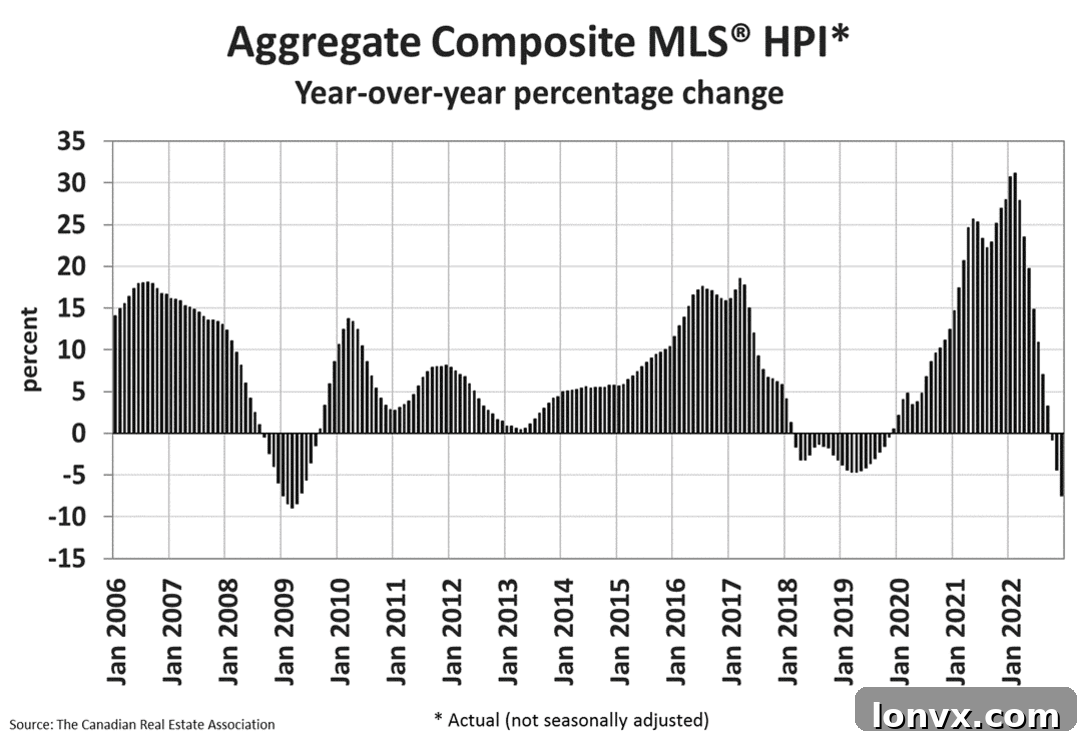
When discussing the critical issue of housing affordability, it’s essential to recognize that most economists analyze it as a multifaceted function of three primary variables:
- House prices: The absolute cost of residential properties.
- Interest rates: The cost of borrowing money to finance a home purchase.
- Income: The household earnings available to cover housing expenses.
These three factors interact dynamically to determine how accessible homeownership is for the average Canadian. The National Bank’s Q3 Housing Affordability Monitor alarmingly reported that housing affordability had plummeted to levels not witnessed since the challenging periods of 1981 and 1989. These previous peaks in unaffordability were significant moments in Canadian economic history, characterized by high inflation and soaring interest rates. Crucially, both historical peaks were subsequently followed by steep recoils in affordability, as market dynamics shifted, leading to price corrections and an eventual normalization of interest rates. This historical precedent offers a potential blueprint for how the current affordability crisis might resolve.
Looking ahead, income is broadly expected to remain stable, or at best, see modest growth. This projection is largely due to the Bank of Canada’s strategic focus on combating inflation, which includes targeting job vacancies to cool the labor market. With wage growth unlikely to outpace inflation significantly in the short term, the onus for improving affordability falls squarely on the other two variables: house prices or interest rates. For the market to achieve sustainable affordability, either average home prices must continue to adjust downwards, or interest rates must eventually decline from their current elevated levels. The interplay between these factors will dictate the pace and extent of affordability improvements.
In December, house prices provided some relief, showing the largest year-over-year decline since 2009. National home prices were down a significant 12 percent compared to the previous year. This substantial correction is a direct result of higher borrowing costs tempering buyer demand and bringing prices closer to equilibrium. While still a long way from the deeply affordable levels seen in past decades, this decline is a crucial step towards rebalancing the market and making homeownership a more attainable goal for a wider segment of the population. The pace of these price corrections will continue to be a key indicator for market health and affordability trends in the coming months.
Regional Dynamics and the Resurgence of Urban Centers
A granular review of regional benchmark prices reveals another compelling trend: a clear re-urbanization of demand is becoming increasingly apparent. During the pandemic, many buyers flocked to suburban and rural areas, driven by the flexibility of remote work and the desire for more space at lower price points. However, with the gradual reopening of workplaces and the return of travel and city life, core urban markets are now demonstrating greater resilience compared to their surrounding suburbs and exurban communities. This shift suggests a renewed appreciation for the conveniences, amenities, and job opportunities that city centers offer.
Many of the municipalities that experienced steep accelerations in price during the peak of the pandemic housing boom are now confronting comparably steep declines. These areas, which saw unprecedented demand and rapid value appreciation as buyers sought larger homes and more green space, are now feeling the brunt of higher interest rates and reduced demand. Conversely, established urban cores, often characterized by more diverse housing stock and enduring appeal, appear to be better weathering the current market correction. Their relative stability underscores a fundamental truth about real estate: location, access to infrastructure, and proximity to economic hubs remain powerful determinants of long-term value and market resilience.
This re-urbanization trend signifies a recalibration of buyer priorities. While the allure of remote work and expansive properties outside the city core remains for some, the increasing return-to-office mandates and the desire for vibrant city living are pulling demand back towards urban centers. As the market continues to evolve, these regional disparities will be crucial for both buyers and sellers to consider, highlighting that the Canadian real estate market is far from monolithic; it is a mosaic of diverse local conditions.
Conclusion: A Market in Transition
The December 2022 statistics paint a picture of a Canadian real estate market in transition. While significant year-over-year declines in sales volume and prices reflect the impact of higher interest rates and broader economic uncertainty, the unexpected month-over-month uptick in sales volume offers a glimmer of hope. It signals a cautious return of opportunistic buyers and a market that is slowly rebalancing away from frenzied urgency towards a more sustainable, affordability-focused environment. The historical context of past market slowdowns provides reassurance of eventual rebounds, and CREA’s 2024 forecast reflects this long-term optimism.
However, the journey towards broad-based affordability remains challenging, heavily dependent on the interplay between house prices, interest rates, and stable incomes. Regional market performance also highlights divergent paths, with core urban centers showing resilience while pandemic-boom areas face steeper corrections. Understanding these dynamics is essential for anyone involved in Canadian real estate, from prospective homeowners to seasoned investors. The market is evolving, offering new opportunities for those who approach it with patience, strategic insight, and a keen awareness of the underlying economic currents.
For a deeper dive into the raw data and comprehensive insights, you can read CREA’s full housing market report for December here.