Quebec Housing Market Shows Resilience: Montreal and Quebec City Sales Surge in May
The real estate markets in Montreal and Quebec City demonstrated notable strength in May, with residential home sales experiencing a significant uptick compared to the previous year. According to the latest data from the Quebec Professional Association of Real Estate Brokers (QPAREB), both metropolitan areas recorded increases in transactions, signaling a robust and active housing landscape across the province. This detailed report delves into the specific trends, property types, and price movements that characterized the May 2024 market, offering insights into buyer demand and seller confidence in two of Quebec’s most dynamic urban centers.
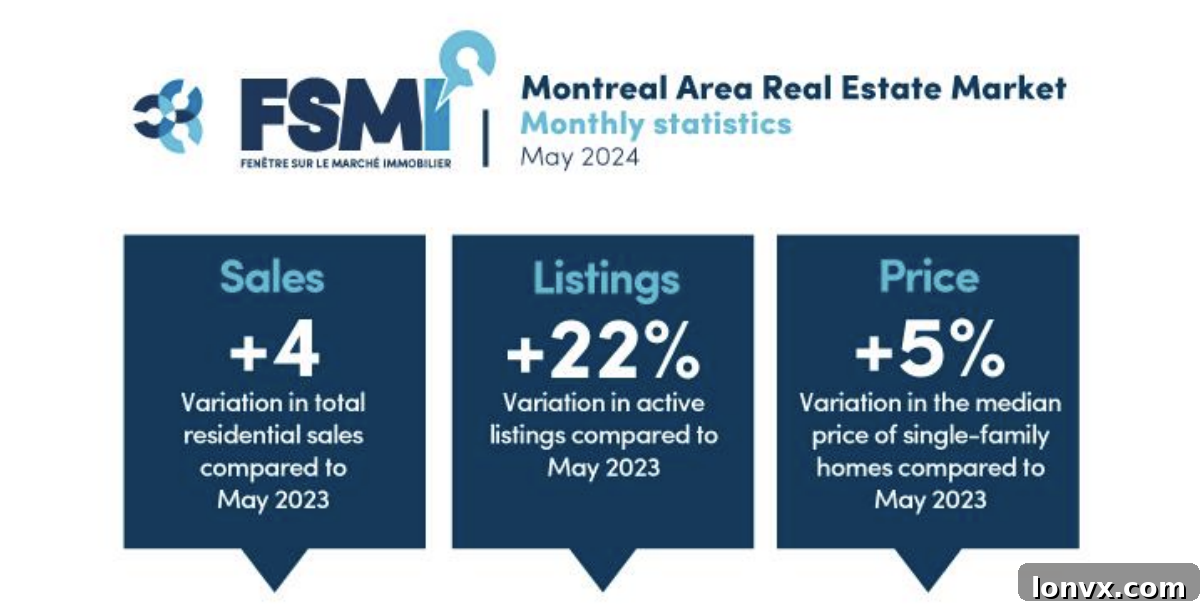
The Montreal Census Metropolitan Area (CMA) recorded 4,563 residential home sales in May, marking a four percent increase compared to the same period last year. This performance not only exceeded the historical average for May but also underscored the market’s underlying resilience. Similarly, Quebec City’s market was particularly vibrant, with 877 residential sales last month. This represents a two percent rise year-over-year and ranks as the third-highest transaction level for the month of May since the year 2000, illustrating the sustained demand in the provincial capital.
Montreal Real Estate: A Market on the Rise with Regional Nuances
The Montreal housing market continues to defy expectations, maintaining a strong trajectory despite economic uncertainties. Charles Brant, QPAREB market analysis director, highlighted the significance of the four percent sales increase in May, especially considering it builds upon an already robust market performance from May 2023. “Activity therefore remained particularly solid,” Brant noted, emphasizing that the growth is a testament to sustained demand. A standout performer within the region was the North Shore of Montreal, which accounted for an impressive one in every four transactions across the entire Montreal region and experienced a substantial 13 percent jump in sales.
This regional dynamism points to evolving buyer preferences and the ongoing search for value and space within proximity to urban conveniences. The North Shore’s robust growth indicates that while the central island remains attractive, peripheral areas are increasingly drawing interest from a diverse range of buyers, from first-time homeowners to those seeking larger properties or more affordable options.
Detailed Breakdown of Montreal Property Types
The May data provides a clear picture of activity across different residential property segments in Montreal:
- Single-Family Homes: Sales for single-family residences reached 2,334 units, marking a two percent increase compared to May of the previous year. This consistent demand for detached homes underscores the enduring appeal of traditional homeownership, particularly as families seek more space and privacy.
- Condominiums: The condominium market saw a five percent rise, with 1,786 transactions. Condos continue to be a popular choice, especially among first-time buyers and those looking for urban living solutions. The steady growth in this sector reflects its accessibility and the ongoing urbanization trend.
- Small-Income Properties (Plexes): This category, often comprising duplexes, triplexes, and other multi-unit residential buildings, experienced an impressive 11 percent increase, with 440 sales. The surge in plex sales highlights a strong interest from investors and owner-occupants looking to generate rental income, signaling confidence in Montreal’s rental market.
Inventory Levels and Price Evolution in Montreal
Active listings in the Montreal CMA saw a significant rise, climbing 22 percent from a year ago to reach 18,996 listings. This increase in available inventory offers buyers more choices and could potentially moderate future price growth, creating a more balanced market environment. Despite the growth in listings, prices across all property types continued their upward trajectory compared to last year, while remaining relatively stable when compared to April 2024, indicating a healthy and sustained market appreciation.
- Condominiums: The median price for condominiums settled at $410,000, representing a two percent increase year-over-year. This modest but consistent growth reflects steady demand without overheating.
- Single-Family Homes: Single-family homes saw their median price rise by five percent to $575,500. This sustained growth in detached home values indicates ongoing strong demand and potentially tighter supply in certain desirable areas.
- Plexes: Small-income properties recorded the most significant median price increase among the categories, rising by seven percent to $780,000. This substantial appreciation further underscores the strong investor interest and the perceived value of income-generating properties in the current market.
Overall, Montreal’s real estate market in May 2024 demonstrated robust health, characterized by increased sales across all property types, growing inventory providing more options for buyers, and consistent price appreciation. The North Shore’s exceptional performance is a key highlight, indicating shifting dynamics and strong growth pockets within the broader metropolitan area.
Quebec City Real Estate: Unprecedented Demand and Soaring Prices
Quebec City’s real estate market in May presented an equally compelling narrative, distinguished by particularly high levels of transactional activity. Charles Brant emphasized that while the two percent increase in sales compared to May 2023 might appear modest, it comes after an already exceptionally strong market performance the previous year. “As regional market strength was already well established in May 2023, the resulting low variation in sales compared to last year can be misleading,” Brant explained. This historical context reveals a market that has consistently performed at a high level.
Brant further highlighted specific areas of strength: “Single-family home activity was particularly strong in the peripheral markets, while the agglomeration of Quebec City saw considerable interest in plexes.” He also pointed to a “spectacular jump in the median price for this property category,” noting that, like other property categories, prices have reached record highs since the beginning of spring. This indicates an extremely competitive market driven by intense buyer demand and limited supply.
Quebec City Property Sales: A Deep Dive into Growth
The sales figures for Quebec City in May reveal remarkable growth across all property types:
- Single-Family Homes: Sales for single-family homes in Quebec City soared by 18 percent year-over-year, reaching 629 transactions. This dramatic increase highlights a strong preference for detached homes, possibly driven by a quest for more space and relative affordability compared to larger metropolitan areas.
- Condominiums: The condominium market also saw substantial growth, with sales up 13 percent to 272 transactions. This indicates a growing appetite for urban living and accessible entry points into homeownership within Quebec City.
- Small-Income Properties (Plexes): Small-income properties experienced an astounding 34 percent increase in sales, totaling 75 transactions. This segment’s exceptional growth underscores a burgeoning investor confidence and a thriving rental market, making these properties highly sought after.
Inventory Challenges and Price Surges in Quebec City
Unlike Montreal, Quebec City faced significant challenges with its active listings. Overall, active listings decreased by nine percent from a year ago, totaling 2,673 listings. This reduction was primarily attributed to fewer condominium and plex listings, indicating a tight supply in these popular segments. The shrinking inventory, coupled with surging demand, inevitably led to considerable price appreciation across all property types, both year-over-year and month-over-month compared to April.
- Condominiums: The median price for condominiums in Quebec City registered a striking 19 percent increase, reaching $276,500. This significant jump reflects the intense competition for condos, driven by high demand and limited supply.
- Single-Family Homes: Single-family homes saw their median price climb by nine percent to $381,340. While substantial, this increase is more tempered than that of condos, suggesting a slightly less frenzied pace but still strong demand.
- Plexes: Plexes experienced a four percent increase in median price, reaching $425,000. Despite the lower percentage increase compared to condos, this still represents a healthy appreciation in a market segment experiencing very high transactional volume.
Quebec City’s real estate market is characterized by exceptionally strong demand and a dwindling supply, leading to significant price increases, particularly in the condominium and small-income property segments. The market dynamics suggest a highly competitive environment for buyers, reflecting the city’s growing appeal as a residential and investment hub.
Regional Comparisons and Future Outlook for Quebec’s Housing Market
Comparing Montreal and Quebec City reveals distinct but equally robust market trends. Montreal’s market is characterized by consistent growth in sales and increasing inventory, suggesting a gradual move towards a more balanced environment, albeit with continued price appreciation. The diversification of demand towards areas like the North Shore highlights evolving urban sprawl and the search for value.
Quebec City, on the other hand, is experiencing an even more intense market, with dramatic sales increases across specific property types and a shrinking inventory. This imbalance between high demand and limited supply is driving rapid price surges, particularly for condominiums and small-income properties. The market’s historic performance levels underscore its sustained popularity and investor confidence.
The QPAREB report for May 2024 paints a picture of resilience and growth across Quebec’s major real estate markets. While both Montreal and Quebec City face unique challenges and opportunities, the overall trend points towards sustained buyer interest and continued appreciation in property values. Factors such as interest rate stability, demographic shifts, and economic conditions will continue to shape these markets in the coming months. Prospective buyers and sellers are advised to stay informed and consult with real estate professionals to navigate these dynamic conditions effectively.
For a comprehensive understanding and further details, review the full reports here.
Enjoying this article?
Get the latest REM articles in your inbox 3x week so you stay up to date on the latest in the Canadian real estate industry