
QUICK INSIGHTS INTO ONTARIO’S HOUSING MARKET:
- Toronto condos represent over 65% of property transfers in 2024, indicating a significant market shift.
- Single-party investors now account for 20% of multi-property purchases, showcasing a growing individual investment trend.
- The median age of Ontario’s first-time homebuyers has risen to 40, highlighting increasing affordability challenges.
- The average holding period for Toronto non-condo properties is nearly 18 years, suggesting homeowners are staying put longer.
- A quarter of homes bought in 2022 under $1M were sold at a loss by 2024, reflecting market volatility and buyer pressure.
The last five years have steered Ontario’s housing market through an exceptionally turbulent journey, characterized by dramatic price surges followed by equally sharp downturns. A comprehensive new Market Insight Report from Teranet, drawing upon extensive 2024 Ontario land registry data, now offers a much clearer and more detailed perspective on how the unprecedented market activity, largely fueled by the pandemic, has fully culminated across the province. This report is a crucial resource for anyone looking to understand the complex dynamics shaping one of Canada’s most vital real estate landscapes.
Delving deep into the core trends, the report meticulously explores several pivotal developments. These include an extraordinary boom in new condo completions, which has significantly altered Toronto’s urban landscape, alongside the mounting financial pressure on homebuyers who made their purchases during the market’s peak. Furthermore, it highlights the intriguing emergence of single-party multi-property investors as increasingly influential players, reshaping traditional investment patterns and market competition. Understanding these trends is essential for homeowners, prospective buyers, and investors navigating the Ontario real estate environment.
Toronto’s Condo Market Dominates 2024 Sales, Despite Resale Slump
In the vibrant and ever-evolving real estate landscape of Toronto, condos have decisively emerged as the dominant force in property transfers. In 2024, this segment accounted for an impressive more than 65 percent of all sales, a statistic that underscores their crucial role in the city’s housing supply and demand dynamics. However, this headline figure only scratches the surface of a more nuanced market reality.
Beneath this robust share of overall sales, Toronto’s resale condo market experienced a notable slowdown, registering its lowest activity levels in a decade. This sluggishness in the secondary market presents a fascinating contrast to another significant trend: a remarkable boom in newly completed condo units. The year 2024 saw approximately 15,000 new condo units become ready for occupancy, representing an astounding 78 percent increase compared to the previous year. This influx of new inventory profoundly impacts the broader market.
As the Teranet report elucidates, “This flood of about 15,000 new condo properties that became available in 2024 was an important piece of data to fully understand the condo market.” The sheer volume of these new units provides a compelling explanation for the quietness observed in the resale market. Potential buyers, faced with an abundance of brand-new options, may be gravitating towards fresh inventory, thereby reducing demand for older, pre-owned units. This dynamic creates a challenging environment for existing condo owners looking to sell, while simultaneously offering a wider selection for buyers, potentially influencing price stability and even driving down values in certain segments of the resale market. The ongoing balance between new construction and resale activity will be a key indicator for Toronto’s housing health in the years to come.
Multi-Property Owners (MPOs) Remain Key Players, But Their Strategies Are Evolving
Multi-property owners (MPOs) consistently remain the largest and most influential buyer segment within Ontario’s housing market. However, their purchasing patterns and investment strategies are undergoing a discernible transformation. Data from Teranet, current as of the end of 2024, reveals that the vast majority of MPOs, specifically 55 percent, own just two properties. Another 20 percent hold three properties. This distribution suggests a significant shift; rather than aggressively accumulating extensive real estate portfolios, most MPOs are likely engaged in more passive investment strategies or holding second properties for personal use, such as cottages or homes for family members, rather than pure speculative ventures.
Furthermore, the market has observed a noticeable pullback among larger investors. The proportion of MPOs holding 11 or more properties has seen a significant decline, dropping from 13 percent in April 2022 to approximately 7 percent by the close of 2024. This trend indicates a potential consolidation or a more cautious approach from institutional or very large-scale individual investors, possibly in response to higher interest rates, stricter regulations, or changing market outlooks. Interestingly, “new” MPOs – defined as buyers who have just acquired their second property – have been a driving force, constituting an impressive 70 percent of all MPO transactions over the last decade. This suggests a continuous pipeline of new entrants into the multi-property ownership segment, often starting small.
Despite shifts in overall MPO behaviour, Toronto continues to exert a powerful magnetic pull for real estate investment. The city witnessed a substantial increase in transactions by existing MPOs, jumping by 38 percent in 2024. Similarly, new MPO purchases in Toronto rose by 22 percent. This sustained interest highlights the perceived long-term value and resilience of the Toronto market, even as other prominent regions such as York, Wentworth, and Waterloo experienced noticeable declines in MPO activity. The divergence in regional performance underscores the localized nature of real estate trends and the unique appeal of Canada’s largest city for diverse investment strategies.
Buyer Segment Spotlight: A Closer Look at Multi-Property Owners
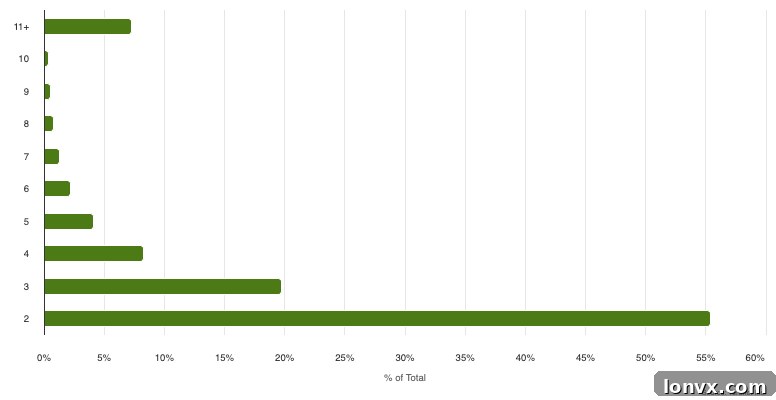
Number of properties held by multi-property owners as of December 31, 2024 (Teranet)
The Rise of Single-Party Investors: A New Force in Ontario’s Housing Market
Adding another layer to Ontario’s evolving investment landscape is the notable ascent of single-party multi-property owners (MPOs). These individual investors are increasingly making their mark, now representing a significant 20 percent of all MPO transactions. This trend signifies a shift towards individual wealth deployment in real estate, potentially driven by a desire for diversification or long-term asset growth. What makes this particular segment especially compelling, as highlighted by Teranet, is their remarkable financial autonomy: almost one-third of these buyers managed to purchase properties entirely in cash, bypassing the need for traditional mortgage financing. This substantial access to liquid capital grants them a significant competitive advantage, particularly in a market grappling with high interest rates and tightening lending conditions, allowing for faster transactions and potentially more favourable terms.
Demographically, these single-party investors are primarily composed of younger generations who are already accumulating wealth. The majority, approximately 39 percent, fall into the Millennial age bracket, indicating a generation that, despite facing housing affordability challenges for primary residences, is actively engaging in investment properties. They are closely followed by Gen-Xers, who account for 36 percent of this segment. This suggests a dual-generational push into individual real estate investment, potentially fueled by different motivations but united by a strategic approach to property acquisition. Their investment focus is largely concentrated in the highly sought-after regions of Toronto, York, and Peel. Interestingly, these investors exhibit no discernible preference for property type, acquiring an almost equal proportion of both condo and non-condo properties. This versatility indicates a pragmatic approach, where investment decisions are likely guided by factors such as potential rental yield, capital appreciation, and overall market conditions rather than a rigid preference for a specific housing style. Their growing presence undoubtedly adds another dynamic layer to the competitive intensity of Ontario’s real estate market.
Regions Feeling the Pressure: An Analysis of Power of Sale Activity
Power of sale activity, which often serves as a sensitive barometer of increasing financial stress among homeowners, has been steadily climbing across Ontario since 2022. While the current volumes remain below the peaks observed during the financially challenging years of 2015 and 2016, the upward trend in 2024 is a clear signal of underlying economic strain. This type of sale occurs when a lender repossesses a property due to defaulted mortgage payments, making it a critical indicator of economic vulnerability within the housing market.
In 2024, certain regions of the province stood out as disproportionately vulnerable to these distress sales. Toronto, as the largest market, accounted for 13 percent of all power of sale transfers. It was closely followed by Peel Region at 9 percent and Simcoe at 6 percent. However, a more insightful analysis emerges when comparing these figures to each region’s overall share of property transactions. Peel, for instance, comprised just 7 percent of all property transfers but an elevated 9 percent of power of sales, indicating a higher incidence of financial distress relative to its market size. Middlesex demonstrated a similar, even more pronounced pattern, making up only 3 percent of the total transfer volume yet contributing 6 percent of power of sales. This suggests that homeowners in these areas might be experiencing greater financial difficulties compared to the provincial average, potentially due to factors like higher initial purchase prices during the market peak, job losses, or an inability to absorb rising interest rates.
Conversely, regions like Halton and Waterloo registered relatively fewer distress sales. This could be attributed to stronger local economies, more resilient homeowner demographics, or perhaps more stable property values that have better withstood recent market fluctuations. The regional variations in power of sale activity paint a complex picture of economic health across Ontario, highlighting pockets of significant vulnerability that warrant closer monitoring by policymakers and lenders alike. These statistics are not just numbers; they represent individuals and families facing difficult circumstances, emphasizing the broader socio-economic impact of a volatile housing market.
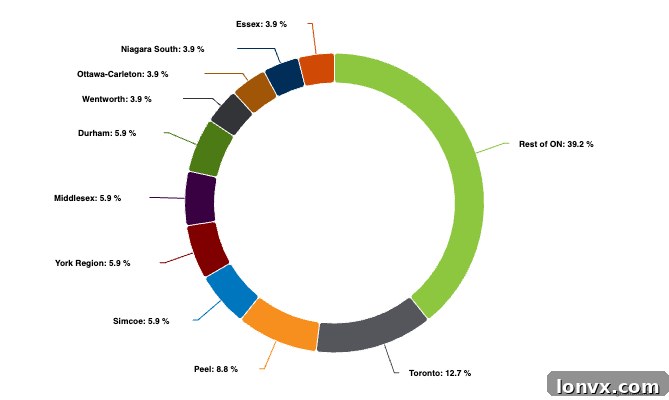
Ontario power of sale transfer volume, percentage of volume by region, 2024 (Teranet)
Pandemic-Era Homebuyers Face Significant Losses Amid Market Reversal
The rollercoaster ride of Ontario’s housing market has left many homeowners who purchased properties during the unprecedented peak of 2022 and 2023 facing substantial financial losses upon resale. This segment of buyers, often enticed by historically low interest rates and intense competition, found themselves vulnerable to the subsequent market correction. A stark statistic highlights this vulnerability: approximately 25 percent of homes purchased for under $1-million in 2022 and subsequently resold in 2024 incurred tangible losses. This represents a significant portion of recent buyers experiencing the downside of a highly volatile market, where the timing of purchase became a critical determinant of financial outcome.
Across Ontario, the median loss for these homeowners is estimated to be around $45,000, a considerable sum that can significantly impact personal finances and future housing plans. However, the financial pain was even more acute in the Greater Toronto Area (GTA), where the median loss climbed higher to $56,000. This disparity underscores the amplified risks associated with higher-priced markets, where even a slight percentage drop translates into larger absolute losses. The situation became even more dramatic in cottage-country regions such as Muskoka, where the median loss spiked dramatically to an alarming $240,000. While the volume of transactions in these recreational markets was relatively lower, the severity of losses indicates that buyers in these regions may have paid extreme premiums at the market’s zenith, making them particularly susceptible to downturns. These figures serve as a potent reminder of the inherent risks in speculative real estate markets and the importance of timing and financial prudence in significant investments, particularly for those who stretched their budgets during the pandemic-driven frenzy.
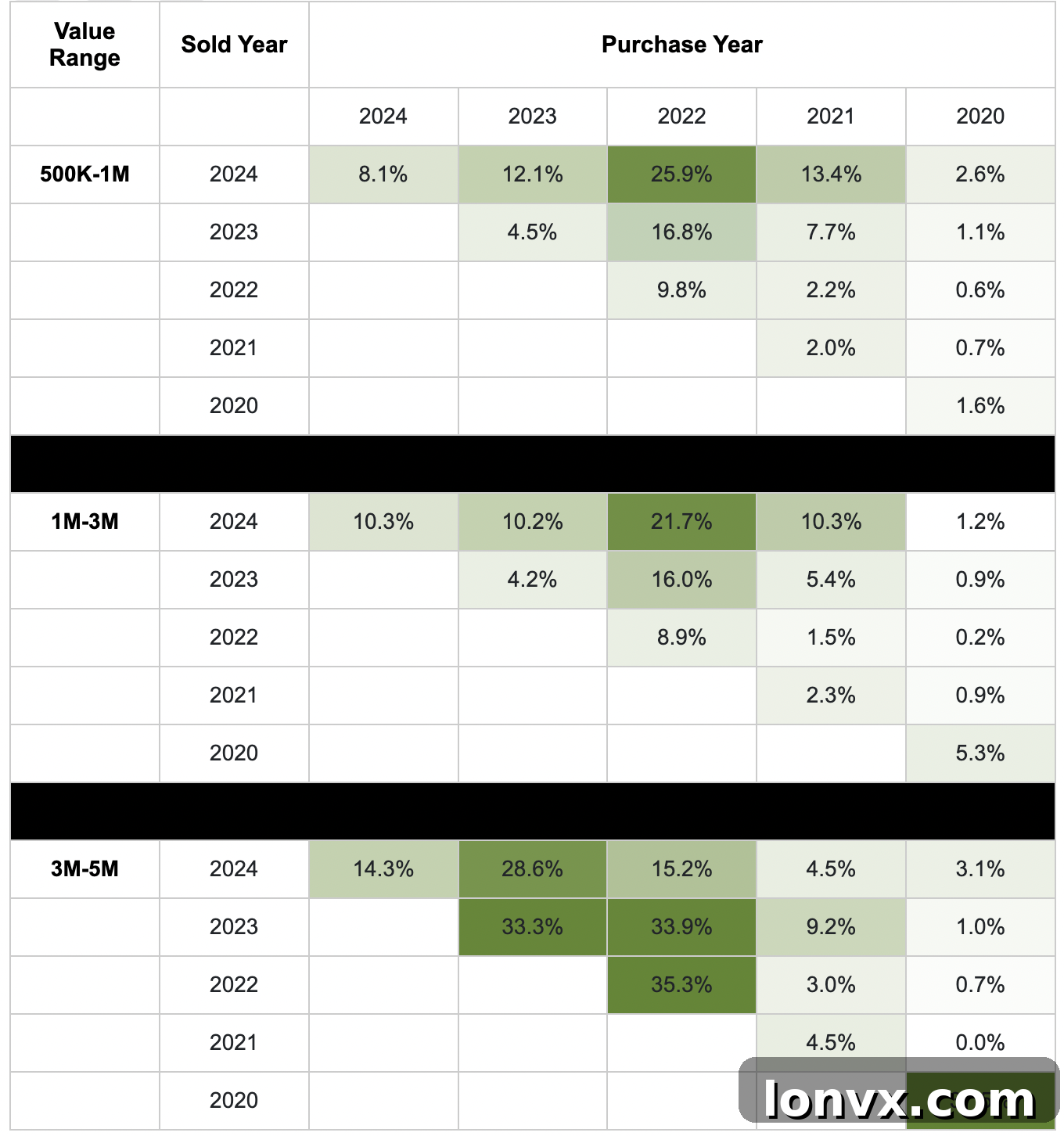
Percentage of properties sold at a loss, by purchase and sold year, by sold value range (Teranet)
First-Time Homebuyers Confront an Increasingly Challenging Path to Ownership
The dream of homeownership in Ontario is becoming an increasingly delayed reality for many, as evidenced by the climbing median age of first-time homebuyers, which has now reached 40. This significant increase from previous generations underscores the deepening affordability crisis and the extended period required for individuals to save for a down payment and qualify for a mortgage in today’s market. A decade ago, the average first-time buyer could expect to spend approximately $500,000 for a non-condo home in Toronto, a figure that, while substantial, was still within reach for many dual-income households.
However, by 2024, that figure for a similar non-condo property has surged to an astounding $1.3-million. This dramatic increase has effectively priced out a significant portion of first-time buyers from the traditional detached or semi-detached housing market, especially in major urban centres. Consequently, condos have become a more attainable and often the only realistic entry point for many newcomers to the real estate ladder. While condos offer a viable path to ownership, they often come with trade-offs in terms of space, private outdoor areas, and potentially lower long-term appreciation compared to freehold properties. The rising age of first-time buyers is not merely a statistic; it reflects broader societal and economic challenges, including stagnant wage growth relative to housing costs, high student debt, and the need for prolonged savings, all of which delay wealth accumulation and family formation. Addressing this trend will require comprehensive strategies aimed at improving housing supply and affordability across the province.
Homeowners Opt to Stay Put Longer, Influencing Market Dynamics
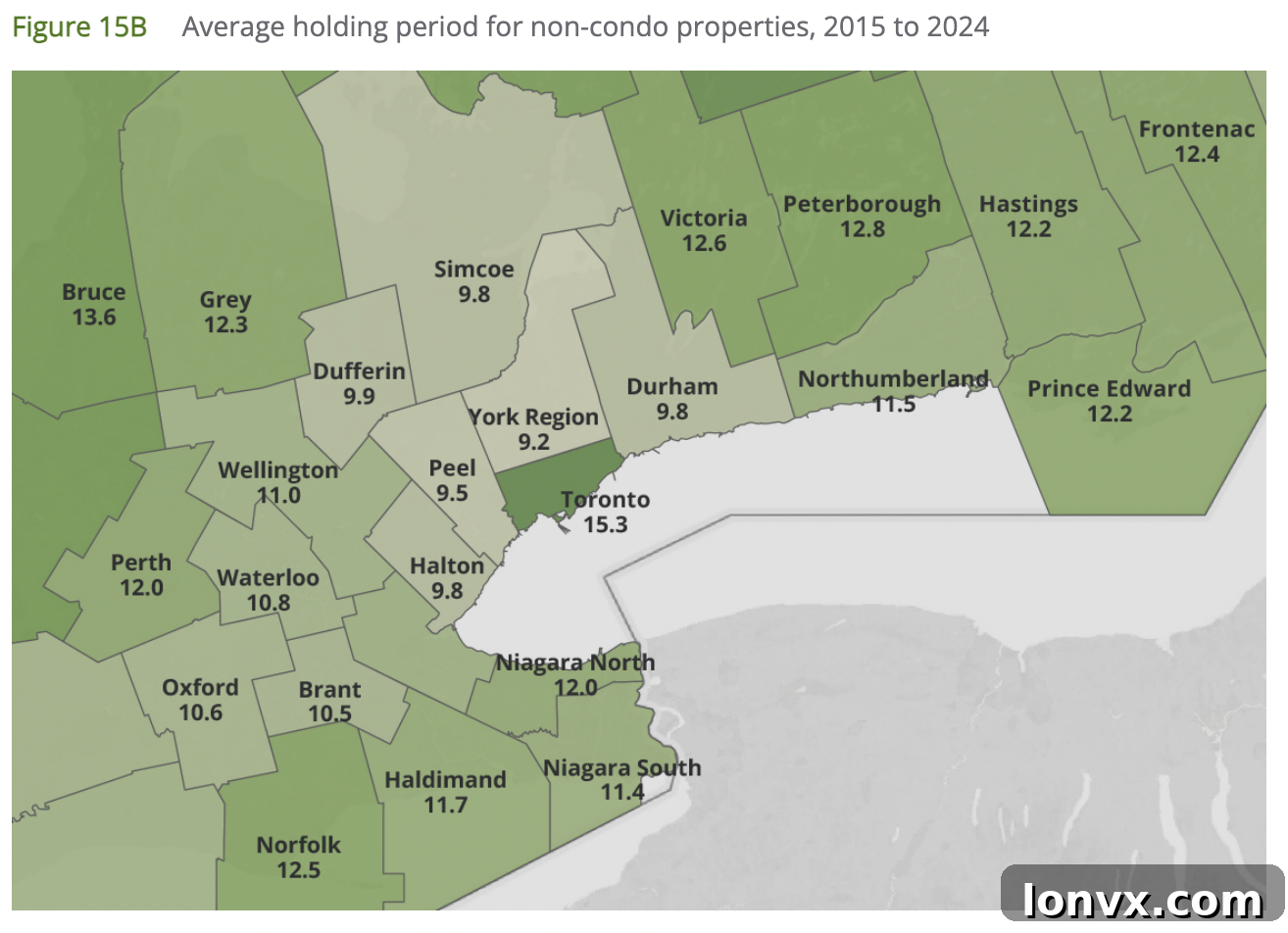
A critical and increasingly prevalent shift observed in the Ontario housing market is the tendency for homeowners to hold onto their properties for significantly longer periods, particularly in Toronto. This trend has far-reaching implications for inventory levels, market velocity, and the overall housing supply. Non-condo homeowners in Toronto now keep their properties for nearly 18 years on average, a notable increase from roughly 14 years in 2015. This extended tenure reflects a complex interplay of economic and lifestyle factors.
As the Teranet report sagely notes, “This data seems to correlate with the idea that due to the lack of affordability in Toronto, many choose to renovate their existing property as opposed to moving to a new one within the same area to meet their evolving housing needs.” Faced with escalating prices for larger homes or those in more desirable neighbourhoods, coupled with high transaction costs (such as land transfer taxes and real estate fees), many homeowners find it more financially sensible to invest in renovations or expansions of their current residences. This “renovate vs. relocate” phenomenon is particularly pronounced in a market where upgrading means incurring substantial new debt at potentially higher interest rates. The reluctance of homeowners to sell their properties directly contributes to a tighter housing supply, which, in turn, can exert upward pressure on prices for the limited available inventory. Furthermore, for those who secured homes with historically low mortgage rates, the prospect of taking on a new mortgage at significantly higher rates acts as a powerful deterrent to moving. This trend suggests a maturing housing market where stability and long-term investment are prioritized, but it also compounds the challenges for prospective buyers hoping to enter or move up the property ladder.
What Lies Ahead for Ontario’s Dynamic Housing Market?
Teranet’s latest Market Insight Report paints a vivid picture of a widening chasm within Ontario’s housing market: a growing divide between those who possess the financial capacity to comfortably invest and those who are increasingly being priced out of homeownership. The key patterns identified, such as the increasing prominence of cash-rich investors and the mounting financial stress among homeowners who acquired properties during the market’s peak, underscore a complex and challenging environment for many.
First-time buyers, in particular, continue to confront significant and often insurmountable hurdles, especially when aspiring to non-condo properties in high-demand areas like Toronto. This persistent affordability crisis has pushed the average purchasing age for a first home to 40, a clear and stark indication that the deep-seated challenges in housing affordability are not only persisting but actively deepening across the entire province. As we look ahead, the interplay of interest rates, new construction volumes, evolving investor strategies, and government policies will undoubtedly shape the trajectory of Ontario’s real estate market. Addressing the affordability gap and ensuring equitable access to homeownership will remain a critical focus for both market participants and policymakers alike. The insights from this report provide a vital foundation for understanding these ongoing shifts and preparing for the future of Ontario’s housing landscape.
For a comprehensive deep dive into these findings and more detailed analyses, access the latest edition of Teranet’s Market Insight Report here.