
Ontario’s Housing Market Faces a New Reality: Building Permits Decline for the First Time in Three Years
After an unprecedented surge that saw residential building permits reach historic highs during the peak of the global pandemic, Ontario’s housing and construction sectors are now navigating a notable shift. For the first time in three years, the province has witnessed a significant decrease in the number of residential building permits issued, signaling a potential cooling in what has long been a red-hot market.
According to comprehensive data released by the Municipal Property Assessment Corporation (MPAC), a total of 108,080 building permits were granted for both new residential developments and a myriad of home improvement projects across Ontario. This figure represents an 11.6 per cent decline when compared to the preceding year, marking a crucial turning point for the province’s construction landscape and its broader economy.
Carmelo Lipsi, MPAC’s vice president and chief operating officer, offered valuable insights into the underlying causes of this downward trend. Lipsi explained, “With the lifting of COVID-19 restrictions, there’s been a noticeable gravitation of people back towards experiences, travel, and activities outside the home. This shift in consumer behaviour, coupled with the significant impact of higher interest rates that have driven up borrowing costs, has contributed to a decrease in permit applications. This trend clearly signals a reprioritization among homeowners and developers alike, moving away from the intensive home-centric investments that defined the pandemic era.”
This economic recalibration suggests a broader impact on consumer confidence and discretionary spending, affecting not only new construction projects but also the appetite for extensive home renovations. Understanding these dynamics is crucial for grasping the current state and future trajectory of Ontario’s diverse housing market.
Residential Home Improvement Permits See Decline While Remaining Above Pre-Pandemic Levels
While the overall decline in building permits is a significant indicator, a deeper dive into specific categories reveals nuanced trends. MPAC’s report highlights a decrease of over nine per cent in residential home improvement permits. This category encompasses a wide array of projects, including major renovations, home additions, the installation of swimming pools, the construction of sheds and garages, and the building of decks. Over 63,000 such permits were issued, reflecting a reduced pace of home-centric investments compared to the previous year.
However, it’s important to contextualize this decline. Despite the recent dip, the volume of home improvement permits remains remarkably robust, standing 22 per cent higher than the levels observed in pre-pandemic 2019. This enduring strength suggests that while the frenzied pace of pandemic-era renovations has subsided, homeowners continue to demonstrate a strong interest in enhancing their living spaces. The investments made during the pandemic may have cultivated a lasting appreciation for functional and aesthetically pleasing home environments, maintaining a demand that still surpasses historical norms.
The post-pandemic market is characterized by a balancing act: a return to normalcy pulling consumers away from home projects, while lingering effects of remote work and a general desire for property value enhancement continue to drive improvements. This category, therefore, serves as a critical barometer for homeowner sentiment and discretionary spending in a fluctuating economic climate.
Toronto Maintains Permit Lead Amidst Widespread Municipal Decreases
Examining permit trends at the municipal level reveals a mixed but predominantly downward picture across Ontario. Toronto, the province’s largest city and economic engine, continued to lead with the highest number of permits issued, recording 9,359. This figure remained almost unchanged from the previous year, demonstrating a remarkable resilience in a period of broader provincial decline. Toronto’s stability can be attributed to its continuous urban development, high population density, and diverse economic drivers that sustain demand for housing and construction.
Conversely, the majority of other municipalities across Ontario experienced a decrease in the number of permits issued. This widespread reduction underscores the provincial-level trend, reflecting the impact of higher interest rates and shifting consumer priorities on local construction activities. However, a few municipalities bucked this trend, registering an increase in permits compared to the previous year. Kitchener, Mississauga, Guelph, and Oshawa all saw an uptick in construction activity. These cities, often considered growth corridors within the Greater Golden Horseshoe, may be experiencing sustained demand driven by population migration, relative affordability, or specific local development projects that continue to attract investment despite broader economic headwinds.
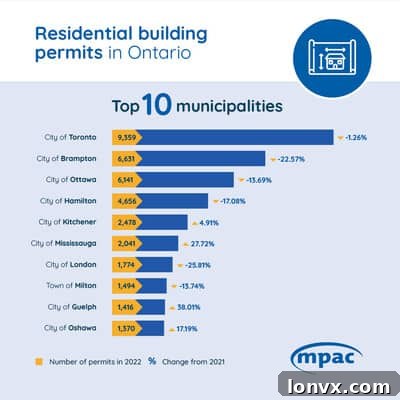
Building Permits Campaign ENG 2 (CNW Group/Municipal Property Assessment Corporation (MPAC))
Detailed Analysis of Specific Home Improvement Categories: Renovations, Additions, and Decks
Delving deeper into individual categories of residential home improvements offers a clearer picture of where homeowners are scaling back or continuing to invest. Permits for residential renovations and additions, a key indicator of significant property upgrades, decreased by almost 3.5 per cent, totaling 37,068 permits. While this represents a slight slowdown, MPAC reports that this figure is still an impressive 28 per cent higher than pre-pandemic levels in 2019. This suggests a lasting commitment to enhancing existing homes, driven perhaps by increased equity, a continued need for optimized living spaces, or the desire to increase property value in a competitive market. Major renovations, such as kitchen and bathroom remodels or structural additions, remain critical components of the residential improvement sector, despite the recent moderation.
Meanwhile, the demand for outdoor living enhancements, specifically deck permits, saw a more pronounced decrease. Approximately 13 per cent fewer deck permits were issued, totaling 8,257 across the province. This category often reflects discretionary spending on leisure and entertainment spaces. The decline here aligns with the broader trend of consumers redirecting funds towards travel and experiences away from home, as mentioned by MPAC’s Lipsi. Interestingly, Hamilton continues to stand out in this category, leading the province with 572 deck permits issued in 2022. This regional anomaly might be attributed to local housing stock characteristics, a strong community focus on outdoor amenities, or specific demographic preferences within the Hamilton area.
Significant Drops in Swimming Pools and Sheds Reflect Shifting Lifestyles
Two categories that experienced particularly sharp declines were residential swimming pools and sheds, indicating a notable shift in lifestyle priorities and investment choices. Residential swimming pool permits dropped by almost 27 per cent province-wide, with only 6,617 permits issued. The pandemic had fueled a boom in pool installations as homeowners sought private recreational spaces during lockdowns. The dramatic decrease now suggests that the allure of private aquatic amenities has waned as travel and public leisure options have returned. The high initial investment, maintenance costs, and seasonal usability of pools make them highly susceptible to changes in economic conditions and consumer preferences.
Ottawa, traditionally known as the “pool capital of Ontario,” experienced an even more dramatic downturn, with a nearly 43 per cent decrease in permits issued compared to the previous year. This sharp decline in a historically strong market segment further underscores the widespread impact of economic factors and the return to pre-pandemic leisure patterns.
Shed permits also saw a substantial decrease of almost 20 per cent, totaling 3,409 permits. This category includes everything from basic storage sheds to the increasingly popular “large, stylish sheds” that homeowners have repurposed as separate living spaces, backyard offices, or creative getaways. The decline here might reflect a reduced need for dedicated home office spaces as more people return to traditional workplaces, or simply a prioritization of other home improvement projects. Countering the provincial trend, Ottawa actually saw a 14 per cent increase in shed permits issued over the previous year. This localized surge could indicate a sustained demand for flexible backyard spaces in the capital, perhaps driven by a continued remote or hybrid work culture, or a specific local trend towards maximizing property utility.
Garage Permits Decline Across Most Municipalities, With Notable Exceptions
The construction of residential garages also contributed to the overall downturn in building permits, experiencing a decrease in the majority of municipalities across Ontario. A total of 6,014 garage permits were issued throughout the province in 2022, representing more than a nine per cent decrease from the previous year. This trend suggests that homeowners are either delaying or foregoing new garage constructions, possibly due to budget constraints or a reduced need for additional storage and vehicle accommodation compared to previous years.
However, much like other categories, there were notable exceptions to this general decline. Toronto, for instance, reported the highest number of garage permits with 330, and remarkably, saw a substantial 41 per cent increase. This significant rise in Toronto could be attributed to ongoing urban intensification, the premium placed on parking and storage in a dense city environment, or the conversion of existing structures. Beyond Toronto, only two other municipalities recorded an increase in garage permits: Sault Ste. Marie and the Township of Muskoka. These isolated increases suggest unique local factors at play. In Sault Ste. Marie, it could be tied to regional economic stability or specific community development. For the Township of Muskoka, known for its recreational properties, increased garage permits might reflect the building of larger storage facilities for recreational vehicles, boats, or workshop spaces associated with seasonal homes, indicating a continued investment in leisure and property utility in cottage country.
Economic Context and Future Outlook for Ontario’s Construction Sector
The latest MPAC data paints a clear picture of a cooling residential construction market in Ontario, largely driven by macroeconomic factors such as rising interest rates and a post-pandemic shift in consumer behaviour. The overall 11.6 per cent decrease in residential building permits signifies a departure from the pandemic-fueled boom, indicating a return to more cautious investment patterns. While the decline is broad-based, affecting various categories from major renovations to swimming pools, the underlying demand for housing and property improvements has not vanished entirely. Many categories, despite recent dips, still remain significantly above pre-pandemic levels, suggesting a lingering appreciation for enhanced home environments.
The regional variations highlight the diverse economic landscapes within Ontario. Toronto’s sustained activity, alongside growth in municipalities like Kitchener and Mississauga, points to areas of continued development and demand, often driven by population growth and specific urban planning initiatives. Conversely, the sharp declines in discretionary spending categories like pools underscore the sensitivity of these investments to economic pressures and lifestyle changes.
Looking ahead, the trajectory of Ontario’s housing market and construction sector will depend on several key factors. Future interest rate adjustments, inflation control, and the province’s ongoing population growth targets will all play pivotal roles. Government policies aimed at increasing housing supply and affordability will also influence permit trends. As the market continues to adjust to this new reality, stakeholders from developers to homeowners will need to adapt to a more measured and possibly more sustainable pace of growth. The data from MPAC serves as a crucial indicator, providing valuable insights into the evolving priorities and economic health of Ontario’s dynamic housing landscape.