
Ontario’s Housing Future: OREA’s 2025 Election Report Card Unveiled
As the 2025 Ontario provincial election draws closer, the province faces a critical juncture, with housing affordability and supply topping the list of voter concerns. In response to this pressing issue, the Ontario Real Estate Association (OREA) has released its comprehensive Election Report Card, offering an in-depth evaluation of the housing platforms put forth by Ontario’s four leading political parties. This vital report serves as a guide for Ontarians, measuring each party’s commitments against OREA’s robust housing plan, which advocates for actionable, sustainable solutions to alleviate the province’s deepening housing supply and affordability crisis. The stakes are high, and OREA’s analysis provides invaluable insights into how future leadership plans to tackle one of Ontario’s most significant challenges.
A Home for Everyone: OREA’s Vision for Ontario’s Housing Landscape
OREA’s meticulously crafted blueprint, aptly titled “A Home for Everyone,” is designed to serve as a comprehensive roadmap for policy-makers. It champions a multi-faceted approach, focusing on three core pillars essential for fostering a healthier, more accessible housing market across Ontario. This plan is not merely a wish list but a strategic document outlining concrete steps that, if implemented, could transform the province’s housing trajectory, ensuring that more Ontarians can achieve the dream of homeownership or secure affordable, stable housing.
1. Increasing Housing Supply: Building More Homes, Faster
- Ending Exclusionary Zoning to Allow Up to Four Units Per Lot Across Ontario: Exclusionary zoning, a historical practice that restricts the types of housing built in specific areas, has long been a barrier to increased density and diverse housing options. OREA advocates for its abolition, proposing a progressive policy that would permit the construction of up to four residential units on any single-family lot throughout Ontario. This move would significantly boost housing supply, particularly “missing middle” housing options like duplexes, triplexes, and fourplexes, making more efficient use of existing urban land and infrastructure. It aims to diversify housing types, creating more affordable entry points into the market and fostering vibrant, inclusive communities.
- Increasing Density Near Transit Corridors Through Zoning Modernization and Commercial-to-Residential Conversions: Recognizing the environmental and economic benefits of transit-oriented development (TOD), OREA emphasizes the importance of maximizing housing density around public transit hubs. By modernizing outdated zoning bylaws, the province can encourage more residential development in these highly accessible areas. Furthermore, promoting the conversion of underutilized commercial spaces into residential units presents a unique opportunity to rapidly add housing supply in established urban areas, revitalizing downtown cores and reducing commute times for residents while leveraging existing infrastructure.
- Promoting Modular Housing as a Scalable Solution to Add Supply Faster: Innovation in construction methods is crucial for addressing the housing deficit at scale. OREA champions modular housing as a viable and highly efficient solution. Modular construction offers significant advantages, including faster build times, reduced material waste, and often lower costs compared to traditional construction. By encouraging the adoption and scaling of modular housing technologies, Ontario can accelerate the delivery of new homes, providing a quicker response to market demand and offering more diverse housing choices to consumers.
2. Lowering the Cost of Homeownership: Making Housing More Accessible
- Reducing or Capping Municipal Development Charges: Development charges are fees levied by municipalities on new construction projects, ostensibly to pay for the infrastructure required to support new development. However, these charges can add tens of thousands of dollars to the cost of a new home, which is ultimately passed on to the buyer. OREA proposes reducing or capping these charges to ease the financial burden on builders and, by extension, homebuyers. This measure aims to directly reduce the upfront cost of purchasing a newly built home, making homeownership more attainable for many Ontarians.
- Creating a Framework to Allow Multiplex Properties to Be Easily Severed or Sold as Condos: Current regulatory frameworks can make it challenging to separate and sell individual units within multiplex properties. OREA advocates for a streamlined legal framework that would allow these units to be easily severed and sold as individual condominium units. This policy would unlock new ownership opportunities within existing and new multiplexes, offering more flexible and potentially more affordable housing options, particularly in urban areas where land is scarce and costly.
- Providing Incentives to First-Time Buyers and Introducing Pathways for Innovative Ownership Models: Supporting first-time homebuyers is crucial for sustaining a healthy housing market. OREA calls for a range of incentives, such as targeted tax breaks, grants, or shared equity programs, to help new entrants overcome the significant financial hurdles of a down payment and closing costs. Additionally, fostering innovative ownership models, like co-ownership agreements or land trusts, can provide alternative pathways to homeownership, offering creative solutions for those who may not fit traditional mortgage criteria.
3. Improving Consumer Protections: Ensuring Fairness and Trust in Real Estate
- Strengthening the Landlord and Tenant Board (LTB) by Addressing Backlogs and Restoring In-Person Hearings: A fair and efficient Landlord and Tenant Board is vital for both landlords and tenants. Chronic backlogs at the LTB have led to significant delays in resolving disputes, causing undue stress and financial hardship for all parties involved. OREA advocates for increased funding and resources for the LTB to clear these backlogs and for the reintroduction of in-person hearings. This would ensure timely justice, uphold contractual agreements, and foster a more stable and predictable rental housing market.
- Eliminating the Auctioneer Exemption to Create a Single Standard of Professional Oversight in Real Estate Transactions: Currently, an exemption allows auctioneers to facilitate real estate transactions without being subject to the same regulatory oversight as licensed real estate professionals. OREA urges the elimination of this exemption to ensure a uniform standard of professional conduct, ethics, and consumer protection across all real estate transactions. This change would enhance transparency, accountability, and public trust in the real estate sector, safeguarding consumers from potential pitfalls.
- Enhancing Professional Education Standards for Realtors to Better Serve Consumers: The real estate landscape is constantly evolving, requiring professionals to be at the forefront of market trends, regulatory changes, and consumer needs. OREA is committed to elevating the professional education standards for Realtors, ensuring they possess the most up-to-date knowledge and skills. Higher educational benchmarks lead to improved service quality, greater client advocacy, and a more trustworthy real estate experience for Ontarians, solidifying the role of Realtors as trusted advisors.
OREA’s Report Card: Evaluating Political Commitments
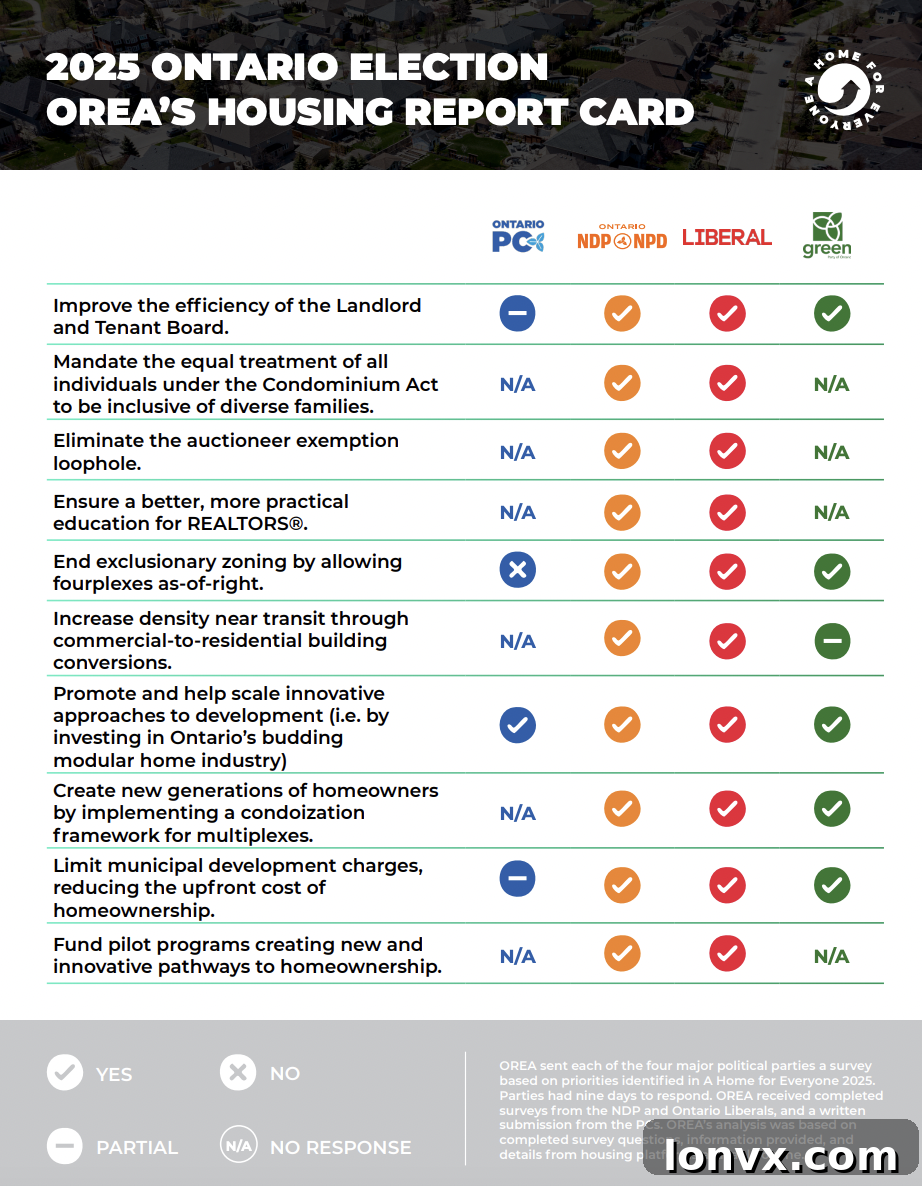
To compile its comprehensive report card, OREA conducted a thorough assessment, sending detailed surveys to each major political party regarding their housing platforms. The Ontario New Democratic Party (NDP) and the Ontario Liberal Party provided completed surveys, while the Progressive Conservative Party of Ontario (PC) submitted a written response. OREA’s expert analysis was meticulously based on the responses received, supplementary information provided by the parties, and publicly available details from their official housing platforms online. This rigorous methodology ensures a fair and objective evaluation, providing voters with a clear understanding of where each party stands on critical housing issues.
Progressive Conservative Party of Ontario (PC)
The Progressive Conservative Party’s platform includes a notable focus on leveraging innovation to boost housing supply. Their proposal to actively encourage modular housing through the creation of housing innovation guides is a key highlight. These guides are designed to help consumers navigate complex building processes and explore various financing options for modular homes. OREA recognizes this initiative as a significant step towards bringing more diverse housing supply to the market efficiently. This aligns directly with OREA’s recommendation to promote and scale innovative approaches to housing development, acknowledging the potential of advanced construction methods to address Ontario’s housing shortage effectively and at speed.
Ontario New Democratic Party (NDP)
The Ontario New Democratic Party has articulated a comprehensive housing strategy that resonates strongly with OREA’s objectives. Their proposals are geared towards significantly increasing the availability of affordable homes, with a specific commitment to doubling the supply. A core tenet of their plan is the legalization of fourplexes and a concerted effort to increase housing density around transit hubs, directly tackling exclusionary zoning practices. Furthermore, the NDP supports crucial consumer protection measures, including the elimination of the auctioneer exemption and the restoration of efficient, in-person hearings at the Landlord and Tenant Board. Their platform also includes establishing a clear framework to facilitate innovative co-ownership options for multiplexes, aligning with OREA’s push for diverse and accessible ownership models.
Ontario Liberal Party
The Ontario Liberal Party’s housing platform demonstrates a strong commitment to reducing the financial barriers to homeownership. A central proposal is the elimination of development charges on new housing units under 3,000 square feet, a measure designed to directly lower construction costs and, consequently, the purchase price for many new homes. In a significant move to enhance affordability, the Liberals also propose to eliminate the provincial land transfer tax for specific, vulnerable groups: first-time homebuyers, seniors who are downsizing, and non-profit homebuilders. These targeted tax relief measures align directly with OREA’s overarching recommendation to actively lower the cumulative cost of homeownership, making it more achievable for a wider range of Ontarians.
Green Party of Ontario
The Green Party of Ontario has put forward an ambitious and environmentally conscious housing plan, pledging to facilitate the construction of two million new homes within the next decade. A cornerstone of this vision is the commitment to legalizing fourplexes “as-of-right” across the entire province of Ontario. This forward-thinking policy directly echoes OREA’s urgent call to end exclusionary zoning, advocating for the automatic allowance of up to four units per single-family lot province-wide. The Green Party’s approach not only addresses the critical need for increased housing supply but also integrates sustainable urban planning principles, promoting denser, more walkability-friendly communities that reduce sprawl and support a lower carbon footprint.
OREA President Rick Kedzior underscored the universal desire for effective housing solutions, stating in a recent press release, “Whether they are voting PC, NDP, Liberal, or Green, Ontarians want leaders who are willing to help people achieve the dream of homeownership, obtain more affordable housing, and break down barriers that prevent them from finding a great place to call home.” This sentiment captures the unifying urgency of the housing crisis and the public’s expectation for decisive political action.
With the provincial polls scheduled for February 27, 2025, Ontarians have a pivotal decision ahead. OREA’s Election Report Card provides an essential tool for voters to critically assess the commitments of each party and choose leaders who are best positioned to deliver on the promise of a more affordable and accessible housing future for all. The path forward for Ontario’s housing market will be significantly shaped by the choices made at the ballot box.