
Due to a stronger-than-expected spring, homeownership costs in Canada saw a surprising uptick in the second quarter of this year, breaking a year-long trend of declining prices. This reversal, while notable, was somewhat tempered by a corresponding gain in household income, offering a nuanced perspective on the nation’s housing affordability landscape.
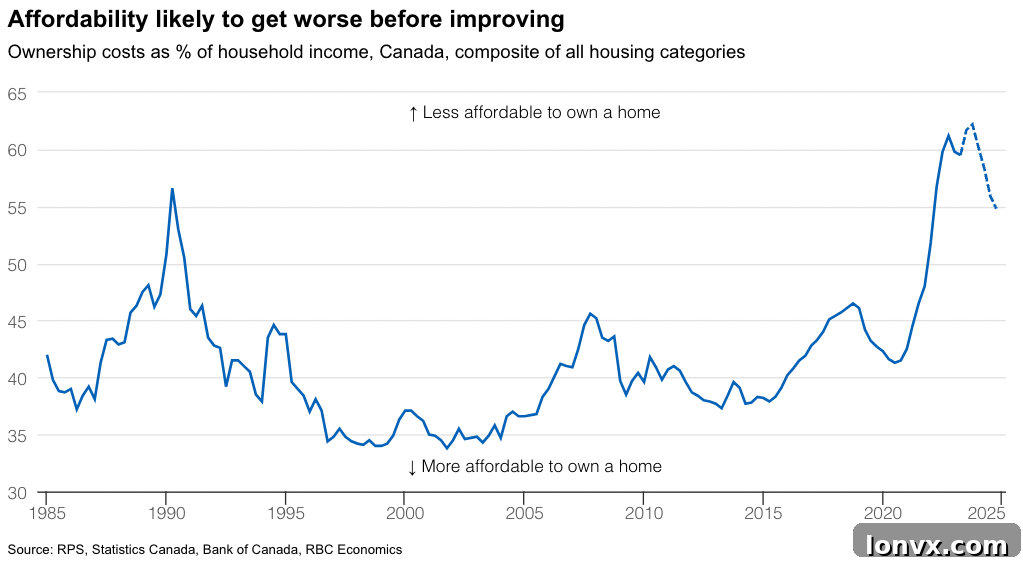
According to a comprehensive report released on September 28 by RBC Economics and spearheaded by economist Robert Hogue, a nationwide income growth of 1.4 percent from the first quarter played a crucial role. This growth helped to reduce the critical ratio of homeownership costs to median household income, indicating a slight, albeit significant, improvement in overall housing affordability. RBC’s aggregate affordability measure, a key indicator, consequently fell for the second consecutive time by 0.3 percentage points, reaching 59.5 percent. This figure represents the share of median household income required to cover the costs of owning a home, underscoring the ongoing financial burden faced by many Canadians.
The Delicate Balance: Income Growth Versus Rising Costs
In the often-intense discussions surrounding housing affordability, the spotlight typically falls on fluctuating home prices and shifting interest rates. However, the RBC report eloquently highlights an often-underestimated factor: the positive impact of increasing household income. While not always a dramatic force, steady income growth can act as a crucial counterbalance against the relentless ascent of housing expenses.
Economist Robert Hogue draws a parallel to the early stages of the pandemic, a period when government support programs provided much-needed financial relief to Canadians grappling with the economic uncertainties of lockdowns. That era marked the last time income had such a discernible effect on RBC’s affordability measure. This historical context underscores the vital role that household financial stability plays in mitigating the pressures of the housing market, suggesting that policies supporting income growth can be as impactful as those directly targeting housing costs.

Navigating a Challenging Near-Term Outlook
Despite the recent welcome boost from income growth, the immediate future for Canadian housing affordability appears challenging. The RBC report forecasts a likely deterioration in the third quarter, driven primarily by two persistent factors: higher mortgage rates and the unwavering appreciation of property prices. This combination is expected to intensify the financial strain on prospective homebuyers and current homeowners alike.
However, a glimmer of hope emerges on the horizon, with expectations pointing towards an improving trend in 2024. This optimism is largely tied to the potential actions of the Bank of Canada, with Hogue anticipating interest rate cuts “around mid-year.” Such a move would significantly ease borrowing costs, potentially revitalizing demand and offering some much-needed relief to a strained market. While not a complete solution, a reduction in rates could be a catalyst for a more accessible housing environment.
Regional Pressures: A Diverging Landscape
Across Canada’s major markets, prospective buyers continue to face formidable affordability hurdles. The report explicitly states, “We believe those pressures are behind the notable cooling in home resale activity we saw this summer in Ontario and British Columbia. They are poised to weigh on demand for months to come in both regions, with many buyers entirely priced out in Vancouver and Toronto.” These two metropolitan giants, known for their high property values and competitive markets, are experiencing a slowdown as an increasing number of individuals find themselves unable to enter or move within the ownership market. The sheer cost of entry has become an insurmountable barrier for a significant segment of the population, impacting migration patterns and overall economic mobility.
Hogue also projects that demand will likely cool in other parts of Canada, with the “possible” exception of the Prairie markets, particularly Calgary. Here, buyer confidence appears to remain remarkably strong. This divergence highlights the varied economic realities and housing market dynamics across the country. Factors such as relatively lower average prices, distinct economic drivers (like the energy sector in Alberta), and a perhaps less intense supply crunch contribute to a more robust and accessible market in these regions, drawing attention from those priced out of more expensive locales.
Towards Sustainable Solutions: The Long-Term Imperative
The path to restoring genuine housing affordability in Canada is not a quick fix; the report emphatically underscores that it will be a slow and arduous process. Barring a catastrophic housing market crash or an unforeseen, dramatic shift in monetary policy, substantial improvements will require sustained effort and strategic intervention. The core issue, as identified by economist Hogue, lies in the fundamental imbalance between supply and demand.
He elaborates, “Supply must increase by giant leaps to make a material difference. But building new homes takes a long time—up to several years in the case of large condo apartment complexes. And it’s increasingly hard to build units ordinary Canadians can afford to buy given soaring construction costs and finite construction capacity.” This statement encapsulates the multifaceted challenges developers face: navigating lengthy approval processes, grappling with escalating material and labor costs, and contending with a limited pool of skilled workers and infrastructure. The current pace of construction is simply insufficient to meet the burgeoning demand, perpetuating the affordability crisis.
Boosting Supply and Supporting Renters
While the problem is complex, actionable solutions are emerging. Hogue acknowledges that the recent cut to the Goods and Services Tax (GST) on new apartment projects represents a positive step in the right direction. This policy aims to incentivize the construction of new rental units, which are desperately needed across the country. However, the report stresses that this measure alone will not be enough. Significantly boosting investment in affordable rental housing is identified as a crucial priority to address the pressing needs of struggling Canadians.
Many individuals and families, unable to enter the homeownership market, rely heavily on a stable and affordable rental sector. When rental costs skyrocket, the entire housing ecosystem becomes more volatile, exacerbating financial stress for a large segment of the population. Therefore, comprehensive strategies that include not only tax incentives but also streamlined zoning, infrastructure investment, and support for non-profit housing initiatives are essential to create a more equitable and accessible housing market for all Canadians. The goal must be to build more homes, faster, and at price points that reflect the realities of average household incomes, ensuring that the dream of secure housing remains within reach for future generations.
For a deeper dive into these critical issues, including detailed regional breakdowns and further economic analysis, you can read the full report from RBC Economics.
Get the latest news directly in your inbox
Join industry leaders getting the latest news right in your inbox 3x per week!