
QUICK HITS
- A new report by RBC Economics reveals Canadian housing affordability has plummeted to its worst-ever levels in six major cities nationwide, primarily due to aggressive interest rate hikes.
- Despite the market nearing a cyclical bottom, prospective buyers continue to grapple with significant affordability challenges across most regions.
- RBC economists anticipate a material improvement in housing affordability throughout 2023, driven by market corrections and stable interest rates.
Canadian Housing Affordability: Navigating Record Lows and Anticipating a 2023 Turnaround
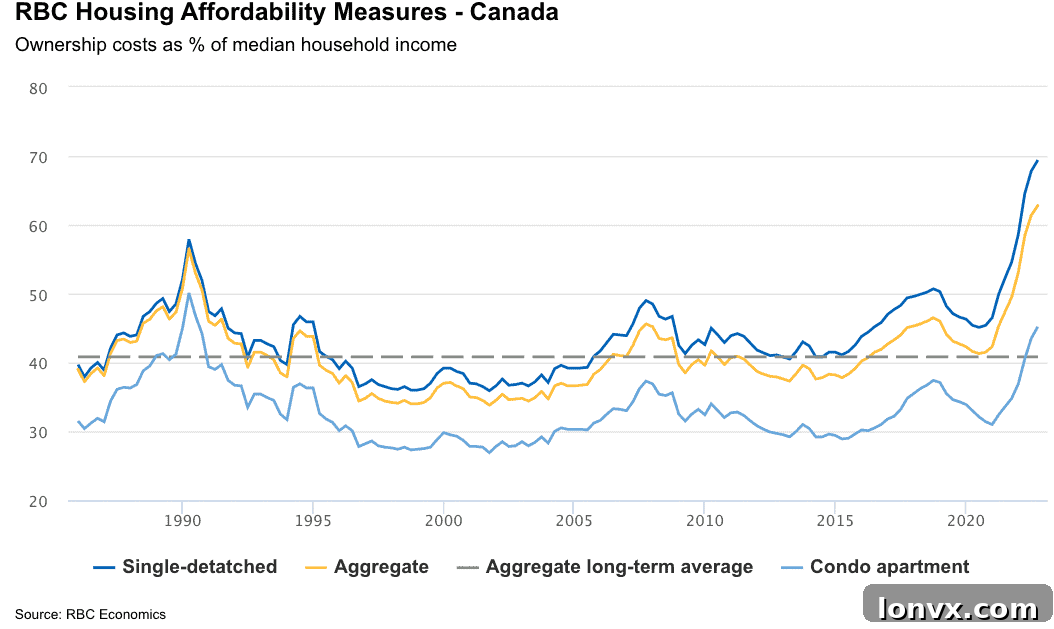
The aspiration of owning a home in Canada has become increasingly challenging for many, with the nation’s housing affordability reaching unprecedented lows. A comprehensive report from RBC Economics, led by Assistant Chief Economist Robert Hogue, highlights a critical juncture for the Canadian real estate market. The analysis reveals that six prominent cities – Victoria, Vancouver, Toronto, Ottawa, Montreal, and Halifax – have experienced their most severe affordability conditions to date. This drastic decline is attributed primarily to the rapid succession of interest rate hikes implemented by the Bank of Canada throughout the previous year.
These aggressive rate adjustments, a strategic move by the central bank to rein in persistent inflation, directly translated into substantially higher mortgage payments and elevated borrowing costs. Consequently, homeownership became financially out of reach for a larger segment of the population, pushing overall ownership costs to record levels. However, amidst this challenging landscape, the RBC report offers a glimmer of optimism. It indicates that the downturn has notably moderated since the fall, suggesting that the Canadian housing market is now closely approaching a crucial cyclical bottom. This forecast implies that the period of intense market adjustment and deterioration may soon conclude.
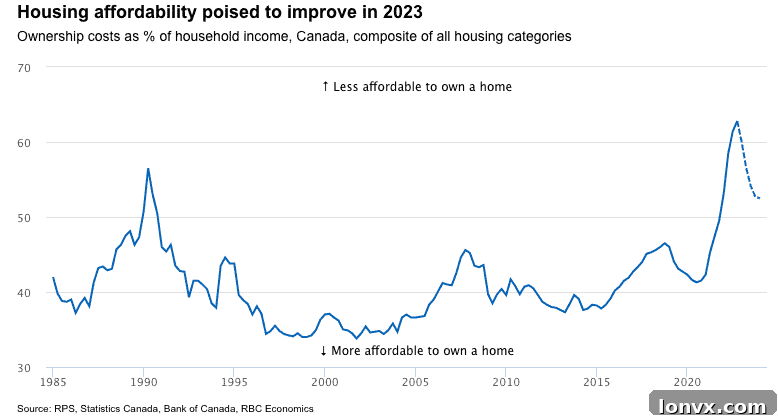
Indeed, the market has already begun to exhibit signs of self-correction. The decline in property values over the past two quarters has provided a modest, albeit limited, improvement in affordability. Yet, this positive shift has not been substantial enough to fully counteract the profound impact of higher interest rates on overall housing costs. Looking ahead, RBC economists project a significant and material improvement in housing affordability over the course of 2023. This optimistic outlook is largely contingent on a pivotal condition: the Bank of Canada maintaining a stable interest rate environment, foregoing further rate hikes, and allowing market forces to recalibrate.
The Unfolding of a Self-Correction Mechanism in the Canadian Housing Market
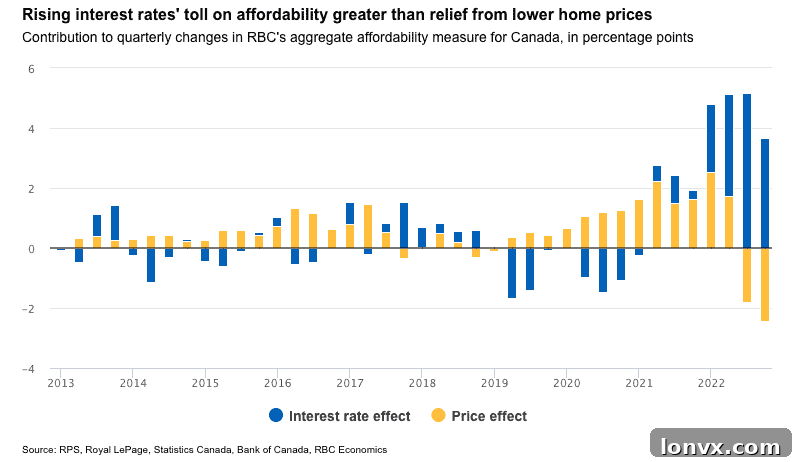
The year 2022 was defined by the profound and pervasive influence of interest rate hikes on the Canadian housing market, catapulting homeownership costs to unprecedented peaks. The RBC Economics report meticulously details how these rate increases exerted immense pressure. Specifically, RBC notes that the higher rates alone contributed an additional 3.7 percentage points to its aggregate affordability measure in the fourth quarter of 2022. This statistic powerfully illustrates the direct and immediate impact of monetary policy on the financial viability of purchasing a home across the nation.
However, within this narrative of escalating costs, a crucial dynamic has been set in motion: the dramatic and sustained loss of affordability witnessed since mid-2021 has effectively triggered powerful self-correcting forces within the housing sector. These inherent market mechanisms are now widely expected to “soon turn the situation around,” as posited by RBC. The fundamental principle driving this correction is straightforward: when buying conditions become exceptionally harsh, demand inevitably contracts. With fewer individuals able or willing to engage in home purchases, resale activity slows considerably, naturally leading to a downward trajectory in property prices.
This anticipated recalibration has already begun to manifest across various regions. Lower property values have, over the past two quarters, started to exert a beneficial influence on overall affordability, offering some degree of relief, albeit localized and initially insufficient. While RBC acknowledges that this nascent impact has not yet been robust enough to entirely offset the burden imposed by elevated interest rates, a significant shift is on the horizon. With increasing signals that the Bank of Canada’s aggressive campaign of rate hikes may have concluded, any subsequent declines in home prices are expected to translate into a much more tangible and meaningful difference for prospective buyers, progressively restoring a sense of balance and accessibility to the housing market.
Persistent Affordability Hurdles Continue for Canadian Homebuyers
Despite emerging indications of market self-correction, the current environment for aspiring homebuyers across the majority of Canada remains exceptionally challenging. The fourth quarter of 2022 marked an unprecedented low point for housing affordability in several key urban centers. RBC’s aggregate measures, which assess the proportion of household income required to cover ownership costs, reached all-time highs in cities such as Victoria, Vancouver, Toronto, Ottawa, Montreal, and Halifax. This indicates that these major metropolitan areas are at the forefront of the national affordability crisis.
Beyond these six particularly hard-hit markets, homeownership costs are also considerably higher than their historical norms in virtually every other market nationwide. The notable exception to this trend appears to be Edmonton, which has exhibited a degree of resilience compared to other major cities. The broader picture further deteriorated across the board in Q4 2022, with RBC’s measures recording the most significant increases in affordability challenges in Saint John, Vancouver, Victoria, and Montreal. This widespread decline underscores the systemic nature of the affordability crisis gripping the country, impacting diverse regional markets.
The national aggregate affordability measure provides an even more striking illustration of the deepening struggle. It has surged by an astounding 21.5 basis points since late-2021. This substantial increase reflects the combined and cumulative effect of rapidly rising interest rates and, initially, strong price appreciation, which together have severely eroded the purchasing power of Canadian households. The elevated cost of servicing a mortgage, coupled with still-high property values in many regions, continues to present formidable barriers for those looking to enter the housing market or move up the property ladder, necessitating cautious planning and financial resilience from buyers.
Is the Canadian Housing Market Truly Nearing a Cyclical Bottom?
The year-long market downturn, characterized by cooling demand, declining sales volumes, and price corrections, has shown compelling signs of moderation since the fall of 2022. According to RBC’s detailed analysis, activity levels across the Canadian housing market have reached profoundly depressed states, suggesting that there is now very little additional downside left to explore. This observation is a critical indicator for understanding the current market trajectory and forecasting its future prospects, signalling a potential turning point for homeowners and buyers alike.
Indeed, home resales across Canada have plummeted to levels not witnessed since the tumultuous period of the 2008-09 global financial crisis, excluding the exceptional and unique circumstances of the initial COVID-19 lockdown phase. Such significantly low activity is a robust indicator of a market undergoing profound rebalancing and adjustment. RBC analysts now anticipate a definitive market bottom to form as early as this spring. However, this recovery is not expected to be uniform across the vast Canadian landscape. Certain markets, particularly those in Ontario and potentially Atlantic Canada, may demonstrate greater resilience and lead the recovery, showing signs of stabilization and potential upward movement sooner. Conversely, other regions, such as the Prairies and Quebec, might experience a slight lag in their recovery timelines, reflecting diverse local economic conditions and supply-demand dynamics.
Following the anticipated stabilization of market activity, home prices are generally expected to level out a few months later, entering a period of relative calm after the turbulence. This crucial prediction is heavily premised on one vital assumption: that the Bank of Canada will indeed refrain from implementing further interest rate increases, effectively keeping its “fingers off the trigger” when it comes to monetary tightening. A stable interest rate environment is paramount for fostering renewed buyer confidence, allowing the market to find its new equilibrium, and facilitating a gradual return to more sustainable and predictable conditions for residential real estate. For more detailed insights into this prediction, RBC encourages readers to explore its comprehensive analysis: read more about this prediction here.
Housing Affordability Poised for Improvement in 2023 and Beyond
While RBC’s comprehensive report starkly illustrates that homeownership costs, when measured as a percentage of household income, have soared to unprecedented heights in recent quarters, it concurrently offers a beacon of hope: a significant and material improvement in affordability is forecast for 2023. This projection marks a crucial turning point after a prolonged period of severe deterioration, offering potential relief to strained Canadian households and prospective first-time buyers.
The report acknowledges that reversing the severe erosion of affordability experienced since 2021 will be a protracted and complex process. It’s not an overnight fix but rather a gradual unwinding of compounded market pressures and economic shifts. To meaningfully “move the needle” towards greater affordability and make a tangible difference for Canadians, two primary factors are identified as indispensable: a reduction in interest rates by the Bank of Canada and a consistent, robust growth in household incomes across the country. Lower interest rates directly alleviate the cost of borrowing, making mortgages more accessible and affordable. Simultaneously, steady income growth enhances the financial capacity of households to manage existing ownership costs and qualify for new mortgages, even if property prices remain elevated.
Furthermore, broader structural changes could significantly bolster this anticipated improvement in affordability. Initiatives aimed at substantially increasing housing supply, particularly in high-demand urban areas where scarcity drives up prices, could alleviate intense price pressures. Thoughtful government policies that support first-time homebuyers, address speculative investment, or streamline construction processes might also contribute positively to the long-term affordability equation. While the primary drivers of immediate improvement are expected to be monetary policy stability and natural market self-correction, long-term, sustainable affordability ultimately hinges on a multi-faceted approach addressing both demand-side costs and fundamental supply-side constraints. The anticipated stability from the Bank of Canada, coupled with ongoing market adjustments, sets the stage for 2023 to be a pivotal year where the pendulum begins to swing back, albeit slowly, in favor of Canadian homebuyers, paving the way for a more balanced and accessible housing market.
Deep Dive: Accessing the Full RBC Economics Report for Comprehensive Insights
For those seeking a more granular and in-depth understanding of the intricate dynamics at play within the Canadian housing market, including detailed regional breakdowns, specific data points, and a deeper exploration of the economic factors influencing affordability, the full report from RBC Economics offers invaluable insights. We strongly encourage all interested readers – including prospective homebuyers, current homeowners, investors, and policy makers – to consult the complete analysis to gain a comprehensive perspective on the current challenges, future outlook, and potential pathways towards a more balanced and affordable housing landscape in Canada. This detailed document elaborates on the methodologies used for affordability measurement, provides extensive historical context, and expands significantly on the forecasts and trends presented herein.
You can access the full report, which provides an in-depth exploration of these critical trends and more, directly through RBC’s thought leadership platform: access the full report here.