
Navigating Canadian Property Taxes in 2024: A Comprehensive Guide to Rates and Regional Variances
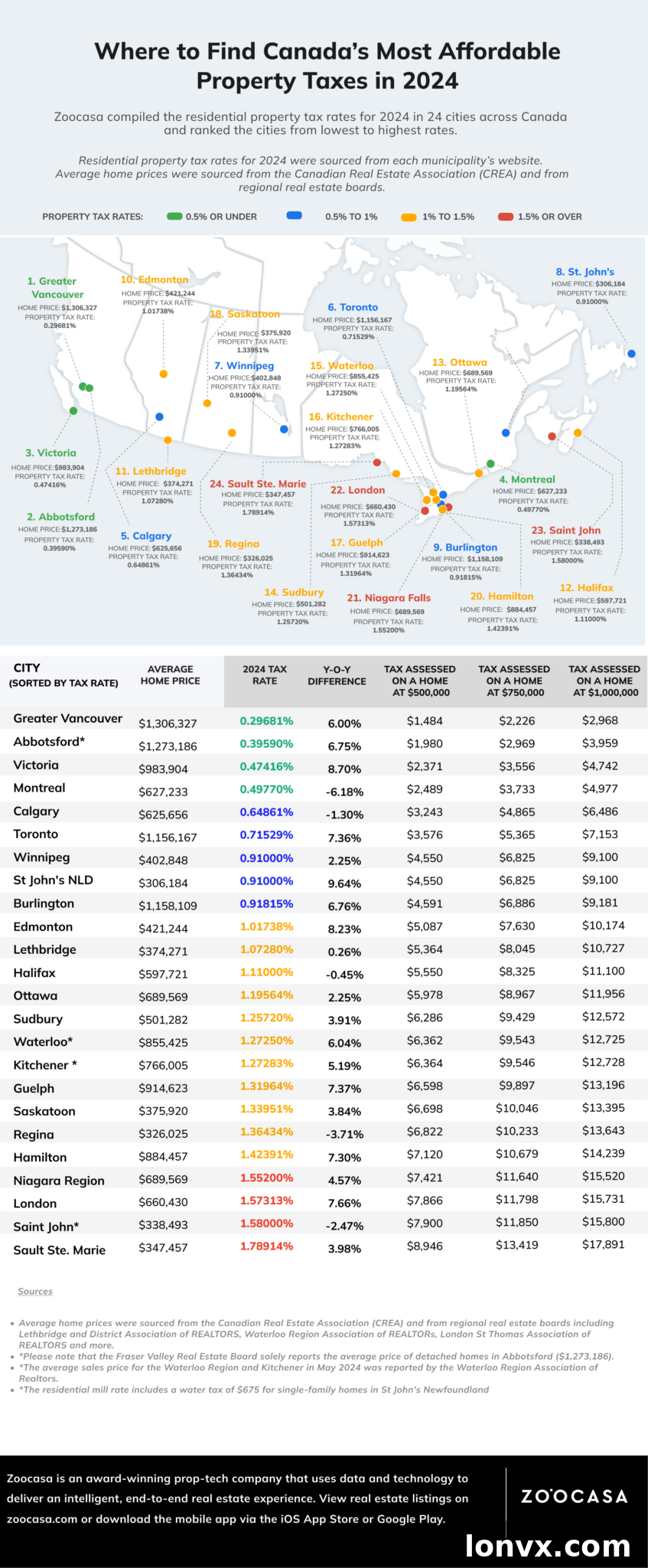
The landscape of property taxes across Canadian cities has proven to be remarkably dynamic in 2024, with significant fluctuations impacting homeowners nationwide. A recent study by Zoocasa sheds light on these shifts, revealing St. John’s, Newfoundland, at the forefront with a notable 9.64% year-over-year increase, marking it as the highest in the country. Conversely, Montreal offered a substantial reprieve to its property owners, experiencing the largest decrease at 6.18%. These shifts are not isolated incidents but rather a complex interplay of municipal budgeting, economic pressures, and the lingering effects of the pandemic’s pause on rate adjustments, which have now led to cities adjusting to compensate for lost time and increased operational costs.
Understanding these variances is crucial for current and prospective homeowners alike, as property taxes represent a significant portion of homeownership costs and directly fund essential municipal services. This detailed analysis will explore the key trends, highlight cities with the highest and lowest tax burdens, and delve into regional specifics, particularly within Ontario, to provide a clearer picture of Canada’s diverse property tax environment.
Unpacking the 2024 Property Tax Landscape: Key Increases and Decreases
The first half of 2024 has seen a pronounced upward trend in property tax rates across many Canadian municipalities. Following St. John’s significant increase, Victoria, British Columbia, recorded the second-highest jump at 8.70%. This rise is particularly noteworthy given Victoria’s reputation for maintaining some of the lowest property tax rates nationally, suggesting a concerted effort by the city to bolster its municipal revenue. London, Ontario, also saw a substantial increase of 7.66%, pushing its rates further up the scale and solidifying its position among cities with Canada’s highest property tax burdens.
These increases are often driven by various factors, including the need to fund new infrastructure projects, address rising operational costs for public services like policing, fire safety, and waste management, or adjust budgets in response to inflation and growing population demands. For instance, cities like St. John’s might be investing in urban development or catching up on deferred maintenance, necessitating higher tax revenues.
On the more favourable side for homeowners, several cities implemented noteworthy decreases. Montreal’s impressive 6.18% reduction provides considerable financial relief, potentially reflecting a strategic municipal decision to attract residents or businesses, or perhaps a healthy fiscal position. Regina, Saskatchewan, followed suit with a 3.71% reduction, and Saint John, New Brunswick, saw a 2.47% decrease. These reductions can be attributed to factors such as successful cost-saving initiatives, growth in other revenue streams, or a deliberate effort by city councils to mitigate the financial strain on taxpayers.
Across the 24 cities included in the Zoocasa study, the median year-over-year property tax change settled at an increase of 4.88%. This median figure underscores a general trend of rising property taxes across Canada, reflecting the ongoing financial pressures faced by municipalities in delivering and maintaining high-quality services for their residents.
Cities at the Extremes: Where Property Taxes Are Highest and Lowest in Canada
British Columbia: Low Rates Amidst High Property Values
Despite its reputation for an exceptionally high cost of living and soaring real estate prices, British Columbia stands out for having some of the lowest property tax rates in Canada. This seemingly counterintuitive situation is primarily due to the astronomical property values in its major urban centres. Even with a minuscule tax rate, municipalities in areas like Greater Vancouver can generate substantial revenue from a large tax base of high-value homes.
For instance, Greater Vancouver boasts the lowest property tax rate in the entire country at a mere 0.29681%. This translates to an annual tax bill of just $2,968 for a home assessed at $1,000,000. To put this into perspective, for the same $1 million property, homeowners in Greater Vancouver pay significantly less than in most other major Canadian cities. Abbotsford follows closely with the second-lowest rate at 0.39590%, resulting in annual taxes of $3,959 for a similarly valued home. Victoria, despite its recent increase, also maintains affordable property taxes at 0.47416%, amounting to $4,742 annually for a $1,000,000 assessed home. These low rates in BC allow homeowners to retain more of their income, even as their property’s market value continues to climb.
The Burden of High Property Taxes: Saint John, NB, and Sault Ste. Marie, ON
In stark contrast to British Columbia, other regions of Canada face a different reality, where lower average property values necessitate higher tax rates to generate adequate revenue for municipal services. Saint John, New Brunswick, despite experiencing a 2.47% decrease in 2024, remains one of Canada’s most expensive areas for property taxes. Homeowners in Saint John face significant tax bills, such as approximately $7,900 for a $500,000 home and a hefty $15,800 for a $1,000,000 home. This illustrates the challenge faced by communities with a lower overall tax base; a higher mill rate is required to fund the same level of services.
Sault Ste. Marie, Ontario, presents an even more pronounced example of a high property tax burden. With an exceptionally high tax rate of 1.78914%, it leads to annual taxes of $8,946 for a $500,000 home and a staggering $17,891 for a $1,000,000 home. This situation highlights a critical disparity: a Vancouver homeowner might pay less than half in property taxes for a $1,000,000 home compared to a Sault Ste. Marie homeowner for a $500,000 home. Such extreme differences underscore the varying economic foundations and municipal funding models across Canada, directly impacting the affordability of homeownership in different regions.
A Closer Look at Ontario’s Diverse Property Tax Landscape in 2024
Ontario, Canada’s most populous province, showcases a wide spectrum of property tax rates, reflecting the diverse economic conditions, municipal priorities, and service demands of its cities. From major metropolitan hubs to smaller, northern communities, the financial obligations for homeowners can vary dramatically.
Toronto, as Canada’s largest city and economic engine, maintains a relatively low property tax rate of 0.71529%. This efficiency is partly due to its extensive and valuable tax base, which allows the city to fund a vast array of services without excessively high individual rates. For a home assessed at $1,000,000, Toronto homeowners would pay approximately $7,153 in annual property taxes. In comparison, Burlington, a city with a similar average property price (around $1.16 million), has a notably higher rate of 0.91815%, demonstrating that average home prices are just one factor in determining local tax burdens. Municipal spending habits, population density, and specific local projects can also significantly influence rates.
Ottawa, the nation’s capital, is often lauded for its relatively affordable cost of living compared to Toronto or Vancouver. However, its property tax rate stands at 1.19564%, which is considerably higher than Toronto’s. This means a $1,000,000 home in Ottawa would incur annual taxes of $11,956 – a stark contrast to Toronto’s $7,153. This difference can be attributed to various factors, including the specific infrastructure needs of a capital city, its distinct service delivery model, and less reliance on other revenue streams compared to a commercial centre like Toronto.
High-Rate Clusters: Sudbury, Waterloo, Kitchener, and Guelph
Several other Ontario cities see their property tax rates exceed 1.25%. These include Sudbury, Waterloo, Kitchener, and Guelph, each with unique economic drivers. Sudbury, a major hub in Northern Ontario, has an annual tax bill of $12,572 for a $1,000,000 home. However, it’s important to note that Sudbury’s average home price is significantly lower at $501,282, meaning that few residents face such high assessments. For the average homeowner in Sudbury, the actual tax bill would be closer to half of the $1,000,000 home example, making it more affordable in practice. Waterloo and Kitchener, forming part of the rapidly growing tech triangle, and Guelph, known for its university and quality of life, reflect the investments in public services and infrastructure needed to support their expanding populations and economies.
Notable Shifts and Peak Rates in Ontario
Niagara Falls experienced a 4.57% increase in its property tax rates, bringing it to 1.552%. This increase could be linked to ongoing investments in its tourism infrastructure or municipal services to support its unique economy. London, as mentioned earlier, now holds the second-highest rate in Ontario at 1.57313%, placing a significant financial demand on its homeowners. However, the highest property tax rate in the province belongs to Sault Ste. Marie at 1.78914%. This city stands out as an extreme example where, despite having some of the lowest property prices in Ontario, its residents face the highest tax rates. This dynamic creates a challenging scenario for homeowners, where a relatively modest property value can still result in a substantial annual tax burden, affecting overall housing affordability and potentially deterring new residents or investments.
Understanding the Broader Implications for Canadian Homeowners and Municipalities
The fluctuations and disparities in property tax rates across Canada have far-reaching implications. For homeowners, these rates directly affect monthly budgets and overall financial planning. Significant increases can strain household finances, potentially impacting discretionary spending or savings. Conversely, decreases offer welcome relief, freeing up funds for other expenses or investments. These tax variations also play a crucial role in real estate decisions, influencing where individuals choose to buy homes, invest in property, or even relocate across provinces.
From a municipal perspective, property taxes are the lifeblood of local government, funding a vast array of essential services that contribute to residents’ quality of life. This includes everything from maintaining roads and parks, providing public transit, supporting libraries and community centers, to funding emergency services like police and fire departments, and ensuring waste management. Municipal councils are constantly balancing the need to provide these critical services with the imperative to keep taxes affordable for their citizens. This balancing act involves careful budgetary planning, exploring alternative revenue streams, and making strategic decisions about infrastructure development and service levels. The pandemic further complicated this, leading to delayed adjustments now manifesting as sharper increases in some areas as cities strive to stabilize their financial foundations.
Conclusion: Navigating Canada’s Diverse Property Tax Environment
The 2024 Canadian property tax landscape is characterized by its significant regional variances and ongoing adjustments. From the dramatic increases in St. John’s and London to the notable decreases in Montreal and Regina, property tax rates are a critical indicator of municipal fiscal health and a major factor in homeowner affordability. British Columbia’s low rates on high-value properties stand in stark contrast to Ontario’s Sault Ste. Marie, where high rates on lower-valued homes create a unique financial challenge.
As property values continue to evolve and municipalities adapt to economic pressures and community needs, understanding these trends becomes increasingly important. Homeowners and prospective buyers are encouraged to stay informed about local tax policies and their potential impact on their finances. Ultimately, property taxes remain a cornerstone of local governance, reflecting the shared responsibility of residents in funding the vibrant communities they call home.
Review the full report here.
Enjoying this article? Get the latest real estate articles in your inbox 3x week so you stay up to date on the latest in the Canadian real estate industry.