
The Canadian real estate landscape continues to evolve, presenting both challenges and opportunities for homebuyers and investors. A recent comprehensive report released by Re/Max Canada sheds critical light on current economic indicators, strongly suggesting that potential homeowners in Canada may face further interest rate increases. This anticipated financial tightening is expected to significantly decelerate growth and activity within the condominium markets across several of Canada’s major urban centers.
The Re/Max Canada 2023 National Condominium Report is a robust analysis, meticulously assessing nearly 100 distinct communities situated within seven key markets. These crucial markets include the expansive Greater Toronto Area (GTA), the nation’s capital Ottawa, the vibrant Halifax-Dartmouth region, the bustling Greater Vancouver area, the rapidly developing Fraser Valley, and the major Western Canadian hubs of Edmonton and Calgary. The insights gleaned from this report offer a panoramic view of the condominium segment, highlighting regional disparities and overarching national trends that will shape the market’s trajectory.
Overview of Condominium Sales and Price Trends Across Canada
While the period from May through August of the current year witnessed a notable level of condominium sales activity, this momentum did not quite match the exceptional year-to-date sales figures recorded in 2022. This comparison indicates a broader cooling trend within the market. Across the first eight months of this year, the condominium segment experienced an overall decline in sales volumes in the majority of assessed markets. However, two significant outliers defied this trend, showcasing the diverse nature of Canada’s real estate ecosystem. Calgary’s condominium sales soared by an impressive over 20 percent year-over-year, while Edmonton also saw a healthy increase of three percent, underscoring the resilience and unique drivers present in Alberta’s real estate sector.
Delving deeper into pricing, the average condominium price demonstrated remarkable consistency in Halifax-Dartmouth, Calgary, and Greater Vancouver. This stability suggests a balanced supply-demand dynamic or perhaps a price ceiling being met in these specific regions. Conversely, average prices registered declines in Edmonton, the Fraser Valley, Ottawa, and the Greater Toronto Area. These decreases are largely attributable to the prevailing economic climate, characterized by heightened borrowing costs and the impact of the mortgage stress test. The stress test, which includes an additional two percent buffer to the minimum qualifying rate, has notably reduced the market share of condominiums in Ottawa, Fraser Valley, and Greater Vancouver. This indicates that potential buyers in these areas are finding it increasingly difficult to qualify for mortgages, pushing them out of the condominium market or forcing them to reconsider their housing options.
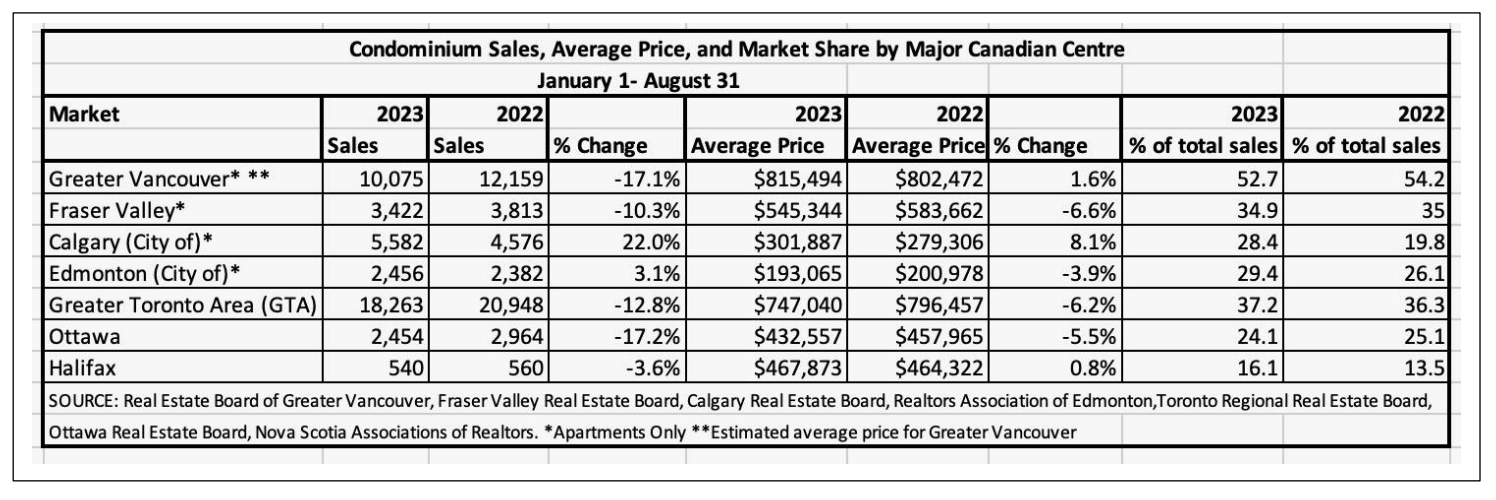
Source: Re/Max Canada
Significant Shifts in Condominium Inventory Levels
One of the most telling indicators of market health is the change in inventory, and recent data reveals some striking shifts. Toronto, which stands as Canada’s most significant condominium market, experienced a substantial surge in apartment inventory, with an increase of nearly 24 percent year-over-year. Townhome listings in the city also saw a considerable boost of 7.5 percent. This influx of units suggests either a slowdown in buyer demand, an increase in new construction completions, or a combination of both. The Fraser Valley mirrored this trend, with its apartment stock rising by almost 28 percent in August compared to the same month last year, further highlighting a softening demand in this historically hot market.
Calgary, despite its robust sales performance, also recorded a near-37 percent boost in listings. However, this increase needs to be interpreted in context: Calgary’s August sales-to-new-listings ratio stood at an impressive 98 percent. This exceptionally high ratio indicates that despite more units coming onto the market, buyer demand was strong enough to absorb nearly all new listings, suggesting a still very active and competitive environment for condominium sales in the city. In contrast to these markets, Ottawa and Greater Vancouver observed declines in condominium inventory, potentially signaling a more balanced market or even a shortage of available units in specific segments, which could support price stability or even modest increases in the future.
Christopher Alexander, President of Re/Max Canada, offered his expert perspective on these developments: “While there was some momentum in the market early in September that dovetailed with the Bank of Canada’s announcement to pause interest rate hikes, the most recent inflation numbers extinguished the flame. Lifecycle sales will continue to contribute to steady activity, but a comeback similar to that of the second quarter is likely out of the question.” This statement underscores the sensitivity of the market to macroeconomic factors, particularly inflation and the Bank of Canada’s monetary policy decisions. Buyers and sellers alike are closely watching interest rate announcements, as they directly impact affordability and market sentiment. The expectation is for a continued, albeit moderate, level of activity driven by essential housing needs, rather than a speculative boom.
Interprovincial Migration: A Key Driver of Regional Market Shifts
One of the most powerful and often underestimated forces influencing Canada’s diverse condominium markets is interprovincial migration. This phenomenon has been a colossal driver of change, particularly evident in Alberta’s condominium market. The allure of enhanced affordability and a significantly lower cost of living has acted as a powerful magnet, drawing buyers away from more expensive and congested markets, notably British Columbia and Ontario. These two traditionally high-cost provinces, according to Statistics Canada’s Quarterly Demographic Estimates, Provinces, and Territories, experienced less interprovincial migration during the first quarter of this year, suggesting a reverse flow or at least a reduced inflow of residents.
Alexander expressed no surprise at the trend of buyers seeking out more economically viable markets such as those found in Alberta or Nova Scotia. He articulated a critical issue facing many Canadians today: “The cost of living is out of control in larger centres and even the most affordable housing now carries a pretty substantial sticker price.” This statement highlights a fundamental disconnect in the economy: while housing costs have continued their upward trajectory, average earnings have largely failed to keep pace. This disparity is exacerbated by persistent inflation, which relentlessly stretches household budgets thin, making homeownership an increasingly distant dream for many.
Beyond the immediate sticker price and interest rates, taxation also emerges as a significant concern for potential homebuyers and current owners. Alexander specifically points out, “Taxation is also an issue, with the City of Toronto gearing up to introduce an even more punitive Municipal Land Transfer Tax in January of 2024.” Such additional costs can significantly impact the overall affordability of a property, particularly in already expensive markets. These cumulative financial pressures force individuals and families to make difficult choices, often leading them to consider relocation to provinces where the financial burden of housing and daily life is considerably lighter. This strategic migration is not just about finding a cheaper home but about achieving a sustainable quality of life, underscoring the deep impact of economic policies and market conditions on individual decisions.
Evolving Condominium Market Trends and Buyer Behavior
The Re/Max Canada report meticulously outlines several key takeaways regarding prevailing condominium market trends, offering valuable insights for anyone navigating this complex landscape. Firstly, a noticeable shift in buyer behavior indicates that many prospective purchasers are lowering their expectations and expanding their search parameters. Driven by the desire for better value or the avoidance of hefty land transfer taxes, buyers are increasingly willing to consider properties further afield from traditional urban cores. This expanded search radius reflects a pragmatic approach to homeownership in an affordability-challenged market.
The luxury condominium market, interestingly, has demonstrated a degree of resilience, particularly in Toronto and Calgary. This segment’s strength is largely attributed to downsizing buyers – individuals or couples moving from larger single-family homes into premium, often amenity-rich, condominium units. These buyers often have significant equity built up in their previous properties, making them less sensitive to rising interest rates or market fluctuations. However, the luxury segment did experience a slowdown at higher price points in Halifax, the Fraser Valley, and Greater Vancouver, suggesting that even affluent buyers are becoming more discerning and price-conscious in certain regions.
Furthermore, the report emphasizes the growing importance of condominium board strength and maintenance fees as critical factors in buying decisions across many markets. Buyers are increasingly sophisticated and cautious, no longer willing to tolerate surprise expenses or poorly managed properties. There is a discernible trend towards greater due diligence when it comes to assessing condo boards, understanding their financial health, and scrutinizing maintenance fee structures. This heightened scrutiny aims to mitigate future financial risks and ensure the long-term value and livability of the investment.
Another significant trend highlighted is the state of new condominium construction. Across most markets, the pace of new developments has either slowed, faced delays, or in some instances, projects have been outright cancelled. While city approvals can sometimes be a bottleneck, the predominant reason cited is financial viability. Developers are contending with soaring material costs, labor shortages, and higher financing costs for construction loans, making many projects less profitable or entirely unfeasible under current economic conditions. This slowdown in new supply could have long-term implications for inventory levels and affordability.
Finally, the report identifies an emerging opportunity in the form of “assignments,” particularly prevalent in the Greater Toronto Area, the Fraser Valley, and Greater Vancouver. Assignments refer to the sale of a purchase agreement for a pre-construction property before the unit is officially registered in the buyer’s name. A significant number of presale buyers from three or so years ago, who committed to purchasing units at lower interest rates, now find themselves unable to qualify for mortgages at the significantly higher current rates. Consequently, many of these individuals are compelled to sell or assign their properties to new buyers, creating a distinct segment of the market where opportunities for immediate occupancy or negotiated prices may arise. This phenomenon reflects the profound impact of interest rate hikes on long-term real estate commitments and represents a unique dynamic in today’s Canadian condominium market.
For more in-depth analysis and specific regional data, you can read the full Re/Max Canada Condominium Report.