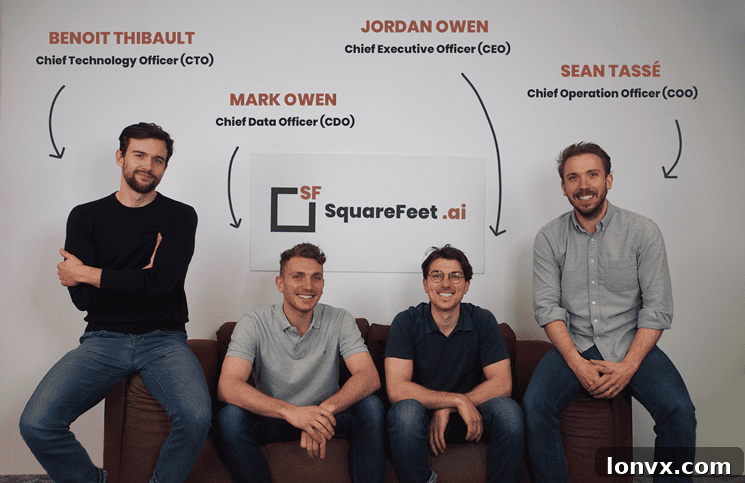
Pioneering Innovation: From Pandemic Pivot to the Future of AI in Real Estate
The year 2020 brought unprecedented challenges, and for many in Quebec’s vibrant construction industry, it meant sudden unemployment. Sean Tassé, then a 28-year-old project manager specializing in residential construction for Montreal-based real estate development firm Mondev, found himself exactly in this position in March 2020 as the province entered its initial three-week lockdown. Instead of succumbing to idleness, Tassé’s entrepreneurial spirit ignited. “I was at home and thinking, this doesn’t make sense. I am fully educated and motivated, and I can do anything to help,” he recalls. At a time when Canada lagged weeks behind Asian countries in pandemic preparedness, a critical gap became glaringly obvious to him: the urgent need for protective equipment. Tassé quickly grasped, “we’re going to have to use masks to be able to fight this disease.” This realization would unexpectedly set the stage for two groundbreaking ventures, intertwining immediate societal needs with long-term technological disruption.
Prior to the lockdown, Tassé’s professional path at Mondev had fostered invaluable connections. He worked closely with brothers Jordan Owen, 26, and Mark Owen, 28, whose family owned the esteemed development company. Beyond professional collaboration, a strong friendship had blossomed among the trio. This existing camaraderie proved crucial when, amidst the uncertainty of the lockdown, Tassé reached out to Jordan Owen with a compelling business proposition: to launch a company dedicated to manufacturing high-quality, reusable masks. Jordan Owen, having just returned to Montreal after his post-graduate program at the Massachusetts Institute of Technology (MIT) swiftly transitioned to online learning, immediately recognized the potential and necessity of Tassé’s idea. He eagerly embraced the challenge.
With Mark Owen joining the budding team, the three co-founders decided to confront the pandemic head-on with a proactive solution. They founded Bien Aller, a company whose name was a nod to Quebec’s widely adopted COVID-19 catchphrase, “Ça va bien aller” (It’s going to be fine). This name encapsulated a message of hope and resilience, resonating deeply with the public. Bien Aller quickly became a market leader, distinguishing itself as the first company to offer reusable masks in Quebec. Their rapid response and commitment to quality quickly paid dividends. Within a mere three months of its inception, Bien Aller achieved remarkable success, selling over 250,000 masks across Canada and the United States. This extraordinary early triumph not only helped protect countless individuals but also generated significant profits, laying a robust financial foundation for their subsequent ambitious endeavors.
Revolutionizing Real Estate: Identifying a Glaring Industry Gap
As Bien Aller soared, providing essential protective gear and demonstrating the power of swift, purpose-driven entrepreneurship, the trio’s attention began to shift. Their success in solving one pressing problem empowered them to tackle another, deeply embedded challenge within an industry they knew intimately: real estate development. “The problem in the industry is that new residential developments or developers have a hard time efficiently determining the pricing of their units,” explains Tassé. This wasn’t merely an inconvenience; it represented a significant pain point for developers, often leading to suboptimal revenue, extended sales cycles, and a lack of market responsiveness.
Traditional methods for pricing new residential units were, to put it mildly, often unscientific and inefficient. Developers frequently relied on a mix of gut feelings, outdated comparative analyses, and limited, siloed data points. This approach left substantial room for error, making it difficult to accurately gauge market demand, competitive landscapes, and the optimal price point that would maximize returns without deterring potential buyers. The existing tools and methodologies failed to provide a holistic, real-time understanding of the dynamic real estate market. This fundamental flaw resulted in developers often leaving money on the table or experiencing slower-than-expected sales, directly impacting project profitability and future investment capabilities. The co-founders recognized that in an era of abundant data, the real estate sector was woefully underutilizing its most valuable asset.
Driven by this insight, the team envisioned a transformative solution. Their goal was to construct a platform that would empower developers with an unprecedented level of market intelligence. Tassé elaborates on their ambitious vision: “We wanted to build a solution that would allow the developer to have an overall market view of the project, where it’s located, help the developer develop his initial pricelist in a more sophisticated way, and allow the developer to have a platform that allows them to follow in real time the sales of his project and optimize those prices.” This comprehensive approach sought to move beyond mere estimation, aiming for a system that could dynamically adapt to market shifts and buyer behaviors, ensuring that pricing strategies remained agile and highly effective throughout the entire sales lifecycle of a development.
The Birth of Squarefeet.ai: PropTech’s New Frontier
To realize this ambitious vision, the team turned to the cutting edge of technology: artificial intelligence (AI). They understood that AI algorithms held the key to moving beyond rudimentary pricing methods, enabling a rigorous, data-driven approach that could analyze vast datasets, identify complex patterns, and predict optimal outcomes with a level of precision previously unattainable. By leveraging AI, they aimed to replace subjective estimations with empirical insights, creating a paradigm shift in how residential units are valued and sold.
The process of building such an sophisticated AI platform required additional expertise and a fresh perspective. In June of the same year, the trio invited a fourth friend, Benoit Thibeault, to join their entrepreneurial journey. Together, they co-founded and officially incorporated Squarefeet.ai. Thibeault’s experience and vision complemented the existing team perfectly, strengthening their collective ability to transform a concept into a tangible, high-impact product. The startup moved with impressive speed, and by September, Squarefeet.ai had successfully launched its online platform. The reception from the real estate industry was immediate and overwhelmingly positive. Tassé proudly states that the platform “got great traction from the (real estate) industry,” indicating a clear demand for their innovative solution and a widespread recognition of its potential to address long-standing inefficiencies.
Squarefeet.ai positions Realtors as the primary end-users of its groundbreaking technology, understanding that their role is pivotal in the sales process. The platform is meticulously designed to provide Realtors with unparalleled insights and tools, allowing them to excel in a highly competitive market. “It allows them to be able to get the maximum revenue for the developer and it’s going to allow them to differentiate themselves from other Realtors, because they’re backed by AI-driven decisions,” Tassé explains. This is a game-changer for real estate professionals. By arming them with data-backed recommendations and predictive analytics, Squarefeet.ai empowers Realtors to justify pricing, identify key selling points, and close deals more effectively. “This is huge for them because now they have a tool that allows them to be better than the competition,” Tassé adds, highlighting the significant competitive advantage the platform offers. The validity and impact of Squarefeet.ai’s claims are further reinforced through ongoing discussions and collaborations with prominent companies in the sector, such as Baker Real Estate and JLL, signaling a strong market validation for their innovative approach.
The Imperative of Data-Driven Decisions in Real Estate
The real estate industry, despite its traditional nature, is inherently data-rich. From property records and sales histories to demographic trends and economic indicators, a wealth of information is constantly generated. However, as Tassé points out, “at the moment, there are very few solutions that allow us to utilize that data, to (deliver) data-driven solutions.” This highlights a critical disconnect: abundant data exists, but the tools to effectively harness it for strategic decision-making are scarce. Squarefeet.ai directly addresses this gap, transforming raw data into actionable intelligence.
The significance of this transformation cannot be overstated. “Those data-driven decisions are going to separate the developers that have huge success and the ones that have less,” Tassé asserts. In an increasingly complex and fast-paced market, relying on intuition or outdated information is no longer sustainable. Technology, particularly AI, is becoming not just an advantage but a necessity for survival and growth. Tassé underscores this point, stating, “Technology is going to have to be implemented in this industry to be able to keep up with the rest of our lives,” especially considering the profound changes brought about by the pandemic, which accelerated digital adoption across all sectors.
Beyond immediate profitability, the long-term impact of data-driven decisions extends to the very fabric of urban development and quality of life. Tassé envisions a future where such insights lead to profoundly better-designed units and ultimately, more responsive cities. “We’re going to be able to quantify what works and what the people want to have as units, which ones are the most successful on the market,” he explains. This feedback loop, fueled by real-world sales data and market preferences, will allow developers to refine their offerings continually. This means constructing buildings and units that are not only aesthetically pleasing but also perfectly aligned with the evolving needs and desires of their occupants. Ultimately, this approach will empower developers “to create better buildings and maybe eventually cities that are more catered to the need of its different citizens,” fostering sustainable, desirable communities that truly serve their inhabitants.
Strategic Growth and a Vision for Industry Transformation
Squarefeet.ai has outlined a clear strategic roadmap for its growth and expansion. By the end of 2021, the company aims to release the first version of its technology specifically designed to “cater to the existing stock of real estate” within the Quebec market. This initial regional focus allows the team to refine their platform, gather crucial user feedback, and establish a strong foothold in their home province. Following this foundational phase, plans are firmly in place to broaden the product’s reach, expanding its services to the rest of Canada. This phased approach ensures sustainable growth and maximum impact.
The journey of Squarefeet.ai is a testament to entrepreneurial ingenuity and strategic financial planning. The company has been effectively bootstrapped by the ongoing, robust earnings generated from its initial success with Bien Aller. This self-funding mechanism provided critical early capital and autonomy, allowing the founders to develop their vision without immediate external pressures. Complementing this, Squarefeet.ai has also successfully raised venture funds through participation in various prestigious business and startup accelerator programs. These programs not only provided capital but also invaluable mentorship, networking opportunities, and strategic guidance, further propelling the company’s development. With this solid financial backing and strategic support, Squarefeet.ai is robustly positioned to establish a dominant foothold within the burgeoning PropTech landscape.
The ultimate vision for Squarefeet.ai transcends mere technological innovation; it aims for a fundamental transformation of the entire real estate industry. As Sean Tassé succinctly puts it, their ambition is to help the industry evolve into “something that’s more refined than what it is right now.” This future vision encompasses a real estate sector that is more efficient, transparent, responsive, and ultimately, more aligned with the needs of both developers and end-users. By continuously leveraging the power of AI and data analytics, Squarefeet.ai is not just building a product; it is actively shaping a more intelligent, adaptable, and successful future for real estate across Canada and beyond.