
Canada’s Housing Market Outlook: A Cautious Path to Rebound by Late 2025
The Canadian housing market, a cornerstone of the national economy, continues to navigate a complex landscape shaped by economic shifts, evolving consumer sentiment, and significant policy interventions. A recent in-depth analysis by TD Economics offers a comprehensive forecast, projecting a mild yet discernable rebound in the country’s housing market during the latter half of 2025. This detailed report, expertly penned by economist Rishi Sondhi, provides crucial insights for stakeholders across the real estate spectrum, outlining both the emerging signs of recovery and the persistent hurdles that define Canada’s residential property sector.
Following a period of subdued activity at the beginning of the year, there are now tangible indicators suggesting a gradual reawakening of buyer interest. National home sales experienced a notable four percent increase in May, building on a modest rise observed in April. These consecutive monthly gains are a positive development, hinting that a portion of the demand that was previously sidelined by economic uncertainties and elevated borrowing costs is beginning to trickle back into the market. While these improvements are encouraging, they signal a cautious revival rather than an immediate surge, underscoring the nuanced and regionally diverse nature of the current market trajectory.
Navigating Current Economic Headwinds and Labor Market Dynamics
Despite the glimmers of recovery in sales figures, the TD Economics report sagaciously highlights the enduring presence of substantial economic headwinds. The report explicitly states, “Uncertainty remains elevated, and job markets are deteriorating.” This assessment paints a realistic picture of an economic environment characterized by multiple pressures, including lingering inflationary concerns, global geopolitical instabilities, and the cumulative impact of previously aggressive interest rate hikes. Such multifaceted uncertainty naturally fosters a cautious approach among potential homebuyers, leading them to carefully weigh the significant financial commitment involved in property acquisition.
The observed deterioration in job markets is a particularly influential factor impacting housing demand. A softening labor market, typically marked by an increase in unemployment rates and a deceleration in wage growth, directly erodes the purchasing power and job security of prospective homeowners. When individuals face heightened uncertainty regarding their employment stability, their willingness to undertake substantial mortgage debt diminishes considerably. This broader economic backdrop acts as a significant constraint on housing demand, especially in Canada’s high-cost, competitive urban centers where financial thresholds for homeownership are already exceptionally high.
Consequently, even if the upward trend in sales volumes continues, market activity is broadly expected to remain subdued in the immediate term. This conservative outlook is particularly pertinent for British Columbia and Ontario, two of Canada’s most populous and historically dynamic real estate markets. These provinces, traditionally characterized by robust demand and rapidly appreciating asset values, are now contending with unique challenges that set their housing trajectories apart from other Canadian regions.
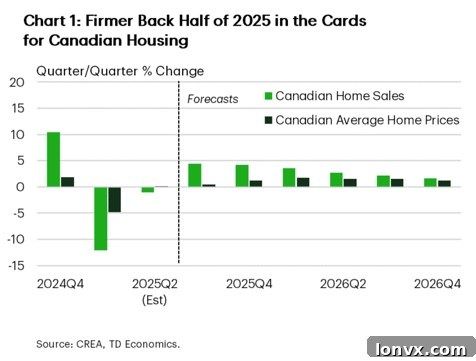
Source: TD Economics Report – Illustrative representation of Canadian housing market trends and forecasts.
Regional Divergence: A Deep Dive into Canada’s Diverse Housing Landscapes
A crucial takeaway from the TD Economics report is its meticulous articulation of the significant regional disparities that define Canada’s housing market narrative. While national averages offer a macro perspective, understanding the distinct provincial dynamics is absolutely essential for a nuanced comprehension of Canadian real estate. This divergence underscores that there isn’t a single “Canadian housing market,” but rather a collection of interconnected yet uniquely performing local markets.
Uplift in the Prairies and Other Key Regions: Supply and Demand Dynamics
In a notable amendment to its previous projections, TD has revised upwards its forecast for average home prices in the latter half of the year, specifically for regions outside of British Columbia and Ontario. This optimistic adjustment is primarily driven by a combination of stronger, more consistent sales activity and tighter housing supply conditions prevalent in these areas, with the Prairie provinces emerging as a standout example.
Provinces such as Alberta, Saskatchewan, and Manitoba have recently experienced sustained inter-provincial migration, attracting residents seeking more affordable housing alternatives, robust employment opportunities within their natural resource sectors, and an overall lower cost of living compared to the highly expensive coastal and central urban hubs. This consistent influx of new residents, coupled with a more moderate and balanced pace of new home construction, has fostered a healthier equilibrium between housing supply and demand. As a result, these Prairie provinces are witnessing conditions that are supportive of price stability and gradual, sustainable growth, thereby presenting a compelling counter-narrative to the more challenging conditions faced in other parts of the country.
British Columbia and Ontario: Persistent Affordability and Supply Imbalances
In stark contrast, the outlook for British Columbia and Ontario remains considerably more challenging, with average home prices generally projected to experience declines. The report attributes this anticipated downturn to a fundamental imbalance: an evident oversupply of homes listed for sale relative to the number of active, qualified buyers within these provinces. This significant mismatch is a direct outcome of several converging factors, including the accumulated impact of elevated interest rates on overall affordability, a moderation in population growth rates within specific segments, and the sheer volume of existing housing stock.
The affordability crisis in these two regions has reached unprecedented levels, effectively pushing a substantial portion of prospective first-time homebuyers out of the market entirely. Many are either unable to meet the stringent mortgage qualification criteria or find themselves compelled to significantly adjust their homeownership expectations, often settling for smaller or less ideally located properties. This elevated barrier to entry means that even with an increased availability of homes, there simply aren’t enough qualified buyers willing or financially capable of purchasing at the current lofty price points. This scenario inevitably creates downward pressure on prices as sellers find themselves competing for a smaller pool of eligible purchasers.
Specific Challenges in Ontario: The GTA Condo Market and Investor Retreat
Within Ontario, the report identifies a unique dynamic that could, paradoxically, lead to a slight upward bump in average prices despite the broader trend of decline. This potential statistical anomaly hinges on a shift in the composition of sales, where a larger proportion of higher-priced or luxury homes might contribute to an elevated overall average. However, it is crucial to understand that such a statistical increase would likely mask underlying weaknesses in the market’s more accessible segments.
A particular area of concern highlighted is the pronounced weak demand for more affordable condominiums in the Greater Toronto Area (GTA), especially from the investor segment. The condominium market, traditionally viewed as an accessible entry point for first-time buyers and an attractive asset class for investors, is now facing significant headwinds. Elevated borrowing costs have considerably diminished the appeal of investment properties, as rental yields may no longer adequately cover increased mortgage expenses. This strategic pullback by investors, combined with a significant volume of new condo completions entering the market, contributes to an oversupply in this critical segment, thereby impacting price growth at the lower and mid-range of the market.
The Path Ahead: Key Influencers for the 2026 Housing Outlook
Looking further ahead into 2026, TD Economics anticipates a stronger and more robust growth trajectory for both home sales and prices across Canada. This more optimistic long-term projection is firmly rooted in expectations of several critical economic improvements and the eventual materialization of current policy impacts.
Anticipated Economic Rebound and Lower Borrowing Costs
The primary catalysts for the projected acceleration in market activity by 2026 are a forecast improvement in the broader Canadian economy and a significant reduction in borrowing costs. As inflationary pressures are expected to recede and central banks gain greater confidence in achieving sustained price stability, interest rates are widely anticipated to embark on a gradual but steady decline. Lower interest rates will directly translate into more manageable mortgage payments, thereby substantially enhancing purchasing power for a broader spectrum of buyers and reinvigorating demand across the entire residential real estate sector.
Furthermore, a healthier and more robust economic environment, characterized by consistent GDP growth and strengthened employment figures, would significantly bolster overall consumer confidence. This renewed optimism is expected to encourage more households to actively participate in housing market activities, ranging from making first-time home purchases to undertaking upgrades or relocations. Such heightened engagement would provide a substantial boost to sales volumes and contribute positively to widespread property price appreciation.
Persistent Affordability Challenges and Demographic Shifts
Despite the generally brighter outlook for 2026, the report wisely introduces a crucial note of caution regarding the potential magnitude of the market’s rebound. Persistently high absolute prices, particularly within Canada’s established and most expensive markets such as British Columbia and Ontario, coupled with a projected moderation in population growth rates specifically for these regions, are likely to impose limits on the extent of any recovery. While Canada as a nation is experiencing robust overall immigration, localized shifts or a deceleration in the pace of inter-provincial migration could critically affect regional demand dynamics and the overall pace of market recovery.
The structural issue of housing affordability remains a formidable and deeply entrenched barrier. Even with the welcome prospect of reduced borrowing costs, the absolute price levels in these highly expensive markets may still remain financially out of reach for a significant portion of the Canadian population. This enduring affordability gap suggests that while the market may indeed recover, it is unlikely to fully revert to previous periods of unbridled, rapid growth. Instead, it may settle into a more sustainable, albeit still challenging, equilibrium, reflecting the underlying structural issues that continue to impact access to homeownership.
The Indispensable Role of Government Policy in Bolstering Housing Supply
A critically important component of any long-term, sustainable resolution to Canada’s pervasive housing challenges lies in a concerted and effective strategy to significantly boost housing supply. The federal government’s recently unveiled housing plan aims to directly confront this fundamental issue by introducing a suite of measures designed to accelerate construction, streamline complex approval processes, and incentivize the development of a more diverse range of housing types across the country. While these governmental initiatives are undoubtedly crucial for ensuring long-term market health and accessibility, their tangible impact will not be instantaneous.
The TD Economics report provides a prudent caution against expecting any immediate or swift resolution from these policy interventions. It explicitly states, “We wouldn’t expect a material boost to housing completions until perhaps late next year.” The inherent lifecycle of real estate development, encompassing everything from initial planning and complex zoning approvals to the actual construction phase and final handover, is by its very nature a lengthy and multi-staged process. Various challenges, including persistent bureaucratic hurdles, chronic labor shortages within the construction sector, and the fluctuating availability and escalating costs of building materials, all contribute significantly to these inevitable delays. Therefore, while proactive government efforts are absolutely vital, their measurable effects on increasing the national housing supply will require considerable time to materialize, meaning the immediate challenges related to affordability and inventory scarcity are likely to persist for the foreseeable future.
The Long Road to Affordability: A Collective National Endeavor
In conclusion, TD Economics unequivocally emphasizes that any meaningful and sustainable improvement in housing affordability across Canada will inherently be a gradual process. This transformative change is heavily contingent upon a sustained, coordinated national effort to construct significantly more homes. This imperative extends beyond merely increasing the sheer quantity of housing; it fundamentally involves ensuring the development of a diverse spectrum of housing types—from affordable rental apartments and purpose-built rentals to various forms of ownership—that are specifically designed to meet the wide-ranging needs and financial capacities of all Canadians.
Addressing the deeply rooted causes of the affordability crisis necessitates a comprehensive and multi-faceted approach that actively involves all levels of government, private sector developers, and community stakeholders. It demands tackling complex issues such as archaic land-use policies, inadequate infrastructure development, critical skilled labor training, and the adoption of innovative construction techniques. The journey towards a more affordable, accessible, and equitable housing market in Canada is unquestionably a marathon, not a sprint. It demands unwavering, sustained commitment and profound collaborative action to overcome deeply entrenched systemic issues. Only through such comprehensive and prolonged efforts to strategically expand and diversify the national housing stock can Canada genuinely hope to achieve a more balanced, inclusive, and accessible real estate environment for its current and future citizens.