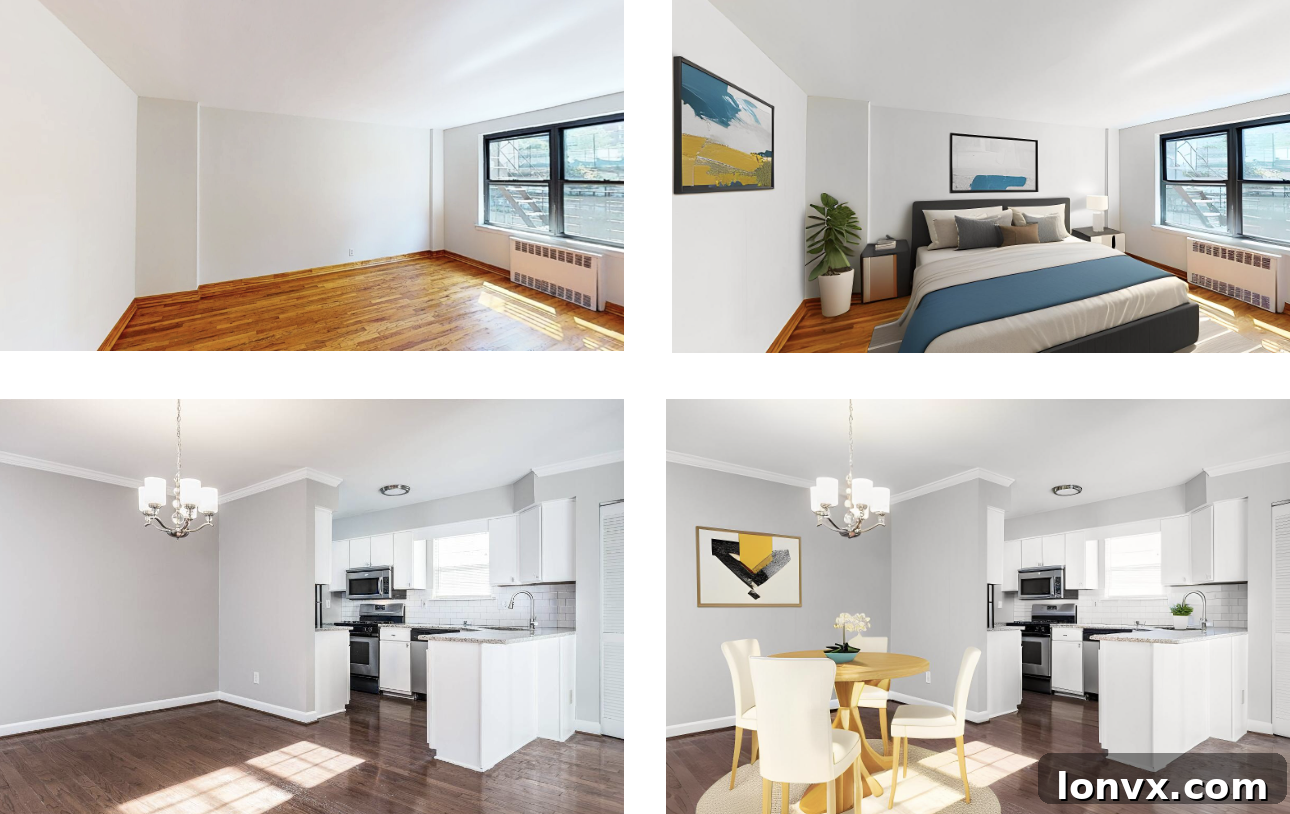
The landscape of residential real estate marketing is undergoing a profound digital transformation, primarily driven by the emergence of Artificial Intelligence (AI) powered virtual staging. This innovative approach is rapidly replacing traditional methods, where human graphic designers manually furnish empty spaces using software like Photoshop. This article delves into how AI virtual staging is revolutionizing residential real estate marketing, exploring its current impact and what the future holds for property showcasing and engagement.
From Physical to Virtual: A Transformative Staging Journey
To fully grasp the current shifts in residential real estate marketing, it’s essential to understand the evolution from physical staging to its virtual counterparts over the past decade. Initially, property marketing was heavily dependent on physical staging. This involved furnishing properties with actual furniture and decor to create an inviting atmosphere for in-person viewings and professional photography. The goal was to help potential buyers envision themselves living in the space, fostering an emotional connection that often translated into quicker sales and higher offers.
The effectiveness of physical staging is well-documented. A study by the Real Estate Staging Association (RESA) revealed that 85 percent of staged homes sold for 5 to 20 percent more than their original asking price, underscoring the significant return on investment it offers. To put this into perspective, based on the Canadian Real Estate Association’s average sale price of $657,145 for a house in Canada in December 2023, a staged home could command an additional $33,000 to $131,000. Furthermore, another RESA study highlighted that home staging reduced a property’s time on the market by an impressive 72 percent, unequivocally demonstrating its power in accelerating sales.
However, physical staging comes with its own set of challenges, including high costs associated with furniture rental, transportation, professional movers, and the time commitment involved in setup and removal. These factors often made it prohibitive for properties below a certain price point. The global pandemic further accelerated the shift towards virtual alternatives as in-person viewings became restricted. Traditional virtual staging emerged as a popular solution, where human graphic designers digitally add furniture and decor to empty room photographs using sophisticated software like Adobe Photoshop. While this offered a more cost-effective and flexible alternative to physical staging, it still relied on manual labor, which could be time-consuming and prone to human inconsistencies. Now, with the rapid advancements in AI technology, this entire process is experiencing an unprecedented evolution.
AI Virtual Staging: Unlocking Unprecedented Efficiency and Cost Savings
The introduction of AI virtual staging marks a pivotal moment, ushering in a new era of unprecedented cost reductions and remarkable increases in speed compared to traditional virtual staging methods. These transformative benefits stem directly from the automation inherent in AI. Instead of relying on manual development by human designers, AI algorithms can automatically generate entire virtual staging designs, furnishing empty rooms with remarkable speed and precision.
The fundamental economic principle at play is simple: the operational cost of an AI system is a mere fraction of what human labor commands. This dramatic reduction in overhead means real estate professionals can stage properties for a significantly lower investment, making professional staging accessible to a much broader market segment than ever before. This shift is rapidly propelling the real estate industry towards a future where virtually every online property listing will feature AI-staged images, rendering photographs of empty, uninspired rooms a relic of the past. Beyond just cost, AI offers unparalleled speed. A human designer might take hours to meticulously stage a single room; an AI system can generate multiple design variations for numerous rooms in mere minutes, allowing agents to quickly upload listings and capture buyer interest sooner. This efficiency is critical in fast-moving markets, providing a distinct competitive advantage.
Tailored Staging Strategies: A Correlation with Property Value
Insights gathered from numerous interviews with real estate agents and photographers reveal a clear correlation between a property’s market value and the preferred staging strategy. While approximately 90 percent of the agents surveyed acknowledge the importance of staging in some form, the specific type of staging employed often aligns with the property’s price point and target demographic.
Properties valued above $1 million typically necessitate physical staging. At this premium level, buyers often expect a luxurious, tactile experience. A physical staging investment of around $5,000, which can elevate the sale price by 5 percent (or $50,000+), represents an excellent return and caters to the discerning tastes of high-end clientele who desire to walk through a fully realized, tangible dream home. This segment values the authenticity and sensory experience that only physical staging can provide, from the feel of the fabrics to the scent of a meticulously styled space.
Conversely, properties within the $400,000 to $1 million range have historically leaned towards traditional virtual staging. For these listings, a modest $250 investment that boosts the sale price by 5 percent (equating to $20,000-$50,000 in additional value) still yields a compelling return. The cost-effectiveness and flexibility of virtual staging make it an attractive option for this mid-market segment. Historically, properties priced below $400,000 often remained unstaged due to budgetary constraints, despite compelling evidence that even minimal staging can significantly enhance their perceived value and marketability. This is precisely where AI virtual staging emerges as a game-changer. Its ultra-low cost and high efficiency democratize staging, making it economically viable for virtually any property, regardless of its price point. Therefore, while high-value properties above $1 million may continue to feature real furniture in their online images, it is highly probable that properties under $1 million will soon be exclusively showcased with stunning, AI-generated virtual furniture, effectively raising the bar for presentation across the entire market.
AI’s Impact on Asset and Property Management
The transformative forces of AI virtual staging extend beyond individual property sales, significantly impacting asset managers and property managers alike. Historically, managers of large, high-end multi-family apartment buildings have relied on physically staged model units to attract tenants. These meticulously designed units serve as tangible representations of the lifestyle offered within the building, allowing prospective renters to visualize their future home. However, for less expensive properties or those with diverse floor plans, maintaining multiple physically staged units is financially unfeasible. As a result, managers of such properties often resorted to showing empty units or reusing generic, virtually staged images across various layouts, which can fail to impress or accurately represent the unique characteristics of each space.
The current economic climate, with an anticipated cap rate compression in 2024, places immense pressure on asset managers to optimize returns and minimize vacancies. This financial imperative strongly incentivizes them to compel their property managers to adopt innovative technology solutions for tenant acquisition. AI virtual staging provides an ideal, affordable solution for this challenge. It enables property managers to showcase every vacant unit with bespoke, appealing virtual furniture tailored to its specific layout and target demographic, without the prohibitive costs of physical staging. This capability not only enhances the online appeal of properties across all price points but also significantly reduces vacancy periods by attracting a wider pool of interested renters, thereby directly contributing to improved occupancy rates and asset performance. AI empowers managers to present properties in their best light, even on a tight budget, ensuring that every listing stands out in a competitive market.
The Future Landscape: Innovations and Interactive Experiences
The future of AI image editing innovations in residential real estate marketing promises to push the boundaries of machine capabilities even further, yet the indispensable role of human creativity and expertise will remain. Firstly, the foundation of any virtual staging, whether human or AI-powered, is the original photograph. This means skilled real estate photographers will continue to be crucial, capturing high-quality, professional images that AI can then transform. Secondly, for bespoke, ultra-luxury properties or projects demanding the absolute highest artistic quality and nuanced customization, human designers will likely retain their edge, working in tandem with AI tools to achieve unparalleled aesthetic results.
Beyond static images, how clients interact with these digitally enhanced visuals is also set for a dramatic evolution. Future real estate platforms will leverage AI to dynamically change how a property is virtually staged, adapting instantly to a client’s specific preferences. Imagine a prospective buyer browsing a listing and, with a few clicks, being able to virtually redecorate a room in a minimalist, contemporary, or classic style. These platforms will empower renters and buyers to become active participants in the staging process, utilizing customizable furniture libraries to design spaces that perfectly align with their vision, rather than passively relying on pre-determined layouts from agents or property managers. This level of personalization will create a far more immersive and engaging experience, significantly enhancing the buyer’s journey.
Furthermore, the integration of AI virtual staging with augmented reality (AR) and virtual reality (VR) technologies will unlock new dimensions of property viewing. Prospective buyers could virtually walk through an empty home while seeing it furnished in real-time through an AR app on their phone, or immerse themselves in a fully staged VR experience from anywhere in the world. AI will also become adept at learning buyer preferences, predicting staging styles that are most likely to appeal to specific demographics, and even suggesting design modifications based on historical sales data. The proliferation of AI virtual staging in residential real estate marketing is not merely a passing trend but a fundamental, accelerating transformation. Online property images will overwhelmingly be staged using AI, leading to a more efficient, visually compelling, and personalized property discovery process for countless prospective buyers and renters as they seek their ideal home.
Enjoying this article?
Get the latest real estate market insights and industry updates directly in your inbox three times a week. Stay ahead of the curve on the Canadian real estate industry.