
Down Payment Assistance: An Essential Pillar for Canadian Homeownership Amid Affordability Challenges
The landscape of homeownership in Canada is undergoing a significant transformation, with new research revealing an increasing dependence on external financial support. A substantial majority of recent homebuyers indicate that acquiring their properties would have been impossible without assistance to cover the crucial down payment, a trend that critically highlights the intensifying pressures on Canada’s housing affordability system.
According to a comprehensive study by Mortgage Professionals Canada, an overwhelming 70% of individuals who purchased a home in the past two years relied on financial aid to make their down payment. This assistance typically encompasses family gifts, loans, and various forms of outside support, underscoring a fundamental shift in the pathways to entering the Canadian real estate market.
These compelling insights are derived from Mortgage Professionals Canada’s annual State of the Housing Market survey, a highly anticipated report conducted earlier this year by Bond Brand Loyalty. The extensive poll, which gathered responses from 2,000 Canadians, starkly illustrates a widening disparity in access to homeownership across the nation. The data paints a clear picture: for many prospective homeowners, personal savings alone are no longer sufficient to meet the formidable financial demands of a down payment.
The implications of these findings are profound, pointing towards a housing environment where the transfer of intergenerational wealth and other forms of external aid are not merely advantageous but have become increasingly vital. This escalating dependency raises critical questions about equitable access to housing, the long-term sustainability of current market dynamics, and the broader socio-economic landscape. As property values continue their upward trajectory in many major urban centres, the chasm between the aspiration for homeownership and the financial reality required to achieve it appears to be growing wider.
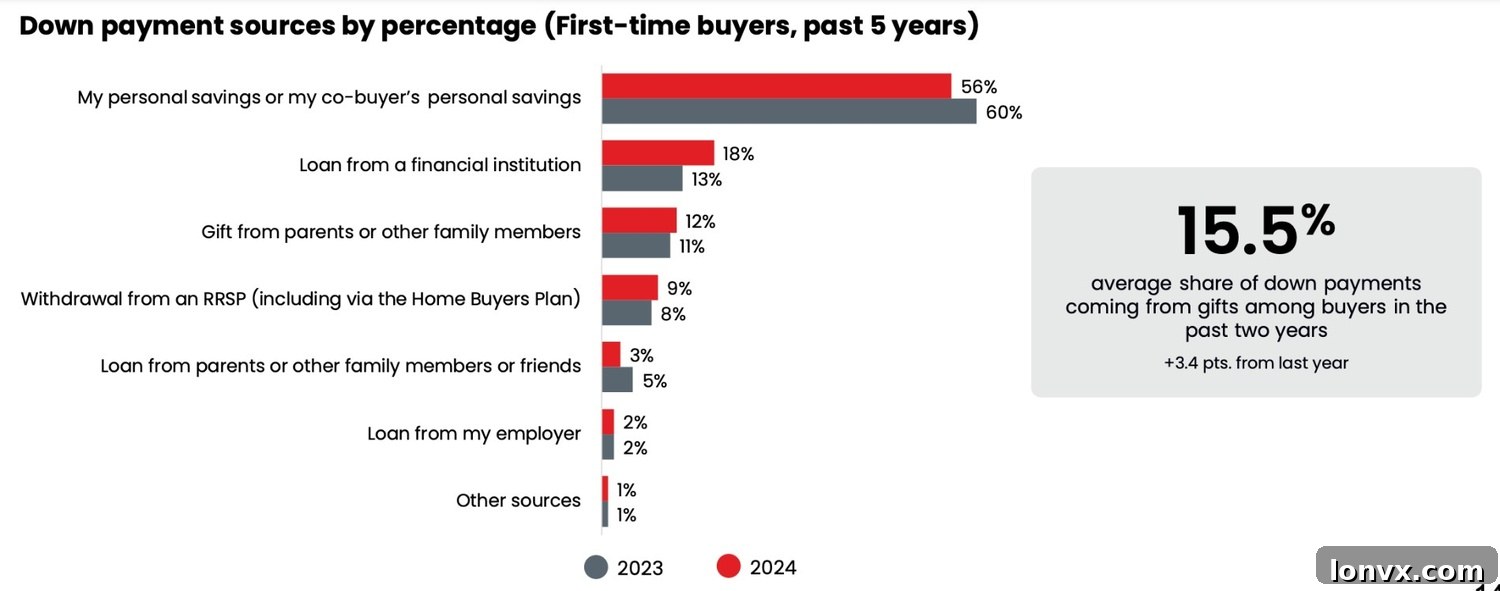
“Down payment assistance is no longer a backup plan—it’s a requirement for many Canadians hoping to buy,” firmly stated Lauren van den Berg, president and CEO of Mortgage Professionals Canada. Her powerful assertion encapsulates the current state of affairs, reclassifying what was once a supplemental aid into an indispensable component of the home buying journey for a significant portion of the population.
She further elaborated on the everyday observations of industry experts: “These findings confirm what brokers across the country are seeing every day: consumers are under pressure, and they need expert, transparent advice to find a way forward.” This emphasizes the crucial and evolving role of mortgage professionals in helping individuals navigate an increasingly complex and challenging financial landscape, offering essential guidance to those striving to secure their place in the housing market.
The Escalating Need for Down Payment Support: Understanding the Underlying Drivers
The pronounced increase in reliance on down payment assistance can be attributed to a multifaceted interplay of economic and market forces. Over recent years, Canada has witnessed an unprecedented surge in home prices, particularly in its most densely populated urban regions. This rapid escalation in property values has consistently outpaced average wage growth, making it exceptionally difficult for countless individuals and families to accumulate the substantial sums necessary for a down payment solely through their earnings.
Consider, for example, the typical requirement of a 20% down payment on a property valued at $700,000 – a common price point in many Canadian cities. This translates to an initial outlay of $140,000. Amassing such a significant amount through personal savings alone often proves to be an insurmountable hurdle for first-time homebuyers, who are frequently contending with additional financial burdens such as student loan debt, escalating rental costs, and a general increase in the cost of living. This economic reality often compels prospective buyers to seek financial assistance from family members, which can take various forms, including outright gifts, interest-free loans, or even leveraging existing family assets.
Furthermore, the implementation of more stringent mortgage lending criteria and the federal stress test by financial regulators, while intended to foster financial stability within the housing market, have inadvertently added another layer of complexity for buyers. These measures often necessitate larger down payments or higher qualifying incomes for the same mortgage amount, thereby further pushing individuals towards securing external financial assistance. Consequently, the market dynamics perpetuate a cycle where substantial initial capital is paramount, making the entry barrier increasingly steep for those without pre-existing wealth or familial financial backing.
Regional Disparities in Homebuying Independence Across Canada
While the overall trend points to a widespread need for down payment assistance, the Mortgage Professionals Canada survey also brought to light significant regional variances in the ability of homebuyers to purchase properties without any external financial aid. These geographical distinctions underscore the diverse economic conditions and real estate market dynamics prevalent across different regions of Canada.
Of all individuals who successfully purchased a home within the last five years, only 42% reported achieving this milestone without any form of assistance for their down payment. This national average, however, conceals considerable variations, with certain provinces exhibiting a far greater dependency on financial support than others, reflecting unique local market pressures.
The proportion of self-funded buyers was notably lowest in British Columbia, standing at a mere 34%. This figure is hardly surprising, considering that major urban centres like Vancouver consistently rank among the most expensive housing markets globally. The sheer magnitude of down payments required in BC often makes it financially unfeasible for even high-income earners to save independently within a reasonable timeframe, without considerable sacrifice.
Closely following BC, the Prairies region registered 37% of buyers making purchases without assistance, while Ontario stood at 38%. In Ontario, particularly within the Greater Toronto Area (GTA), immense pressure on housing affordability mirrors the challenges observed in British Columbia. Although the Prairies historically offered more attainable housing options, recent market shifts and significant population growth in key urban centres such as Calgary and Winnipeg have also contributed to rising property prices and an increased reliance on external financial aid.
In notable contrast, Quebec emerged with the highest share of homebuyers who did not require assistance, at an impressive 51%. This suggests a relatively more accessible housing market compared to its highly competitive Western counterparts. Factors potentially contributing to this include different urban development patterns, diverse provincial economic structures, and perhaps more stable and predictable price growth over time. Following Quebec, Atlantic Canada recorded 47% of buyers who purchased their homes without external assistance. While the Atlantic provinces have experienced their own recent surges in property values, they generally maintain lower average home prices than the national hot spots, thereby mitigating the down payment barrier for a larger segment of their residents.
These crucial regional insights are invaluable for policymakers and industry stakeholders alike, as they underscore the imperative for tailored and region-specific approaches to effectively address housing affordability challenges. A uniform, one-size-fits-all solution may not adequately tackle the nuanced and diverse issues faced by different provinces and territories across Canada.
The Long-Term Impact on Canadian Homeownership and Broader Society
The escalating reliance on down payment assistance carries profound implications for the future trajectory of Canadian homeownership and the broader societal fabric. Primarily, it illuminates and exacerbates a growing intergenerational wealth divide. Individuals fortunate enough to have family members who can provide financial support gain a substantial and often insurmountable advantage in the highly competitive housing market, potentially locking out aspiring homeowners from less affluent backgrounds, irrespective of their personal income, creditworthiness, or career success.
This trend has the potential to intensify social inequality, fostering a two-tiered system where access to homeownership is increasingly determined by inherited wealth or familial capacity rather than by individual earned income and diligent savings. Furthermore, it can place significant financial burdens on parents or other family members, who might be compelled to dip into their retirement savings, delay their own financial goals, or take on additional debt to assist their loved ones, thereby potentially compromising their own long-term financial security.
Moreover, an economy that heavily depends on external financial infusions for housing down payments may signal deeper underlying systemic issues within the housing market itself. It suggests that prevailing market prices may be out of alignment with general economic realities, creating a scenario where affordability is, to some extent, artificially sustained through non-market mechanisms. If not appropriately addressed, such a dynamic could have considerable long-term consequences for overall economic stability and the health of the broader financial system.
Navigating the Complex Landscape: The Indispensable Role of Mortgage Professionals
In this increasingly challenging and complex housing environment, the specialized expertise of mortgage professionals has become more critical and indispensable than ever before. As Lauren van den Berg aptly noted, consumers are operating under immense financial pressure, making transparent, expert, and unbiased advice absolutely essential to identify and navigate a viable path to homeownership.
Mortgage brokers play a pivotal and multifaceted role by offering personalized guidance tailored to individual circumstances. They help prospective buyers understand the full spectrum of available financing options, which includes various mortgage products, government programs designed for first-time homebuyers, and strategic approaches for effectively leveraging different forms of down payment assistance. These professionals provide crucial clarity on eligibility criteria, demystify the intricacies of the mortgage stress test, and assist clients in structuring their finances in a manner that significantly enhances their chances of mortgage approval.
Beyond simply facilitating the securing of a mortgage, these dedicated professionals serve as vital navigators throughout the entire home buying process, from the initial stages of budgeting and financial planning to the intricate procedures of closing the deal. Their ability to compare and contrast offers from multiple lenders and provide objective, unbiased advice ensures that homebuyers receive the most suitable and financially sound solutions available. This expert guidance makes the often arduous and overwhelming journey toward homeownership less daunting, more transparent, and ultimately more achievable for many Canadians.
Looking Ahead: Towards a More Sustainable and Accessible Housing Future
The recent findings from Mortgage Professionals Canada serve as a critical and timely barometer for the overall health and accessibility of the Canadian housing market. While the deeply ingrained dream of owning a home remains a powerful aspiration for many, the path to achieving it has undeniably shifted, now demanding greater external financial support for the initial down payment.
Effectively addressing this profound challenge will necessitate a comprehensive and multi-faceted approach. This will likely involve a combination of strategic policy interventions aimed at increasing housing supply across all segments of the market, implementing measures to prudently moderate demand, supporting first-time buyers through innovative and accessible programs, and ensuring that sustainable economic growth translates into real wage gains that genuinely keep pace with the ever-evolving costs of housing. As the Canadian housing market continues its dynamic evolution, a clear understanding of these changing dynamics and a proactive adaptation to them will be absolutely crucial for fostering and maintaining a truly accessible, equitable, and sustainable housing landscape for all Canadians.