
Navigating Canada’s Economic Shift: Interest Rates, Inflation, and the Canadian Real Estate Outlook
The global economic landscape has been dominated by the persistent challenge of inflation, prompting central banks worldwide to adopt aggressive monetary policies. In North America, the Bank of Canada (BoC) has been at the forefront of this effort, implementing a series of significant interest rate hikes designed to restore price stability and curb inflationary pressures within the Canadian economy.
The Bank of Canada’s Policy Shift: A Glimpse of a Potential ‘Pivot’
In its most recent announcement, the Bank of Canada once again raised its target overnight rate by 50 basis points (bps), pushing the key lending rate to 3.75 per cent. This places the rate comfortably above the BoC’s estimated “neutral” rate, typically considered to be between two and three per cent. The neutral rate is a theoretical benchmark that neither stimulates nor constrains economic growth, aiming for stable inflation.
However, the most significant takeaway from this announcement was not the rate increase itself, but rather its perceived moderation. Financial markets and economists had largely anticipated a more assertive 75 basis point hike. The decision to opt for a 50 bps increase instead immediately sparked widespread speculation about a potential “pivot” in the BoC’s monetary policy strategy.
A central bank “pivot” signifies a shift in its policy stance, often moving from an aggressive tightening cycle (raising rates) towards a more neutral approach or even an easing cycle (lowering rates). In this instance, the less aggressive increase was interpreted as a preliminary signal that the central bank might be nearing the peak of its current rate-hiking cycle. While not an outright reversal, it indicates a more cautious and data-dependent approach, acknowledging the emerging signs of economic cooling.
Indeed, there are already tangible indicators of a softening Canadian economy. The residential housing market, which experienced unprecedented growth during the pandemic, is now showing significant deceleration, marked by declining sales volumes and moderating price growth across many regions. Simultaneously, consumer expenditure, a critical engine of economic activity, appears to be losing momentum as households grapple with elevated borrowing costs and the erosion of purchasing power due to sustained inflation. Based on these developing trends, Avison Young projects that the Canadian economy is likely to face a moderate recession in early 2023. This forecast has now been publicly acknowledged by the Bank of Canada, lending further credence to the evolving economic outlook. While the journey towards economic stability is not yet complete, this recent decision by the BoC serves as a crucial initial signal that we are approaching the apex for interest rates in Canada.
Expert Forecasts: Navigating Future Rate Adjustments and Stabilization
Looking ahead, our expert analysis at Avison Young anticipates a continuation of the rate-hiking trajectory, albeit at a progressively more measured pace. We foresee a further interest rate increase of 25 basis points in December. This projection, however, is subject to economic data; exceptionally strong employment figures and robust wage growth could potentially compel the Bank of Canada to implement one more 50-point increase to more decisively address lingering inflationary pressures. Following this, we predict another (and, under current market conditions, likely final) 25 basis point hike early next year, which we believe will mark the culmination of the current tightening cycle.
Upon reaching this anticipated peak, we expect the Bank of Canada to adopt a period of sustained stability, holding interest rates constant. This crucial phase will allow the cumulative effects of past rate hikes to fully permeate the economy and provide the central bank with sufficient time to observe clear and enduring evidence that inflation is on a firmly downward trajectory, moving definitively towards its two per cent target. The BoC’s commitment to a data-driven approach will be paramount during this observational period.
Notably, our outlook suggests that inflation in Canada is likely to moderate more swiftly in 2023 compared to many other major global economies. This comparatively faster deceleration could strategically position the Bank of Canada to lead other central banks in the global shift towards monetary policy stabilization. Consequently, we would anticipate the BoC potentially initiating interest rate cuts towards the latter part of next year, marking a significant transition from an era of tightening to one of potential easing, contingent upon sustained disinflationary trends and a stable economic environment.
The Evolving Landscape of Finance Costs, Bond Yields, and Real Estate Valuations
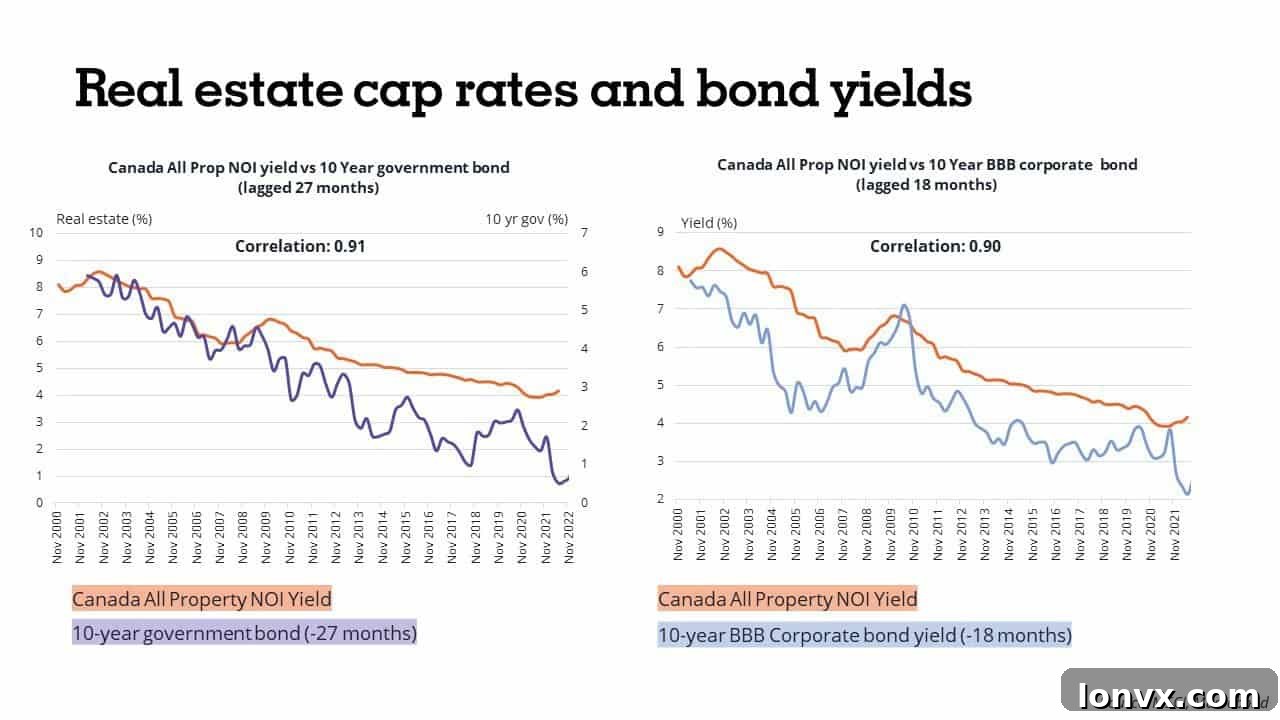
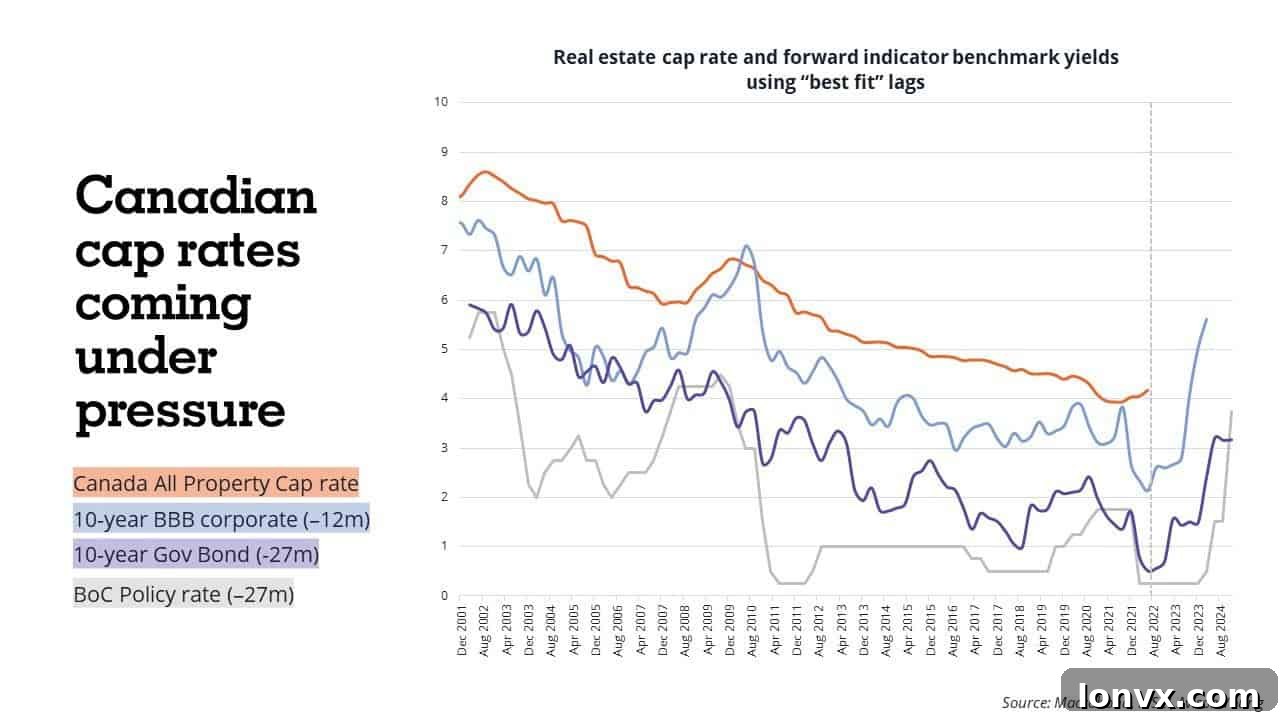
The prevailing high-interest rate environment inevitably translates into persistent upward pressure on finance costs for both businesses and individual consumers. This dynamic directly impacts the real estate sector, where key bond yields serve as fundamental benchmarks for property pricing and investment decisions. Our comprehensive analysis consistently highlights a strong and discernible correlation between real estate capitalization rates (cap rates), long-term government bonds, and BBB corporate bonds. This relationship is critical for understanding market movements, though it’s important to acknowledge a significant lag—typically one to two years—for bond market pricing fluctuations to be fully reflected and integrated into real estate valuations.
To contextualize this, ten-year government bond yields, which are primary indicators of long-term borrowing costs and broader investor expectations, have surged dramatically. They currently stand almost 300 basis points higher than their levels in 2020, having experienced a sharp and consistent ascent over the past 12 months. This substantial rise signals a fundamental recalibration of risk-free rates within the economy, influencing all other asset classes.
Furthermore, the equivalent BBB corporate bond yields, which broadly represent the credit quality and borrowing costs for the typical tenant mix found in high-quality commercial real estate portfolios, have seen an even more pronounced increase. These yields have climbed from approximately 2.5 per cent just a year ago to nearly six per cent today. Such a significant increase in corporate borrowing costs directly elevates the cost of capital for real estate investors and developers, raising their required hurdle rates for new projects and acquisitions.
The undeniable consequence of these escalating bond yields is that real estate yields, particularly cap rates, will come under increasing pressure in the months ahead. As the cost of capital rises and alternative investment opportunities (like bonds) offer higher, more competitive returns, investors will naturally demand commensurately higher returns from real estate assets. This market dynamic inevitably leads to an upward adjustment in cap rates and, conversely, exerts downward pressure on property valuations. This principle is a cornerstone of real estate finance, ensuring that property returns remain competitive relative to other investment avenues.
Current Real Estate Market Dynamics: A Period of Re-pricing and Strategic Opportunity
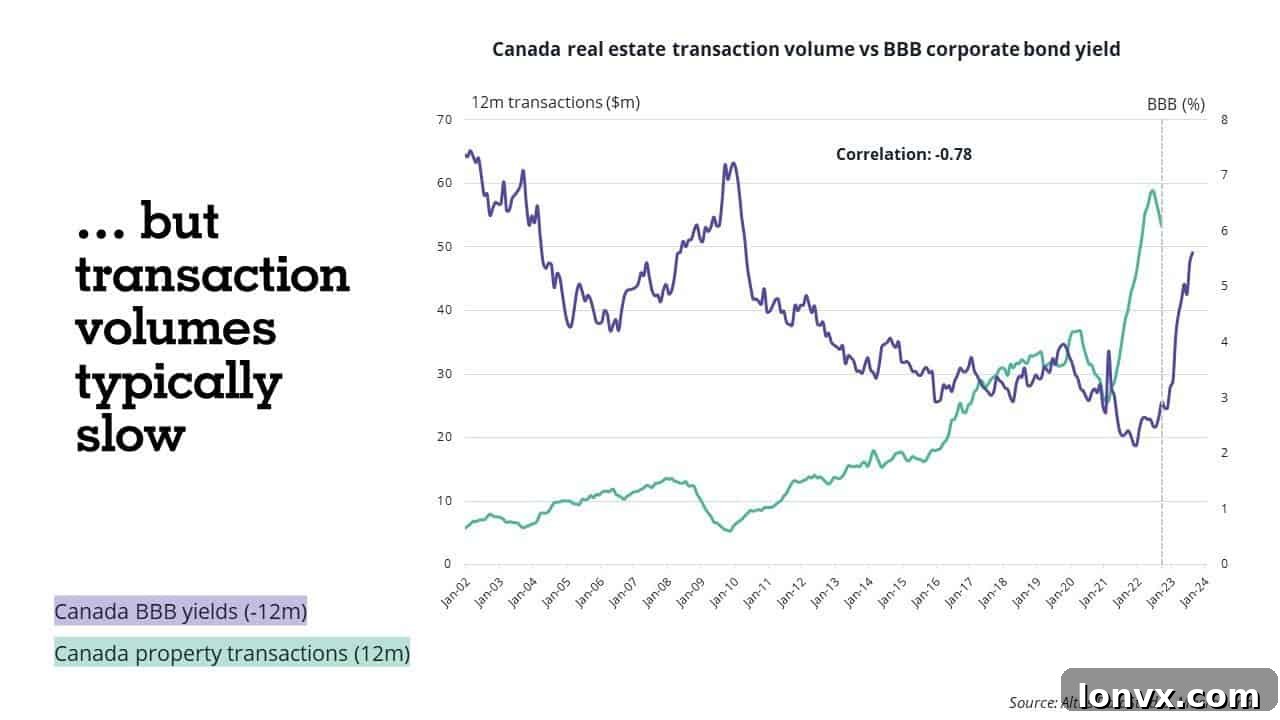
The cumulative pressures emanating from rising interest rates and elevated bond yields are already casting a palpable influence over the real estate market. A considerable segment of potential buyers has adopted a cautious “wait-and-see” approach, opting to remain on the sidelines in anticipation of a market repricing. These buyers are holding back, expecting property values to adjust downwards to align with the new economic realities of higher financing costs. Conversely, many property owners are currently demonstrating a reluctance to sell, facing a backdrop of softening demand and the prospect of achieving lower sale prices than they might have envisioned just a few months prior.
This inherent misalignment between buyer and seller expectations is an inevitable outcome, leading to a widening “bid-ask spread”—the differential between the price a buyer is willing to offer and the price a seller is prepared to accept. Such a dynamic typically translates into reduced transaction volumes, as fewer deals are able to successfully bridge this pricing gap. Simultaneously, capitalization rates across various asset classes are experiencing an upward trend, reflecting the market’s demand for higher returns to compensate for increased risk and financing costs. While these shifts are undeniably underway, it often takes a considerable amount of time for them to be fully captured and officially reflected in reported market data and transaction statistics, given the inherently less liquid nature of real estate compared to other financial markets.
Despite these prevailing headwinds, it is crucial to acknowledge that a substantial pool of capital remains actively poised to enter the market, contingent on attractive and appropriate pricing. Discerning investors, particularly those with a strong equity base and long-term horizons, are strategically positioned to capitalize on these evolving conditions. Top-quality, prime assets—characterized by strong locations, stable income streams, and high-credit tenants—are expected to continue commanding healthy demand. These core assets are projected to be least impacted by the broader repricing trend, as “pure-equity players” with significant cash reserves are prepared to leverage any perceived weakening in price. Their objective is to secure long-term value and stable returns, with less reliance on debt financing, making them more resilient to interest rate fluctuations.
Disproportionate Impacts on Secondary and Tertiary Real Estate Markets
The most significant and pronounced impacts on real estate valuations are expected to be observed within secondary and tertiary markets. Unlike prime, core assets in established urban centers, these markets are inherently more sensitive and vulnerable to broader economic shifts and changes in investor sentiment. Several converging factors are likely to contribute to considerable repricing pressure in these particular market segments:
- Weakening Occupier Demand: Economic slowdowns frequently result in reduced demand for commercial and residential space from tenants. This leads to higher vacancy rates and downward pressure on rents, particularly in less central or less desirable locations that characterize secondary and tertiary markets.
- Lower Investor Risk Appetite: During periods of economic uncertainty and monetary tightening, investors typically retreat from higher-risk propositions. Secondary and tertiary markets, by their very nature, are often perceived as carrying elevated risks compared to established primary markets, leading to a noticeable reduction in overall investment interest and capital deployment.
- More Restricted Availability and Higher Cost of Debt: Lenders tend to become more conservative and selective during economic tightening cycles. This means that securing financing for properties in secondary and tertiary markets can become substantially more challenging, and when available, the cost of that debt will be significantly higher, further eroding potential investment returns and viability.
- Elevated Construction Costs: Persistent high costs for construction materials and labor continue to impact new development and redevelopment projects across the board. In markets where rental growth is already constrained, these elevated input costs make new projects less financially viable and add considerable pressure to the valuations of existing assets.
Collectively, these factors create a challenging and complex operating environment for assets situated in secondary and tertiary markets, making them notably more susceptible to significant valuation adjustments compared to their more resilient prime counterparts.
Navigating Refinancing Challenges and the Limited Scope of Distressed Sales
The current landscape of elevated interest rates undeniably presents significant challenges for property owners approaching refinancing deadlines. Many will confront substantially increased debt service costs, which could exert considerable strain on cash flows and overall profitability, particularly for those who secured historically low rates during the preceding era of cheap money. However, it is crucial to temper expectations regarding the extent of potential distressed sales resulting directly from these challenges.
While some instances of distressed sales are certainly likely to emerge as market conditions adjust, our comprehensive analysis suggests that they will be limited in scope and are not indicative of a widespread market collapse. This assessment is primarily supported by the significantly improved lending standards and more prudent practices that have been implemented in this current economic cycle, particularly in the aftermath of the 2008 global financial crisis. Lenders have generally exercised greater caution, resulting in lower loan-to-value (LTV) ratios compared to the speculative build-up that preceded the financial crisis. This means that property owners typically possess a larger equity buffer within their assets, providing a stronger financial cushion against market fluctuations and potential economic headwinds.
Furthermore, the underlying health of the real economy, coupled with the anticipation of only a moderate recession, plays a pivotal role in mitigating widespread distress. The vast majority of tenanted assets across Canada are expected to remain income-producing, generating essential cash flow that can cover debt obligations, even if at potentially reduced margins. In such a scenario, most lenders are highly unlikely to force a sale into a weak or declining market, even in the event of a technical breach of loan covenants (e.g., a temporary dip in debt service coverage ratios). Lenders typically prefer to collaborate with borrowers to restructure debt or provide temporary relief, recognizing that compelling a sale in a depressed market often results in greater losses for all parties involved, including the lender.
The New Normal: Beyond the Era of Cheap Money
As we cast our gaze towards the future, while we fully expect interest rates to moderate and eventually stabilize as inflationary pressures subside, it is imperative to temper any expectations of a rapid return to the “era of cheap money” that characterized the decade leading up to the COVID-19 pandemic. The period of ultra-low, near-zero interest rates was an anomaly, largely driven by specific post-2008 financial crisis conditions and a prolonged environment of suppressed inflation. The ongoing transition towards more “normal” interest rates—reflecting a healthier, more balanced cost of capital—represents a fundamental and enduring shift that will redefine economic and investment strategies for many years to come.
This significant transition to a higher interest rate environment will undoubtedly create some turbulence and necessitate adjustments across various sectors and among market participants over the next year. However, it is precisely within such periods of economic recalibration and market repricing that significant opportunities often emerge for those investors who possess foresight, strategic acumen, and the boldness to act decisively at the opportune moment. For astute investors, understanding these profound shifts and identifying intrinsic value in a repriced market will be the definitive key to achieving long-term success and resilience within Canada’s evolving economic landscape.