Exploring Charleston’s Enduring Architectural Charms: Single Houses, Piazzas, and Earthquake Bolts
A journey to Charleston, South Carolina, transcends a mere vacation; it’s an immersive experience into a city where history is etched into every streetscape and every façade. Here, the architectural lexicon is uniquely rich, distinguishing itself from typical real estate terminology found elsewhere. Phrases such as “earthquake bolts,” “piazzas,” “single houses,” and the mystical shade of “haint blue” are as fundamental to Charleston’s identity as palm trees are to its skyline. These terms aren’t just local slang; they are keys to understanding the city’s remarkable past, its resilience, and the ingenious adaptations that define its iconic homes.
The city’s allure is undeniable, woven into the fabric of its pastel-hued homes. These graceful residences are nestled along streets shaded by ancient live oak trees, their branches draped in Spanish moss, creating an ethereal canopy. Many properties boast meticulously tended gardens, elaborate wrought-iron gates that are works of art in themselves, and the soft, perpetual glow of gas lamps. Lit twenty-four hours a day, these lamps cast an enchanting, warm ambiance, particularly as dusk settles, transforming the historic district into a scene from a bygone era. This timeless beauty makes Charleston a living museum, where architectural heritage is not just preserved but celebrated as an integral part of daily life.
The desirability of these historic properties is reflected in the vibrant Charleston real estate market. A stroll down Broad Street, for instance, offers a glimpse into this enduring appeal. Stephen Rosling of the Old South Carriage Company famously describes this historic artery as the socio-economic dividing line between “the haves” and “the-have-a-whole-lot-mores.” The profound charm and historical gravitas of these homes stem not only from their aesthetic grandeur but also from the unique architectural solutions and stories they embody, making them highly coveted and deeply cherished.
It is precisely these unusual, often curious, architectural elements that consistently captivate first-time visitors and are thoughtfully highlighted in guided tours across the city – whether experienced on foot, by comfortable bus, or via the charming clatter of horse-drawn carriages. These tours invariably spotlight several standout features that set Charlestonian dwellings apart from any other architectural landscape in the world. Among the most frequently noted and historically significant are the ‘single house’ design, the inviting ‘piazzas’ often adorned with ‘haint blue’ ceilings, and the robust ‘earthquake bolts’—each telling a fascinating tale of adaptation, culture, and resilience.
The Ingenious Charleston Single House: A Legacy of Urban Adaptation

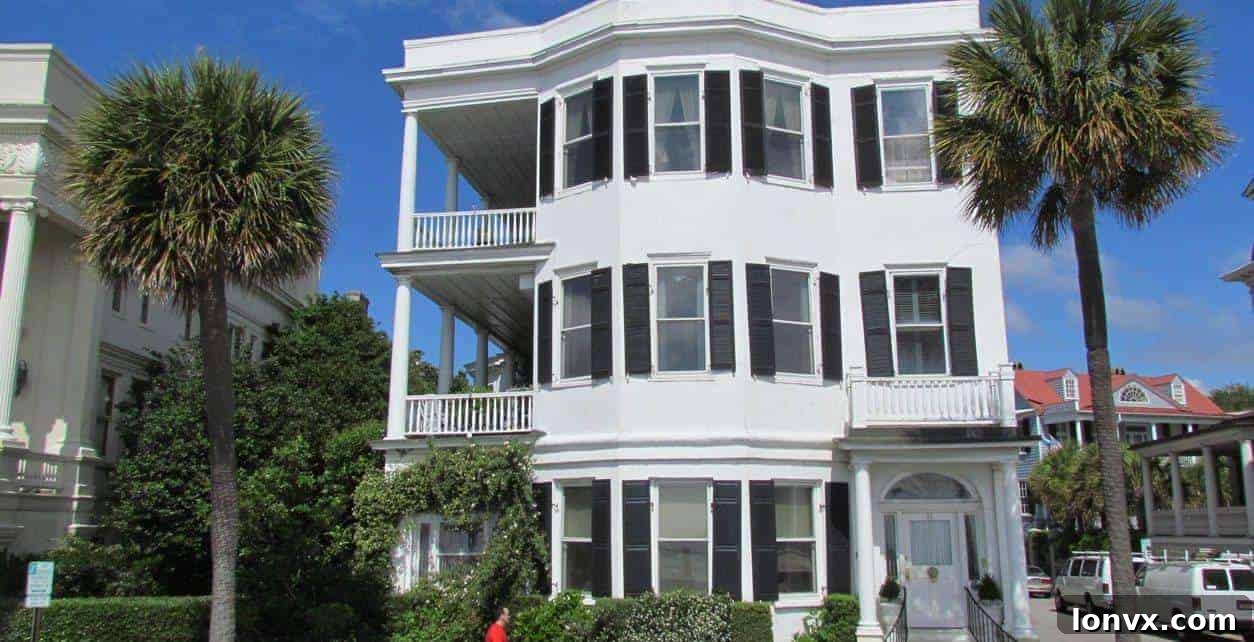
A quintessential “single house” in Charleston, demonstrating its unique sideways orientation and the welcoming expanse of its piazza. (Photo by Diane Slawych)
While the architectural styles of Charleston’s single houses encompass a broad range—from the dignified Georgian and refined Federal to the majestic Greek Revival—their defining characteristic lies in their innovative footprint. Unlike traditional homes that face the street directly, a single house is oriented sideways on its lot, presenting only its narrow end to the public thoroughfare. This clever configuration allows for the integration of beautiful, long, covered verandahs, universally known in Charleston as ‘piazzas,’ which stretch along the side of the house.
The designation “single house” literally refers to its width: historically, these homes were designed to be a single room deep on the street-facing side. This contrasts with the “double house,” which would be two rooms deep, a less common but still present style. This unique architectural solution dates back to the city’s nascent years in the late 17th century, specifically the 1680s, when it was known as Charles Town. As a burgeoning port city, land was a precious commodity. Early urban planners and builders sought efficient designs that maximized residential density while providing comfortable and elegant living conditions amidst the challenging climate of the humid Lowcountry.
Situating the home lengthwise on its plot offered several ingenious advantages for both urban development and homeowner comfort. Firstly, it allowed for a greater number of lots to benefit from valuable street frontage, crucial for property value and access in a bustling city. Secondly, and perhaps most vitally for residents, the piazzas were almost exclusively constructed on the south or west sides of the house. This strategic positioning offered crucial protection from the intense, often relentless, late afternoon sun, which could otherwise render interiors insufferably hot. Concurrently, these open-air living spaces were perfectly aligned to capture and channel the refreshing southerly breezes, creating natural cross-ventilation that provided much-needed relief long before the advent of modern air conditioning. These expansive piazzas thus evolved into essential outdoor living rooms, serving as primary spaces for families to gather, dine, and socialize during Charleston’s extended warm seasons.
Another distinctive feature of the single house configuration is its unique relationship with outdoor space. Instead of a traditional backyard directly behind the house, these homes typically feature a side yard, often transformed into a lush, private garden retreat. The door that directly faces the street, historically referred to as a “privacy door,” does not lead immediately into the main residence but rather opens onto the piazza. The true front entrance to the home is located along the side, accessible from the piazza itself. This design created a deliberate and elegant transition from the public street realm to the private, intimate living spaces of the home.
Stephen Rosling vividly recounts the intricate social etiquette associated with this design: “If you wanted to show someone you were welcoming guests, sit out on your piazza, open the privacy door. That’s a sign of wealth. Come on, I’d love to share a drink with you, talk about the issues of the day.” Conversely, if the privacy door remained closed, it served as an unmistakable signal of the homeowners’ desire for privacy. In such cases, one would respectfully refrain from intruding or even peeking around the corner. This subtle yet powerful architectural cue speaks volumes about the refined social customs and inherent respect for privacy that characterized historic Charlestonian society.
The Mystique of Piazzas and the Enchanting Haint Blue Ceilings
The piazzas, central to the single house design, are far more than mere covered porches; they are iconic outdoor rooms that have fundamentally shaped Charleston’s social life, climate adaptation, and architectural identity for centuries. But beyond their structural beauty and functional design, many of these piazza ceilings harbor a secret—they are painted in a distinctive, ethereal color known as “haint blue.”
This captivating tradition traces its origins to the local Gullah people, who are direct descendants of enslaved Africans residing in the Lowcountry regions of South Carolina and Georgia. Central to Gullah folk beliefs was the concept of “haints”—restless spirits or ghosts that could cause mischief or illness. It was a deeply held conviction that painting the porch ceilings a specific shade of light blue, often a milky robin’s egg or sky blue, would effectively deter these spirits from entering the home. The belief typically stemmed from the idea that haints either couldn’t cross water (and the blue color visually mimicked water) or that they would mistake the ceiling for the boundless sky and simply fly straight through, unable to locate an entrance. This enduring practice is a powerful testament to the rich cultural heritage, spiritual resilience, and folk traditions of the Gullah community, which profoundly influenced Lowcountry life and aesthetics.
While its spiritual purpose holds significant meaning for many, “haint blue” has also unexpectedly acquired a practical application in modern times. As guide Bill Stanton of Lowcountry Walking Tours keenly observes, “We’re now finding that birds, wasps, and spiders will not nest in something that is painted that color.” The precise scientific explanation for this natural deterrent effect remains a subject of fascinating debate among naturalists and historians. Theories range from the color mimicking the sky, thereby disorienting insects and birds, to the possibility that the lye historically used in traditional milk paints (which could produce this blue hue) acted as a natural repellent. Regardless of the exact scientific rationale, homeowners continue to embrace haint blue, appreciating its aesthetic charm, its historical resonance, and its unexpected practical benefits, making it an indispensable part of Charleston’s enchanting streetscapes and a symbol of its adaptive living.
Earthquake Bolts: Resilient Guardians of Charleston’s Historic Homes

An exterior view of a historic Charleston home prominently featuring decorative earthquake bolts, often shaped as stars or other intricate designs, a visible testament to the city’s structural resilience and architectural history.
Among the most intriguing and historically significant features adorning many of Charleston’s venerable homes are the prominent “earthquake bolts.” These are not merely decorative elements but serve as profound physical reminders of one of the most catastrophic natural disasters in the city’s long and storied history: the Great Charleston Earthquake of 1886.
On the evening of August 31, 1886, Charleston was struck by a devastating seismic event, estimated to be between 6.9 and 7.3 on the Richter scale, making it one of the largest earthquakes to ever hit the eastern United States. The tremor caused widespread devastation, damaging approximately 2,000 buildings across the city, leading to significant structural collapse, and tragically, many fatalities. In the harrowing aftermath of this disaster, a monumental and concerted effort to rebuild and, more importantly, reinforce the city’s damaged structures began. The implementation of earthquake bolts became a crucial and innovative part of this extensive retrofitting process, designed to prevent future catastrophic failures.
These essential structural reinforcements consist of long, robust iron rods that are expertly threaded horizontally or diagonally through the interior brick walls of a building. On the exterior, these rods are securely capped at both ends by a distinctive “gib plate” (also known as a star bolt or wall anchor). These plates are typically large, flat pieces of metal, often showcasing a variety of shapes such as circular discs, S-shapes, X-shapes, or even intricately designed with decorative elements like lion’s heads, floral motifs, or stars. The rods are designed to be regularly tightened or “cranked” to maintain precise tension, effectively pulling the walls inward and outward to counteract structural instability, straighten leaning walls, and significantly enhance the overall lateral stability of the building. The analogy often used is that they perform for houses what braces do for teeth, providing essential structural support and precise alignment that has allowed these historic homes to stand for well over a century.
The visible presence of earthquake bolts is, therefore, a highly reliable indicator of a building’s age and its journey through Charleston’s tumultuous history. As Stephen Rosling astutely points out, “If the structure has earthquake bolts it’s from 1886 or older, 99 percent of the time.” These enduring anchors are a powerful testament to the city’s remarkable resilience and its unwavering determination to preserve its architectural treasures in the face of formidable natural forces. They symbolize a practical, robust, and enduring engineering solution to a profound existential challenge, showcasing a deep commitment to architectural preservation and safety.
However, the deep allure of historical authenticity in Charleston occasionally leads to interesting imitations. Rosling adds a humorous and insightful caveat: “One percent of the time you get people with newer structures who want you to think their building is more historic than it really is. They put fake earthquake bolts on their building.” This amusing detail brilliantly underscores the deep cultural value placed on history and original architecture in Charleston. Irony aside, it’s quite a testament to the pervasive cultural cachet and cherished status of these structural reinforcements that even newly constructed properties might seek to emulate their antique charm. Amusingly, one of the few structures adorned with these cleverly placed fake bolts happens to be the very office of the Old South Carriage Company – Rosling’s own employer, highlighting the widespread and enduring appreciation for Charleston’s unique historical markers and architectural narrative.
Charleston’s Enduring Legacy: A Symphony of History, Culture, and Design
The distinctive architectural vocabulary of Charleston – encompassing the innovative ‘single house’ design, the inviting ‘piazzas’ with their mystical ‘haint blue’ ceilings, and the resilient ‘earthquake bolts’ – collectively paints a vibrant and multifaceted portrait of a city that has masterfully blended practicality with profound beauty and deep cultural significance. Each unique feature is not just an aesthetic detail but a vital chapter in Charleston’s ongoing story, reflecting its historical challenges, its unique climate, its rich and diverse cultural influences, and its unwavering commitment to the preservation of its unparalleled heritage.
These architectural gems are more than mere buildings; they are living testaments to the ingenuity, resilience, and artistic vision of past generations. They stand as a source of endless fascination for both residents and visitors alike. To walk through Charleston’s storied historic district is to embark on a captivating journey through time, where every intricate detail, from a subtly painted ceiling to a robust iron anchor, whispers tales of the past. These homes and their unique features invite us to delve deeper into the intricate tapestry of history, innovative design, and cherished tradition that collectively makes Charleston, South Carolina, a truly extraordinary and unforgettable place to explore.