
Don’t miss out—join us online for REM’s monthly market breakdown on May 27 at 2 PM ET. REM columnist Daniel Foch will analyze CREA’s latest stats, regional variations and what shifting sentiment means for Realtors. Register here.
Navigating Canada’s Divergent Housing Market: A Regional Breakdown
In a real estate landscape as vast and varied as Canada’s, national averages often obscure more than they illuminate. The Canadian Real Estate Association (CREA) April 2025 data serves as a compelling reminder of a truth already well-known by many real estate professionals on the ground: the performance of Canada’s housing market is intrinsically tied to its geographical location. Far from a monolithic entity, the nation’s housing market is increasingly characterized by stark regional contrasts, presenting both unique challenges and opportunities across provinces.
While the country grapples with overarching economic factors, the lived experience of homeowners, buyers, and sellers differs dramatically. In provinces like Ontario and British Columbia, once the undisputed titans of Canadian real estate, prices are softening, property listings are on the rise, and prospective buyers are approaching the market with palpable caution. Conversely, regions spanning Alberta, Quebec, and much of Atlantic Canada paint a remarkably different picture, showcasing more stable prices, sustained demand, and persistently tight inventory levels.
This evolving dynamic appears to be more than a fleeting fluctuation; it signals a deeper structural shift driven by an intricate interplay of fundamental economic and social forces. These include, but are not limited to, household indebtedness, evolving migration patterns, critical policy decisions, widening affordability gaps, and the varying economic resilience of different provincial economies. To truly grasp the trajectory of Canada’s housing market, one must move beyond generalized national figures and instead scrutinize the distinct realities unfolding on the regional map.
Softness Turns into Stagnation in British Columbia and Ontario
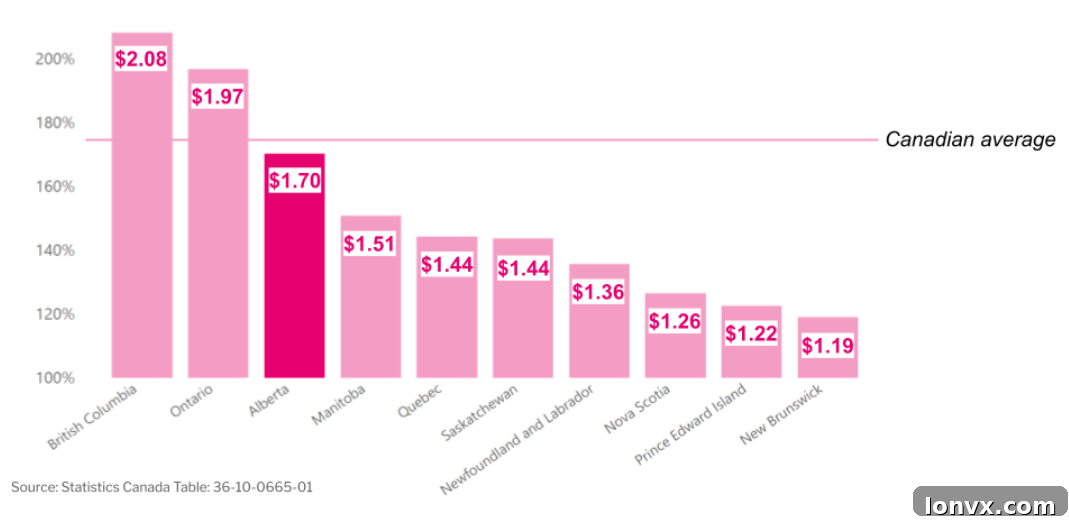
Ontario and British Columbia have long held the distinction of being the most expensive provinces for homeownership in Canada. This elevated cost of entry has historically compelled buyers to assume increasingly larger mortgages, leading to outsized debt-to-income ratios that render these regions particularly vulnerable. It is no coincidence that these are precisely the areas most acutely impacted by rising interest rates, inflationary pressures, and recent shifts in employment levels.
The prolonged period of low interest rates fuelled a significant appreciation in property values, making homeownership in these provinces a formidable financial undertaking. As borrowing costs have climbed and economic uncertainty has lingered, the cumulative effect of high debt burdens and reduced purchasing power has begun to manifest as a tangible drag on market activity. What was initially perceived as a period of market “softness” is now showing signs of evolving into more prolonged stagnation, as buyers recalibrate their expectations and financial capabilities.
Canadian Household Credit Debt to Disposable Income
Home Prices Continue to Drift Downward
The provinces that traditionally anchored and propelled the national real estate market are now exhibiting a downward pull. Their cooling trends significantly influence the overall Canadian average, demonstrating a clear shift in market leadership.
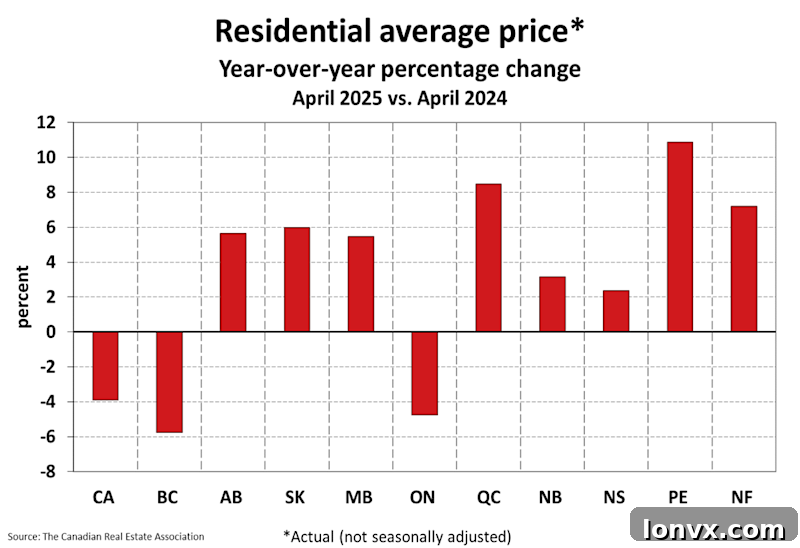
According to CREA’s comprehensive April 2025 report, the year-over-year performance in these key markets tells a clear story of price depreciation:
- Ontario experienced a price decline of 4.8 per cent year-over-year.
- British Columbia saw its home prices decrease by 5.8 per cent year-over-year.
- Reflecting these provincial trends, the national average price dropped by 3.9 per cent year-over-year.
These declines are not indicative of a panic-driven market collapse, but rather a persistent and increasingly undeniable retreat. The market in these regions is not crashing but is instead quietly and cautiously unwinding, as sellers adjust to new realities and buyers hold their ground.
Buyer Confidence Has Not Recovered
Despite recent periods of interest rate stability, buyer psychology in Ontario and British Columbia remains fragile. CREA highlights that evolving economic uncertainties, including concerns related to international trade tariffs, have emerged as additional factors suppressing demand. In these typically overheated markets, buyers are no longer merely deterred by the sheer cost of homeownership but by a pervasive sense of caution and a “wait and see” attitude. This prudence stems from a combination of economic apprehension and the belief that prices may yet fall further. Many potential purchasers are actively choosing to postpone their buying decisions, and history demonstrates that when confidence falters, price erosion typically follows.
Atlantic Canada and the Prairies: Quiet Strength in the Margins
The narrative shifts dramatically when examining other parts of Canada. Far from the softening conditions of the major urban centers, much of Atlantic Canada and the Prairie provinces are demonstrating robust and sustainable market strength. These regions, often considered “secondary markets” in national real estate discussions, are now stepping into the spotlight with steady growth and strong underlying fundamentals.
Consistent Price Growth in Emerging Markets
As of April 2025, year-over-year price growth in these regions underscores their resilience and increasing appeal:
- Prince Edward Island: A significant increase of +10.9 per cent.
- Quebec: Solid growth at +8.5 per cent.
- Newfoundland & Labrador: A healthy rise of +7.2 per cent.
- Alberta: Strong performance with +5.6 per cent.
- Saskatchewan: Steady appreciation at +6.0 per cent.
- Manitoba: Consistent growth of +5.5 per cent.
These impressive figures are a direct reflection of enduring affordability, consistent buyer demand, and tightly constrained housing inventory. Unlike the speculative surges seen in the major urban centers from 2020–2022, these markets experienced more measured appreciation, meaning there is less “froth” to dissipate. Their growth is rooted in more sustainable factors, making them attractive to both local buyers and those seeking more accessible homeownership opportunities.
Inventory Remains Tight Outside the Big Two
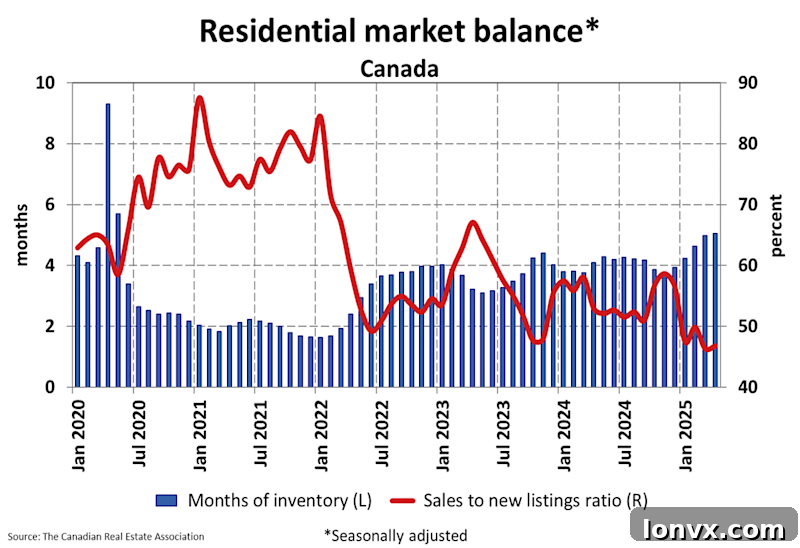
CREA reported that the national sales-to-new listings ratio edged up slightly to 46.8 per cent, sitting just below the long-term average of 54.9 per cent, suggesting a relatively balanced national market. Furthermore, there were 5.1 months of inventory across Canada, a level generally consistent with equilibrium between supply and demand.
However, these national aggregates mask profound regional divergences. While active listings surged by 14.3 per cent year-over-year, reaching approximately 183,000 homes, the bulk of this inventory increase is concentrated within Ontario and British Columbia. In these provinces, demand has cooled considerably, resulting in properties spending longer periods on the market. In stark contrast, inventory levels in provinces such as Alberta, Quebec, and many parts of Atlantic Canada remain notably tight. This scarcity continues to fuel competitive conditions, supports multiple-offer scenarios, and exerts sustained upward pressure on prices.
In many of these tighter markets, homes are still selling briskly, often flying under the radar of national headlines. The perceived “balance” at the national level is, in reality, a complex mosaic of robust sellers’ markets in certain regions and increasingly challenging buyers’ markets in others.
What’s Driving Canada’s Two-Speed Housing Market?
Understanding the fundamental forces behind this geographic divergence is crucial for grasping the future trajectory of Canadian real estate. Several interconnected factors are shaping these distinct market realities.
Ontario and British Columbia: Demand Drains and Economic Drag
Interprovincial migration patterns are playing a significant role in reshaping housing demand. According to BMO Economics, Ontario experienced a net loss of over 32,000 people to other provinces in 2024, marking its largest outflow on record. British Columbia followed a similar trend, losing almost 10,000 residents. While migration is not the sole determinant, such substantial population shifts undoubtedly contribute to softer housing demand in what were once Canada’s most expensive and consistently high-growth markets.
Beyond migration, economic confidence has also suffered. Ontario’s economy, with its significant manufacturing base, remains exposed to U.S. trade tensions, including the persistent threat of tariffs on Canadian steel and other goods, which can impact employment and investment. In British Columbia, factors such as stagnant wage growth, elevated household debt loads, and a waning interest from both domestic and international investors are compounding buyer reluctance. The combination of these internal and external economic pressures creates a challenging environment for its housing sector.
Alberta, Quebec, and Other Provinces: Growth Anchored in Migration and Affordability
In stark contrast, Alberta emerged as the primary beneficiary of interprovincial migration in 2024, gaining almost 53,000 new residents – the highest in Canada. Quebec and various Atlantic provinces also recorded steady population increases, with a notable proportion of these newcomers originating from Ontario and British Columbia. These significant inflows are directly influencing housing demand, injecting new life and competition into these regional markets.
Crucially, these markets maintain a relative advantage in affordability. Lower average home prices allow buyers to absorb the impact of higher interest rates more comfortably, making homeownership a more attainable goal. With more accessible entry points, demand remains robust and active, translating into sustained price growth across much of the Prairies and Atlantic Canada. This “affordability advantage” acts as a powerful magnet, drawing both individual homebuyers and investors seeking better value and potential returns.
What Realtors Should Be Telling Their Buyers and Sellers
Given the deeply fragmented nature of the Canadian housing market, real estate professionals must equip their clients with highly localized, nuanced advice. A “one-size-fits-all” approach is no longer effective.
For Buyers: Conditions Vary Sharply by Region
If you are actively house hunting in Ontario or British Columbia, you are entering a market that has definitively cooled. Prices have softened year-over-year, inventory is steadily building, and buyer competition is noticeably thinner. Furthermore, a wave of upcoming mortgage renewals could put additional pressure on some sellers, potentially opening up more negotiation room. This period represents a strategic window for buyers to negotiate firmly, particularly for properties that have been lingering on the market.
Conversely, in provinces like Alberta, Quebec, and Prince Edward Island, the market dynamic shifts dramatically. Prices are still on an upward trajectory, and sales-to-new listings ratios firmly indicate a robust seller’s market. With affordability still largely intact and an anticipated continued rise in demand due to migration, delaying a purchase in these regions could mean facing higher prices and more intense competition in the future. Buyers here should act decisively but always with thorough due diligence.
For Sellers: Know Your Local Conditions
In Ontario and British Columbia, accurately pricing your home is paramount. Overpricing in a softening market is a direct route to stale listings, extended days on market, and potentially multiple price reductions. Effective presentation, including professional staging and high-quality photography, meticulous pricing aligned with current market comparables, and a degree of patience are all critical success factors. Sellers here must be prepared for more discerning buyers and potentially fewer offers.
In more active markets such as Alberta, Quebec, and parts of Atlantic Canada, sellers generally still retain significant negotiating power. However, it’s essential to recognize that even in strong markets, today’s buyers are more rate-sensitive and financially prudent than in the frothy years of the past. Realistic pricing, strong marketing, and flexibility can still lead to swift and favourable outcomes.
A word of caution, particularly for Alberta: while it has become the new darling of interprovincial capital, attracting significant investment from Ontario and B.C. buyers seeking better affordability and rental yields, this momentum carries inherent risks. As investment flows and demand intensifies, the potential for overheating grows. Early indicators, such as price-to-income and debt-to-income ratios in key urban centers like Calgary and Edmonton, are beginning to mirror those of the very provinces investors and homebuyers are fleeing. Should market fundamentals erode under the weight of speculative demand, Alberta could find itself retracing a familiar cycle of boom, overleverage, and subsequent correction. This serves as a vital reminder that no market is entirely immune to economic principles, and even strong affordability can be fleeting when an excessive amount of capital chases too few available homes.
The Bottom Line: One Country, Two Distinct Markets
The conversation surrounding the Canadian housing market can no longer be simplified into a binary of “hot” or “cold.” Instead, it requires acknowledging entirely different economic and psychological climates operating simultaneously across the nation. In some regions, the primary challenge is effectively absorbing and managing robust buyer demand, often complicated by limited supply. In others, the focus is squarely on mitigating financial risk, navigating price corrections, and restoring buyer confidence.
What we are witnessing is a profound geographic divergence, meticulously shaped by underlying economic fundamentals, evolving demographic shifts, and significant shifts in consumer psychology. This is not a temporary anomaly but rather the inception of a more permanent, multi-speed real estate landscape in Canada. As such, the next time a headline boldly declares the state of “the Canadian housing market,” it behooves every stakeholder – from policymakers to first-time homebuyers – to ask a crucial, clarifying question:
Which Canada are they talking about?
Because in 2025 and beyond, understanding that critical distinction will be the fundamental difference between making a sound, informed decision and embarking on a potentially risky venture in Canadian real estate.