
Amid a period marked by significant interest rate hikes, persistent inflationary pressures, and a constantly evolving economic landscape, the Canadian real estate market presents a complex picture for prospective homebuyers. While much attention has been paid to the detached and condominium segments, the affordability of townhomes has emerged as a crucial narrative, offering a unique perspective on the nation’s housing dynamics.
The notion of “affordability” itself has become highly regionalized. Some markets, like Calgary, continue to exhibit robust activity and remain relatively accessible, drawing in inter-provincial migration. In stark contrast, other major hubs, such as Toronto, have faced steeper challenges, with some projections even suggesting a potential downturn towards multi-decade lows in specific segments. This divergence underscores the fragmented nature of Canada’s housing story.
A recent comprehensive report by Zoocasa sheds critical light on this intricate subject. The study meticulously analyzes townhome affordability across various Canadian markets, offering a valuable comparison of current down payment requirements versus those from five years ago. This data-driven approach allows for a clearer understanding of how rapidly — or slowly — access to homeownership has changed within this particular housing type.
Home Price Corrections and Market Opportunities: What the Dip Means for Townhome Buyers
The broader Canadian housing market has recently experienced a notable adjustment, with overall home prices dipping by approximately 1.2 percent month-over-month, settling just above the $740,000 mark. While this decline is a welcome sign for many, it’s important to contextualize that these prices haven’t yet returned to the lower levels observed in 2018. The intervening years witnessed unprecedented price surges and mounting affordability issues across many Canadian cities, making homeownership an increasingly distant dream for a significant portion of the population.
This recent price correction, however modest, could signal a turning point. For the multitude of interested buyers who have been patiently waiting on the sidelines, often priced out by bidding wars and rapidly escalating values, this dip potentially opens up critical market opportunities. It could alleviate some of the competitive pressures, allowing for more thoughtful decision-making and potentially more favorable purchasing conditions. The stability offered by townhomes, often bridging the gap between high-rise living and detached homes, makes them particularly attractive in such a scenario. They typically offer more space and privacy than a condo, often with a small yard or garage, without the full maintenance responsibilities or higher price tag of a detached property, making them an ideal choice for families and first-time buyers alike.
Understanding the Interplay of Interest Rates and Affordability
While a drop in home prices is a positive development, its impact on overall affordability must be considered alongside the current interest rate environment. Higher interest rates directly translate to increased borrowing costs, meaning that even with a slightly lower purchase price, the monthly mortgage payments might remain substantial. This creates a delicate balance for buyers, where lower prices might be offset by higher financing expenses. The ‘stress test’ implemented by Canadian regulators further compounds this, requiring buyers to qualify at a higher theoretical interest rate, thus reducing their maximum borrowing capacity. Therefore, even as prices cool, the financial barrier to entry for many remains significant, particularly for those eyeing townhomes in desirable urban centers where demand continues to outstrip supply.
A Kaleidoscope of Price Growth: Navigating Canada’s Diverse Townhome Markets
The Zoocasa report emphatically highlights the vast disparity in townhome price growth across the country, painting a diverse picture rather than a uniform trend. While a national average might suggest a general direction, the reality on the ground is far more nuanced, with localized economic conditions, population shifts, and housing supply dynamics playing pivotal roles in shaping individual market trajectories.
The analysis revealed that most of the markets surveyed experienced required townhome down payment increases of less than $20,000 over the past five years. A more encouraging trend was observed in six specific markets, where the increase in down payment requirements was remarkably modest, falling below the $5,000 threshold. These areas often benefit from more balanced supply-demand dynamics, lower population growth, or more diversified local economies that don’t solely rely on the red-hot housing sector.
However, this stability was not universal. One market stood out dramatically, registering an increase in down payment requirements exceeding an astonishing $160,000. This stark contrast underscores the extreme pressures faced in Canada’s most coveted and supply-constrained urban centers, where the quest for even a townhome can entail a monumental financial commitment. Understanding these regional discrepancies is paramount for any prospective buyer attempting to navigate Canada’s intricate housing landscape.
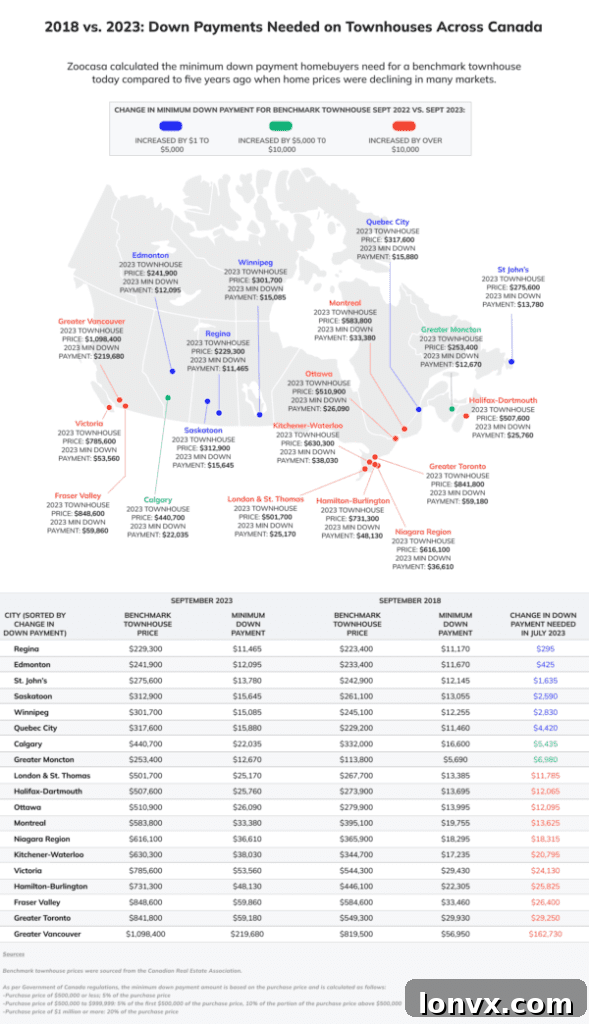
Source: Zoocasa, illustrating the varying increases in minimum down payment requirements for townhomes across Canadian cities between 2018 and the present.
Regional Snapshots: From Modest Shifts to Multi-Six-Digit Spikes in Down Payments
Delving deeper into the regional data reveals fascinating insights into how different Canadian cities have fared in terms of townhome affordability. The spectrum of change in down payment requirements is remarkably wide, reflecting distinct local economic conditions, population growth patterns, and housing supply levels.
Markets with Minimal Down Payment Changes: Opportunities for Stability
On one end of the spectrum, Edmonton and Regina emerged as beacons of relative stability. These two provincial capitals were the only cities to report required down payment boosts of less than $1,000 over the five-year period, specifically $425 for Edmonton and an even more modest $295 for Regina. This minimal change suggests a more balanced and perhaps less volatile housing market compared to their larger counterparts.
Edmonton’s market, often characterized by its robust energy sector and more abundant land for development, has historically offered greater affordability. Similarly, Regina’s steady economic base and more manageable population growth have contributed to a more stable housing environment. For first-time homebuyers or those looking to maximize their purchasing power, these cities present compelling opportunities, allowing for a more accessible entry into the townhome market without the intense financial strain seen elsewhere.
The Epicenter of Unaffordability: Greater Vancouver’s Significant Leap
At the other extreme lies Greater Vancouver, the undisputed outlier in the report. This highly sought-after metropolitan area witnessed an astronomical jump in required townhome down payments. The current minimum down payment stands at a staggering $219,680, representing a colossal increase of $162,730 over the past five years. This dramatic surge firmly places Vancouver at the forefront of Canada’s most challenging real estate markets.
The primary driver behind this steep climb is multifaceted. Greater Vancouver’s perennial challenges include extremely limited developable land, high demand fueled by both inter-provincial and international migration, and its status as a global financial hub. Critically, the province’s stringent 20 percent down payment requirement on homes priced over $1 million significantly impacts the townhome segment, pushing the entry barrier to unprecedented heights. Many townhomes in desirable Vancouver neighborhoods now easily surpass the $1 million threshold, automatically triggering this higher down payment rule, which in turn necessitates substantial personal savings. This makes homeownership in Greater Vancouver a distant dream for many, often requiring generational wealth or exceptionally high incomes.
Mid-Range Increases: Navigating Growth in Key Urban Corridors
Between these two extremes lie several major Canadian cities that have experienced substantial, though not catastrophic, increases in down payment requirements. These markets reflect the ongoing demand pressures and urban expansion seen across the country.
- Toronto: Canada’s largest city saw its required townhome down payment reach $59,180, marking a significant five-year jump of $29,250. Toronto’s continuous population growth, limited housing supply within the city core, and its role as a major economic engine contribute to these persistent affordability challenges. The city remains a highly competitive market, where townhomes are often seen as a more accessible alternative to detached homes, albeit still requiring substantial financial commitment.
- Fraser Valley: As a rapidly growing region directly adjacent to Greater Vancouver, the Fraser Valley has increasingly become a popular choice for those priced out of the core Vancouver market. Its townhome down payment now stands at $59,860, an increase of $26,400 since September 2018. This trend highlights the “spillover” effect, where demand and price pressures from major urban centers radiate outwards to surrounding communities.
- Victoria: The charming capital of British Columbia has also seen considerable growth, with down payments for townhomes reaching $53,560, an increase of $24,130 from five years ago. Victoria’s appeal as a lifestyle destination, combined with its island geography limiting new construction, continues to drive up housing costs, even for townhomes.
Beyond these, other important urban centers also demonstrated significant down payment increases, albeit just under the $50,000 threshold. Hamilton-Burlington, a burgeoning region within Ontario’s Golden Horseshoe, experienced a change of $25,825. Similarly, Kitchener-Waterloo, known for its thriving tech sector and proximity to Toronto, saw an increase of $20,795. These cities exemplify the broader trend of rising property values in communities that offer strong employment opportunities and a high quality of life, often attracting residents seeking alternatives to the more expensive primary urban centers.
The Mechanics of Down Payments: What Buyers Need to Know
Understanding how minimum down payment amounts are calculated is fundamental for any prospective homebuyer in Canada. These rules, set by the Canadian government and mortgage insurers, directly impact the amount of upfront capital required to purchase a property. The Zoocasa report utilized these standard guidelines:
- For homes priced at $500,000 or less, a minimum down payment of 5 percent of the purchase price is required.
- For homes priced between $500,001 and $999,999, the requirement is 5 percent on the first $500,000, and 10 percent on the portion of the price exceeding $500,000. This effectively means a blended rate for properties in this bracket.
- For homes priced at $1 million and over, a significantly higher minimum down payment of 20 percent of the entire purchase price is mandated.
These tiered requirements explain why the down payment jump in Greater Vancouver was so substantial. As townhomes in that region increasingly breach the $1 million mark, they automatically fall into the 20 percent category, demanding a significantly larger upfront investment compared to properties priced just under this threshold, which could still qualify for a lower blended rate. This structure aims to mitigate risk in higher-value transactions but also creates a significant hurdle for buyers in expensive markets.
The Future of Townhome Affordability in Canada
The Canadian townhome market is at a fascinating crossroads. While recent price dips offer a glimmer of hope, the pervasive influence of high interest rates, regional economic disparities, and underlying supply challenges continue to shape its trajectory. For buyers, the message is clear: thorough research into local market conditions is paramount. What constitutes “affordable” in Calgary may be vastly different from Toronto or Vancouver, and vice-versa.
Townhomes remain a vital component of Canada’s housing supply, offering a desirable middle-ground for many. As cities continue to grapple with housing shortages and the need for denser, yet family-friendly, housing options, the role of townhomes will only grow. Policy decisions regarding zoning, development, and support for first-time homebuyers will be critical in determining whether this segment can truly open up to a wider range of Canadians or if it will remain largely exclusive to those with significant financial backing. The ongoing evolution of work-from-home trends may also continue to redistribute demand, potentially boosting affordability in secondary markets while primary hubs remain competitive.
Ultimately, navigating Canada’s townhome market requires a strategic approach, a keen eye on regional trends, and a clear understanding of personal financial capacity. While challenges persist, opportunities for homeownership in the townhome segment still exist, albeit in a landscape that demands careful consideration and informed decision-making.