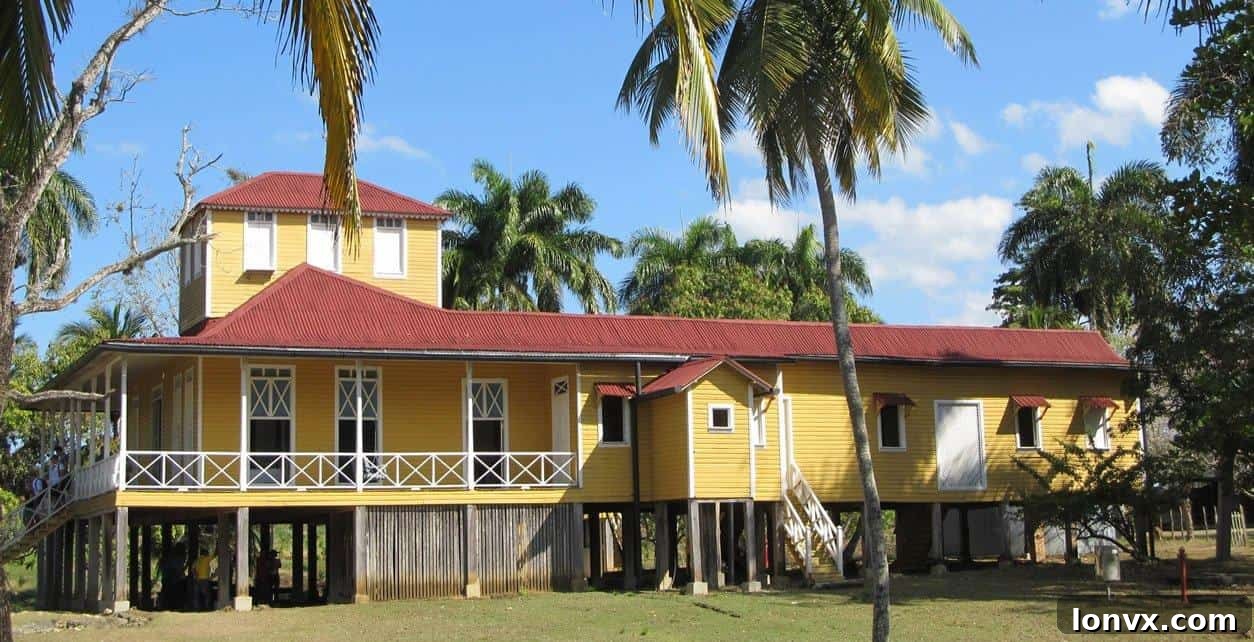
Fidel Castro, a figure of immense historical weight, commanded Cuba’s destiny for nearly five decades. Yet, despite his ubiquitous presence on the world stage, the exact whereabouts of his personal residence remained one of the communist leader’s most guarded secrets. Plagued by countless assassination attempts, many orchestrated by the CIA, Castro was compelled to frequently relocate, ensuring his safety through constant vigilance and an impenetrable veil of secrecy, a practice he maintained even into his retirement years.
However, in stark contrast to his adult life, the origins of this revolutionary leader are openly accessible. Fidel Castro’s formative years were spent on a sprawling 12,000-hectare farm and sugar plantation situated near the quaint village of Birán in Holguín Province, a picturesque region in eastern Cuba. While perhaps not as widely publicized as some of Cuba’s more conventional tourist destinations, this remarkable historical site was officially opened to the public in 2002, offering an unparalleled glimpse into the humble beginnings of one of the 20th century’s most iconic and controversial personalities.
Exploring Finca Las Manacas: The Castro Family Estate
The vast property, affectionately known as Finca las Manacas, was acquired by Fidel’s father, Angel Castro y Argiz, in 1915. Angel, a Spanish immigrant with a formidable entrepreneurial spirit, transformed the fertile land into a thriving agricultural enterprise. Here, he cultivated vast fields of sugarcane, a commodity central to Cuba’s economy, harvested timber from the dense forests, and raised a considerable herd of cattle. Strategically located, the estate once bordered a section of the historic Camino Real, or Royal Road, which served as Cuba’s primary east-west thoroughfare during the colonial era, facilitating trade and communication across the island.
So immense were these holdings that Finca las Manacas functioned akin to a self-contained community, a small village born out of Angel Castro’s ambition. Many of the original structures from that era remain remarkably preserved and are visible to visitors today. Near the entrance, several modest thatched huts stand as a poignant reminder of the living conditions of the mainly Haitian laborers who toiled on the plantation. Beyond these, the property boasts a traditional cockfighting ring, a popular Cuban pastime, alongside several vibrantly colored wooden buildings that once housed essential community services: a bustling post office, a welcoming guest house for visitors, and a general market store where daily necessities could be purchased. Visitors are also invited to peer inside the primary schoolhouse where Fidel Castro and other local children received their early education, offering a tangible connection to his boyhood. The family’s deep roots in Birán are further underscored by the presence of the cemetery on the estate grounds, where Angel Castro and Lina Ruz González, Fidel’s parents, are laid to rest.
Angel Castro: From Soldier to Landowner
Angel Castro’s journey to becoming a prominent Cuban landowner is a testament to resilience and ambition. He first arrived in Cuba from Galicia, Spain, as a young soldier in 1895, dispatched by the Spanish Crown to assist in quelling the burgeoning Cuban independence movement. Following the conflict, he returned to Spain, but the allure of the Caribbean island proved too strong, and he made the pivotal decision to return to Cuba four years later. With determination and shrewd business acumen, Angel steadily built his fortune, transforming himself from a former soldier into a prosperous, well-to-do landowner. It was during this period that he began a relationship with Lina Ruz González, a household servant significantly younger than himself, by 27 years. Their union, though unconventional for its time, was a loving one, and together they raised a large family, comprising three sons and four daughters. Fidel, who would later become the most famous of their children, was born before their marriage, which took place after his birth.
The Castro Homestead: A Glimpse into Fidel’s Birthplace
Undoubtedly, the centerpiece of any visit to Birán is the Castro homestead itself – a striking yellow wooden mansion elevated on tall stilts. This iconic structure served as the family’s primary residence and holds the profound distinction of being Fidel Castro’s birthplace. As visitors approach, they pass directly beneath the raised house, where a remarkable artifact from a bygone era is proudly displayed: Angel Castro’s 1918 Ford motorcar, a symbol of the family’s burgeoning prosperity and a fascinating glimpse into the automotive history of early 20th-century Cuba.
The dining room and living room of the home near Biran, Cuba where Fidel Castro and his younger brother Raul spent their childhood years.
The interior of the home offers a compelling journey back in time. Its spacious layout retains much of the original furnishings, meticulously preserved or authentically recreated to reflect the period. Visitors can explore several bedrooms, a comfortable living room, and a generous dining room, all of which are said to be remarkably authentic representations of a traditional Cuban campesino (peasant) household, albeit one of considerable means. The displays are thoughtfully curated, showcasing intimate family photographs that offer personal insights into the Castro clan. Among the more unique artifacts is a distinctive chair crafted from cowhide, which ingeniously doubled as a drum during lively local festivities, highlighting the family’s connection to Cuban cultural traditions. Also on display are Fidel’s crib and his childhood bedroom, where a simple sport shirt, bearing his name embossed on the back, hangs in a wardrobe, a poignant reminder of the boy who would one day alter the course of history.
Fidel’s sports shirt with his name on the back hangs in the wardrobe of his former bedroom in the home where he grew up.
Parental Quarters and a Family Anecdote
A particularly intriguing aspect of the homestead’s layout is the separate bedrooms maintained by Fidel’s parents, Angel and Lina, a common practice in many traditional households of the era. Angel’s room, thoughtfully preserved, contains his original bed, a grand mahogany wardrobe, and a table set with a game of dominos, suggesting a penchant for leisure. A striking photograph in the room captures a young Angel on his first trip to Cuba at the age of 20, dressed in his Spanish soldier’s uniform – a powerful visual link to his past. In one corner of the room, a heavily damaged safety deposit box stands as a silent witness to a family drama. Following her father’s passing, Fidel’s sister, Juanita Castro, driven by curiosity and expectation, was compelled to forcibly open the safe to uncover its contents.
“She assumed it contained a significant amount of money,” recounted guide Antonio Lopez during a recent tour, sharing a fascinating anecdote. “However, to her surprise, inside she discovered only a single peso alongside a multitude of important documents.” This revelation, Lopez explained, shed light on the elder Castro’s unique financial philosophy. Apparently, Angel Castro had “no concept of storing cash because he believed you don’t keep your money, you invest it,” a principle that undoubtedly contributed to his success as a landowner and entrepreneur.
The Carambola Tree and the Home’s Reconstruction
Behind the historic house, our guide, Antonio Lopez, paused beneath the leafy canopy of an ancient tree, gently shaking its branches. As several bright yellow, star-shaped fruits tumbled to the ground, he explained their significance. These fruits, variously known as Chinese plum, carambola, or star fruit, held a special place in Fidel’s childhood. “Fidel loved it because he was also a good runner and got a lot of energy from this fruit,” Lopez shared, implying a connection between the simple pleasures of his youth and his later athletic vigor.
Cupping a handful of the freshly fallen carambola, Lopez then revealed a crucial piece of the homestead’s history: the original family home suffered a devastating fire in 1954. By this time, Fidel had already departed Birán, embarking on his revolutionary path. The house that stands today is, in fact, a meticulous replica, faithfully reconstructed in 1974 to preserve the site for future generations. The fire also claimed the original carambola tree, but in a gesture of continuity and remembrance, another was planted in its place – the very tree under which we stood, its branches heavy with fruit, symbolizing the enduring spirit of Birán.
Birán: A Quiet Gem for Cuban Heritage Tourism
Interestingly, despite its profound historical importance, Fidel Castro himself preferred to keep his family’s homestead low-key and non-commercialized. This preference has significantly impacted the tourism promotion of the Castro family’s ancestral home, leading to surprisingly minimal fanfare. For instance, a roadside billboard advertising the site is strikingly understated. It features a simple photograph of Fidel and his younger brother, Raúl, with their childhood home in the background, accompanied by just one word: “Birán.” This minimalist approach offers no explicit indication of the significant historical attraction nearby, leaving most visitors to discover it through word-of-mouth recommendations, a testament to the site’s quiet allure and the power of local storytelling.
The visitor statistics underscore this unique dynamic: of the approximately 500,000 visitors who have explored the site since its opening, a remarkable 400,000 have been Cubans, reflecting the deep national pride and historical connection the local population feels towards the birthplace of their revolutionary leader. Only around 100,000 foreigners have made the journey, making Birán a particularly authentic and less commercialized Cuban historical experience for international travelers seeking to delve deeper into the island’s rich past.
The Canadian Catalysts: How Birán Became a Museum
The very existence of Finca las Manacas as a public museum is owed, quite unexpectedly, to the persistent curiosity of a group of Canadian tourists. Guide Antonio Lopez recounted the pivotal event, explaining that around 2001, a group of inquisitive Canadians from Quebec arrived at the estate’s gates, eager to explore. Initially, they were denied entry, as the property was not yet officially open to the public. A bit of a “fracas” ensued, a spirited debate over access that caught the attention of Raúl Castro, Fidel’s brother and Cuba’s future president, who happened to be on the farm at the time.
Intrigued by their determination and recognizing the genuine public interest in the property, Raúl personally intervened and granted the Canadians permission to enter. This impromptu visit proved to be a turning point. Raúl quickly realized that people, both Cuban and foreign, were deeply interested in exploring the site that shaped his brother’s and his own formative years. Shortly thereafter, recognizing its immense historical and cultural value, he initiated the process to officially open the property to visitors, transforming it into the museum we know today. “So the museum started with Canadians,” Lopez concluded with a smile, acknowledging the unlikely but significant role played by these persistent visitors from Quebec in preserving and sharing this vital piece of Cuban history with the world.
Birán: A Unique Window into Cuban History
The Fidel Castro childhood home in Birán offers a truly unique and intimate window into the formative years of a man who profoundly impacted 20th-century history. Far removed from the political grandstanding and revolutionary rhetoric, this serene estate provides a tangible connection to the humble beginnings of Fidel and Raúl Castro, revealing the family life, the economic realities, and the cultural environment that shaped their earliest experiences. It stands not merely as a collection of buildings, but as a vibrant testament to Cuban heritage, demonstrating how a simple farm in the Holguín Province became the unexpected cradle of a global revolution, offering invaluable insights for historians, tourists, and anyone seeking a deeper understanding of Cuba’s complex narrative.