
Canada’s Housing Market: A Tale of Regional Contrasts Amidst National Headwinds
The first half of 2023 painted a complex picture for Canada’s housing construction sector, marked by a slight overall increase yet significant regional disparities. According to a comprehensive report from the Canada Mortgage and Housing Corporation (CMHC), national housing supply saw a modest one percent year-over-year growth across six major cities. However, this seemingly flat trend belies a stark divergence: a robust surge in apartment builds in the country’s most expensive markets, Toronto and Vancouver, contrasted sharply with notable declines in other major urban centers. This intricate landscape underscores the persistent challenges facing Canada’s ambition to address its long-term housing affordability and supply crisis, even as certain regions demonstrate impressive growth.
H1 2023 Housing Starts: A Divided Landscape
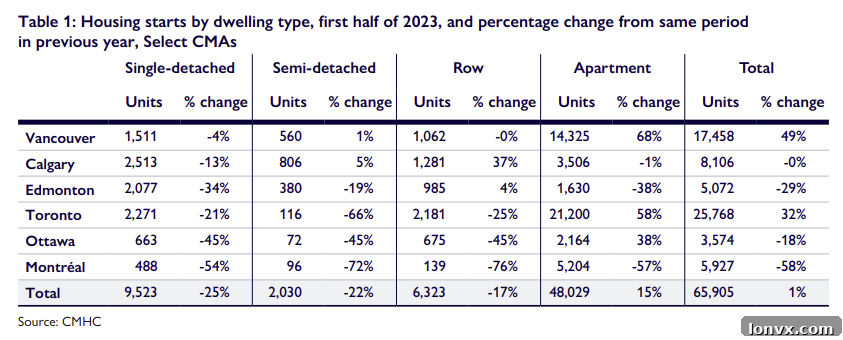
The CMHC’s analysis reveals that Toronto and Vancouver were the primary drivers of the national increase, collectively accounting for nearly two-thirds of all new housing starts. In these vibrant metropolitan areas, apartment construction emerged as the dominant force, comprising close to three-quarters of all new housing projects. This emphasis on high-density living reflects both market demand and the realities of urban development in land-scarce regions. While these two markets significantly boosted national figures, the broader Canadian context shows a less optimistic trend, with most other major cities struggling to keep pace with historical benchmarks in new housing construction.
Toronto and Vancouver Lead the Charge: An Apartment-Driven Boom
Defying broader economic slowdowns and rising interest rates, Toronto and Vancouver experienced remarkable growth in housing starts during the first half of 2023. Toronto recorded an impressive 32 percent increase, while Vancouver saw an even more substantial 49 percent surge. Both cities not only surpassed their previous year’s figures but also exceeded their average housing start levels over the past five years. This sustained momentum, particularly in the multi-unit segment, suggests strong underlying demand and developer confidence that was likely established under more favorable market conditions. As Kevin Hughes, CMHC Deputy Chief Economist, noted, “Given larger building size and resulting longer preparation time of the buildings started in Toronto and Vancouver, the numbers posted in these cities are the result of a process that began at a time when financing and building conditions were considerably more favourable.” This highlights the lag effect in large-scale construction, where projects initiated months or even years ago are now coming to fruition, somewhat buffering these markets from the immediate impact of recent economic shifts.
Regional Declines: Montreal, Edmonton, and Ottawa Face Headwinds
In stark contrast to the West Coast and Ontario’s capital, other major Canadian cities reported significant downturns in new housing construction. Montreal experienced a drastic 58 percent decrease in housing starts, reflecting a market grappling more acutely with the current challenging economic environment. Edmonton saw a 29 percent decline, and Ottawa recorded an 18 percent drop. These figures indicate a widespread retrenchment among developers in these regions, likely due to increased financial pressures and a more cautious outlook. Calgary, meanwhile, saw its housing starts remain flat, a modest outcome that still signals stagnation rather than growth in a city that has traditionally seen robust development. CMHC’s Kevin Hughes further explained that Montreal’s data, in particular, “better reflects the current, more challenging environment characterized by higher financing and construction costs.” This geographical divergence underscores how varying local economic conditions, existing housing supply levels, and developer pipelines influence the resilience of different markets to national economic shifts.
Deep Dive into the Economic Hurdles Affecting Construction
The muted national growth and significant regional declines are symptoms of a confluence of challenging economic factors that are collectively hindering housing construction across Canada. These hurdles create a less predictable and more costly environment for developers, ultimately impacting the pace and volume of new home builds.
The Impact of High Interest Rates and Tighter Borrowing Conditions
One of the most significant impediments to new housing construction is the prevailing high-interest rate environment. The Bank of Canada’s aggressive rate hikes, implemented to combat inflation, have directly led to tighter borrowing conditions across the board. For developers, this translates into higher costs for construction loans, making projects less financially viable. Increased debt servicing expenses can deter new ventures or lead to the postponement of existing ones, particularly for smaller developers or those with less access to robust capital. For potential homebuyers, elevated mortgage rates erode purchasing power and increase the financial burden of homeownership, slowing down sales velocity and reducing the incentive for builders to bring new units to market. This dynamic creates a vicious cycle where higher borrowing costs for both builders and buyers contribute to a slowdown in the entire housing ecosystem.
Soaring Construction and Labor Costs
Beyond financing, the physical act of building has become considerably more expensive. The cost of essential construction materials, while showing some signs of stabilizing, remains elevated compared to pre-pandemic levels. Everything from lumber and steel to concrete, insulation, and even finishing materials has seen persistent price increases, adding substantial sums to project budgets. Concurrently, the construction industry continues to grapple with persistent labor shortages across various skilled trades. A shrinking pool of qualified workers drives up wages, further escalating overall project costs and often extending project timelines. These dual pressures of material and labor expenses significantly reduce profit margins for builders, making it harder to deliver housing at affordable price points and contributing to the overall slowdown in new construction activity.
Regulatory Challenges and Permitting Delays
While not explicitly highlighted as a new factor in this specific CMHC report, regulatory complexities and prolonged permitting processes are perennial challenges that exacerbate the current economic difficulties in Canada’s housing sector. Navigating the intricate web of municipal zoning bylaws, environmental assessments, development charges, and various building code requirements can be a time-consuming and costly endeavor for developers. Delays in obtaining necessary approvals from local authorities can add months, if not years, to project timelines, leading to increased holding costs, greater uncertainty, and making it difficult for builders to respond swiftly to market demands. Streamlining these processes at all levels of government is a critical step towards unlocking greater housing supply, especially in high-demand urban and suburban areas.
Land Availability and Infrastructure Constraints
In many of Canada’s rapidly growing urban centers, suitable and serviced land for new development is becoming increasingly scarce and, consequently, prohibitively expensive. This scarcity drives up land acquisition costs, which are then inevitably passed on to homebuyers and renters in the form of higher prices. Furthermore, existing infrastructure—such as water, sewer, electrical grids, and transportation networks—may not always be adequate to support rapid housing expansion, particularly for high-density, multi-unit projects. Significant investments in upgrading and expanding municipal infrastructure are often required before large-scale housing development can proceed, adding another layer of complexity, cost, and time to the supply chain. Addressing these foundational issues of land use and infrastructure development is vital for sustainable, long-term housing growth across the nation.
The Growing Affordability Crisis and Rental Market Strain
The current levels of new construction, even with the positive surges observed in Toronto and Vancouver, are unequivocally deemed too low by CMHC to effectively tackle Canada’s escalating affordability and housing supply crisis in the long run. The combination of soaring home prices and persistent high-interest rates has created significant barriers to homeownership, pushing a growing segment of the population out of the ownership market and into the rental sector. CMHC explicitly predicts a strong demand for rentals in the second half of the year, a trend driven by these heightened barriers to purchasing property. This increased pressure on an already tight rental market is likely to further push up rental rates, exacerbating the affordability challenges for individuals and families who are unable to enter the ownership market, especially new immigrants and young professionals.
The long-term implications of this sustained housing deficit are profound, extending beyond individual households to impact the broader economy and social fabric. It affects economic productivity, as individuals struggle to live and work in the same cities, leading to longer commutes and reduced quality of life. It impacts social equity, widening the gap between those who own property and those who cannot, creating a sense of generational disadvantage. The challenge is not merely about building more homes; it is about building the right types of homes – from detached houses to townhouses and a diverse range of apartment units – in the right locations, at price points that are accessible to a diverse range of Canadians. Without a substantial and sustained increase in supply across all housing types and price points, the dream of affordable and quality housing will remain out of reach for many, threatening the social cohesion and economic vibrancy of the nation.
Pathways to Progress: Boosting Construction Productivity and Policy Solutions
Recognizing the severity of the housing crisis, CMHC emphasizes the urgent need for “significant increases” in the construction industry’s productivity. This call to action is not just about working harder but working smarter and more efficiently, leveraging modern approaches to overcome traditional limitations. Boosting productivity encompasses several key strategies, including the widespread adoption of innovative building technologies such as modular construction and prefabrication. These methods can significantly reduce construction timelines, minimize waste, and control costs by shifting much of the building process to off-site factories, where conditions are optimized for efficiency, precision, and quality control, regardless of weather conditions.
Beyond technological innovation, productivity gains can also come from streamlining regulatory frameworks and accelerating the permitting process at municipal levels. Reducing bureaucratic hurdles and fostering greater collaboration and communication between developers, planning departments, and local governments can cut down on costly delays and inject much-needed predictability into project timelines. Furthermore, sustained investment in training and upskilling the construction workforce can help address chronic labor shortages, attract new talent, and improve overall efficiency and safety on job sites. Policymakers at all levels—federal, provincial, and municipal—have a critical role to play in incentivizing new construction, providing targeted financial support for affordable housing initiatives, and implementing forward-thinking land-use policies that promote higher density, mixed-use developments, and diverse housing options. A concerted, multi-faceted approach involving close collaboration among industry stakeholders, government bodies, and local communities is essential to create a resilient and responsive housing supply system that can meet the evolving and diverse needs of all Canadians.
Looking Ahead: Navigating Canada’s Housing Future
The mid-year housing construction report from CMHC serves as a crucial barometer for Canada’s real estate health. While the dynamism and apartment-driven growth in Toronto and Vancouver offer a glimmer of hope and demonstrate what is possible, it simultaneously underscores a deepening regional divide and the persistent national challenge of housing supply and affordability. The coming months are likely to see continued strong demand in the rental market, further pressure on affordability, and a sustained need for creative and collaborative solutions from all sectors. Addressing Canada’s pervasive housing crisis requires more than just incremental changes; it demands bold policy interventions, significant strategic investment in both social and physical infrastructure, and a fundamental transformation in how homes are planned, financed, built, and brought to market. Only through such comprehensive, coordinated, and proactive efforts can Canada move towards a future where every Canadian has access to affordable, quality housing, thereby ensuring long-term economic stability, social well-being, and a robust quality of life for all its citizens.
Enjoying this article?
Get the latest REM articles in your inbox 3x week so you stay up to date on the latest in the Canadian real estate industry